




The right youth dirt bike is the one whose seat height your child can safely reach, paired with an engine size that matches their riding experience. As a starting point, most beginners between ages 3 and 7 belong on a 50cc machine, kids 7 to 12 fit the 50cc to 110cc range, and riders 12 to 14 typically graduate to 125cc. Before anything else, check that feet can plant flat or close to it, and never skip the helmet.
TL;DR:
- Prioritize correct seat height and inseam measurement over engine displacement when sizing a child’s dirt bike for safety and control.
- Measure the child’s inseam every few months during growth spurts to ensure ongoing proper fit and prevent riding a bike that feels too tall.
- Automatic transmission and throttle limiters are ideal for beginners, with engine size increasing progressively as riding skills develop.
- Always use proper safety gear, including certified helmets, riding boots, goggles, gloves, and protective pads, before each ride.
- Select a bike slightly larger than the child’s current inseam for growth buffer, avoiding oversized models that hinder confidence and proper technique.
Table of Contents
- Youth Dirt Bike Size Chart by Age, Height, and Seat Height
- Measuring Fit at Home and on the Test Ride
- Matching Engine Power to Your Child’s Experience
- The Non-Negotiable Safety Gear and Training Checklist
- What to Expect When You Buy: Price, Used Bikes, and Extras
- What We See Parents Get Wrong Most Often
- An Editorial Take on Getting Youth Dirt Bike Sizing Right
- How Gokartsusa Makes Sizing Simple, From First Bike to Next Upgrade
- Sources
Youth Dirt Bike Size Chart by Age, Height, and Seat Height
Sizing a dirt bike for a child comes down to three numbers working together: age, height, and seat height. Engine size matters too, but it’s the last domino to fall, not the first. Get the seat height right, and the right cc range usually follows on its own.
The chart below reflects the sizing ranges used across dealer and manufacturer guides, built around age bands matched to seat height and engine displacement. Treat it as a starting map, not a rulebook. Every kid grows at a different pace, and a tall 6-year-old might belong a band higher than the age column suggests.
A second chart, drawn from height-to-seat-height mappings used across dealership sizing pages, breaks things down by height rather than age. It’s worth cross-referencing both, because a smaller-framed 11 year old and a lanky 9 year old can land in very different rows.
Two notes matter more than the numbers themselves. First, an experienced 9 year old who’s been riding since age 5 can often handle a bike a size up from what the age chart alone suggests, while a first-time 11 year old should stay conservative even if the height chart says otherwise. Second, build in a growth buffer. A common and sensible approach is to choose a bike with a little room to grow rather than one sized exactly to today’s inseam, so the bike lasts a full season or two instead of getting outgrown by summer’s end.
Measuring Fit at Home and on the Test Ride
Two numbers decide whether a bike fits: your child’s inseam and the bike’s seat height. Getting both right before you buy saves you a return shipment and a disappointed kid standing next to a bike he can’t touch the ground on.
Here’s the sequence we recommend walking through, in order:
- Measure the inseam. Have your child stand flat against a wall in the socks or boots they’ll actually wear while riding, feet about 6 inches apart. Slide a book snugly into the crotch, level with the floor, and measure from the top of the book down to the floor.
- Compare to the bike’s seat height. Look up the seat height on the spec sheet, and match it against your inseam measurement. Dealers across the industry consistently prioritize seat height over strict cc numbers, and for good reason: a kid who can’t stabilize the bike at a stop is a kid who’s going to tip over at the worst moment.
- Run the flat-foot test. With the bike stationary and supported, have your child sit on the seat. Both feet should reach the ground, ideally flat, though tip-toe contact is acceptable for a slightly more experienced rider stepping up in size.
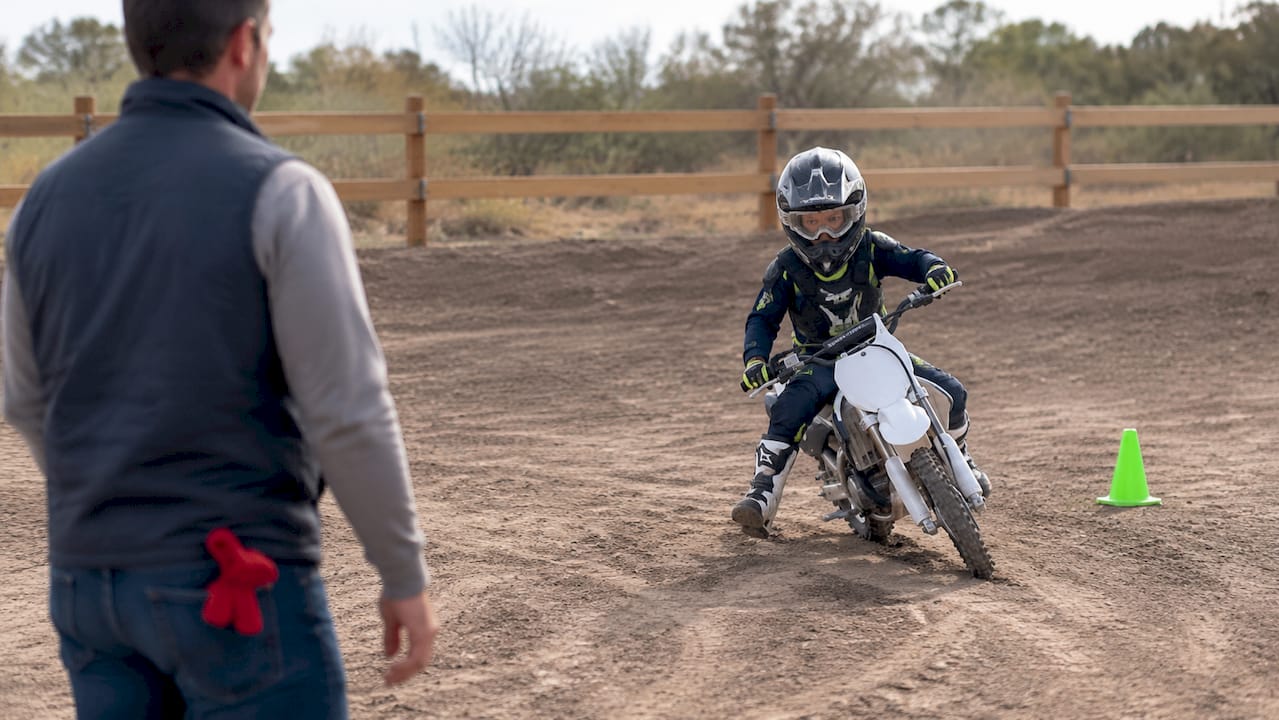
- Do the stop-and-plant drill. At walking pace, have them come to a stop and plant a foot without you catching the bike. If they hesitate or lean hard to one side, the bike sits too tall.
- Watch slow-speed handling. Figure-eights in a parking lot reveal more about fit than a straight-line cruise ever will.
Pro Tip: Measure the inseam again every three to four months during growth spurts. A bike that fit perfectly in March can feel noticeably tall by August.
Keep the throttle limiter engaged and a spotter within arm’s reach for every test ride, gear on, no exceptions.
Matching Engine Power to Your Child’s Experience
Engine displacement gets all the attention, but it’s the least important number on the spec sheet for a first-time rider. A 50cc engine with a jumpy throttle can be harder to control than a 70cc engine with smooth, linear power delivery. What actually matters is how the power reaches the rear wheel and how much of it your kid can manage.
Beginners under about 10 years old, or under roughly 5 feet tall regardless of age, do best on machines under the 110cc mark equipped with an automatic clutch or a simplified transmission. There’s no shifting to learn, no stalling at a stop sign, just twist and go, which lets a new rider focus entirely on balance and steering.
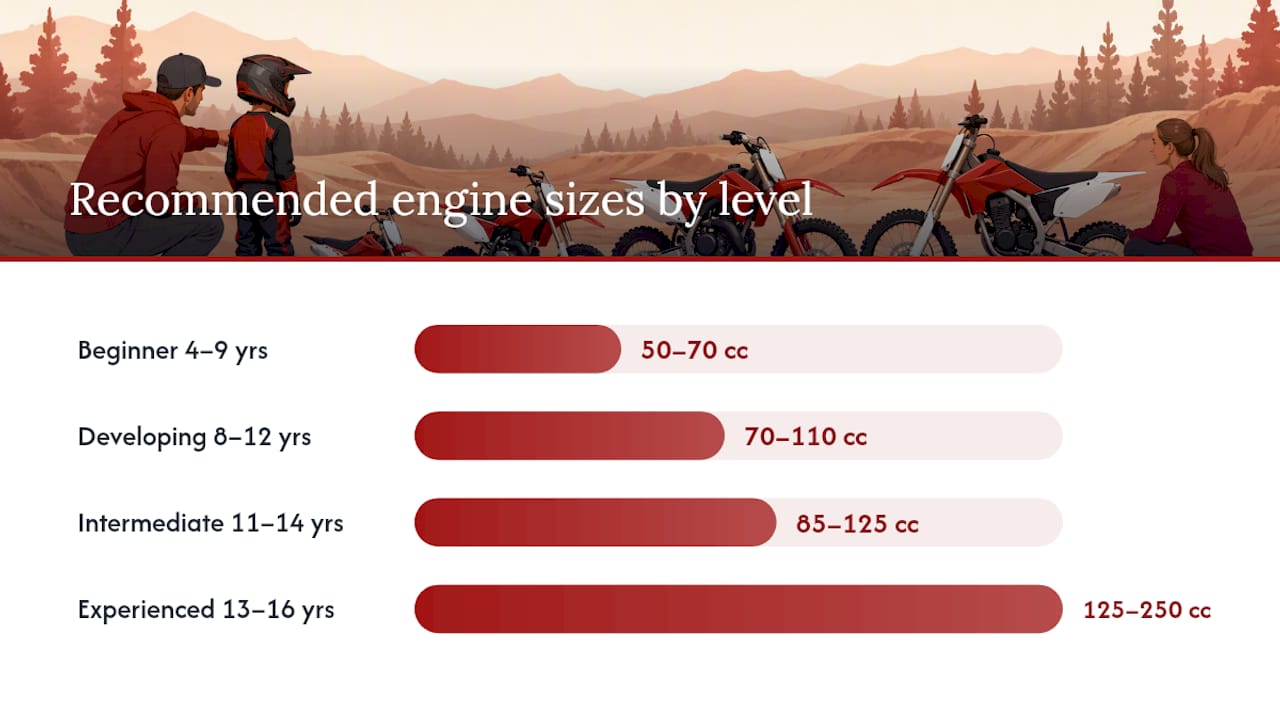
As skill builds, the progression generally looks like this:
- Beginner (ages 4 to 9): 50cc to 70cc, automatic transmission or a throttle limiter dialed down
- Developing rider (ages 8 to 12): 70cc to 110cc, semi-automatic or 3-speed manual with clutch training
- Intermediate (ages 11 to 14): 85cc to 125cc, full manual transmission
- Experienced teen (ages 13 to 16): 125cc to 250cc, depending on riding terrain and track experience
Weight matters just as much as age here. A heavier or taller-than-average kid will bog down a 50cc engine and outgrow it fast, while a lighter, smaller rider can find a 110cc bike genuinely difficult to muscle around in soft dirt or on a hill. Curb weight of the bike itself factors in too, since a heavier frame is harder to pick up after a tip-over, and tip-overs happen constantly in the first few months. Automatic transmissions and adjustable throttle limiters remain the two features that let parents dial power up gradually without buying a whole new bike every time a kid gets more confident.
The Non-Negotiable Safety Gear and Training Checklist
No bike, regardless of how well it fits, belongs under a kid without the right gear and a plan for how they’ll actually learn to ride it. This is the checklist we’d hand any parent before the first key gets turned.
- A DOT or ASTM-certified helmet sized to the child’s head, not “grown into”
- Over-the-ankle riding boots, not sneakers or rain boots
- Goggles rated for dirt and debris, not sunglasses
- Riding gloves with palm padding
- A chest and back protector for anything above a 50cc starter bike
- Knee and elbow pads, especially during the first season
Training beats trial and error every time. Local dirt bike schools and private coaching sessions exist specifically to build throttle control and braking habits before a kid ever sees a public trail, and many powersports dealers can point you toward one nearby. Practicing in a flat, open, obstacle-free yard or an empty lot beats a public trail for months one and two. Trails bring rocks, roots, other riders, and legal questions about where kids can legally operate depending on your state and local ordinances, so check those rules before you head out.
Pro Tip: Stage the power increases the same way you’d stage swim lessons. Don’t jump from a 50cc automatic straight to a 125cc manual just because a birthday happened. Let confidence on the current bike, not the calendar, decide when it’s time to size up.
Supervision stays constant through every stage. Even confident intermediate riders benefit from a parent or coach within earshot, both for safety and for the coaching moments that come up mid-ride.
What to Expect When You Buy: Price, Used Bikes, and Extras
Budget expectations vary widely by category. Entry-level youth dirt bikes and mini-bikes commonly run from the low hundreds into the low thousands of dollars, with price scaling alongside displacement, brand reputation, and included features like adjustable suspension or a digital throttle limiter.
If you’re shopping used, run through this list before handing over cash:
- Frame and fork for cracks, rust, or previous crash damage
- Engine compression and starting behavior, cold and warm
- Tire tread depth and wheel trueness
- Throttle response and kill switch function, tested every time
- Brake lever travel and pad wear front and rear
Extras worth asking about include throttle limiters, adjustable or lowered seat options, and footpeg placement for shorter legs. Many retailers bundle a helmet or starter gear with the bike itself, which is worth factoring into your price comparison. Ask sellers directly about warranty coverage, financing terms, and return windows before you commit, since youth bike return policies vary far more than adult models.
What We See Parents Get Wrong Most Often
After years of fielding sizing questions from parents, the most common mistake isn’t picking a bike too small. It’s picking one too big “so it lasts longer.” A bike a kid can’t control confidently teaches bad habits faster than any bike they’ll outgrow in a year. The fix is simple: size for today’s inseam plus a small buffer, not for next year’s growth spurt.
Available product lineups span bands covered in this guide, from smaller automatic starter bikes for beginner riders up through larger machines for kids ready for more. Listings typically include seat height and recommended age range up front, and customer support teams often field sizing questions from parents working through this fuoristrada në shitje në Shqipëri decision.
An Editorial Take on Getting Youth Dirt Bike Sizing Right
The conventional wisdom on this topic treats engine size as the headline decision, and that’s backwards. The research consistently shows seat height and transmission type matter more for a beginner’s safety than whatever number follows the “cc.” A 50cc bike with a jumpy manual clutch is a worse choice for a nervous 6 year old than a 70cc automatic with smooth power delivery, yet most parents still shop by displacement first out of habit.
Where advice typically falls short is the growth question. Plenty of guides tell parents to “buy a size up” without explaining that oversizing a bike undermines the flat-foot test that keeps a beginner upright at a stop. A small growth buffer makes sense; a bike two sizes too big does not.
If you take one thing from this guide, measure the inseam before you shop, not after. Everything else, including engine size, experience level, and gear, falls into place once that one number is locked down.
— Mario
How Gokartsusa Makes Sizing Simple, From First Bike to Next Upgrade
Some retailers cut out the guesswork that sends many parents back to the return counter by listing youth model seat heights and recommended age ranges clearly on product pages, rather than buried in spec sheet PDFs. That’s the real advantage over shopping blind at a general retailer: you know the fit before the box arrives.

For the smallest beginners, the Demon Kids Gas Dirt Bike runs a 40cc automatic engine built specifically for riders just starting out, no clutch to fumble and a throttle that’s easy to modulate. Kids ready to step up can look at the 110cc Mini Sport ATV with parental remote start and kill switch control, which gives you a safety override the whole time your child is riding. If a two-wheeler feels like too much bike too soon, our gas-powered kids go-kart offers the same outdoor thrill with a lower center of gravity and none of the balance learning curve.
Not sure which size fits your kid right now? Consider reaching out to a retailer’s support with your child’s height and inseam to be guided toward an appropriate model, possibly with gear bundles included.
Sources
- What Size Dirt Bike Does My Kid Need? Youth Sizing Guide - Risk Racing
- Comparing Dirt Bike Sizes: Which Dirt Bike Is Right For You? - ChapMoto
- What Size Dirt Bike Do I Need? - Xplor-int
- What Size Dirt Bike is Best for My Kid? Youth Dirt Bike Sizing Guide - Apollo