




ATVs are not street legal in most of the United States. A small number of states allow limited on-road use, and only after the owner meets state registration, equipment, and licensing rules plus local county or city approval. Before you ever roll onto pavement, you need to confirm both state statute and local ordinance.
TL;DR:
- Most states restrict ATV road use to specific routes, with only a few permitting full street legality under strict conditions.
- Achieving street legal status requires extensive modifications, including lighting, mirrors, registration, insurance, and compliance with local standards.
- Verification of local laws and ordinances is essential before installing conversion parts or riding on public roads, as enforcement varies widely.
- Federal regulation classifies ATVs as off-highway vehicles, meaning aftermarket parts do not make them legally suitable for road use.
- Riders often mistakenly assume a universal definition of street legality, risking fines or legal issues without proper local and state documentation.
Table of Contents
- Are ATVs Street Legal in Your State?
- What Does “Street Legal” Actually Require?
- Where and When Can You Actually Ride?
- How Do You Confirm the Rules for Your Road?
- What Iowa, Utah, and Wisconsin Teach You About State Rules
- Why the Federal Government Still Calls ATVs Off-Highway Vehicles
- What Riders Actually Get Wrong About ATV Road Rules
- Looking for an ATV or a Safer Road Alternative?
- Sources
Are ATVs Street Legal in Your State?
The honest answer is: it depends on where you draw the line on a map, sometimes down to the county. States generally fall into four practical categories, and knowing which bucket your state sits in tells you almost everything you need to know before you throw a leg over the seat.
Permissive states allow ATVs on many public roads once the machine is registered and equipped correctly. Limited-access states allow road use only on specific designated routes, usually secondary or county roads, not highways. Crossing-only states let you cross a road to get from one trail to another but bar sustained travel on the roadway itself. Restrictive states essentially keep ATVs off public roads altogether, with narrow exceptions for farming or emergency use.
States commonly cited for some form of on-road allowance include:
- Montana — broad permissive framework on many county roads
- South Dakota — allows road use with registration in many jurisdictions
- Minnesota — permits road use on certain trails and shoulders under state ATV law
- Wisconsin — road use exists only where a county or municipality enacts a specific ordinance
- Iowa — allows registered ATVs on authorized roads with strict speed and licensing rules
- Utah — permits street-legal ATV registration under defined equipment and road conditions
- Idaho — allows limited road crossing and some county-approved routes
Even in these states, the state law only sets the ceiling. Oregon’s parks agency makes clear that many quads simply cannot be made street-legal under current state law, and that an off-highway vehicle sticker never doubles as a road permit. County commissioners and city councils decide the floor, and that floor moves constantly.
What Does “Street Legal” Actually Require?
Where a state allows conversion, it is never as simple as bolting on a headlight. The vehicle typically needs to look and behave like a genuine road vehicle, not just an off-roader with a few extra parts.
- Lighting and visibility gear — headlights, taillights, brake lights, and turn signals where required
- Mirrors and a horn — usually mandatory for any road-registered ATV
- Muffler and spark arrestor — noise control matters to regulators as much as safety
- Hard-surface-rated tires — many trail tires are not built for pavement traction or wear
- Registration and titling — a street plate is a different document than an off-highway vehicle sticker, and a VIN inspection is common
- Liability insurance — most states that allow road use require it, alongside a valid driver’s license
- Fee and inspection steps — expect a visit to your local DMV office with paperwork in hand
Pro Tip: Do not buy a conversion kit before checking with your state DMV. A perfectly legal setup in one state can be worthless paperwork in another, since the insurance and liability rules that govern road use vary so much state to state.
Where and When Can You Actually Ride?
Even a properly registered, street-legal ATV faces real limits on where and when it can move. Interstates are closed to ATVs throughout the country.
- Road types are usually capped at secondary, county, or designated ATV routes, rarely full highways
- Speed limits on ATV routes commonly run up to 35 mph, and posted limits override the vehicle’s top speed
- Many states restrict night riding or require extra lighting after dark
- Passenger limits and helmet requirements vary; some states mandate helmets for riders under 18 only
- Agricultural use often carries separate exemptions for farm equipment moving between fields
- Noise and emissions rules can disqualify a machine even if it meets every other requirement
How Do You Confirm the Rules for Your Road?
Guessing gets riders fined, or worse. A short verification routine before you ride will save you a headache and possibly a court date.
- Start with your state DMV or transportation department page. Iowa’s own guidance spells out the driver’s license, insurance, registration decal, and 35 mph cap that govern legal road use there.
- Check county and municipal ordinances next. A state law that “allows” ATV routes often means nothing until a local government actually enacts one.
- Call your sheriff’s office or county roads department. Ask directly which roads are posted as ATV routes and how enforcement works locally.
- Confirm registration, VIN inspection, and insurance requirements with your DMV before you ride, not after you get pulled over.
- Carry your documentation in the vehicle and obey every posted sign. Signage is often the actual legal trigger, not just a suggestion.
Pro Tip: Print the relevant statute section and keep it with your registration. An officer unfamiliar with ATV law is far more likely to let you go with a warning if you can point to the exact code section that applies.
What Iowa, Utah, and Wisconsin Teach You About State Rules
These three states show three different philosophies, and studying them tells you what to look for in your own state’s language.
- Iowa requires a valid driver’s license, liability insurance, and a registration decal, with a 35 mph speed cap on authorized roads, plus explicit county or city authorization.
- Utah spells out required safety equipment and road and speed limits directly in Traffic Code 41-6a-1509, giving riders a single statute to check.
- Wisconsin flips the model: the state sets the framework, but a road is not a legal ATV route until a county or municipality passes its own ordinance and posts signage.
Iowa and Utah put the rules in state statute you can read once. Wisconsin puts the real decision in the hands of your county board, which means the same state law produces wildly different results from one township to the next.
Why the Federal Government Still Calls ATVs Off-Highway Vehicles
No matter what your state allows, the federal government views ATVs the same way everywhere. NHTSA classifies ATVs as off-highway vehicles, and aftermarket lights, mirrors, or horns do not convert one into an FMVSS-certified highway vehicle. State permission is the mechanism that allows any road use at all, not the parts you add.
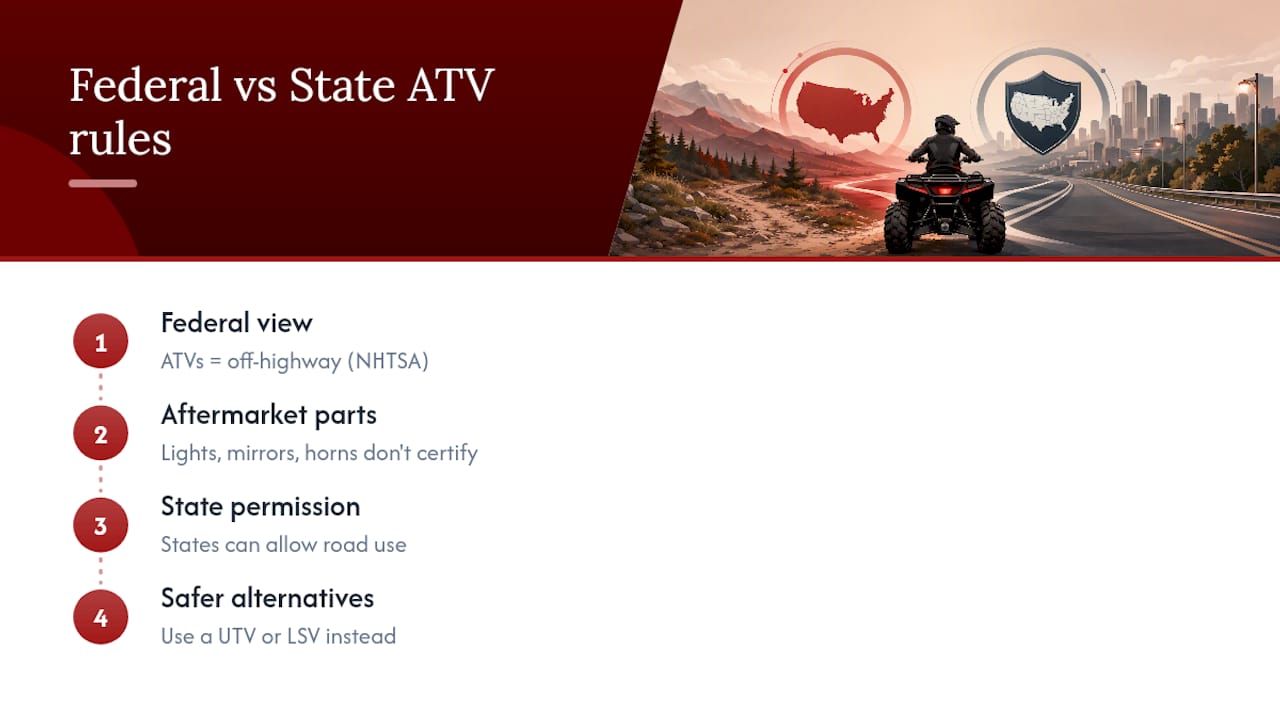
That distinction has real safety consequences. ATVs handle differently on pavement than dirt, with narrower tires and a higher center of gravity than a car, and crash risk climbs on hard surfaces. For riders who genuinely need a road-capable off-road vehicle, a UTV or low-speed vehicle is often a safer, more defensible option than converting an ATV.
What Riders Actually Get Wrong About ATV Road Rules
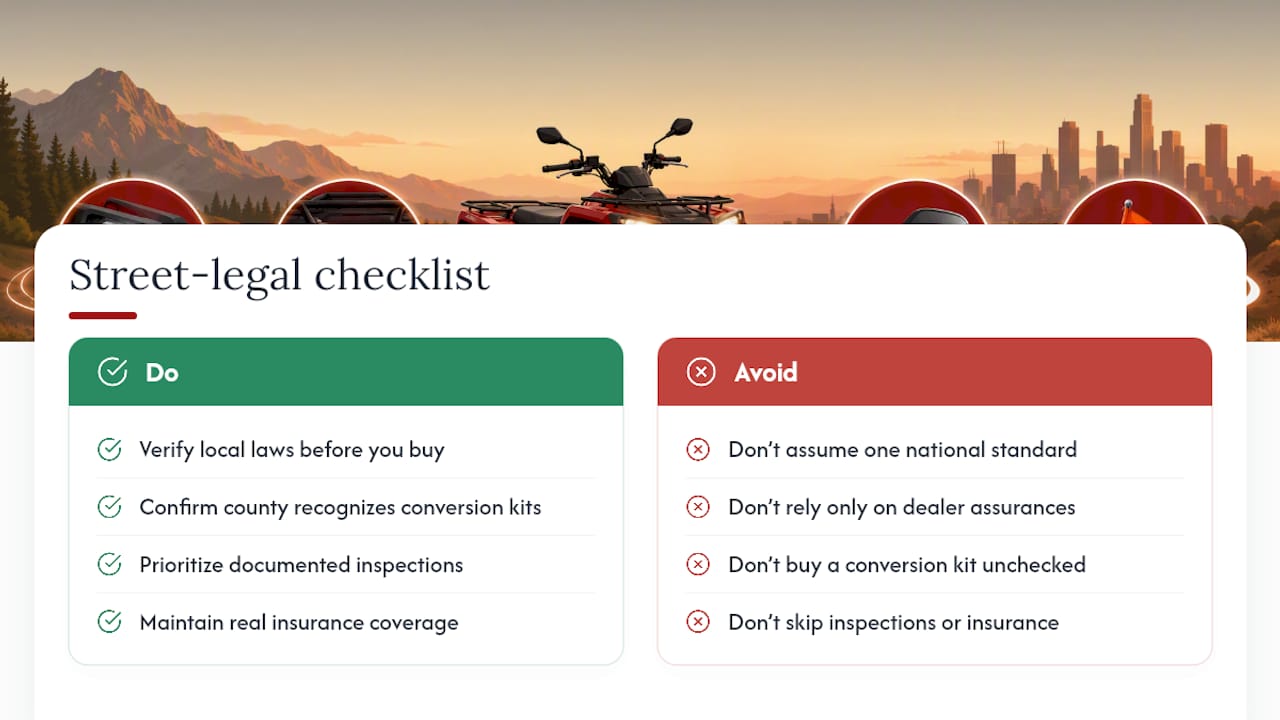
Most riders treat “street legal” like a single national standard, and that’s the mistake that gets people ticketed. It is not one rule. It is a patchwork of state statute, county ordinance, and posted signage, and the gap between what a dealer tells you and what your county sheriff actually enforces can be significant.
My advice is simple: verify before you spend a dime. Don’t sink money into a conversion kit until you’ve confirmed your specific county recognizes it, because plenty of riders learn the hard way that a fully equipped, “street legal” ATV in one county is just an off-roader with expensive extra parts three miles down the road. Prioritize documented inspections and real insurance coverage over guesswork, and lean on resources like smarter riding safety guidance when you’re choosing gear. If you’re unsure which model fits your situation, consider reaching out to a knowledgeable dealer. They can help you think through the right machine and the safety equipment that goes with it.
— Mario
Looking for an ATV or a Safer Road Alternative?
Most riders who ask about street legality actually want one thing: a reliable machine for trails, private land, or organized riding areas, without the legal gray zone of public roads. There are various youth and adult ATVs available for that kind of riding, along with the safety gear that matters most once you’re out there.

The Mini Sport Kids ATV with a 110cc gas engine and parental remote start is a strong option for younger riders learning on trails or private property, and it comes with the kind of control features parents actually want. If your riders are ready for something with pedals or wheels built for a track instead of a trail, the gas-powered off-road go-kart gives you a private-venue alternative that sidesteps the road-legality question entirely. Whatever you choose, pair it with a proper helmet, mirrors, and lights, and always confirm your local laws before you plan any road use. Browse available product lines from trusted retailers to find the model that fits your riding plans.
Sources
- Driving Your ATV or UTV/ORV on Public Roads and Streets — Iowa DOT / DNR guidance
- Utah Code — Title 41, Traffic Code 41-6a-1509
- All-Terrain Vehicles and Utility Terrain Vehicles on state highways — WisDOT
- ATV FAQ — Oregon Parks and Recreation Department
- NHTSA interpretation on ATV classification — NHTSA