




In most states, a standard driver’s license or a moped permit is enough to legally ride a 50cc scooter on public roads. Some states classify small scooters as motorcycles, which means a motorcycle endorsement and a road test before you ever twist the throttle. The rules hinge on your state, your age, and sometimes the top speed of the machine, so check your state DMV before you assume anything.
TL;DR:
- Most states require registration and a license plate for 50cc scooters classified as mopeds, even if a full motorcycle endorsement is not necessary.
- A motorcycle endorsement is mandatory in states where the scooter exceeds either 50cc displacement or a specific top speed, usually over 30 mph.
- Teenagers can legally ride 50cc scooters in some states starting at age 14 or 16 with a moped permit or restricted license, but licensing requirements vary widely.
- Confirm your state’s specific classification thresholds—engine displacement, top speed, and license type—before purchasing or registering a scooter to avoid legal issues.
- Insurance and registration costs, along with licensing rules, depend heavily on local laws, making thorough research essential for legal and safe riding.
Table of Contents
- Which States Require What for a 50cc Scooter License?
- What’s the Difference Between a Driver’s License, Moped Permit, and Motorcycle Endorsement?
- Can a Teenager Legally Ride a 50cc Scooter?
- Do You Have to Register and Insure a 50cc Scooter?
- Where Can You Legally Ride a 50cc Scooter?
- Which States Have the Most Surprising Scooter Rules?
- How Do You Check Your State’s Exact Scooter Licensing Rules?
- What Do Scooter Buyers Ask Us Most About Licensing?
- Why the “Just a Moped” Assumption Keeps Getting Riders in Trouble
- Sources
Which States Require What for a 50cc Scooter License?
Here’s the part that trips up most first-time buyers: there is no single “50cc scooter license” at the federal level. Licensing is entirely a state matter, and each state writes its own definition of what separates a moped from a motorcycle. Some use engine displacement (typically the 50cc mark), some use top speed, and a few use both. That’s why the exact same scooter can be legal to ride on a standard license in Texas and require a full motorcycle endorsement three states over.
We’ve grouped states into four practical buckets based on how they treat 50cc-class scooters. This isn’t a substitute for checking your own state’s page, but it will tell you which bucket to start looking in.
States where a standard driver’s license is enough. These states generally treat 50cc scooters (and mopeds under a defined cc or speed cap) as a lighter vehicle class that doesn’t require any special endorsement. A regular Class D driver’s license covers you.
- Texas: No motorcycle endorsement required for mopeds under 50cc with a top speed under 30 mph; registration required.
- Georgia: Standard license covers mopeds; minimum age 15 with a moped operator’s license option for those without a full license.
- North Carolina: Standard license sufficient for mopeds under 50cc; registration and a license plate are required.
- Ohio: Regular driver’s license covers mopeds under 50cc with top speed limits; some counties require a moped-specific permit for riders under 18.
- Alabama: Standard license accepted for scooters classified as mopeds; minimum age 14 with a moped license option.
States that offer a standalone moped permit. These states created a separate, lighter-weight permit specifically so riders without a full driver’s license, or those who don’t want to bother with a motorcycle endorsement, can legally operate a 50cc-class vehicle.
- Maryland: Offers a dedicated moped permit for riders as young as 16 who pass a knowledge test; no road test required for the permit itself.
- Virginia: Moped permit available for riders 16 and older; requires a vision screening and knowledge test.
- Pennsylvania: Motorized pedalcycle license available separately from a full driver’s license, with its own age and testing rules.
- New Jersey: Requires either a basic driver’s license or a special learner’s permit for low-speed scooters; registration and insurance mandatory.
States that require a motorcycle endorsement regardless of engine size. This is the category that catches new buyers off guard. These states don’t carve out a lighter moped class for small scooters at all, or they set the bar so low that most 50cc scooters land in motorcycle territory.
- Florida: Treats motor scooters as motorcycles when no specific “motor scooter” statute applies; a standard license covers scooters under 50cc, but anything over that displacement needs a motorcycle endorsement.
- Hawaii: Requires a motorcycle license (Class 2) for any scooter capable of exceeding 30 mph, regardless of cc rating.
- Rhode Island: Classifies most motorized two-wheelers as motorcycles, requiring a Class M endorsement and road test.
- Alaska: Motorcycle endorsement required for any motor-driven cycle over 50cc or capable of speeds above 30 mph.
States with mixed or speed-dependent rules. These states use a combination of engine size and top speed to decide, so two visually identical scooters can fall into different categories depending on how they’re geared.
- California: Riders must be at least 16 with a valid driver’s license or permit; scooters capped at 30 mph and 50cc or less qualify as mopeds, while faster models need a motorcycle license.
- New York: Mopeds under 50cc and 30 mph require only a driver’s license, but Class B or C mopeds with higher speeds need a motorcycle learner’s permit.
- Illinois: Moped classification depends on both displacement and speed; anything exceeding either threshold shifts into motorcycle licensing.
- Washington: Uses a “moped” definition capped at 50cc and 30 mph; scooters exceeding either limit require a motorcycle endorsement.
This table is a starting reference, not a final word. Aggregated summaries like the Moped Wiki from Moped Army compile many of these rules in one place, but state legislatures update thresholds and age brackets often enough that you should confirm directly with your state DMV before buying or riding.
What’s the Difference Between a Driver’s License, Moped Permit, and Motorcycle Endorsement?
The confusion around scooter licensing usually comes down to three different credentials that sound similar but mean very different things on paper. Understanding what each one actually authorizes clears up most of the guesswork.
- Standard driver’s license (Class D): The everyday license most adults already carry. In states that classify 50cc scooters as mopeds, this license alone covers you, no additional test needed.
- Moped or motorized bicycle permit: A standalone credential, separate from a full driver’s license, created for riders who only want to operate a low-power, low-speed vehicle. It typically requires a knowledge test and sometimes a vision screening, but skips the road test that a motorcycle endorsement demands.
- Motorcycle endorsement (Class M): An add-on to your existing license that requires passing a written knowledge test and a road skills test, often after completing an approved rider training course. This is the credential states require when a scooter’s engine size or top speed pushes it out of the moped category.
Displacement and top speed decide which of these three you need, not how the vehicle looks or what the dealer calls it on the sticker. A legal summary from LegalClarity makes this point directly: styling and marketing labels don’t determine your legal obligation, the statutory numbers do. A scooter marketed as a “moped” can still legally require a motorcycle license if its top speed exceeds your state’s cap.
The motorcycle endorsement matters beyond just satisfying a DMV clerk. It’s the credential insurance companies recognize nationwide, and it often unlocks lower premiums compared to riding without proper licensing. It also means your license is valid if you cross state lines into a stricter jurisdiction, something a state-specific moped permit usually can’t guarantee.
Can a Teenager Legally Ride a 50cc Scooter?
Yes, in most states, but the minimum age and required credential vary more here than almost anywhere else in scooter law. A lot of states set the moped-permit age lower than the standard driving age specifically because 50cc scooters are viewed as a lower-risk stepping stone into powered transportation.
- Georgia and Alabama allow moped operation starting at 14 to 15 with a restricted moped license, well before the standard driving age.
- Maryland’s moped permit opens at 16, letting teens ride legally without holding a full driver’s license first.
- Many mixed-rule states, including California and New York, set 16 as the floor for any scooter-related credential, tying it to the general driving age.
A moped permit exists precisely so a 15 or 16-year-old doesn’t need to wait for a full driver’s license to get around town on a low-power scooter. That’s a meaningful difference from motorcycle licensing, which almost universally requires the rider to already hold, or simultaneously earn, a base driver’s license.
Pro Tip: Before your teen rides anywhere, confirm whether your state requires a completed driver’s education or moped safety course before issuing the permit. Several states, including Georgia, mandate a short safety course for riders under 18, and skipping that step is one of the most common reasons a permit application gets rejected.
For parents, the practical checklist is short: confirm the minimum age in your state, verify whether a safety course is required, and get a DOT-compliant helmet before the first ride, regardless of whether your state legally mandates one for the vehicle class. Supervised practice runs in an empty parking lot before hitting real traffic will do more for safety than any permit ever will.
Do You Have to Register and Insure a 50cc Scooter?
Registration requirements split almost evenly across the country, and this is one area where assuming “it’s just a moped” can get expensive fast. Most states that classify 50cc scooters as mopeds still require registration and a license plate, even when they exempt the vehicle from full motorcycle titling.
- States like Texas, Georgia, and Washington require moped registration and a plate, even though the vehicle doesn’t need a motorcycle title.
- A smaller group of states, often ones with looser rural vehicle codes, exempt mopeds below a certain cc threshold from registration entirely.
- States that classify 50cc scooters as motorcycles (Florida over 50cc, Rhode Island, Hawaii) require full motorcycle titling and registration, no exceptions.
Insurance is where things get genuinely risky if you skip it. Some states don’t legally mandate insurance for moped-class vehicles, but riding uninsured is still a bad bet. If you’re in an accident, an uninsured moped can leave you personally liable for medical bills and property damage that would otherwise be covered. Buyers weighing that cost against the price of the scooter itself should factor in typical scooter insurance costs before finalizing a purchase, since even minimal moped coverage tends to run far cheaper than standard auto policies.
Registration status also affects enforcement in a way many riders don’t expect. An unregistered scooter that gets pulled over, even in a state where mopeds are technically exempt from titling, often draws closer scrutiny about engine displacement and top speed. If the officer determines the vehicle exceeds the moped threshold, you could be cited for operating an unlicensed motorcycle, a considerably steeper penalty than a simple registration fine.
Where Can You Legally Ride a 50cc Scooter?
Helmet laws split states into two camps: universal helmet requirements that apply to every rider regardless of age, and age-limited laws that only mandate helmets for riders under 18 or 21. California’s DMV, for example, lists both age and helmet requirements together on its motorcycle and scooter guidance page, a sign that state agencies treat the two rules as closely linked in practice even when they’re legally separate.
- Universal helmet law states require every rider, regardless of age, to wear a DOT-compliant helmet on any moped or motorcycle-class vehicle.
- Age-limited states only require helmets for riders under a set age, commonly 18 or 21, leaving it optional for adults.
- Nearly every state prohibits mopeds and low-speed scooters from interstates and limited-access highways, regardless of helmet law.
- Sidewalk riding is banned almost everywhere, and several states also restrict scooters from dedicated bike paths depending on local ordinance.
The NHTSA tracks helmet law patterns at the federal safety level, and enforcement data consistently points to one practical reality: riders are cited far more often for missing safety equipment or lapsed insurance than for a borderline classification dispute at the roadside. That doesn’t mean classification stops mattering. It resurfaces hard after an accident, when an insurer or court digs into whether you were legally licensed for the vehicle class you were riding.
Top speed governs road access as much as licensing does. A scooter capped at 30 mph typically stays restricted to local roads and streets with lower posted speed limits, while a model that can push past that threshold sometimes qualifies for broader roadway access, provided the rider holds the correct motorcycle credential. Buyers cross-shopping vehicle classes, including 49cc mini choppers built for younger riders, should treat the top-speed rating as seriously as the engine displacement number when deciding what’s legal to ride and where.
Which States Have the Most Surprising Scooter Rules?
A few states consistently catch riders off guard because their statutes don’t fit the general pattern most people expect from a “moped.”
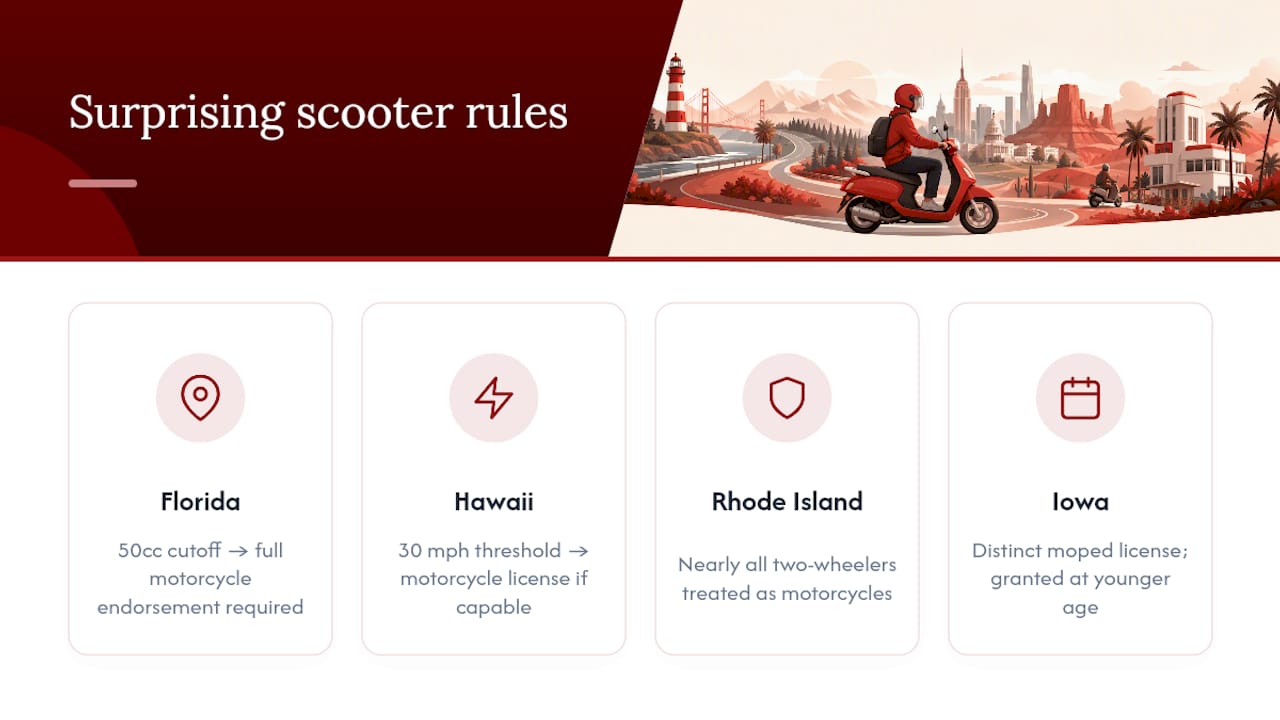
Florida doesn’t carve out a distinct legal category called “motor scooter” at all. Instead, the Florida DHSMV folds scooters into its motorcycle definitions once displacement crosses 50cc, requiring a full endorsement. Riders who assume “it’s just a scooter” and skip the endorsement risk a citation that carries the same weight as riding an unlicensed motorcycle.
Hawaii sets its bright line at speed rather than pure displacement, requiring a motorcycle license for anything capable of topping 30 mph. A technically small-engine scooter that’s geared for higher speeds can still land a rider in Class 2 motorcycle territory.
Rhode Island treats nearly all motorized two-wheelers as motorcycles by default, leaving almost no separate moped lane for casual riders who assumed a driver’s license would cover them.
Iowa requires a moped license distinct from a standard driver’s license for riders without one, but grants it at a notably younger age than most neighboring states, a detail that trips up out-of-state buyers who assume Iowa mirrors regional norms.
The consequences of guessing wrong here go beyond a simple ticket. Riding what turns out to be an unlicensed motorcycle can mean vehicle impoundment, and it can give an insurance company grounds to deny a claim after an accident since you weren’t legally licensed for the vehicle class. If you live in, or plan to ride in, any of these four states, confirm your classification before you ever register the scooter, not after you’ve already been pulled over.
How Do You Check Your State’s Exact Scooter Licensing Rules?
Every DMV site buries this information a little differently, but the search path is nearly identical everywhere. Follow these steps before you buy or register anything.
- Go to your state DMV’s website and search “moped,” “motorized scooter,” and “motor vehicle classification” separately. Different states use different primary terms, and one search often surfaces pages the others miss.
- Look for a dedicated motorcycle or moped licensing subsection, usually filed under “driver license endorsements” or “vehicle registration.”
- Cross-check the engine displacement and top speed thresholds listed against your specific scooter’s spec sheet, since a 1cc difference or a slightly higher factory speed cap can shift you into a different legal category entirely.
- If the page is unclear or contradicts itself, call the DMV directly and ask a specific scripted question rather than a general one.
Have these details on hand before you search or call:
- Engine displacement in cc, taken from the manufacturer spec sheet, not the marketing name.
- Top speed rating as tested by the manufacturer.
- VIN and bill of sale, especially if you’re registering a used scooter.
- The exact statutory terms your state uses (“moped,” “motor-driven cycle,” “motorized bicycle”).
When calling, ask precisely: “Does a scooter with a 50cc engine and a top speed of [X] mph qualify as a moped or a motorcycle under [state] law, and what license or permit do I need to operate it legally?” That phrasing forces a direct answer instead of a generic brochure response.
What Do Scooter Buyers Ask Us Most About Licensing?
We hear the same handful of licensing questions from customers shopping for 49cc and 50cc-class vehicles, and the pattern is telling. Most buyers assume a “scooter” automatically means “no special license needed,” and that assumption is exactly where the trouble starts. The most common question we field is whether a specific model, like our Romeo 50N street-legal scooter, needs anything beyond a standard driver’s license, and the honest answer is always the same: it depends entirely on your state, not on the vehicle.
The second most common question involves cost planning. Buyers frequently underestimate how registration and insurance stack on top of the purchase price, which is why we point people toward a full breakdown of what a 50cc scooter actually costs before they commit to a model. Getting the licensing question right before you buy saves you from a scooter sitting unused in a garage because it turns out your state classifies it as a motorcycle.
Why the “Just a Moped” Assumption Keeps Getting Riders in Trouble
The biggest gap in how people think about 50cc scooter licensing is treating it like a single national rule instead of fifty separate ones. Most of the confusion online comes from generic articles that answer the question for one state and imply it applies everywhere. It doesn’t, and the states that break the pattern, Florida, Hawaii, Rhode Island, aren’t obscure edge cases. They’re states where thousands of scooters get sold every year to buyers who assumed wrong.
The conventional advice to “just check your state” is technically correct but practically useless without knowing where to look or what to ask. That’s the real gap: not a lack of available information, but a lack of a clear script for finding it fast. The engine displacement and top speed numbers matter more than anything the dealer tells you, and they’re the two facts you should have memorized before you ever fill out a registration form.
If you take one thing from this, prioritize confirming your state’s classification before you buy, not after. A returned scooter costs you a restocking fee. An unlicensed one costs you a citation, a possible impoundment, and a denied insurance claim if something goes wrong.
— Mario
Sources
- Motorcycle, motor scooter, moped and motorized scooter - Florida DHSMV
- Motorcycles, Mopeds, and Scooters - California DMV
- Moped Laws: United States | Moped Wiki — Moped Army
- Moped permit - Maryland MVA