




In the U.S., basic liability coverage for a 50cc scooter typically starts around $75 per year and can vary by state and rider profile. Add collision and comprehensive, and that range commonly climbs to roughly $150 to $600 annually, depending on your state, your age, and what the scooter is worth. Riders in rural areas with clean records land near the bottom of that range. Riders in dense cities, or anyone with a rough driving history, sit closer to the top.
Here’s the baseline we recommend before you ride:
- Carry state-minimum liability at a minimum, no exceptions.
- Add uninsured/underinsured motorist coverage if your state allows it. Scooters lose fights with distracted drivers.
- Skip collision/comprehensive on a scooter worth less than $2,000 or so, unless you’re financing it.
Key Takeaways
Scooter insurance cost in the U.S. depends primarily on rider age, location, engine size, and whether you add collision or comprehensive coverage on top of liability.
| Point | Details |
|---|---|
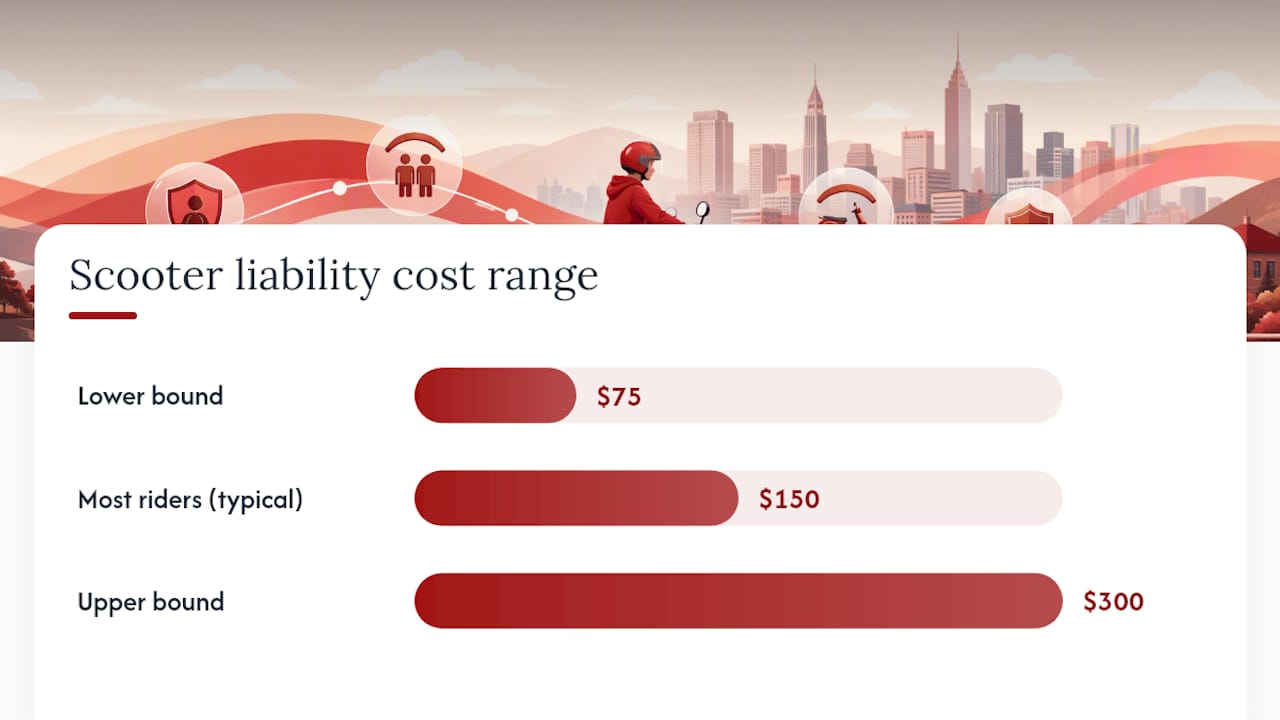
| Liability-only baseline | Expect $75 to $300 per year for basic liability on a typical scooter. |
| Full coverage adds cost | Collision and comprehensive push the total to roughly $150 to $600 annually. |
| Discounts stack | Safety courses, bundling, and anti-theft devices each shave money off your premium. |
| Skipping insurance backfires | An SR-22 filing after riding uninsured raises premiums for years, often costing more than the coverage would have. |
| Know your specs before quoting | Gokartsusa product pages list the engine size and model details insurers ask for when you request a quote. |
Table of Contents
- Scooter Insurance Cost Ranges You Can Actually Plan Around
- What Actually Moves Your Premium Up or Down
- Which Coverage Types You Actually Need
- Do You Legally Need Insurance for a 50cc Scooter?
- How to Lower Your Scooter Insurance Cost
- When Full Coverage Actually Pays Off
- Getting Quotes That Actually Compare Apples to Apples
- Publisher Note: How Vehicle Value Shapes Your Insurance Decision
- Frequently Asked Questions
- Sources
Scooter Insurance Cost Ranges You Can Actually Plan Around
Liability-only policies for scooters nationwide typically fall between $75 and $300 a year, with most riders landing near $150. That’s the starting point insurers like GEICO and Progressive both advertise, and it’s a fraction of what a motorcycle policy runs.
Adding collision and comprehensive changes the math fast. Physical damage coverage tacks on anywhere from $75 to $300 more per year, pushing a full-coverage policy to somewhere between $150 and $600 annually. CostInsider’s analysis puts most 50cc policies squarely in that band once you factor in rider age and vehicle value.
Three quick profiles show how wide the swing can be:
- A 45-year-old commuter on a 50cc scooter with a clean record and garage parking: expect a range of costs for liability-only coverage depending on age, location, and vehicle value.
- A 22-year-old rider on a 150cc maxi-scooter in a city with street parking: $250 to $450 for liability, more with full coverage.
- A hobbyist with a rarely-ridden 70cc scooter stored indoors: often under $150, even with basic physical damage coverage added.
What Actually Moves Your Premium Up or Down
Insurers price scooter policies using a short list of variables, and knowing them tells you exactly where you have leverage.
- Rider factors: age, driving record, license/endorsement status, and whether you’ve completed an approved safety course.
- Vehicle factors: engine size in cc, the scooter’s age and current value, any modifications, and whether it’s garaged or left on the street.
- Location factors: your state’s minimum coverage law, local theft and accident rates, and even your specific zip code.
- Policy choices: the coverage limits you pick, your deductible, and any optional add-ons like roadside assistance.
GEICO and Nationwide both list engine size and annual mileage among the biggest rate drivers, right alongside your driving history.
Pro Tip: Ask your insurer for the exact rating factors they weigh before you shop around. Two carriers can price the identical 50cc scooter $100 apart just because one weighs zip code more heavily than the other.
Which Coverage Types You Actually Need
Each coverage type protects something different, and each one moves your premium by a different amount.
- Liability pays for the other party’s injuries or property damage when you’re at fault. It’s the cheapest coverage on the policy and the one every state requires in some form.
- Collision pays to repair or replace your scooter after a crash, regardless of fault. This is where premiums jump, especially on newer or higher-value models.
- Comprehensive covers theft, vandalism, fire, and weather damage. Worth considering if you park on the street or in a high-theft zip code.
- Uninsured/underinsured motorist (UM/UIM) pays your medical bills and damage when the other driver has no insurance or not enough. Scooter riders are especially exposed here since a two-wheeler always loses a collision with a car.
- Medical payments covers your own injury costs regardless of fault, often for a modest premium bump.
Raising your deductible from $250 to $500 or $1,000 typically shaves a meaningful chunk off collision and comprehensive premiums, according to Forbes Advisor’s breakdown of moped coverage economics.
Do You Legally Need Insurance for a 50cc Scooter?
State rules split largely on engine size. Scooters 50cc and above are usually treated like motorcycles and require the same liability minimums as any registered vehicle. Scooters under 50cc sometimes get exempted in certain states, especially when they’re classified as mopeds with lower top speeds.
Riding without required coverage carries real consequences:
- Fines that vary by state but often start in the hundreds of dollars.
- Registration or license suspension until you show proof of coverage.
- An SR-22 filing requirement, which insurers use to flag high-risk drivers and which typically raises your premiums for three years or more.
LegalClarity’s rundown of state moped insurance rules confirms the SR-22 penalty is often the costliest part of getting caught uninsured, worse than whatever you saved skipping the policy. Since rules vary by state, confirm your exact requirement with your state DMV or insurance department before you register.
How to Lower Your Scooter Insurance Cost
A few concrete moves reliably bring your premium down, and none of them require shopping ten different carriers.
- Complete an approved safety course. Most insurers, including GEICO, offer a discount for finishing a recognized motorcycle or scooter safety class.
- Bundle policies. Adding your scooter to an existing auto, home, or renters policy commonly earns a multi-policy discount.
- Store it securely. Garage parking and anti-theft devices like disc locks or GPS trackers lower comprehensive premiums.
- Raise your deductible. Moving from $250 to $500 cuts your physical-damage premium, as long as you can cover that deductible out of pocket if you need to.
Pro Tip: Call your existing auto insurer first. Bundling a scooter onto a policy you already have often beats even the cheapest standalone scooter quote, because the multi-policy discount stacks on top of an already competitive rate.
When Full Coverage Actually Pays Off
A simple rule of thumb: if your annual added premium for collision and comprehensive exceeds 10% of the scooter’s replacement value, you’re probably better off self-insuring.
- Financed or newer high-value scooters (think 150cc+ models over $3,000): full coverage almost always makes sense, since your lender likely requires it anyway and the replacement cost justifies the premium.
- Commuters parking on the street: comprehensive is worth the extra cost given theft exposure, even on a modest scooter.
- Low-value hobby scooters stored in a garage: liability-only, plus UM/UIM, usually covers the real risk without overpaying. Forbes Advisor notes riders often overpay for physical damage coverage on scooters worth under roughly $3,000.
Factor in setup fees and state taxes too. First-year costs can run $50 to $150 above the base premium once those extras hit.
Getting Quotes That Actually Compare Apples to Apples
Gather your details before you call anyone. It saves time and gets you a firmer number on the first pass.
- Collect your specs: exact engine size in cc, purchase invoice or bill of sale, garaging zip code, and a rough estimate of annual mileage.
- Ask every insurer the same three questions: What are the exact liability limits? What’s excluded? What’s the total cost including fees, not just the base premium?
- Confirm whether your state’s SR-22 rules apply to your situation if you’ve had a lapse in coverage or a violation on record.
- Get two or three online quotes, then call one agent directly. Agents sometimes catch discount eligibility that an online form misses, especially for bundling.
- Line up the quotes side by side on limits, deductibles, and total annual cost, not just the sticker premium.
Publisher Note: How Vehicle Value Shapes Your Insurance Decision
At Gokartsusa, we sell scooters and mini bikes across a range of price points, and that price tells you a lot about your coverage decision. A 49cc mini bike or entry-level 50cc model often costs little enough that skipping collision/comprehensive is financially reasonable once liability is squared away.
- Keep your purchase invoice, model number, and engine size on hand. Insurers ask for all three.
- Photograph any accessories or aftermarket parts at purchase. It speeds up claims later.
- Written by Mario, drawing on Gokartsusa’s experience helping riders document their vehicles for insurance and registration.
A Practical Take on Balancing Premium and Risk
Buy the scooter that fits your budget, then let its actual value drive your coverage choice, not the other way around. Gokartsusa’s product pages give you the specs you need to quote accurately before you ever call an insurer.
Where to Find Your Scooter’s Specs Before You Call an Insurer
Gokartsusa is the direct route to the exact documentation your insurer will ask for, without hunting through a filing cabinet for a receipt you can’t find. Every product page lists the engine size, model name, and specs you need on hand when you request a quote, whether you’re looking at a 49cc mini bike near the legal moped threshold or a street-legal model like the Romeo 50N.

Save your order confirmation, model number, and any accessory invoices the moment you buy. That paperwork is what turns a slow insurance quote into a five-minute phone call. Browse our gas-powered mini bike lineup now, and keep the confirmation email handy for your next call to an insurer.
Frequently Asked Questions
How much is scooter insurance on average? Most riders pay between $75 and $300 a year for liability-only coverage, with full coverage running $150 to $600 depending on the state and scooter value.
What’s the average scooter insurance price for a 50cc model? A 50cc scooter insurance cost typically falls between $90 and $300 annually for liability, with clean-record commuters on the lower end.
Are scooter insurance rates cheaper than motorcycle rates? Yes. Scooters generally cost less to insure than motorcycles because of lower speeds, smaller engines, and typically lower repair costs.
Can I get cheap scooter insurance without sacrificing coverage? Bundling with an existing auto or renters policy, completing a safety course, and raising your deductible are the most reliable ways to lower cost without dropping essential coverage like liability and UM/UIM.
Do I need insurance for a scooter under 50cc? It depends on your state. Some states exempt mopeds under 50cc from mandatory coverage, while others require the same liability minimums as any registered vehicle. Check with your state DMV to confirm.
Sources
- GEICO — Scooter insurance
- Forbes Advisor — Moped and scooter insurance
- LegalClarity — Do 50cc scooters need insurance?
- Nationwide — How much is scooter/moped insurance?