




Every parent faces the challenge of finding fun activities that bring their family together outdoors. For American families looking to balance excitement with safety, electric go-karts are changing the game by offering environmental consciousness and zero emissions during operation. These vehicles deliver clean, quiet power with features like parental speed controls and emergency shutoff switches, giving kids the thrill of driving while parents retain peace of mind. Discover how electric go-karts turn weekend play into true family bonding.
Table of Contents
- Defining Electric Go-Karts For Families
- Core Features And How Electric Go-Karts Work
- Main Types Of Electric Go-Karts For Kids
- Safety Standards And Legal Age Guidelines
- Costs, Maintenance, And Buying Considerations
Key Takeaways
| Point | Details |
|---|---|
| Environmental Benefit | Electric go-karts produce zero tailpipe emissions, promoting cleaner air and teaching kids about sustainability. |
| Safety Features | Modern models include adjustable speed governors and emergency shut-off switches, enhancing safety for young drivers. |
| Low Maintenance Costs | Electric go-karts require minimal maintenance compared to gas models, significantly reducing long-term operating expenses. |
| Variety of Options | Choosing the right model depends on age and skill level, with various designs available for different stages of childhood development. |
Defining Electric Go-Karts for Families
An electric go-kart is a small, open-frame vehicle powered by rechargeable batteries and electric motors instead of gasoline engines. Think of it as a stripped-down race car designed for recreational fun, but without the noise, fumes, or maintenance headaches of traditional gas-powered models. Your child sits in a bucket seat, grips the steering wheel, and experiences the thrill of speed in a safe, controlled environment. These vehicles are built from the ground up with families in mind, combining the excitement of racing with the peace of mind that comes from choosing a cleaner, quieter alternative.
Unlike their gas-powered cousins, electric go-karts rely on rechargeable battery systems and electric motors to deliver smooth acceleration and consistent power. The absence of an internal combustion engine means no oil changes, spark plugs, or complicated maintenance routines. Your backyard stays cleaner, your garage stays quieter, and you spend less time troubleshooting mechanical problems and more time actually enjoying outdoor activities with your kids. The electric approach also means instant torque—your child gets responsive handling the moment they press the accelerator, creating an engaging driving experience that feels more intuitive than traditional go-karts.
Electric go-karts designed for families typically fall into these categories:
- Ride-on models for younger children (ages 3-7): Single-seat vehicles with parental controls, top speeds of 3-8 mph, and training wheels for stability
- Youth performance models (ages 8-12): Dual or single-seat options reaching 15-25 mph, with adjustable speed governors so parents can set safe limits
- Family-friendly track karts: Larger vehicles accommodating parent and child together, designed for organized track experiences at racing venues
- Off-road electric go-karts: All-terrain versions with rugged suspensions for backyard terrain and light trail use
Electric go-karts represent a fundamental shift in recreational vehicles—combining the joy of speed with environmental responsibility and zero emissions during operation.
What makes electric go-karts particularly appealing for American families is their environmental consciousness combined with practical benefits. These vehicles produce zero tailpipe emissions while operating, reducing air pollution in your neighborhood and teaching children about sustainable choices early in life. The quiet operation means no disturbing neighbors at 7 a.m. on Saturday mornings. Battery charging takes just a few hours from a standard household outlet, eliminating the need for special fuel storage or dangerous gasoline cans around curious kids.
The safety features built into modern electric go-karts for children demonstrate how seriously manufacturers take family recreation. Most models include speed governors that parents can adjust via remote control, emergency shutoff buttons within easy reach, low center-of-gravity designs that prevent tipping, and padded safety frames. The slower acceleration compared to gas models gives young drivers more time to react and develop proper steering habits. When your 8-year-old is learning to drive, the last thing you want is a vehicle that lurches forward unpredictably—electric systems provide smooth, measured power delivery that builds confidence gradually.
Electric go-karts also represent an investment in family bonding and outdoor engagement. They encourage kids to get off screens and experience the genuine thrill of vehicle operation in a controlled setting. Parents can supervise closely, adjust speed settings as skills develop, and even ride alongside their children in models designed for two passengers. The low operating costs mean families can enjoy more frequent outings without guilt about fuel expenses or environmental impact.
Pro tip: Before purchasing, verify that any electric go-kart model includes a parental remote control feature and adjustable speed governor—these two safety components allow you to match the vehicle’s power to your child’s skill level while maintaining oversight of their driving experiences.
Core Features and How Electric Go-Karts Work
Electric go-karts operate on a completely different principle than their gas-powered counterparts, and understanding the mechanics helps explain why they’re becoming the preferred choice for family fun. At the heart of every electric go-kart is a brushless direct current (BLDC) motor—a highly efficient electric engine that converts electrical energy into smooth, consistent power. Rather than relying on spark plugs, fuel injectors, and combustion cycles, BLDC motors use electromagnetic fields to spin a rotor at incredible speeds, then gearing systems translate that spin into wheel movement. The result is a vehicle that feels responsive the instant your child touches the accelerator, with no lag, no stalling, and no need to warm up before driving.
Powering the motor is a lithium-ion battery pack, which serves as the vehicle’s fuel tank. These batteries store electrical energy in rechargeable cells and release it on demand to the motor controller. BLDC motors and lithium-ion battery systems work together through a sophisticated electronic management system that optimizes both performance and safety. You charge the battery at home using a standard electrical outlet—no special equipment required, no dangerous fuel storage, and no toxic fumes filling your garage. Depending on the model, a full charge takes anywhere from 2 to 8 hours and provides 1 to 3 hours of continuous driving, making electric go-karts perfect for afternoon backyard sessions.
The key components that make electric go-karts function smoothly include:
- Motor controller: An electronic brain that regulates how much power flows from the battery to the motor based on accelerator input
- Battery management system: Monitors battery health, temperature, and charge levels to prevent overcharging and ensure longevity
- Gearbox and transmission: Converts the motor’s high-speed rotation into lower-speed, high-torque output at the wheels for actual movement
- Brake system: Often regenerative brakes that capture energy during braking and feed it back into the battery, extending driving range
- Speed governor: A parental safety feature that electronically limits maximum speed to match your child’s skill level
- Emergency shutdown switch: A fail-safe button that instantly cuts power if needed
The beauty of electric go-kart design lies in its simplicity—fewer moving parts mean less breaks, lower maintenance costs, and more time spent actually enjoying the vehicle.
How does power delivery actually work when your child presses the accelerator? When they push the pedal, a sensor reads the input and sends a signal to the motor controller. The controller then decides exactly how much electrical current to send from the battery to the motor. This happens thousands of times per second, creating smooth acceleration rather than the jerky, sudden power surges that characterize gas engines. Parents can set maximum speed limits before each session, so a hesitant 7-year-old can experience a safe 10 mph while a confident 11-year-old operates at 20 mph on the same vehicle.
The frame and chassis of an electric go-kart are engineered specifically for family safety and durability. Most models feature a low center of gravity that prevents tipping during sharp turns, padded roll bars that protect occupants if the vehicle does roll, and reinforced frames that absorb impact. The weight of the battery pack, positioned low in the chassis, actually works in your favor—it keeps the vehicle planted firmly to the ground and stable during acceleration and braking.
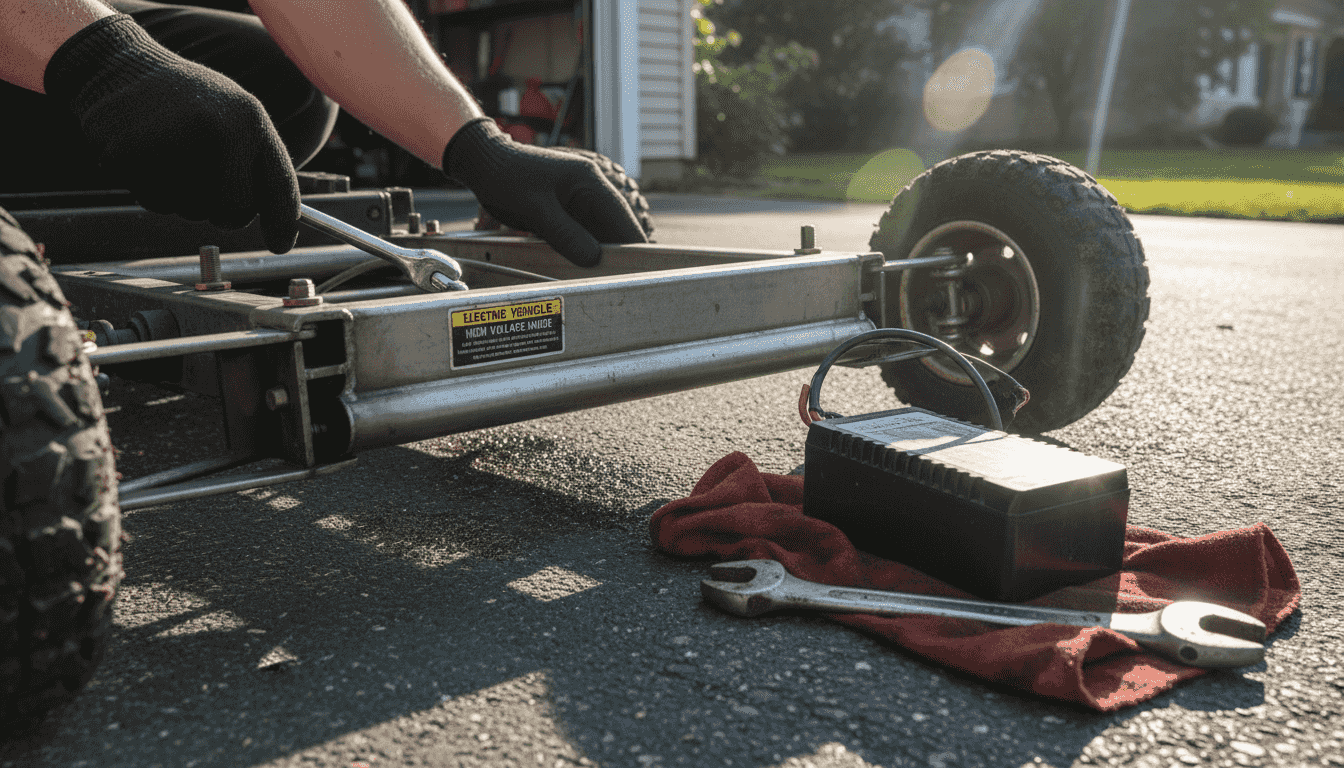
Electric go-karts also offer substantial advantages in operational costs compared to gas models. No oil changes, no spark plug replacements, no air filter maintenance. The main wear item is the brake pads, which last far longer due to regenerative braking systems. Battery life typically spans 3 to 5 years of regular use, and replacement packs are increasingly affordable. A season’s worth of driving costs just dollars in electricity compared to tens of dollars in gasoline for comparable gas-powered vehicles.
Pro tip: When first using your electric go-kart, start with the speed governor set to 50 percent of maximum, then gradually increase as your child demonstrates confident steering, braking, and awareness—this progressive approach builds skills without overwhelming young drivers.
Main Types of Electric Go-Karts for Kids
Not all electric go-karts are created equal, and choosing the right type depends on your child’s age, skill level, and what kind of fun you’re hoping to experience together. Manufacturers have developed several distinct categories, each engineered with specific safety features and performance characteristics suited to different stages of childhood development. Understanding these categories helps you make an informed decision that matches both your child’s abilities today and their growth potential over the next few years.
Beginner Models for Young Riders
Toddler ride-on karts (ages 3-6) are the gentlest introduction to electric driving, designed more for sitting and cruising than actual racing. These single-seat vehicles feature massive safety features: automatic braking when a parent releases a remote control, maximum speeds between 2-5 mph, wide wheelbases for stability, and cushioned seats that keep tiny drivers comfortable during short rides. Many models include training wheels that can be removed as confidence builds. The batteries are small and well-protected, and the entire frame is engineered low to the ground to minimize any possibility of tipping. Your 4-year-old can experience genuine vehicle operation without any real danger.
Early elementary models (ages 6-9) represent a significant step up in capability. These offer speeds reaching 10-15 mph, removable parental remote controls, and adjustable speed governors that let you control maximum velocity. The steering is responsive enough to teach proper turning technique, and the brakes provide immediate stopping power. Age-appropriate speeds and control mechanisms are carefully engineered into these models to ensure safety while building driver confidence. Many include lap counters and simple displays that appeal to kids while teaching them to track their performance.
Performance Models for Older Kids
Youth racing karts (ages 10-15) are where electric go-karts start feeling like real vehicles. These models reach speeds of 20-35 mph, offer dual-seat options for parent-child rides, and feature responsive steering that rewards smooth driving technique. They come equipped with racing harnesses, reinforced frames, and suspension systems that handle turns at higher speeds without losing stability. The batteries are larger and more powerful, providing extended run times. These vehicles can be raced at organized tracks or driven in backyards with plenty of open space. Parents maintain secondary control options but primarily serve as passengers or observers.
Specialized Categories
Beyond the standard progression, several specialized types serve specific purposes:
- Dual-seater family models: Purpose-built vehicles where parent and child sit side-by-side or one behind the other, ideal for supervised bonding experiences
- Track rental karts: Commercial-grade models designed for repeated use at go-kart racing facilities, emphasizing durability and consistent performance
- Off-road electric karts: Rugged vehicles with suspension and tires designed for uneven terrain, dirt, and light trails rather than smooth surfaces
- Competition karts: High-performance machines built for organized racing events, with sophisticated battery management and performance tuning
The best choice isn’t necessarily the fastest model—it’s the one that matches your child’s current skill level while offering room to grow into more challenging driving experiences.
When comparing different types, pay attention to several key specifications beyond just speed. Battery capacity determines how long your child can drive before needing a recharge. Weight capacity ensures the kart will handle your child’s size safely. Safety features like emergency stop buttons, automatic braking systems, and rollover protection vary significantly between models. The quality of the frame construction and welds determines longevity and crashworthiness. Consider whether you want a parental remote control for continued oversight, or if your child is ready for more independent operation.
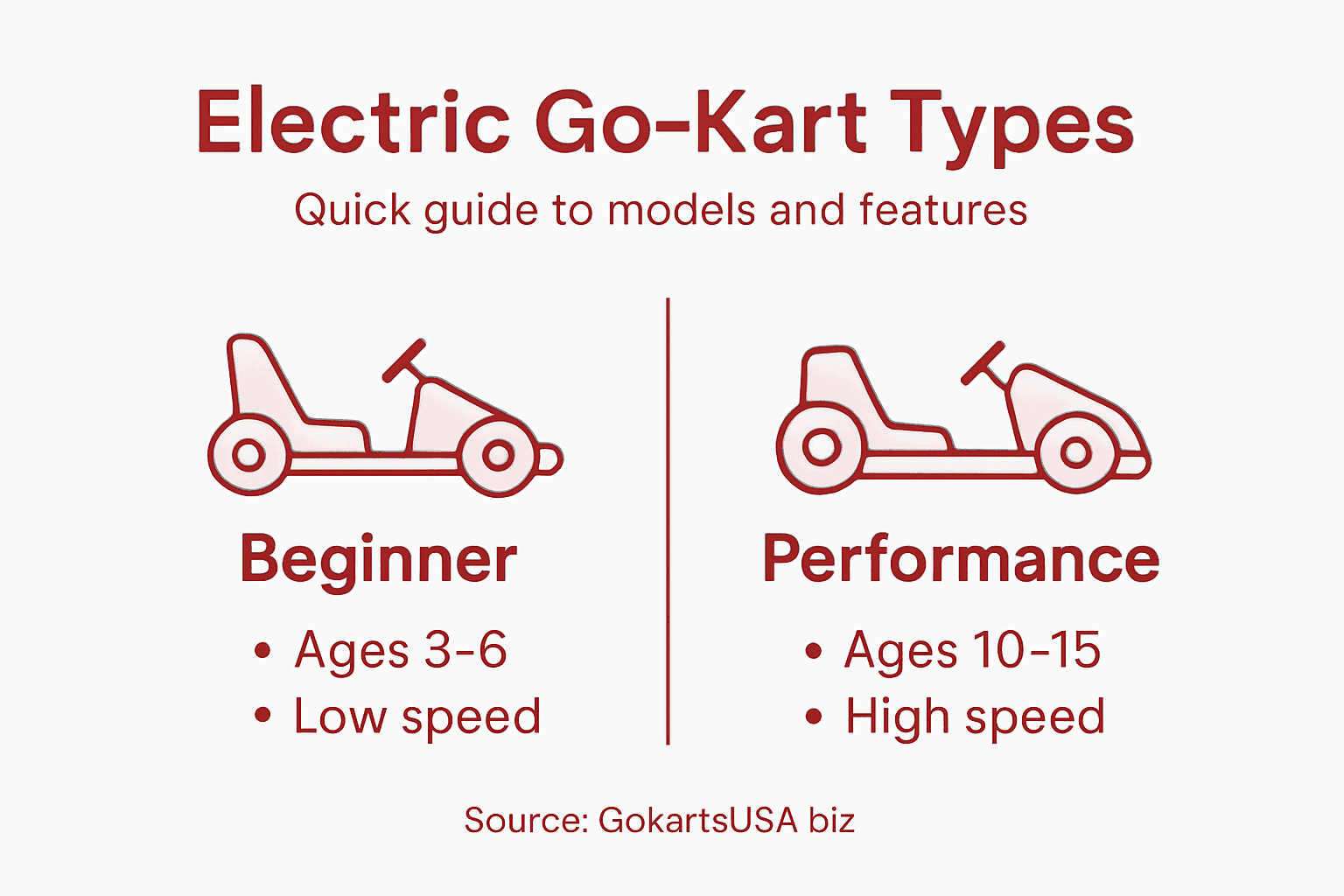
Here’s a comparison to help you choose the right electric go-kart for your family:
| Model Type | Typical Age Range | Max Speed | Key Emphasis |
|---|---|---|---|
| Toddler Ride-On | 3-6 years | 2-5 mph | Safety & Stability |
| Early Elementary | 6-9 years | 10-15 mph | Skill Development |
| Youth Racing Kart | 10-15 years | 20-35 mph | Performance & Realism |
| Off-Road Electric Kart | 8+ years | 12-20 mph | All-Terrain Adventure |
| Family Track Model | All ages (with adult) | 8-20 mph | Supervised Bonding |
Electric go-karts come with different battery technologies as well. Lithium-ion batteries are lighter and more efficient but tend to be more expensive. Lead-acid batteries are heavier and require more maintenance but cost less upfront. For family use, lithium-ion batteries justify their cost through better performance and lower maintenance needs.
One practical consideration many parents overlook: some models stack for storage, while others fold or separate for easier transport in a vehicle. If you have limited garage space or plan to take the kart to different locations, these design features matter more than you might initially think.
Pro tip: When shopping for your child’s first electric go-kart, prioritize models with adjustable speed governors and parental remote controls—these two features let you customize the driving experience as your child’s skills improve, effectively future-proofing your purchase investment.
Safety Standards and Legal Age Guidelines
When it comes to electric go-karts for kids, safety isn’t just a marketing talking point—it’s built into every legitimate vehicle through rigorous standards and regulations. Different jurisdictions and racing organizations have established specific guidelines about age requirements, power limits, and mandatory safety equipment. Understanding these standards helps you make informed decisions and ensures your child operates a vehicle that meets recognized safety benchmarks rather than an unregulated knockoff.
In the United States, there’s no single federal law governing recreational electric go-karts, which means regulations vary by state and locality. Some states treat electric go-karts similar to bicycles, while others classify them more strictly. Most reputable manufacturers design their consumer models to exceed industry best practices, incorporating safety features that go beyond minimum legal requirements. When you purchase from established retailers, you’re typically getting vehicles that comply with American Society for Testing and Materials (ASTM) standards for children’s ride-on vehicles and Consumer Product Safety Commission (CPSC) guidelines.
International Racing Standards
If you’re interested in competitive electric go-kart racing, the international standards become more relevant. The Fédération Internationale de l’Automobile (FIA) has established formal categories and technical regulations for electric karting. FIA technical regulations for electric go-karts standardize critical safety elements including emergency shut-off systems, battery containment and placement, power output limits, and mandatory safety equipment. These regulations apply primarily to organized racing events and track facilities rather than backyard recreational use, but they demonstrate the level of engineering sophistication in modern electric karts.
The FIA has also formalized junior and senior electric kart racing categories with specific voltage, power, and battery installation standards. These categories establish age-appropriate divisions, ensuring that younger drivers compete in vehicles matched to their physical size, reaction time, and cognitive development. The junior categories typically accommodate drivers aged 8-14, while senior categories serve older teens and adults. The specific age brackets and homologation requirements continue to evolve as electric karting becomes more integrated into mainstream motorsport.
Key Safety Features You Should Verify
Regardless of whether your child will use their electric go-kart recreationally or competitively, certain safety features should be non-negotiable:
- Emergency shut-off switches: A big red button accessible to the driver that instantly cuts power to the motor
- Speed governors: Adjustable electronic limiters that let parents cap maximum velocity
- Parental remote controls: Secondary controls allowing adults to override steering or cut power from a distance
- Safety harnesses: Multi-point seat belts designed to keep drivers secure during acceleration, braking, and turns
- Roll bars or roll cages: Reinforced structures that protect occupants if the vehicle tips or rolls
- Helmet compatibility: Design that accommodates standard children’s safety helmets without interference
- Battery containment: Secure enclosures that prevent battery damage or electrical hazards during collisions
- Ground clearance: Sufficient space underneath to prevent ground contact during normal operation
The best safety standard is one that’s actually built into the vehicle before you purchase it—don’t settle for products that promise safety “with proper use” if the engineering doesn’t support it.
Age and Skill Level Matching
Most manufacturers recommend minimum age guidelines based on vehicle design, power output, and handling characteristics. A well-designed 6-year-old model will have different ergonomics, lower top speed, and more forgiving handling than a 12-year-old model. However, manufacturer recommendations are just starting points. Your individual child’s maturity level, physical coordination, and comfort with technology matter significantly. A naturally cautious 9-year-old might be ready for a vehicle recommended for ages 10 and up, while an impulsive 10-year-old might benefit from sticking with the 8-9 age bracket until they demonstrate better judgment.
Local regulations about helmet use, protective gear, and where electric go-karts can operate also vary. Some states require helmets for all riders, others only for track use, and some leave it to parental discretion. Many municipalities prohibit electric go-karts on public streets but allow them on private property or designated recreational areas. Check your local regulations before purchasing, as this might influence which model makes sense for your situation.
When comparing models, ask manufacturers directly about their compliance testing and certifications. Legitimate companies provide documentation showing they’ve tested their vehicles for stability, braking performance, steering response, and electrical safety. They can explain exactly how their models meet or exceed relevant standards. If a seller can’t provide this information or gets evasive about safety testing, that’s a red flag.
Pro tip: Before allowing your child to operate any electric go-kart, require them to wear a properly fitted safety helmet and demonstration competency with basic controls on flat, open ground with you supervising—this simple progression builds foundational skills before they tackle more challenging terrain.
Costs, Maintenance, and Buying Considerations
Pricing for electric go-karts varies dramatically based on age-appropriateness, features, and build quality. Entry-level toddler models start around $300-600, while mid-range youth karts typically fall between $800-2,000. High-performance models designed for older kids or competitive use can exceed $3,000-5,000. Rather than focusing solely on the sticker price, smart purchasing means evaluating the total cost of ownership over several years—what you spend initially plus maintenance, repairs, and eventual battery replacement.
One major advantage of electric go-karts compared to gas models is dramatically lower operating and maintenance costs. Gas karts require regular oil changes, air filter replacements, spark plug maintenance, and carburetor cleaning. Electric karts eliminate virtually all of this. The electric powertrain simplicity means substantially reduced maintenance compared to traditional combustion engines. Your primary ongoing expenses are electricity for charging and occasional brake pad replacements. Over a 5-year ownership period, many families find electric karts cost 30-50% less to operate than comparable gas-powered vehicles.
Understanding Battery Costs and Lifespan
The battery represents your largest potential future expense. Lithium-ion batteries, while more expensive upfront, typically last 3-5 years of regular recreational use before requiring replacement. Most manufacturers offer replacement batteries in the $300-800 range, depending on capacity. Lead-acid batteries cost less to replace but require regular water level checks and may need replacement every 1-2 years with heavy use. When comparing initial purchase prices between models, factor battery type into your decision. A kart costing $200 more upfront with a lithium-ion battery might save you significant money over time.
Battery management matters considerably for lifespan. Store electric go-karts with fully charged batteries if you’ll leave them unused for extended periods. Avoid completely draining batteries before recharging. Don’t leave karts in extreme heat or cold for weeks at a time. These simple practices extend battery life substantially. Most manufacturers provide detailed battery care instructions—following them faithfully can add 6-12 months to your battery’s usable life.
Maintenance Essentials and Costs
Electric go-karts require far less hands-on maintenance than their gas counterparts, but they’re not completely maintenance-free:
- Tire maintenance: Check pressure monthly, rotate tires every 20-30 hours of use, replace when tread wears down ($100-250 per set)
- Brake system checks: Inspect brake pads quarterly, replace when worn ($50-150 per set)
- Wheel alignment: Get checked annually or after significant impacts ($75-150)
- Battery connections: Clean corrosion from battery terminals every 3-4 months using baking soda and water
- Suspension lubrication: Apply grease to suspension pivot points twice yearly ($0 if you do it yourself)
- Electrical connectors: Inspect for corrosion or loose connections before each season
- Frame inspection: Check for cracks, rust, or loose bolts monthly
The best maintenance is prevention—spending 30 minutes monthly on basic inspections costs you nothing but saves hundreds in repairs down the line.
Making Your Buying Decision
Before purchasing, consider what matters most to your family. Will your child use this kart for just one season, or are you hoping they’ll enjoy it for 3-5 years? Do they have friends with electric go-karts already, or will this introduce the hobby? Is storage space limited in your garage? Can you transport it to track facilities, or will it live permanently in your backyard?
Buying from established retailers like GokartsUSA.biz offers genuine advantages. Reputable dealers provide detailed specifications, honest age recommendations, warranty support, and after-sale service. They can answer technical questions about battery management, explain safety features, and help you choose the right model for your specific situation. They also typically offer protective accessories like helmets, gloves, and body armor that budget retailers might skip.
Be wary of suspiciously cheap models from unfamiliar sellers. These often cut corners on safety systems, use inferior battery packs that die after one season, or have inadequate quality control. A kart priced 40% below market rate probably has significant compromises hiding somewhere. Reading customer reviews carefully—especially looking for comments about longevity, customer service, and actual maintenance costs—reveals patterns that manufacturers’ marketing won’t mention.
Consider your child’s growth trajectory. Kids grow fast. A model your 7-year-old fits perfectly into might feel cramped by age 9. Some manufacturers design adjustable seats, pedals, and steering wheels specifically to accommodate growth over 2-3 years. These adaptable models cost more initially but provide better long-term value than replacing a kart that’s become too small.
Long-Term Value Assessment
Calculate the cost per year of use. A $1,200 kart used actively for 4 years costs $300 annually. That same kart used for only 1 year costs $1,200 per year. Factor in whether your child will outgrow it or potentially pass it down to a younger sibling. Consider resale value—quality electric go-karts hold 50-70% of their initial value when sold used, while budget models often depreciate to 20-30%.
Compare the long-term value factors below before purchasing:
| Factor | Impact on Ownership Cost | Reason to Consider |
|---|---|---|
| Battery Technology | Affects lifespan and replacement | Lower replacement costs later |
| Adjustability | Extends years of use | Fits growing children |
| Resale Value | Recoups part of investment | Better for high-quality karts |
| Maintenance Needs | Lowers annual upkeep expense | Electric models need less TLC |
| Warranty Coverage | Reduces repair uncertainty | Peace of mind for families |
Battery charging and motor durability significantly impact lifecycle costs and should factor into your purchasing decision. Models engineered for durability with quality materials and proven reliability records deliver better value than cheaply constructed alternatives despite higher initial prices.
Pro tip: Before buying, ask the retailer for realistic estimates on battery replacement cost, typical annual maintenance expenses, and warranty coverage—these three numbers combined give you true total-cost-of-ownership figures that reveal which models offer genuine value versus which ones look cheap initially but drain your wallet later.
Discover the Perfect Electric Go-Kart for Your Family Today
Understanding what makes an electric go-kart safe, fun, and family-friendly is just the first step. Many parents face the challenge of finding a reliable, well-built vehicle that balances speed control, safety features like parental remote controls and speed governors, and long-term value. You want a go-kart that grows with your child, offers easy maintenance, and encourages outdoor bonding without the worries of noise, fumes, or complex upkeep.
At GokartsUSA.biz, we specialize in offering a wide selection of electric go-karts designed specifically with families in mind. Whether you need a beginner model with adjustable speed limits or a performance kart for older kids, our inventory focuses on safety, durability, and exciting performance. Experience the thrill of electric go-karting while enjoying peace of mind from quality engineering and trusted customer support.

Ready to give your child an unforgettable outdoor adventure? Visit GokartsUSA.biz now to explore our full range of electric go-karts, take advantage of our spring sales, and secure free shipping plus complimentary accessories. Act today and transform family fun with a vehicle that matches your child’s skill level and your safety expectations.
Frequently Asked Questions
What is an electric go-kart?
An electric go-kart is a small vehicle powered by rechargeable batteries and electric motors, designed for recreational use. It provides a fun driving experience for kids without the noise, fumes, or maintenance associated with gas-powered models.
What are the safety features to consider in electric go-karts for kids?
Modern electric go-karts come with essential safety features such as speed governors, emergency shut-off buttons, padded safety frames, and low center-of-gravity designs to prevent tipping. These elements enhance safety, making them suitable for young drivers.
How do electric go-karts operate compared to gas-powered karts?
Electric go-karts operate using a brushless DC motor that provides smooth acceleration and responsive handling. They rely on lithium-ion battery packs for power, eliminating the need for oil changes, spark plugs, and complex maintenance associated with gas-powered karts.
What types of electric go-karts are available for different age groups?
Electric go-karts for children are categorized into beginner models for younger riders (ages 3-7), youth performance models (ages 8-12), family-friendly track karts for parent-child experiences, and off-road electric go-karts for all-terrain use.
Recommended
- Why Choose Electric Go-Karts for Family Fun – GoKarts USA®
- 7 Reasons Why You Should Choose an Electric Kids Go Kart – GoKarts USA®
- What Is a Go-Kart and Why Safety Matters Most – GoKarts USA®
- Why Choose Go-Karts for Family Fun – GoKarts USA®
- How To Decide Between an Electric or Gas Golf Cart — GOLFCARTSTUFF.COM™