




Many families assume mini bikes are the safer option for young riders because they’re smaller and lighter. However, injury statistics tell a different story. ATVs with safety protocols reduce child injuries by up to 40% compared to mini bikes, which actually cause more pediatric emergency room visits. This guide breaks down the real differences in safety, cost, terrain capability, and family suitability to help you choose the right vehicle for outdoor adventures.
Table of Contents
- Introduction To ATVs And Mini Bikes
- Safety And Risk Comparison
- Terrain And Performance Differences
- Cost And Affordability Analysis
- Usage Suitability And Skill Levels
- Common Misconceptions About ATVs And Mini Bikes
- Legal And Regulatory Considerations
- Practical Considerations For Families
- Conclusion And Recommendations
- Frequently Asked Questions
Key Takeaways
| Point | Details |
|---|---|
| Safety Statistics | ATVs with proper safety features reduce child injuries by 40% compared to mini bikes due to four-wheel stability. |
| Cost Comparison | Mini bikes cost 30-50% less upfront, but total ownership expenses balance out with safety gear and potential injury costs. |
| Terrain Capability | Four-wheel ATVs handle mud, hills, and rough terrain; two-wheel mini bikes need flat, smooth surfaces. |
| Age Suitability | Youth ATVs suit beginners aged 6-8 with speed limiters; mini bikes require more balance skills for older children. |
| Legal Requirements | Most states mandate helmets and minimum ages for both vehicles, with varying road usage restrictions. |
Introduction to ATVs and Mini Bikes
Understanding what sets these vehicles apart helps families make informed choices. An ATV (all-terrain vehicle) is a four-wheeled off-road vehicle designed to handle varied terrain from trails to muddy fields. It features wide tires, a low center of gravity, and handlebars for steering. In contrast, a mini bike is a smaller, two-wheeled motorized bike built for casual recreation on smoother surfaces. Think of it as a compact motorcycle designed for fun rather than serious off-roading.
Both vehicle types gained popularity among families over the past two decades as manufacturers introduced affordable youth models. The recreational powersports market expanded significantly in the 2010s, with safety becoming a central selling point. Manufacturers began adding features like speed limiters, automatic transmissions, and bright color options to attract parents seeking safe outdoor activities for their kids.
Affordability trends have made both options accessible to middle-income families. Entry-level youth models now start around $800 for mini bikes and $1,200 for ATVs, with financing options and seasonal sales making them even more attainable. This accessibility has driven adoption rates, but it’s also increased the importance of understanding safety differences before purchasing.
Key characteristics that distinguish these vehicles include:
- ATVs offer four-wheel stability, higher weight capacity, and built-in safety features like throttle limiters
- Mini bikes provide portability, lighter weight, and simpler mechanics for easier basic maintenance
- ATVs excel in rugged terrain with larger engines (50cc to 250cc for youth models)
- Mini bikes work best on flat surfaces with smaller engines (40cc to 110cc typically)
- Both require proper safety gear, but ATVs include more integrated safety technology
Safety and Risk Comparison
When it comes to protecting your children, the numbers matter more than assumptions. Injury patterns among children using mini-bikes and ATVs reveal that mini bikes cause more frequent emergency room visits despite their smaller size. The four-wheel design of ATVs provides inherent stability that prevents many of the balance-related falls common with two-wheeled mini bikes.
Modern youth ATVs incorporate multiple layers of safety technology that mini bikes typically lack. ATV safety features and guidelines include adjustable speed limiters that parents can control, remote engine shutoffs for emergency situations, and automatic transmissions that eliminate clutch coordination challenges. These features create a controlled learning environment where children build skills gradually.
Mini bikes demand more from young riders. Balancing a two-wheeled vehicle while managing throttle and brakes requires coordination that many children under 10 haven’t fully developed. Falls from mini bikes often result in wrist fractures, head injuries, and road rash. Mini bikes safety considerations emphasize the critical importance of proper training and supervision.
Common injury causes differ between the two vehicles:
- Mini bikes: Loss of balance during turns, inadequate braking control, collisions with obstacles
- ATVs: Terrain misjudgment, rollovers on steep inclines, passenger-related incidents
- Both: Lack of helmet use, riding beyond skill level, inadequate adult supervision
Supervision and proper safety gear dramatically reduce injury rates for both vehicle types. Helmets, gloves, long sleeves, and closed-toe boots should be non-negotiable requirements. Adult oversight ensures children ride within designated safe areas and follow speed restrictions appropriate for their skill level.
Pro Tip: Start children on vehicles with the lowest available speed setting and increase gradually as they demonstrate consistent control and decision-making skills over multiple supervised sessions.
“The stability advantage of four wheels cannot be overstated when it comes to young riders. We see far fewer serious injuries from properly supervised youth ATV use compared to mini bikes in our emergency department.” – Pediatric Trauma Specialist
Terrain and Performance Differences
The physical design of each vehicle dictates where families can safely ride and explore. ATVs feature four-wheel drive systems and knobby tires measuring 18 to 20 inches in diameter, allowing them to grip loose dirt, power through mud, and climb moderate hills. The wider wheelbase (typically 35 to 42 inches) distributes weight effectively and prevents tipping on uneven ground. This makes ATVs ideal for trail riding, farm exploration, and varied outdoor environments.
Mini bikes, with their two-wheel configuration and smaller 10 to 12-inch tires, perform best on flat, compact surfaces. They excel in controlled environments like paved paths, dirt tracks with minimal obstacles, and level fields. The narrow profile makes them agile for quick turns, but this same design creates vulnerability on slopes or loose terrain. ATV terrain performance capabilities open up more diverse family adventure possibilities.
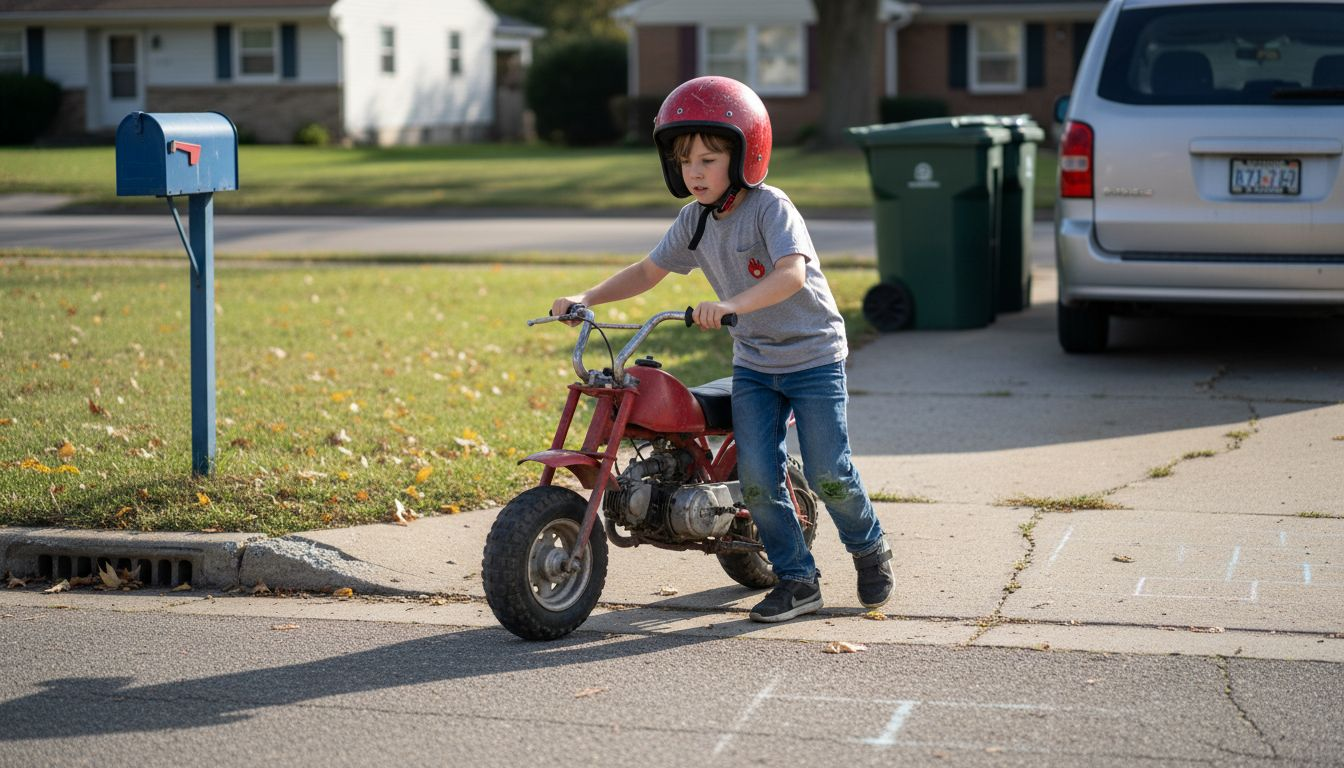
Speed and handling characteristics differ significantly. ATVs typically reach top speeds of 15 to 30 mph for youth models, with governors allowing parents to set maximum speeds. The four-wheel platform provides predictable handling, though riders must learn weight shifting for turns. Mini bikes can reach 20 to 40 mph depending on engine size, requiring active balance management and more refined throttle control.
| Feature | ATV | Mini Bike |
|---|---|---|
| Wheel Configuration | Four-wheel drive | Two-wheel rear drive |
| Terrain Capability | Mud, hills, trails, uneven ground | Flat surfaces, packed dirt, pavement |
| Typical Speed Range | 15-30 mph (youth models) | 20-40 mph |
| Weight | 200-400 lbs | 50-100 lbs |
| Stability | High (wide wheelbase) | Moderate (requires balance) |
| Learning Curve | Easier for beginners | Steeper (balance required) |
Transport and storage logistics also stem from these physical differences. ATVs require trailer hauling or truck beds for transport, while mini bikes often fit in SUV cargo areas or even large car trunks. Families planning frequent trips to riding areas should consider transport practicality alongside performance needs.
Cost and Affordability Analysis
Budget-conscious families need to look beyond the price tag and consider total ownership costs. Entry-level mini bikes typically range from $600 to $1,200, while comparable youth ATVs cost $1,200 to $2,500. This 30 to 50% price difference attracts many families to mini bikes initially. However, the complete financial picture includes ongoing expenses that narrow this gap.
Maintenance requirements differ substantially. ATV cost overview reveals that four-wheel vehicles need more frequent service due to complex drivetrain components. Expect to spend $150 to $300 annually on oil changes, air filter replacements, brake maintenance, and tire wear. Mini bikes have simpler mechanics, with annual maintenance typically costing $75 to $150 for basic upkeep.
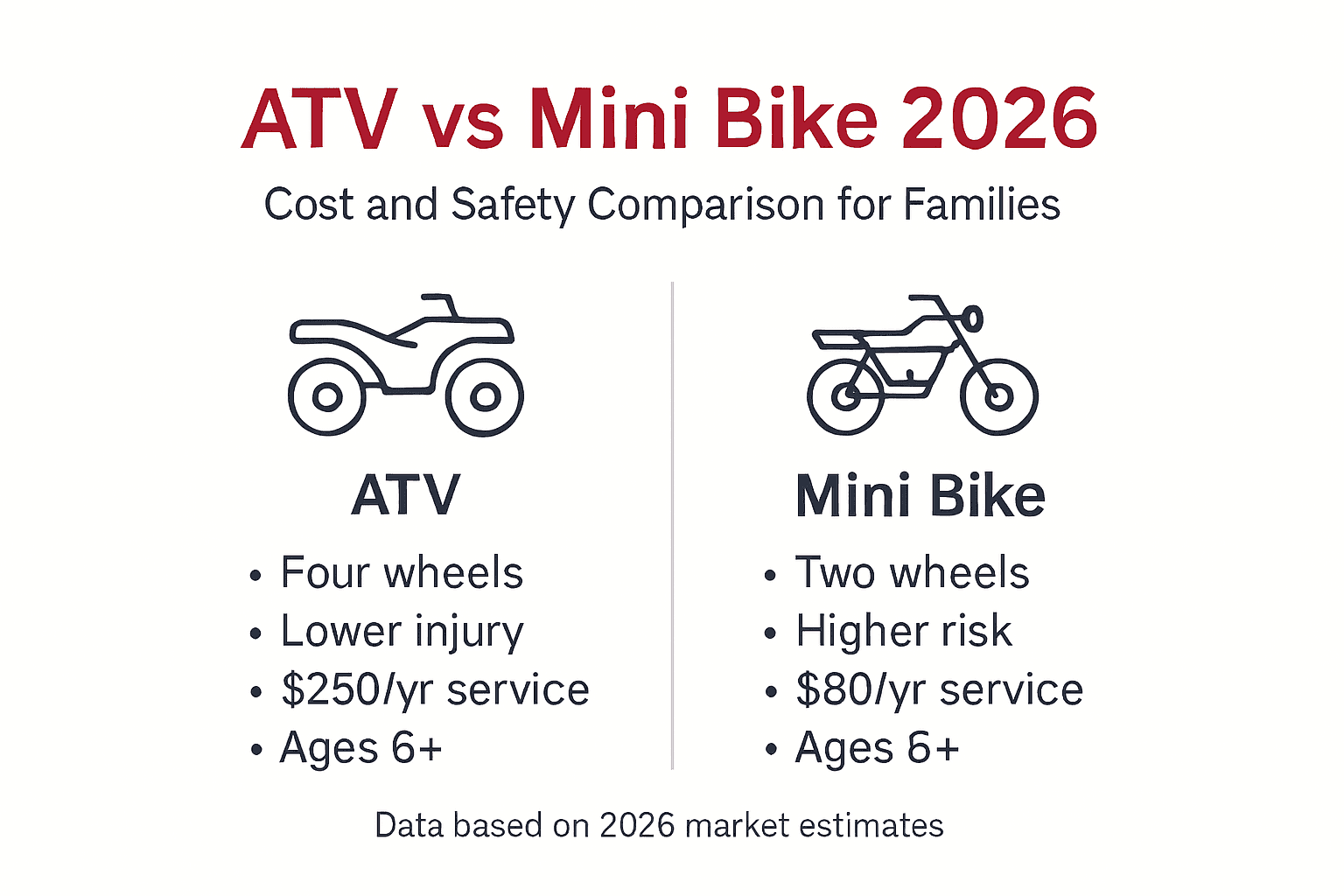
| Cost Category | Mini Bike | ATV |
|---|---|---|
| Initial Purchase | $600-$1,200 | $1,200-$2,500 |
| Annual Maintenance | $75-$150 | $150-$300 |
| Safety Gear (helmet, pads, boots) | $150-$250 | $150-$250 |
| Insurance (optional/required by state) | $100-$200/year | $150-$300/year |
| Fuel Costs (annual, 20 hours use) | $40-$60 | $60-$100 |
Safety gear costs remain consistent across both vehicle types. Quality youth helmets run $80 to $150, protective pads cost $30 to $60, and proper boots range from $40 to $100. These expenses apply regardless of vehicle choice, though the higher injury risk associated with mini bikes may lead to medical costs that dwarf equipment expenses.
Hidden costs can shift the affordability equation. Mini bikes often require more frequent tire replacements due to their smaller size and higher speeds. Families may also invest in training courses, which typically cost $50 to $150 per child. ATVs hold resale value better due to longer lifespan expectations and broader market demand.
Consider these financial factors when budgeting:
- Initial savings from mini bike purchase may be offset by higher injury risk and medical expenses
- ATV durability often means one vehicle serves multiple children over many years
- Seasonal sales and promotions can reduce initial ATV costs by 10 to 20%
- Financing options spread larger ATV purchases into manageable monthly payments
Pro Tip: Calculate a three-year total ownership cost including purchase price, maintenance, gear, and potential medical expenses to make an apples-to-apples comparison that reflects true affordability.
Usage Suitability and Skill Levels
Matching vehicle type to your child’s age and abilities ensures both safety and enjoyment. Most manufacturers recommend youth ATV age suitability starting at 6 years old for 50cc models with robust safety features. The four-wheel stability allows younger children to focus on throttle control and steering without the added challenge of maintaining balance. As coordination develops, children can progress to larger displacement ATVs.
Mini bikes typically suit children aged 8 and older who have already developed core balance skills through activities like bicycling or skateboarding. The two-wheel design demands simultaneous management of balance, throttle, braking, and spatial awareness. Younger children often struggle with this multitasking, leading to frustration or accidents. Mini bike beginner tips emphasize starting with the smallest available engine sizes.
Youth ATVs come with adjustable speed controls that create a graduated learning pathway. Parents can start with speeds limited to 5 mph while children master basic controls, then incrementally increase limits as competence grows. This controlled progression builds confidence without overwhelming young riders. Mini bikes lack this feature, operating at relatively high speeds even in lower gears.
Skill assessment should drive vehicle selection:
- Children with limited motor vehicle experience: Start with 50cc youth ATVs featuring full safety packages
- Kids comfortable on bicycles with good balance: Consider 50-70cc mini bikes with close supervision
- Beginners of any age: ATVs provide easier skill development and lower initial injury risk
- Experienced young riders: May handle mini bikes safely with proper gear and designated riding areas
Family composition matters too. If you have multiple children of different ages, an ATV often serves the broadest age range safely. The passenger racks on some youth ATVs even allow supervised rides with younger siblings, though manufacturers discourage passengers on most youth models.
Common Misconceptions About ATVs and Mini Bikes
Several persistent myths mislead families during the selection process. The most damaging misconception claims that mini bikes are safer because they’re smaller and lighter. Size and weight don’t determine safety; stability and control do. The actual injury data shows mini bikes cause more frequent and often more severe injuries despite their compact dimensions.
Another common belief suggests ATVs are too complex or intimidating for beginners. Modern youth ATVs are specifically engineered for first-time riders with automatic transmissions, intuitive controls, and multiple safety systems. The learning curve is actually gentler than mini bikes because children don’t need to master balance simultaneously with other riding skills.
Some families assume mini bikes offer better long-term value due to lower purchase prices. However, this ignores total cost of ownership including maintenance, safety gear, potential medical expenses, and resale value. When you factor in all expenses over a typical three-year ownership period, the cost difference shrinks considerably. Mini bikes also have shorter useful lifespans due to their simpler construction and higher stress during operation.
The perception that mini bikes are just “small motorcycles” suitable for any smooth surface causes problems. While they do require paved or packed surfaces, they still demand significant riding skill and pose substantial injury risks. Parents sometimes underestimate the balance and coordination required, leading to premature introduction for children who aren’t developmentally ready.
Key misconceptions to avoid:
- Myth: Smaller size equals safer operation for young children
- Reality: Four-wheel stability provides better safety for beginners regardless of vehicle size
- Myth: ATVs are too complicated for kids to learn
- Reality: Youth models with safety features are actually easier to master than two-wheeled alternatives
- Myth: Mini bikes are dramatically cheaper overall
- Reality: Total three-year ownership costs are comparable when including all factors
- Myth: Any child who can ride a bicycle can safely operate a mini bike
- Reality: Motorized vehicles require additional skills and pose different risks than pedal bikes
“We constantly educate parents that smaller doesn’t mean safer. The stability platform matters far more than vehicle size when it comes to preventing injuries in young riders.” – Certified Powersports Safety Instructor
Legal and Regulatory Considerations
Navigating state and local regulations ensures legal compliance and protects your family from fines or liability issues. Most U.S. states require helmets for riders under 18 operating either ATVs or mini bikes, with some states mandating helmets for all ages. Penalties for non-compliance range from $25 fines to potential child endangerment charges depending on jurisdiction and circumstances.
Minimum age requirements vary significantly by state. Some states set no minimum age for private property use but restrict public land riding to children 12 or older. Others establish tiered systems where 6 to 11-year-olds may ride specific engine sizes under direct adult supervision. Before purchasing, verify your state’s Department of Motor Vehicles or Parks and Recreation regulations.
Off-road versus on-road usage creates another legal distinction. Mini bikes are generally illegal on public roads in most states because they lack required safety equipment like turn signals, mirrors, and brake lights. ATVs face similar restrictions but may qualify for limited road use in rural areas with proper equipment and registration. Violating these rules can result in vehicle impoundment and substantial fines.
Insurance requirements depend on state law and where you plan to ride. Some states mandate liability coverage for any motorized recreational vehicle, while others only require insurance for on-road use. Even when not legally required, insurance provides financial protection against property damage or injury claims. Annual premiums typically range from $100 to $300 depending on coverage levels.
Compliance steps for families:
- Research your state’s helmet laws, minimum age requirements, and registration rules before purchasing
- Obtain required safety certificates or training completion documentation where mandated
- Keep proof of insurance accessible if your state or riding location requires coverage
- Understand private property versus public land regulations; rules differ significantly
- Check local noise ordinances that may restrict when and where you can operate vehicles
Practical Considerations for Families
Daily logistics significantly impact how often families actually use their recreational vehicles. ATVs typically weigh 200 to 400 pounds and measure 5 to 6 feet in length, requiring dedicated storage space in garages or sheds. They need protection from weather to prevent rust and mechanical issues. In contrast, mini bikes weigh just 50 to 100 pounds and measure 3 to 4 feet long, easily fitting in corners or hanging on wall mounts.
Transport logistics affect spontaneous riding opportunities. ATVs require trailer hauling or truck beds with ramps for loading. This means families need appropriate tow vehicles and may face parking challenges at riding destinations. Mini bikes fit in most SUV cargo areas with seats folded, or even in larger sedan trunks with creative positioning. Compact youth ATVs and easy transport mini vehicles offer different solutions to portability needs.
Maintenance space requirements differ too. ATVs need room for oil changes, air filter access, and tire work. A garage workspace with basic tools suffices, but the larger size demands more maneuvering space. Mini bikes require minimal workspace, often serviceable on a driveway or patio with simple hand tools.
Practical factors to evaluate:
- Available storage space: Measure garage or shed areas before purchasing larger ATVs
- Transport capacity: Ensure your vehicle can safely haul or tow your chosen recreational vehicle
- Nearby riding locations: Proximity affects how often you’ll realistically use the vehicle
- Number of family members: Multiple riders may justify larger investment in more versatile ATVs
- Seasonal use patterns: Consider whether limited riding seasons justify storage and maintenance commitments
Securing vehicles properly prevents theft and weather damage. ATVs benefit from wheel locks and chain anchors in storage areas. Mini bikes are easier targets for theft due to portability, requiring locked storage or security cables. Both vehicle types appreciate covered storage to extend mechanical lifespan.
Conclusion and Recommendations
Choosing between ATVs and mini bikes ultimately depends on your family’s specific priorities and circumstances. Safety should anchor every decision, and the evidence clearly shows that ATVs with proper safety features provide a more secure platform for young or inexperienced riders. The 40% reduction in child injuries when using ATVs with safety protocols makes them the smarter choice for families with children under 10 or those new to motorized recreational vehicles.
For budget-focused families with older children who have strong balance skills, mini bikes offer an affordable entry point into powersports. They work well in neighborhoods with flat terrain and designated riding areas. However, parents must commit to rigorous supervision, comprehensive safety gear, and realistic assessment of their child’s coordination abilities.
Terrain access plays a crucial role too. Families with property featuring trails, hills, or varied landscapes will get far more utility from ATVs. Those limited to flat surfaces like driveways or community parks may find mini bikes adequate for their recreational needs. Consider where you’ll actually ride, not just where you imagine riding.
Balancing all factors creates a decision framework:
- Choose ATVs for children under 10, beginners, families wanting versatile terrain capability, and those prioritizing maximum safety features
- Choose mini bikes for older children with proven balance skills, families with strict space or budget constraints, and controlled flat-surface riding environments
- Never compromise on safety gear, training, or supervision regardless of vehicle choice
- Verify legal compliance with your state and local regulations before purchasing
Remember that the best vehicle is the one your family will use safely and consistently. An expensive ATV that sits unused doesn’t serve anyone, nor does a mini bike that causes anxiety due to safety concerns. Assess your unique situation honestly, prioritize your children’s developmental readiness, and choose accordingly.
Explore Family-Friendly Powersports Vehicles at GoKarts USA®
Ready to give your family safe outdoor adventures? GoKarts USA® offers carefully selected youth ATVs and mini bikes designed with family safety and enjoyment in mind. Our mini sport kids ATV with remote safety features includes parent-controlled speed limiters and automatic transmission, perfect for beginners aged 6 to 10. For families considering mini bikes, the Storm 200cc mini bike delivers reliable performance with safety-focused design.

Every purchase includes comprehensive safety information and setup guidance. Our blog features detailed resources to help you make informed decisions and maintain your vehicles properly. Learn more about ATV safety practices that protect your children while maximizing fun. We’re committed to supporting families with affordable options, seasonal promotions, and responsive customer service throughout your ownership experience.
Frequently Asked Questions
Are mini bikes safer for younger children than ATVs?
No, mini bikes have higher injury rates for young children due to balance and stability challenges. Youth ATVs with safety features like speed limiters and four-wheel stability are statistically safer for beginners. Supervision and proper training remain critical regardless of vehicle type.
What terrain is best suited for mini bikes versus ATVs?
Mini bikes perform best on flat, smooth, packed surfaces like driveways, trails, or level fields. ATVs excel on diverse terrain including mud, hills, loose dirt, and uneven ground thanks to four-wheel drive and larger tires. Match vehicle choice to your available riding locations.
How do maintenance costs compare between ATVs and mini bikes?
ATVs typically require $150 to $300 in annual maintenance due to more complex drivetrain systems and larger engines. Mini bikes cost $75 to $150 annually for basic upkeep. However, mini bikes may incur higher injury-related medical costs that offset initial maintenance savings.
Are there legal restrictions for children riding ATVs or mini bikes?
Most states require helmets for riders under 18 and set minimum age limits ranging from 6 to 12 years depending on engine size. Public road use is generally prohibited for both vehicles. Check your state’s Department of Motor Vehicles for specific regulations before purchasing.