




Every parent faces the challenge of balancing fun with safety when it comes to outdoor adventures like ATV riding. With so many models on the market, it can be tough to separate reliable information from common myths—especially when some assume all-terrain vehicles are just big toys. This guide breaks down what truly matters in youth ATVs, from proper sizing to built-in safety features, so you can confidently choose the safest ride for your child.
Table of Contents
- Defining ATVs For Kids And Common Myths
- Popular Types Of Youth-Sized ATVs
- Essential Features And Safety Standards
- Legal Age, Training, And Supervision Rules
- Choosing And Maintaining The Right Kids’ ATV
Key Takeaways
| Point | Details |
|---|---|
| Understanding ATV Safety | ATVs are not toys; proper training and protective gear are essential for young riders. |
| Choosing the Right ATV | Select a youth ATV that matches the child’s age, size, and skill level to enhance safety and confidence. |
| Mandatory Supervision and Training | Active adult supervision and mandatory safety training are crucial for youth riders to ensure safe operation. |
| Compliance with Safety Standards | Always verify that youth ATVs comply with federal safety standards to prevent accidents and injuries. |
Defining ATVs for Kids and Common Myths
All-terrain vehicles, or ATVs, are motorized machines built to handle rough outdoor terrain like trails, dirt, and grass. They come with handlebars, a seat positioned over the engine, and wide tires for traction on uneven surfaces. Unlike go-karts that sit low to the ground, ATVs position riders higher and require active balance and steering control.
The U.S. Consumer Product Safety Commission emphasizes that ATVs are not toys and carry significant risks, particularly for younger riders. This distinction matters because many parents mistakenly treat them as casual recreational equipment without proper training or oversight.
What ATVs Actually Are
ATVs designed for kids typically feature smaller engines, lower seat heights, and reduced speed capabilities compared to adult models. A child’s ATV might have a 50cc to 150cc engine, while adult versions reach 400cc or beyond. The handlebars control steering, throttle, and brakes—all functions the rider must manage simultaneously.
Key features of youth ATVs include:
- Engine size: Smaller displacement engines (50cc-150cc) for developing riders
- Seat height: Adjusted so feet touch the ground when seated
- Speed limiters: Governors that cap maximum velocity
- Automatic transmissions: Eliminates the need for manual gear shifting
- Safety-focused design: Enhanced brakes and reduced acceleration rates
Debunking Common Myths
Myth #1: ATVs are safe without training. This is completely false. Riders need hands-on instruction covering balance, braking, turning, and emergency procedures. Training isn’t optional—it’s foundational.
Myth #2: Kids can ride adult-sized ATVs if they’re tall enough. Adult machines are too powerful and heavy for developing strength and coordination. A child on an oversized ATV lacks proper control, even if they can physically reach the seat.
Myth #3: Paved roads are fine for ATV riding. ATVs are designed exclusively for off-road terrain. Road riding creates unpredictable traction issues, reduces tire grip, and dramatically increases accident risk.
Myth #4: Protective gear is optional on short rides. Every ride requires full protection—helmet, gloves, boots, and body armor—regardless of duration or distance.
ATVs demand respect, proper training, and complete protective gear every single time. Casual attitudes lead to serious injuries.
Pro tip: Start your child on a properly-sized youth ATV with an engine no larger than 110cc, ensure certified hands-on training before the first ride, and require full protective equipment without exception—every single time.
Popular Types of Youth-Sized ATVs
Youth ATVs come in different sizes and power levels, each designed for specific age groups and skill levels. The variety ranges from small 50cc machines for young children to more powerful 250cc models for teenagers with riding experience. Understanding these categories helps you match your child’s age, size, and abilities to the right machine.
Here’s a quick comparison of youth ATV model categories and their ideal riders:
| Model Type | Engine Size Range | Ideal Age Group | Key Skill Requirement |
|---|---|---|---|
| Entry-Level | 50cc–70cc | Ages 6–10 | Basic control, active supervision |
| Mid-Range | 110cc–125cc | Ages 11–14 | Intermediate technique, some independence |
| Advanced | 150cc–250cc | Ages 14+ | Advanced skills, proven responsibility |
Entry-Level Models (Ages 6-10)
Smaller ATVs under 70cc are perfect for introducing young riders to off-road vehicles. These machines feature automatic transmissions, low seat heights, and governors that limit top speed. Many include parental remote controls that let adults kill the engine instantly if needed.
Entry-level features include:
- Engine sizes from 50cc to 70cc
- Automatic transmission (no gear shifting required)
- Seat heights around 20-24 inches
- Speed limiters capping velocity at 25-30 mph
- Parental throttle or engine kill switches
- Lightweight frames for easier handling
Mid-Range Models (Ages 11-14)
Mid-size ATVs with 110cc to 125cc engines bridge the gap between beginner and advanced riders. These machines still feature automatic transmission but offer increased power and slightly larger frames. Youth ATVs ranging from 70cc to 250cc accommodate progressively experienced riders as they develop skills and confidence.
Mid-range specifications include:
- Engine displacement from 110cc to 125cc
- Automatic transmission with reverse
- Seat heights between 24-26 inches
- Adjustable speed limiters
- Better suspension for rougher terrain
- Enhanced braking systems
Advanced Models (Ages 14+)
Older, more experienced riders can handle 250cc ATVs with advanced features like manual transmission options and performance suspension. These machines demand genuine riding skill and physical strength. They’re suitable only for teenagers who’ve completed extensive training and demonstrated consistent responsibility.
Starting with the right engine size prevents frustration, injuries, and safety risks—oversized machines overwhelm developing riders.
What to Look For
When selecting a youth ATV, consider these factors beyond engine size:
- Seat height: Child’s feet should touch ground when seated
- Weight: Lighter machines are easier to control and recover from tipping
- Braking power: Adequate stopping ability for the engine size
- Safety features: Remote kill switches, governors, and automatic transmission
- Build quality: Durable frames and reliable components
Matching your child to the right ATV size dramatically reduces accident risk and builds confidence. A properly-sized machine feels manageable rather than intimidating.
Pro tip: Visit a dealer to let your child sit on multiple ATVs before purchasing—proper fit matters more than horsepower, and a machine that feels too big will discourage safe riding.
Essential Features and Safety Standards
Youth ATVs aren’t regulated like cars or motorcycles—they follow specific federal safety standards that manufacturers must meet. The Consumer Product Safety Commission (CPSC) and American National Standards Institute (ANSI) set strict requirements for engine size, speed limiters, and design specifications. Understanding these standards helps you identify safe machines and avoid dangerous models.
Critical Safety Features
Every quality youth ATV must include built-in safety mechanisms that protect young riders from excessive speed and uncontrolled acceleration. These features are non-negotiable—they form the foundation of accident prevention.
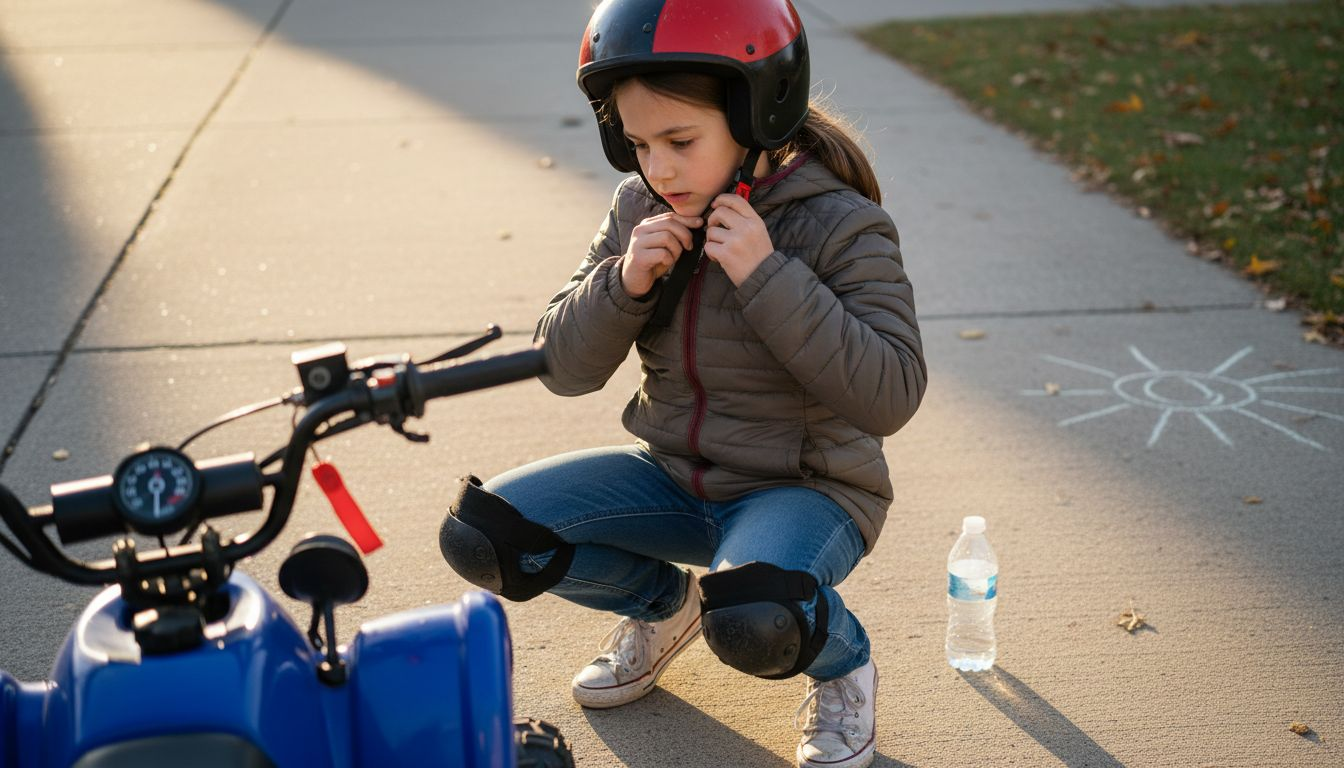
Essential safety components include:
This table summarizes essential safety mechanisms found on compliant youth ATVs:
| Safety Feature | Primary Purpose | Typical Implementation |
|---|---|---|
| Throttle limiter | Controls acceleration | Adjustable knob or screw |
| Speed governor | Caps top speed | Built-in electronic module |
| Remote kill switch | Allows emergency shutoff | Wireless or tethered control |
| Safety labels | Warns about usage limits | Visible stickers or tags |
- Throttle limiters: Restrict maximum acceleration for developing riders
- Speed governors: Cap top velocity (typically 30-35 mph for entry-level models)
- Remote engine kill switches: Allow parents to shut off the engine instantly
- Safety labels: Clear warnings about age requirements and riding rules
- Automatic transmission: Eliminates manual gear shifting complexity
- Emergency braking systems: Responsive, reliable stopping power
Federal Compliance Standards
Youth ATVs must comply with CPSC safety standards and ANSI/SVIA design requirements that address vehicle size, weight distribution, and hazard reduction. These regulations ensure machines are age-appropriate and equipped with mechanisms that prevent injuries. When shopping, look for certification labels indicating compliance with federal standards.
Compliant machines feature:
- Age and weight recommendations on visible labels
- Engine displacement matched to rider age groups
- Seat heights proportional to average child dimensions
- Tested braking distances and acceleration rates
- Impact-resistant frames and components
Protective Gear Standards
The American Academy of Pediatrics emphasizes DOT-approved helmets and comprehensive protective equipment as mandatory safety requirements. Riders need more than just helmets—they require full-body protection including eye protection, gloves, boots, and body armor.
Required protective gear:
- DOT-certified helmet: Full-face design with proper fit
- Eye protection: Goggles or face shield preventing dirt and debris
- Riding gloves: Impact-resistant with good grip
- Long pants and sleeves: Abrasion-resistant materials
- Closed-toe boots: Ankle support and foot protection
- Body armor: Chest protectors and spine guards
Safety features on the ATV plus proper protective gear create redundant layers of protection—if one fails, the others still defend your child.
What Standards Really Mean
Federal compliance isn’t just a checkbox. It means manufacturers have tested their machines under rigorous conditions and proven they reduce hazard risks. Compliant ATVs have predictable acceleration, reliable brakes, and design features that prevent common injuries.
Non-compliant or modified ATVs—especially adult machines with removed limiters—bypass these protections entirely. They’re far more dangerous and illegal for youth use.
Pro tip: Always request proof of federal compliance certification when purchasing a youth ATV, and verify that all safety features work before your child’s first ride—test the kill switch, throttle limiter, and brakes yourself.
Legal Age, Training, and Supervision Rules
There’s no single federal law setting a minimum age for ATV operation in the United States. Instead, each state writes its own regulations, creating a patchwork of rules that vary widely. Before your child rides, you must understand your state’s specific requirements and follow them strictly.
Recommended Age Guidelines
Experts recommend different machines for different age groups based on physical and cognitive development. Most pediatric health organizations suggest waiting until age 16 before allowing independent riding. However, younger children can ride smaller, properly-equipped machines under direct adult supervision and with proper training.
Age-appropriate machine sizes:
- Ages 6-11: 50cc to 70cc ATVs only
- Ages 12-15: 70cc to 125cc ATVs with adult supervision
- Ages 16+: 150cc and larger with demonstrated riding competence
Understanding State Laws
Legal age requirements vary significantly by state and region, with most states requiring riders under 16 to either complete safety training or maintain adult supervision. Some states enforce both requirements. Your state may mandate specific engine size restrictions tied to age groups, limiting younger riders to smaller machines regardless of their skill level.
Check your state’s regulations for:
- Minimum operating age
- Engine size limits by age
- Mandatory training course requirements
- Supervision rules for unsupervised riding
- Helmet and protective gear mandates
Mandatory Safety Training
Most pediatric health guidelines emphasize safety training courses as essential preparation before any riding occurs. These courses teach proper techniques, emergency procedures, and risk awareness. Some states require completion certificates; others recommend it as best practice. Either way, trained riders suffer far fewer injuries than untrained riders.
Proper training covers:
- How to mount and dismount safely
- Throttle and brake control techniques
- Turning, stopping, and emergency maneuvers
- Recognizing hazards and terrain challenges
- Understanding protective gear importance
Supervision Requirements
Younger riders need constant, active adult supervision. This doesn’t mean watching from a distance—it means riding alongside your child, monitoring their technique, and intervening immediately if problems develop. An attentive adult can catch mistakes before they become injuries.
Effective supervision includes:
- Riding directly beside or immediately behind your child
- Staying alert for fatigue or overconfidence
- Stopping rides immediately if safety concerns arise
- Inspecting the machine before every ride
- Enforcing protective gear without exception
Age restrictions exist for biological reasons—younger children lack the strength, judgment, and reaction speed needed for larger machines, regardless of maturity level.
Pro tip: Check your state’s Department of Natural Resources or Motor Vehicle Division website for current ATV regulations, then contact local ATV clubs about certified training courses before your child’s first ride.
Choosing and Maintaining the Right Kids’ ATV
Selecting the perfect ATV for your child isn’t just about finding the shiniest model on the lot. You need to match machine size, power, and features to your child’s age, physical size, and riding experience. The wrong choice creates frustration, dangerous situations, and wasted money. The right choice builds confidence and creates lasting outdoor memories.
Matching Size and Power to Your Child
The most common mistake parents make is buying machines that are too large, thinking their kids will grow into them. This backfires. An oversized ATV feels uncontrollable, exhausting, and dangerous. Your child will lose confidence before gaining real skills.
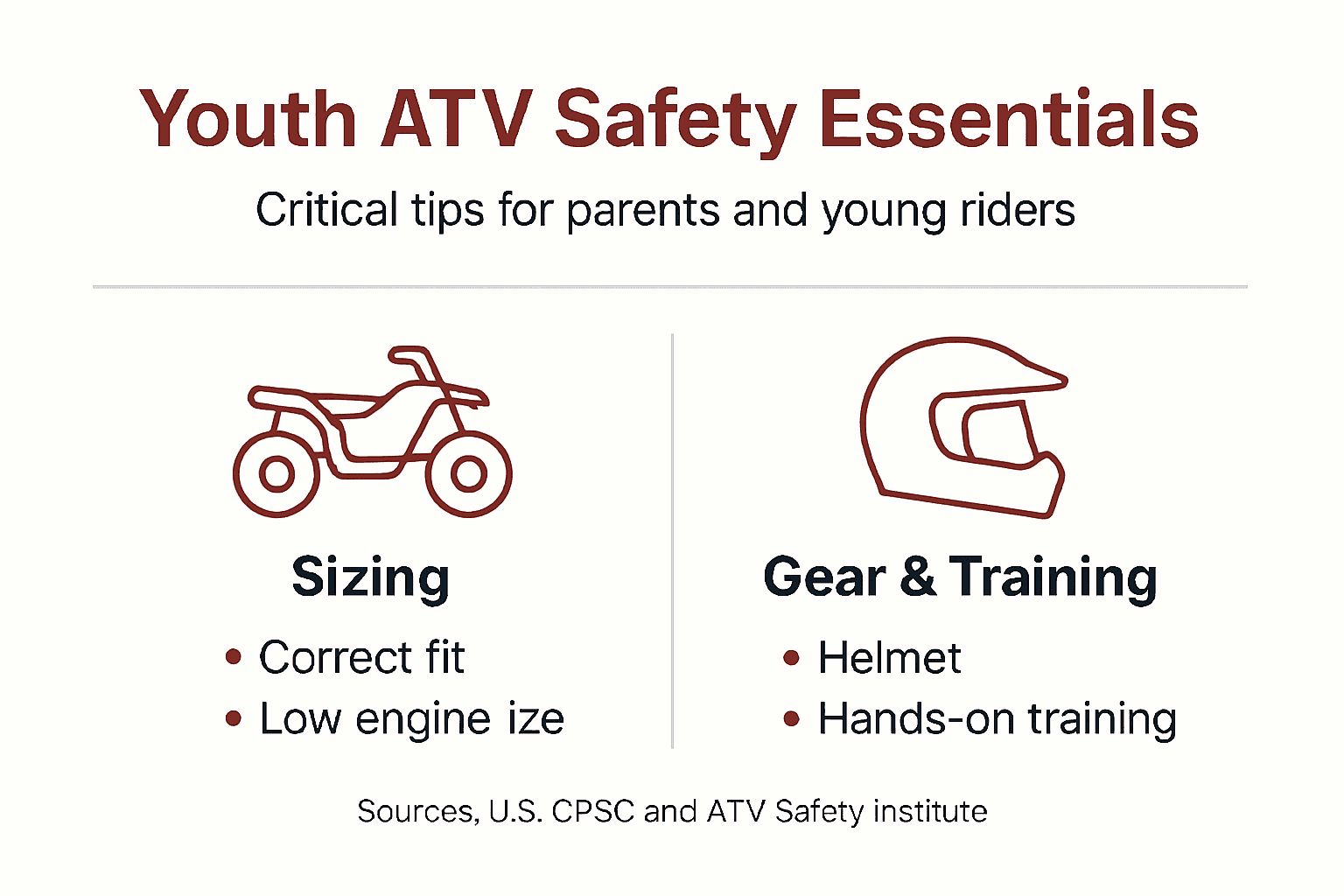
Selecting age and size-appropriate vehicles with engines under 90cc ensures riders can manage acceleration, braking, and steering without becoming overwhelmed. The right machine should feel responsive but controllable—your child should operate it confidently, not fight it constantly.
Choosing the right ATV involves:
- Seat height: Child’s feet must touch ground when seated
- Engine size: Match to age group and experience level
- Weight: Lighter machines are easier to recover from tipping
- Throttle response: Smooth, gradual acceleration preferred over jerky power delivery
- Overall length: Proportional to your child’s reach and body length
Testing Before Purchase
Never buy an ATV without letting your child sit on it first. A proper fit matters infinitely more than brand reputation or price. Visit multiple dealers if needed—this single decision affects safety and enjoyment for years.
Before committing to purchase:
- Have your child sit on the machine with both feet flat on the ground
- Check that they can comfortably reach handlebars without stretching
- Verify throttle and brake controls are within natural reach
- Ensure they feel balanced and stable, not cramped or overextended
- Test the machine at low speeds in a safe area before committing
Essential Maintenance Schedule
A well-maintained ATV is a safe ATV. Mechanical failures cause accidents. Before every ride, perform basic safety checks that take just five minutes.
Maintenance checklist:
- Brakes: Test stopping power and check brake fluid levels
- Throttle response: Ensure smooth, lag-free acceleration with no sticking
- Tires: Check pressure and inspect for damage or excessive wear
- Speed limiters: Verify governors function correctly at set limits
- Chain and sprockets: Look for wear, proper tension, and lubrication
- Lights and mirrors: Confirm all safety features work
Seasonal Storage Care
Off-season storage requires specific steps to prevent damage. Drain fuel or add stabilizer, check tire pressure monthly, and store in a dry location. Neglecting storage creates problems when you’re ready to ride again.
A machine that fits perfectly becomes an extension of your child’s body, not a machine they battle with every ride.
Pro tip: Create a simple pre-ride checklist and have your child complete it before every outing—this builds mechanical awareness, catches problems early, and reinforces the connection between maintenance and safety.
Find the Perfect Youth ATV with Confidence and Safety in Mind
Choosing the right ATV for your child is critical to keeping them safe and ensuring they enjoy every ride. This article highlights common safety challenges like matching engine size to age, using speed limiters, and requiring proper protective gear. At GokartsUSA.biz, we understand the importance of these safety fundamentals. Our carefully selected youth ATVs feature built-in throttle limiters, automatic transmissions, and compliance with federal safety standards — all designed to protect young riders and build their confidence.

Start your child’s off-road adventure the right way. Explore our range of youth ATVs suited for various skill levels and age groups. Benefit now from our spring sales, free shipping offers, and bundled helmet accessories that ensure your child rides fully protected from day one. Don’t wait until injuries happen. Visit GokartsUSA.biz today to find the perfect, safe ATV that matches your child’s size and experience.
Frequently Asked Questions
What age is appropriate for a child to start riding an ATV?
Experts recommend that children ages 6 to 10 should start on entry-level ATVs with engine sizes between 50cc and 70cc. For those aged 11 to 14, mid-range ATVs with 110cc to 125cc engines are suitable. Riders 14 and older can handle more powerful models up to 250cc with proper training.
Why is safety training important for young ATV riders?
Safety training is essential for young riders to learn proper techniques, handling skills, and emergency procedures. Courses provide foundational knowledge that significantly reduces the risk of accidents compared to untrained riders.
What should I look for when choosing an ATV for my child?
When selecting an ATV, consider factors such as seat height, engine size, weight, and safety features. The ATV should be age-appropriate, allowing the child to touch the ground with their feet while seated, and should have built-in safety mechanisms like throttle limiters and speed governors.
What protective gear is necessary for riding an ATV?
Riders should wear full protective gear including a DOT-certified helmet, eye protection (goggles or face shield), riding gloves, long pants and sleeves made of abrasion-resistant materials, closed-toe boots for foot protection, and body armor for added safety.
Recommended
- What Is an ATV and Why Safety Matters Most – GoKarts USA®
- What Is a Go-Kart and Why Safety Matters Most – GoKarts USA®
- What Is a Youth Go-Kart and Why Age Matters – GoKarts USA®
- Mini Sport Kids ATV, 110cc Gas Engine with Parental Remote Start/Kill – GoKarts USA®
- Safe Adventure in Jaco for Kids | Zipline, ATV & Waterfalls