




The fastest route to the best powersports financing is simple: get written preapprovals from at least two or three lenders before you ever talk numbers with a dealer. Preapprovals give you a real rate and term to compare, not a guess, and they hand you leverage the moment a dealer tries to beat or match your offer. The CFPB and FTC both back this approach, and GoKartsUSA built its own resources around that same logic.
TL;DR:
- Preapproving with two to three lenders provides a clear rate and term baseline, giving you leverage when negotiating with the dealer.
- Online lenders offer quick comparisons, making them ideal for initial research before visiting a dealership; bank and credit union rates are more predictable but less flexible.
- Longer loan terms lower monthly payments but increase total interest paid, while larger down payments and shorter terms reduce overall costs.
- Always get written preapprovals, rate details, and any dealership markup or add-ons in advance to avoid hidden costs and deceptive promotional offers.
- Use official guides to compare total loan costs and verify rates, ensuring you understand the real affordability before signing any financing agreement.
Table of Contents
- Where to find powersports loans: banks, credit unions, online lenders, and dealers
- How to shop for financing and use it to negotiate with the dealer
- What credit scores, APR ranges, and down payments actually mean for your loan
- Terms to watch and red flags that inflate your total cost
- Why GoKartsUSA built its financing resources around real buyer questions
- Financing your ride at GoKartsUSA: what to expect at checkout
- Where to verify rates and calculate your real loan cost
- Sources
- FAQ
Where to find powersports loans: banks, credit unions, online lenders, and dealers
Every rider eventually faces the same question: who actually lends money for a go-kart, ATV, or UTV? The honest answer is that several types of lenders compete for that business, and each comes with its own trade-offs.
Banks and credit unions tend to offer the most predictable underwriting. Credit unions in particular often publish specific powersports loan rates, and lender pages like Lanco FCU’s powersports rate sheet show how APRs shift by term and model year. Online lenders move fast and let you compare multiple offers in a single sitting, which makes them a natural first stop before you visit a showroom.
Dealer-arranged financing works differently. The dealer submits your application to one or more lenders, receives a wholesale “buy rate,” and can add a markup on top of it before presenting the number to you. That markup is legal and common, but it means the rate you see at the counter isn’t necessarily the rate the lender actually approved.
Treat any advertised 0% claim as a starting point for questions, not a guaranteed rate.
In-house or buy-here-pay-here financing exists for buyers who can’t qualify elsewhere, but it usually carries the highest cost and the least flexibility, making it a last resort rather than a first choice.
- Banks and credit unions: competitive rates, straightforward underwriting, best used for preapproval.
- Online lenders: fast comparison shopping, useful for building a rate baseline.
- Dealer-arranged loans: convenient but include a markup over the lender’s buy rate.
- OEM promotions: attractive headlines, but tied to model year, term, and credit tier.
- In-house financing: accessible but typically the most expensive option available.
How to shop for financing and use it to negotiate with the dealer
A little sequencing turns financing from a guessing game into a controlled comparison. Here’s the order that protects both your credit score and your wallet.
- Pull your credit report and check your score before applying anywhere.
- Request written preapprovals from two or three lenders, banks, credit unions, or online, each showing the rate, term, and maximum loan amount.
- Submit those applications within a short window, since major scoring models generally treat multiple auto-loan inquiries made within 14 to 45 days as a single inquiry.
- Use a loan worksheet to compare total loan cost (amount financed plus finance charge) rather than monthly payment alone, following the format in the CFPB’s auto loan guide.
- Bring your strongest written preapproval to the dealer and ask them to match or beat it.
- Get any improved offer in writing before you sign anything.
GoKartsUSA’s own guide on ATV financing and approval strategy walks through this same sequence in more detail if you want a second reference while you shop.
Pro Tip: Ask the dealer directly what their buy rate is; you’re not obligated to accept their markup once you already hold a competing written offer.
What credit scores, APR ranges, and down payments actually mean for your loan
There’s no universal minimum credit score for powersports loans. The CFPB explains that lenders weigh your credit history, income, debts, loan amount, down payment, and loan term together, so two buyers with the same score can land different rates depending on the rest of their application.

GoKartsUSA’s breakdown of APR by FICO tier shows how rates commonly range from roughly 12% for stronger credit profiles up to 35% for weaker ones, a spread wide enough to change your monthly payment by a meaningful margin.
A larger down payment or a shorter loan term generally lowers your total interest paid, even when the monthly payment looks less friendly on paper. That’s the trade-off the FTC warns about: buyers who focus only on the monthly number often extend the term without realizing how much extra interest stacks up over time.
- Stronger credit profiles typically unlock the lower end of a lender’s advertised APR range.
- A bigger down payment reduces the amount financed and the interest charged on it.
- Shorter terms raise the monthly payment but usually cut total interest owed.
- Longer terms lower the monthly payment but stretch out finance charges for years.
The shorter term carries a higher monthly payment but a smaller total finance charge, while the 60-month version looks easier month to month yet accumulates more interest across its longer life. Running both scenarios through a loan worksheet before you commit is the only way to see which one actually costs less.
Terms to watch and red flags that inflate your total cost
Financing paperwork hides a few phrases worth knowing before you sign. The buy rate is the wholesale rate a lender quotes the dealer; the dealer markup is what gets added on top. GAP coverage and extended warranties are optional add-ons that can be rolled into your loan balance, quietly raising the amount you finance. A prepayment penalty charges you for paying the loan off early, which defeats the purpose of refinancing or an early payoff later.
The FTC has found that buyers often focus so heavily on the monthly payment that they miss deceptive low-rate advertising or fine-print eligibility rules attached to promotional offers.
Get every promised rate, term, and condition in writing before you sign, especially for advertised 0% or low-rate offers, which often apply only to specific models or highly qualified buyers. Consumer guidance from the FTC and CFPB
- Ask whether any add-ons are optional and can be removed from the loan.
- Ask for the lender’s buy rate before discussing the dealer’s offered rate.
- Ask whether the loan carries a prepayment penalty.
- Ask which model years and credit tiers actually qualify for an advertised 0% rate.
Why GoKartsUSA built its financing resources around real buyer questions
We built our blog because we kept hearing the same questions from parents and riders standing in a showroom, unsure whether the financing offer in front of them was actually fair. Our APR-by-FICO breakdown and preapproval guides exist so you can walk in already knowing what a reasonable rate looks like for your credit tier, not guessing based on a dealer’s pitch.
We treat financing the same way we treat safety gear and vehicle selection: as part of getting a family or a rider set up right, not just a checkout step. Promotional perks such as free shipping and complimentary helmets on qualifying orders help lower your total cost of ownership alongside whichever financing route you choose.
— Mario
Financing your ride at GoKartsUSA: what to expect at checkout
Once you’ve compared preapprovals and settled on a budget, Checkout financing options let you apply directly against the vehicle you’ve chosen instead of guessing at a number in advance. Most applications ask for basic identification, proof of income, and consent for a credit check, the same documents any lender would request.
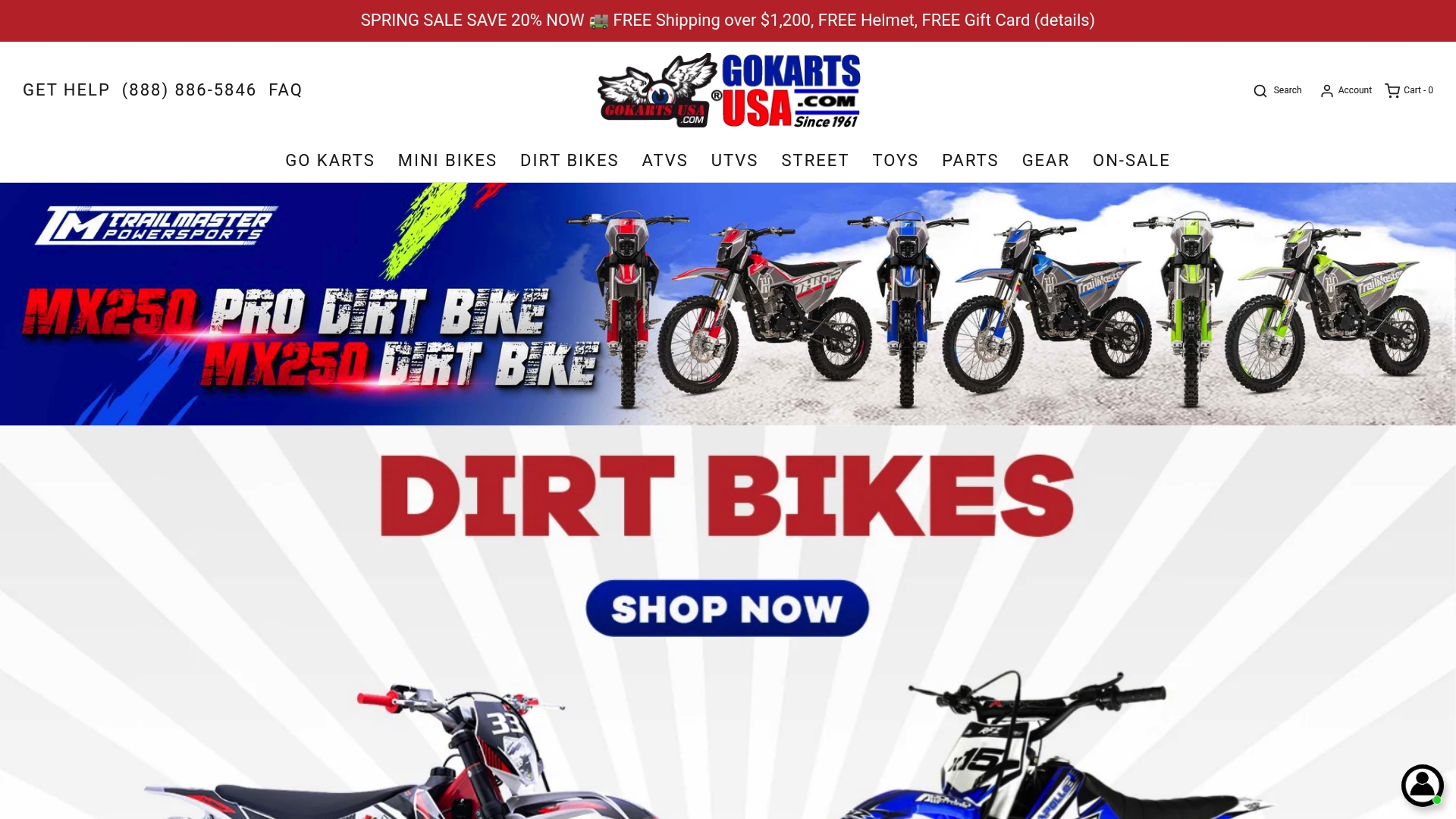
Seasonal promotions, including spring sales, free shipping, and complimentary helmets on select orders, can reduce the out-of-pocket cost around your purchase, potentially shrinking the total amount needed to finance.
- Apply for financing directly on a product page during checkout.
- Bundle a helmet or accessory promotion into your order where available.
- Compare the financed total against your own preapproval before confirming.
| Category | What it covers |
|---|---|
| Go-Karts | Entry-level and racing models for kids and adults |
| Mini Bikes | Gas-powered models for ages 12 and up |
| Dirt Bikes | Manual and automatic options across skill levels |
| UTVs | Side-by-side models for trail and family use |
Pro Tip: Bring your written preapproval number with you when you check out, even if you plan to use our in-house financing option, so you know exactly what rate you’re comparing against.
Browse our full lineup on the GoKartsUSA catalog or start with a specific ride like the Sport Kart Kids Gas Go Kart or the TrailMaster Challenger 300EX UTV to see financed pricing firsthand.
Where to verify rates and calculate your real loan cost
Before you sign anything, run the numbers through sources built to protect you rather than sell to you.
- The CFPB’s guide to auto loan rate decisions explains exactly what underwriters weigh.
- The CFPB’s auto loan worksheet helps you compare total cost, not just monthly payment.
- Synchrony’s powersports financing page shows how term limits and financed-amount ranges vary by lender and vehicle type.
This article is general information, not a substitute for advice from a qualified financial advisor. Consult a qualified financial professional about your own circumstances before acting on anything here.
Sources
- How does a lender decide what interest rate to offer me on an auto loan? | CFPB
- Take control of your auto loan: A step-by-step guide | CFPB
- Powersports financing | Synchrony
FAQ
Who has the best ATV financing?
No single lender wins for every buyer, since the best rate depends on your credit profile, down payment, and the term you choose. Comparing written preapprovals from a bank, a credit union, and an online lender, then letting the dealer try to match your best offer, is the most reliable way to find your own best deal.
What credit score is needed to finance an ATV?
There’s no fixed minimum score for ATV loans; the CFPB notes that lenders weigh your full financial picture, including income, debts, and down payment, alongside your credit score. Stronger credit profiles typically qualify for the lower end of a lender’s advertised APR range.
What is a good interest rate for an ATV loan?
A good rate depends heavily on your credit tier, and GoKartsUSA’s APR-by-FICO breakdown shows rates commonly ranging from around 12% for strong credit up to 35% for weaker profiles. Comparing your preapproval against that range tells you whether a dealer’s offer is competitive for your situation.
Is Polaris offering 0% interest?
Always confirm the current terms directly and get the exact conditions in writing, since the FTC warns that advertised low or zero rates often apply only to highly qualified buyers.
Should I finance or lease a powersports vehicle?
Financing builds ownership and equity over time, while leasing typically means lower payments but no ownership at the end of the term. Most powersports buyers choose financing since resale value and long-term use tend to favor ownership over a lease structure built for shorter commitments.