




TL;DR:
- Powersports vehicles include ATVs, UTVs, dirt bikes, snowmobiles, and personal watercraft, each designed for specific terrains and uses. Selecting the right vehicle depends on intended tasks, rider age, experience, and local regulations, prioritizing safety and practicality. Matching the vehicle type to lifestyle needs ensures safe, enjoyable riding experiences for families and enthusiasts alike.
Powersports vehicles are motorized recreational and off-road machines built for adventure across land, snow, and water. The main categories include motorcycles, ATVs, UTVs, snowmobiles, and personal watercraft, each engineered for a distinct riding experience. Brands like Polaris, Can-Am, Sea-Doo, and Ski-Doo define the market with models that range from family-friendly youth ATVs to 325-horsepower jet skis. Whether you are a recreational rider chasing trails or a parent searching for a safe first machine for your child, knowing the specific examples of powersports vehicles in each category is the fastest way to make a confident purchase decision in 2026.
1. All-terrain vehicles (ATVs): sport, utility, and youth options
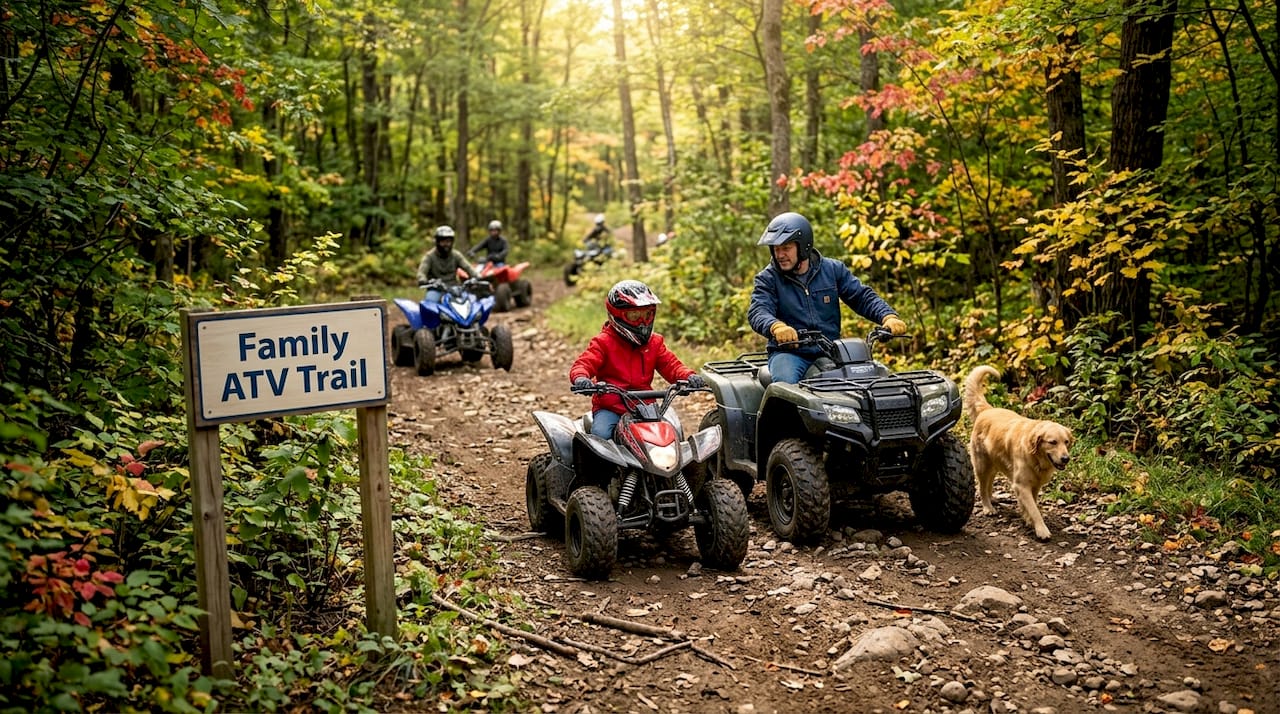
ATVs are four-wheeled, single-rider off-road machines and the most recognized powersports vehicle category for families and beginners. ATVs come in three main types: sport, utility, and youth, each built for a different rider profile and purpose.
Sport ATVs like the Polaris Scrambler 850 and Can-Am Renegade 1000R are built for aggressive trail riding and high-speed performance. These machines carry larger engines, sport-tuned suspension, and minimal cargo capacity. They are not appropriate for children or beginners.
Utility ATVs prioritize hauling and towing over speed. Models in this class often include front and rear racks, a tow hitch, and engines tuned for torque rather than top-end power. Farmers, ranchers, and property owners favor them for real work alongside weekend recreation.
Youth ATVs are the category parents care about most. Models like the Mini Sport Kids ATV 110cc from GoKartsUSA® come with a parental remote start and kill switch, giving adults direct control over when the machine runs. Engine displacement is intentionally limited, typically 50cc to 125cc, to match a child’s developing skill level. States like New Hampshire define ATV classifications by weight, width, and safety equipment, which directly affects what vehicles children can legally operate. Always verify your state’s regulations before buying.
Pro Tip: Always match engine displacement to the rider’s age and experience. A 110cc youth ATV is appropriate for ages 6 to 12, while a 125cc model suits teens with prior riding experience.
For a deeper look at safe beginner ATV choices, GoKartsUSA® has a dedicated resource covering the features that matter most for young riders.
2. Utility task vehicles (UTVs): three subtypes with real-world specs
UTVs, also called side-by-sides, are multi-passenger off-road vehicles with a steering wheel, roll cage, and side-by-side seating. UTVs divide into three subtypes: sport, utility, and sport utility. Understanding which subtype fits your needs prevents a costly mismatch.
Sport UTVs
Sport UTVs like the Polaris RZR Turbo S and Can-Am Maverick X3 are designed for speed and trail handling rather than cargo capacity. They typically seat two to four riders and feature long-travel suspension, high-output turbocharged engines, and aggressive tires. These are the machines you see at desert races and sand dunes.
Utility UTVs
Utility UTVs like the Polaris Ranger XP 1000 and Can-Am Defender are built to haul and tow. Utility UTVs carry over 1,000 lb of payload and tow up to 2,500 lb, making them genuinely useful on farms, ranches, and large properties. The TrailMaster Taurus 200U from GoKartsUSA® is a utility-focused side-by-side that suits lighter-duty tasks and recreational property use at a more accessible price point.
Sport utility UTVs
The Polaris General XP 1000 sits in the sport utility class, blending trail-capable suspension with a usable cargo bed. This overlap between sport and utility appeals to buyers who want one machine that handles weekend trails and weekday chores. The TrailMaster SportsCross 1000 is another sport utility option worth considering for families who want recreational performance without sacrificing practicality.
| UTV subtype | Key examples | Payload/tow capacity | Best for |
|---|---|---|---|
| Sport | Polaris RZR Turbo S, Can-Am Maverick X3 | Low cargo priority | Trail racing, dunes, performance riding |
| Utility | Polaris Ranger XP 1000, Can-Am Defender | 1,000+ lb / 2,500 lb tow | Farm work, hauling, property management |
| Sport utility | Polaris General XP 1000, TrailMaster SportsCross 1000 | Moderate cargo + trail suspension | Mixed recreational and light work use |
Pro Tip: If you plan to use your UTV for both trail riding and light hauling, the sport utility class gives you the most flexibility without forcing you to compromise on either end.
3. Dirt bikes and motorcycles: two-wheel powersports examples
Dirt bikes and street motorcycles both fall under the powersports umbrella, but they serve very different purposes. Dirt bikes are purpose-built for off-road terrain, with knobby tires, high ground clearance, and lightweight frames. Street motorcycles are engineered for paved roads, with smoother tires, lower suspension, and higher top-end speed.
Popular dirt bike examples include the Honda CRF450R for competitive motocross and the Yamaha YZF-R6 on the sport motorcycle side. The Honda CRF450R produces around 60 horsepower in a sub-240-pound package, making it one of the most capable motocross machines available. The Yamaha YZF-R6 is a track-focused supersport bike that rewards experienced riders with precision handling at high speeds.
For riders who want something between a traditional motorcycle and a car, the Can-Am Ryker is a three-wheel option that offers stability without a full UTV footprint. It uses a 900cc Rotax engine and leans into corners like a motorcycle, making it approachable for riders who are not yet confident on two wheels.
Parents researching two-wheel options for teenagers should look at 50cc to 125cc dirt bikes with automatic or semi-automatic transmissions. These machines limit top speed, reduce the learning curve, and allow young riders to build confidence on trails before moving to larger displacement bikes.
4. Snowmobiles: performance and recreational examples
Snowmobiles are tracked, engine-powered vehicles designed for travel across snow and ice. They are a core powersports vehicle type in northern states and Canada, with a riding season that typically runs from December through March depending on location.
BRP’s Ski-Doo brand is the market leader in snowmobiles, offering models from entry-level trail sleds to high-performance mountain machines. BRP drives the powersports market with recognized products across Ski-Doo, Sea-Doo, and Can-Am, giving buyers a consistent ecosystem of parts and dealer support. Lynx, also owned by BRP, targets the Scandinavian and Canadian backcountry market with sleds built for deep powder and extreme terrain.
Key specs to compare when choosing a snowmobile include engine displacement (ranging from 400cc to 900cc), track length (longer tracks grip better in deep snow), and dry weight. Lighter sleds are easier to maneuver in tight trees, while heavier trail sleds offer more comfort on groomed runs. Beginner riders should start with a trail sled in the 400cc to 600cc range before moving to high-performance mountain or racing models.
5. Personal watercraft: from recreational to high-performance examples
Personal watercraft (PWC), commonly called jet skis, are sit-down or stand-up water vehicles powered by an inboard jet pump. They are among the most popular examples of recreational vehicles for summer use, with models ranging from casual lake cruisers to race-ready performance machines.
The 2026 Sea-Doo RXP-X is the benchmark for high-performance PWC. It features a supercharged 325-horsepower engine, accelerates from 0 to 60 mph in 3.4 seconds, and is electronically limited to 69 mph. That acceleration figure puts it in the same conversation as sports cars, which illustrates just how far PWC performance has advanced. The Kawasaki Jet Ski Ultra 310X is a comparable competitor, producing 310 horsepower and targeting the same performance-focused buyer.
For families and beginners, Sea-Doo’s GTI series and Yamaha’s WaveRunner EX offer gentler power delivery, three-person seating, and storage compartments for a day on the water. These recreational models top out around 50 mph and prioritize stability over raw speed. Choosing between a performance and recreational PWC comes down to one question: are you riding for thrills or for a relaxed afternoon on the lake?
Pro Tip: Always check local waterway speed limits before purchasing a high-performance PWC. Many lakes and rivers cap speeds at 35 mph or enforce no-wake zones that make a 325-hp machine impractical for everyday use.
Key takeaways
Powersports vehicles span five major categories, and matching the right type to your intended use is the single most important purchase decision you will make.
| Point | Details |
|---|---|
| ATVs suit families and beginners | Youth ATVs with remote kill switches like the 110cc Mini Sport model are the safest entry point for children. |
| UTVs split into three clear subtypes | Sport, utility, and sport utility UTVs each serve a distinct purpose; choose based on cargo needs and trail use. |
| Dirt bikes require age-appropriate sizing | Match engine displacement to rider age and experience; 50cc to 125cc is the right range for teenagers. |
| PWC performance varies dramatically | The Sea-Doo RXP-X hits 0 to 60 in 3.4 seconds; recreational models are far more appropriate for casual family use. |
| Regulations shape your options | State-level ATV and UTV definitions affect what vehicles children can legally operate, so verify local rules first. |
Why matching vehicle type to lifestyle matters more than brand loyalty
I have seen buyers walk in with a brand preference and walk out with the wrong machine. It happens more than you would expect. A family buys a sport ATV because it looks exciting, then discovers their 10-year-old cannot safely operate it and their property does not have the terrain to justify it. The vehicle sits in the garage.
The practical framework I recommend is simple: identify the primary task first, then the rider profile, then the budget. A utility UTV that hauls firewood on weekdays and takes the family on trails on weekends is a smarter buy than a sport machine that only does one thing well. The sport utility UTV class exists precisely because most buyers have mixed needs.
For parents, the safety controls on youth-specific models are not optional features. They are the difference between a positive first experience and a trip to the emergency room. Remote kill switches, speed limiters, and age-appropriate engine sizes are non-negotiable starting points. I also strongly recommend checking family powersports safety guidance before any purchase, because gear selection and riding environment matter as much as the vehicle itself.
The riders who get the most out of powersports are the ones who bought the right machine for their actual life, not the most impressive one on the showroom floor.
— Mario
Find the right powersports vehicle at GoKartsUSA®
GoKartsUSA® carries a hand-picked selection of powersports vehicles built for real riders and real families across America. From youth ATVs with parental safety controls to capable side-by-sides for trail and property use, the inventory is designed to match the way you actually ride.

For parents looking for a safe, confidence-building first machine, the Mini Sport Kids ATV 110cc is the standout choice. It comes with a parental remote start and kill switch, a 110cc engine sized right for young riders, and the kind of build quality that earns trust on the first ride. GoKartsUSA® backs every purchase with dedicated customer support, free shipping options, and the expertise of a team that lives the powersports lifestyle. Your next adventure starts here.
FAQ
What are the main examples of powersports vehicles?
The main powersports vehicle types are ATVs, UTVs, dirt bikes, street motorcycles, snowmobiles, and personal watercraft. Each category is built for a specific terrain and riding purpose, from off-road trails to open water.
What is the safest powersports vehicle for a child?
A youth ATV with a 50cc to 110cc engine and a parental remote kill switch is the safest starting point for children. These features limit speed and give parents direct control over the machine.
What is the difference between an ATV and a UTV?
An ATV is a single-rider, handlebar-steered four-wheeler, while a UTV is a multi-passenger side-by-side with a steering wheel and roll cage. UTVs generally offer more cargo capacity and passenger seating than ATVs.
How fast is the Sea-Doo RXP-X personal watercraft?
The 2026 Sea-Doo RXP-X reaches 0 to 60 mph in 3.4 seconds and is electronically limited to 69 mph, powered by a supercharged 325-horsepower engine.
Do I need to check local laws before buying a powersports vehicle for my child?
Yes. States like New Hampshire define ATV and UTV classifications by weight, width, and safety equipment, which directly affects what vehicles children can legally operate. Always verify your state’s regulations before purchasing.