




Your credit score won’t necessarily determine whether you get approved for a go-kart, ATV, or dirt bike loan, but it absolutely determines what that loan costs you. Approvals happen across nearly the entire credit spectrum. Borrowers with scores near 670 or higher typically land APRs in the single digits to low teens, while subprime borrowers can face rates from 12% up past 35%. Before you sign anything, prequalify with a soft credit pull, since it costs you nothing and shows real numbers instead of guesses.
TL;DR:
- Borrowers with credit scores above 670 typically pay single-digit to low teens APRs, while subprime borrowers often face rates from 12% up to 35 percent or more.
- Prequalifying with multiple lenders through a soft credit pull can help you compare real rates without affecting your score or incurring costs.
- Applying through banks or credit unions generally yields better rates but requires prime or near-prime credit, while specialty lenders accommodate lower scores with higher interest rates.
- Improving your credit within one to three months by disputing errors and reducing utilization can significantly lower your interest costs, but waiting may be better if your score is very low.
- The application process involves prequalification, comparing offers, submitting full documents, and usually receiving funding within one to three days, with total costs depending heavily on loan terms and credit profile.
Table of Contents
- Powersports Financing Credit Score Tiers: What Each Range Really Gets You
- How Do Lenders Judge You Beyond Your Credit Score?
- What Financing Options Fit Your Credit Profile?
- How Fast Can You Improve Your Credit Before Financing?
- What Does the Application Process Actually Look Like?
- A Publisher’s Take on Borrowing Responsibly for Recreational Vehicles
- Ready to Explore Financing With Gokartsusa?
- Where to Verify Rates and Lender Credentials
- Sources
- FAQ
Powersports Financing Credit Score Tiers: What Each Range Really Gets You
Lenders don’t look at your FICO score as a pass/fail test. They use it to price risk, and the difference between tiers can mean thousands of dollars over the life of a loan.
Here’s roughly how the tiers break down for powersports financing:
- Super-prime (800+): Near-automatic approval, the best available APRs, minimal or no down payment required.
- Prime (670–799): Strong approval odds, competitive rates, often 0% to 10% down.
- Near-prime (640–669): Approval odds improve significantly here, though rates climb and lenders may ask for a bit more down.
- Subprime (500–599): Financing is still possible, but expect APRs in the double digits, typically paired with a required down payment or need for a co-signer
- Deep subprime (below 500): Approval gets harder and usually requires a specialty lender, a large down payment, or both.
There’s no single national cutoff score, and that trips up a lot of shoppers. Some lenders treat 640 as their line for competitive pricing, others use 680, and manufacturer promotions almost always reserve their best rates for the best-qualified applicants.
Statistic to know: Subprime borrowers often see APRs stretch from 12% up to 35% or more, with down payments running 10% to 30% of the vehicle’s price. Shorter loan terms sometimes unlock better rates even at a lower score, since lenders take on less long-term risk.
How Do Lenders Judge You Beyond Your Credit Score?
Your score gets you in the door, but underwriters look at the whole picture before they hand over the keys. Income stability, your debt-to-income ratio (DTI), how long you’ve held your job, and whether you’ve had recent delinquencies or a bankruptcy all factor into the decision. The vehicle itself matters too. A brand-new UTV with strong resale value is safer collateral than an aging dirt bike with high mileage.
There’s also a timing detail that trips up plenty of buyers: prequalification uses a soft credit pull that leaves your score untouched, while a full application triggers a hard inquiry that can knock off a few points. Smart shoppers prequalify with several lenders first, compare offers, then commit to one hard application.
Where you apply changes your odds and pricing, too:
- Banks and credit unions offer the tightest underwriting and typically the best rates, but they lean heavily on strong credit.
- Dealer or manufacturer in-house financing often runs promotional rates for prime buyers, similar to how Gokartsusa connects shoppers with financing resources for its go-kart, ATV, and dirt bike lineup.
- Specialty or subprime lenders cast a wider net and approve scores in the low 500s, but the tradeoff is a steeper APR.
Pro Tip: Prequalify with two or three lender types (bank, specialty lender, and dealer) on the same day. Soft pulls don’t stack up as hard inquiries, so you get real rate comparisons without any credit cost.
What Financing Options Fit Your Credit Profile?
Where you shop for a loan should match where you sit on the credit spectrum. Here’s how the main routes stack up:
- Banks and credit unions. Best rates available, but approval generally requires prime or near-prime credit and solid income documentation.
- Manufacturer or dealer financing. Frequently the easiest path for prime buyers chasing promotional rates, and a realistic option for near-prime shoppers too.
- Specialty or subprime powersports lenders. Approvals reach into the low 500s, though acceptance often hinges on steady income and a bigger down payment.
- Personal loans (secured or unsecured). Worth considering if you want to avoid using the vehicle as collateral, though unsecured personal loans usually carry higher rates than a secured powersports loan.
A co-signer with strong credit or a larger down payment can shift you into a better rate bracket even if your own score hasn’t moved yet. Be careful with dealers who stretch your term to 72 or 84 months just to shrink the monthly payment. That tactic often adds thousands in total interest, even when the payment looks friendlier on paper.
How Fast Can You Improve Your Credit Before Financing?
You don’t need a perfect score to buy smart. You need a plan. Start by pulling your credit report and disputing any errors, since mistakes are more common than most people assume. Next, work on lowering your credit utilization, keep every payment on time, and resist opening new credit accounts right before you apply, since each hard inquiry can ding your score slightly.
- Dispute report errors first. It’s often the fastest score bump available.
- Pay down revolving balances to cut utilization below 30%.
- Avoid new credit applications for at least 60 to 90 days before financing.
- Consider a secured card or credit-builder loan if your file is thin.
Most of these moves show measurable results within one to three billing cycles, though bigger jumps can take several months. The payoff is real: moving from fair credit to very good credit can save you thousands in interest over the life of a loan. If you need the vehicle now, a co-signer or a larger down payment often beats waiting months for a score bump that may only shave a point or two off your rate.
What Does the Application Process Actually Look Like?
The path from browsing to riding follows a predictable sequence, and knowing it in advance keeps you from getting blindsided.
- Prequalify with a soft pull to see estimated rates across a few lenders.
- Compare offers side by side, looking at APR, term length, and total cost, not just the monthly payment.
- Submit a full application with your chosen lender, which triggers a hard inquiry.
- Provide documents: government ID, Social Security number, recent pay stubs or proof of income, proof of residence, and insurance information for the vehicle.
- Get funded, typically within one to three business days after approval.
Pro Tip: Always compare the total interest paid over the life of the loan, not just the monthly payment. A longer term can look cheaper month to month while costing you far more overall.
A Publisher’s Take on Borrowing Responsibly for Recreational Vehicles
Buying a go-kart, ATV, or dirt bike is supposed to be fun, and that excitement is exactly when people make financing mistakes. Run the total-cost math before you sign anything. A low monthly payment stretched over 84 months can quietly cost more than a shorter loan with a higher payment. If your credit isn’t where you want it yet, a modest wait or a co-signer often beats locking into a high APR out of impatience. For a deeper walkthrough of loan options and approval strategy, our ATV financing guide breaks down the numbers further, and our buyer’s guide to powersports vehicles helps you match a vehicle to a realistic budget.
— Mario
Ready to Explore Financing With Gokartsusa?
This retailer gives you a direct path to financing guidance without sending you through a maze of third-party comparison sites. Their resources are built around real vehicle pricing rather than generic loan advice.

If you’re weighing a purchase, start with our ATV financing breakdown to see how rates and terms typically shake out, then browse the full lineup to find a model that fits your budget. Once you’ve got a vehicle in mind, gather your pay stubs and ID, prequalify with a soft pull, and reach out to our support team to compare terms before you commit. And once you’re riding, a proper motorcycle wash routine helps protect your investment and resale value for years down the road.
Where to Verify Rates and Lender Credentials
Check any lender’s registration through the NMLS consumer access database before signing paperwork. LendingTree’s powersports loan guides offer solid rate benchmarks, and Crediful’s ATV loan breakdown clarifies how score thresholds vary by lender.
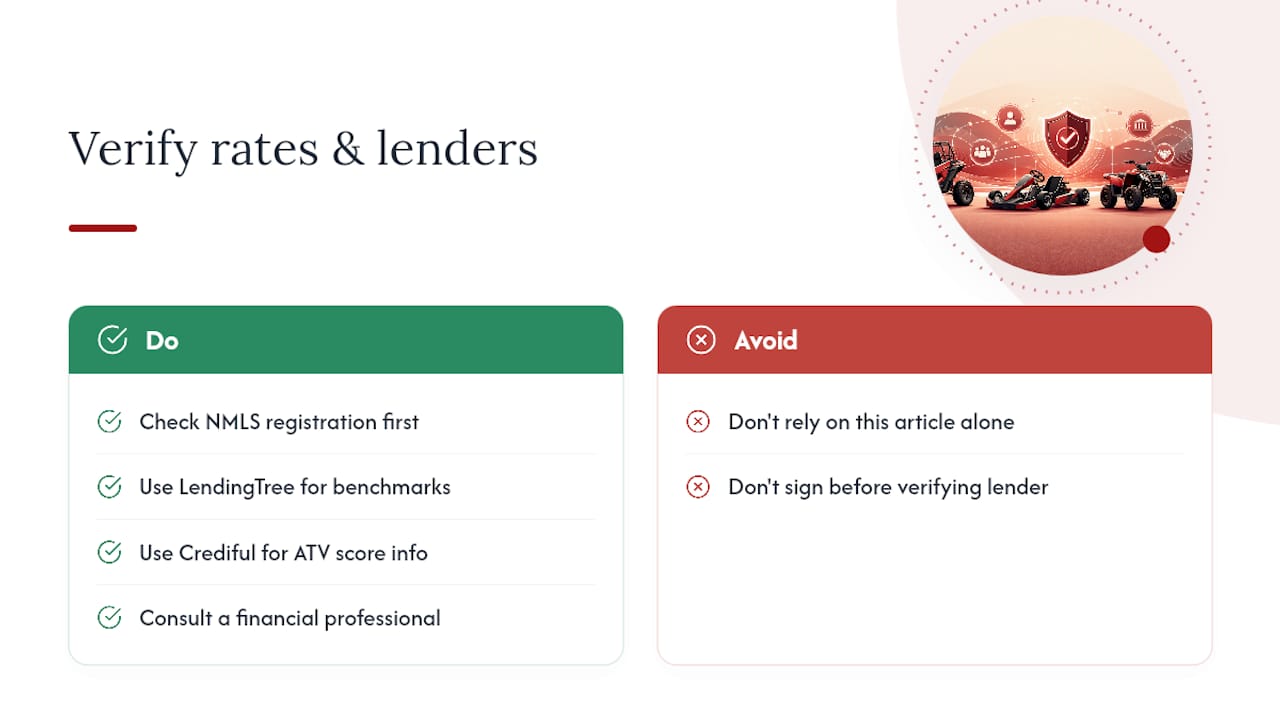
This article is general information, not a substitute for advice from a qualified financial advisor. Consult a qualified financial professional about your own circumstances before acting on anything here.
Sources
- Bad credit powersports and ATV financing options in 2026 | LendingTree
- How to get a powersports loan in 5 steps | LendingTree
- Motorcycle financing with bad credit | CarFix Credit
- What credit score is needed for an ATV loan? | Crediful
FAQ
What credit score is needed to finance an ATV?
There’s no fixed national minimum, but many lenders treat scores around 640 to 680 as the practical threshold for competitive rates. Scores below that range can still qualify through specialty lenders, though expect a higher APR and possibly a down payment.
What credit score does Honda Powersports financing require?
Honda’s dealer financing programs typically favor prime and near-prime borrowers for their best promotional rates, similar to most manufacturer captive-finance programs. Buyers with lower scores can still apply, but they’re more likely to land standard rates rather than promotional ones.
Can I finance a motorcycle with a 400 credit score?
Approval at that level is difficult through traditional banks, but specialty subprime lenders sometimes work with borrowers in this range if income and employment history are stable. Expect a required down payment, a co-signer, or both, along with an APR at the high end of the range.
What credit score does Polaris require for financing?
Polaris and similar manufacturer financing programs don’t publish a single universal minimum, since approval depends on the lender partner, income, and the specific promotion running at the time. Prime credit (670 and up) gives you the best shot at promotional rates, while lower scores may still qualify through standard financing at a higher APR.