




If you need an ATV loan now, prequalify with a credit union or online lender and compare that against any dealer or manufacturer promo. The right route depends on your credit score and whether you’re chasing the lowest APR or the easiest approval.
Excellent credit (prime): A bank, an online personal loan, or a manufacturer captive program will usually get you the lowest rate. Check for 0% promotional financing before you sign anything else.
Fair or limited credit: Credit unions typically beat bank rates for this tier. Community Resource Credit Union lists ATV loans starting around 6.99% APR for new units, with terms stretching to 84 months. Specialty powersports lenders and dealer-arranged financing also widen your approval odds here.
Below-average credit: Expect a higher APR. A co-signer, a bigger down payment, or a short-term credit-builder loan can open doors that a straight application won’t.
Whatever tier you’re in, the move right now is the same: get prequalified with two lender types and run the numbers through a loan calculator before you set foot on a dealer lot.
TL;DR:
- Prequalify with at least two lenders using soft pulls to compare rates and avoid unnecessary credit score impacts before visiting a dealer.
- Expect manufacturer promotional APRs as low as 0.99% to 3.99% mainly for excellent credit during seasonal sales, with higher rates for fair or poor credit.
- Shorter loan terms, such as 36 months, can save up to $1,400 in interest over 84-month loans on a $7,500 ATV, making them more cost-effective long-term.
- Longer loans increase the risk of negative equity, especially if the ATV depreciates faster than the loan amortizes, complicating resale or refinancing.
- Secured loans generally offer lower APRs and higher approval chances but require full-coverage insurance and collateral, unlike unsecured personal loans with higher rates and limited amounts.
Table of Contents
- What Are the Best ATV Financing Options?
- What APR and Loan Terms Should You Expect?
- How Do Lenders Decide ATV Credit Approval?
- What Does an ATV Really Cost Beyond the Loan?
- How Do You Apply for ATV Financing Step by Step?
- Why Shop ATV Financing Through Gokartsusa?
- How Does Loan Term Affect ATV Resale or Refinance Later?
- Should You Choose a Secured or Unsecured ATV Loan?
- Key Takeaways
- Sources
What Are the Best ATV Financing Options?
Four channels dominate ATV financing, and each one fits a different rider.
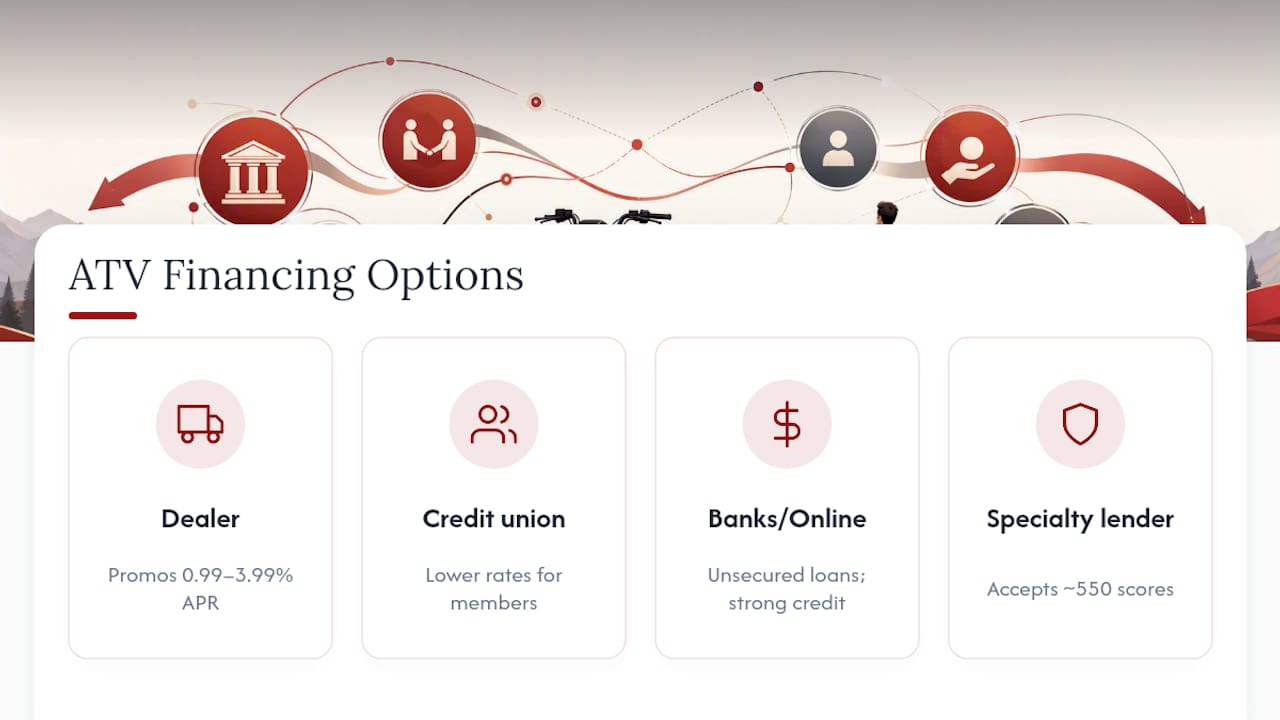
Dealership and manufacturer financing runs through the dealer’s finance desk, which submits your application to its lender network, including captive programs from brands like Polaris and Yamaha. The dealer handles the paperwork, and approval can happen the same day. The upside is access to manufacturer promotional APRs, some as low as 0.99% to 3.99% on select models. The catch: those rates almost always require excellent credit and a purchase during a limited promotional window.
Credit unions tend to undercut bank rates for members, particularly on new ATVs. You’ll need to join before applying, but that step often pays for itself in savings over the loan’s life. The NCUA oversees federal credit unions and is a solid starting point for finding one near you.
Banks and online personal loans work well for borrowers with strong credit who want an unsecured loan and don’t want the vehicle itself pledged as collateral.
Specialty powersports lenders fill the gap for subprime borrowers. Roadrunner Financial accepts scores as low as roughly 550 in some programs and offers soft-pull prequalification through dealer networks, often with instant decisions.
What APR and Loan Terms Should You Expect?
Rate spreads on ATV loans are wide, and credit score does most of the driving. Crediful’s 2026 data puts APRs at roughly mid-single digits for excellent-credit borrowers, climbing past 20% to 30% or more for subprime applicants. Term length is the other lever, and most lenders offer somewhere between 24 and 84 months.
Here’s how term length changes the math on a $7,500 ATV purchase:
- 36 months at 7% APR: about $232 a month, roughly $848 in total interest.
- 60 months at 9% APR: about $156 a month, roughly $1,845 in total interest.
- 84 months at 11% APR: about $128 a month, roughly $2,240 in total interest.
Shorter terms cost more per month but save real money over the life of the loan. A longer term can still make sense if it keeps the payment comfortably inside your budget, especially when you plan to keep the ATV for years rather than trade it in early.
How Do Lenders Decide ATV Credit Approval?
Lenders look at a handful of factors before they hand over the keys to a loan.
- Credit score and history. Most programs use FICO tiers, with subprime specialty lenders accepting scores near 550 and traditional lenders favoring 660 and above.
- Debt-to-income ratio. Lenders want to see your monthly obligations, including the new payment, stay within a manageable share of income.
- Income documentation. Pay stubs or bank statements confirm you can actually make the payment.
- Vehicle age and value. Many credit unions and banks set age limits on collateral, since older ATVs depreciate fast and secure less loan.
Prequalification uses a soft credit pull, so checking your likely rate with two or three lenders costs you nothing on your credit report. A formal application triggers a hard inquiry, which is why prequalifying first, then applying only where the numbers work, protects your score.
Pro Tip: Pull your credit report before you shop and dispute any errors immediately. A single incorrect late payment can knock 20 to 40 points off your score and push you into a worse rate tier.
Adding a co-signer, putting more money down, or choosing a secured loan (where the ATV itself backs the debt) can all move your approval odds and your rate in the right direction.
What Does an ATV Really Cost Beyond the Loan?
The loan payment is only part of the budget. Sales tax typically runs 6% to 9% depending on your state, and title and registration fees add more on top. Dealer fees vary by location and should always show up in writing before you sign.
Insurance is the cost buyers underestimate most. Annual premiums for ATV coverage vary by state and rider history, and many lenders require full-coverage insurance naming them as lienholder on the loan. Routine maintenance, oil changes, tires, and filters, adds a few hundred dollars a year on top.
Rolling taxes and fees into the loan is tempting, since it keeps cash in your pocket at signing. But it also pushes your loan-to-value ratio above 100%, raising both your APR and your risk of owing more than the ATV is worth. Rolling in modest fees on a short loan term is usually fine. Rolling in everything on an 84-month term is how negative equity happens.
How Do You Apply for ATV Financing Step by Step?
Getting from research to signed paperwork takes fewer steps than most buyers expect.
- Check your credit score so you know roughly which rate tier you’re in.
- Prequalify with at least two lender types, such as a credit union and a specialty powersports lender, using soft-pull applications.
- Run the numbers through a loan calculator at a few term lengths to see real monthly payments.
- Get written preapproval from your strongest offer before you visit a dealer.
- Bring that preapproval to the dealer and negotiate the vehicle price separately from any financing terms.
At the dealer, negotiate the ATV’s price first, before financing enters the conversation. Decline add-ons you didn’t ask for, and always ask for the rate in writing so you can confirm the dealer isn’t marking up a lender’s base rate for its own margin. Manufacturer promotional APRs tend to appear most often during spring model-year clearouts and end-of-season sales, so timing your purchase around those windows can save you real money if your credit qualifies.
Why Shop ATV Financing Through Gokartsusa?
Gokartsusa specializes in ATVs, mini ATVs, go-karts, and the accessories that come with them, and every product page includes the detail you need to make a confident call: specs, sizing, and safety features side by side.
We back that up with buyer resources, including an ATV buying checklist and a safety checklist for riders and parents, built to help you match the right machine to your budget and your family’s needs before financing enters the picture.
Financing is available at checkout on eligible ATVs and mini ATVs. If you’re not sure whether a specific model qualifies, our customer service team or the product page itself will tell you.
How Does Loan Term Affect ATV Resale or Refinance Later?
The length of your loan shapes your options long after you’ve ridden off the dealer lot.
A shorter term, say 36 months, builds equity fast. By the time you’re two years in, you likely owe less than the ATV is worth, which means you can sell or trade it without writing a check to cover the gap. That flexibility matters if your riding habits change or you decide to upgrade to a bigger machine sooner than planned.
Stretch that same loan to 72 or 84 months, and the math flips. ATVs depreciate steadily in the first few years, often faster than a long loan amortizes. That gap between what you owe and what the ATV is worth, negative equity, can trail you for years. Try to sell or trade in that window, and you’ll likely need to pay the difference out of pocket or roll it into your next loan, which just repeats the cycle.
Refinancing follows the same logic. Lenders want to see the loan balance below the ATV’s current value before they’ll offer a better rate. A long-term loan with heavy depreciation makes refinancing harder to justify, since there’s often little room to improve your terms until you’ve paid down more principal.
If you know you’ll want to upgrade or sell within a few years, lean toward the shortest term your monthly budget can handle. If you’re planning to keep the ATV long term, ride it into the ground, essentially, a longer term, slower equity build matters a lot less.
Should You Choose a Secured or Unsecured ATV Loan?
Most ATV loans are secured, meaning the vehicle itself backs the debt. If you stop paying, the lender can repossess the ATV to recover its loss. This structure is why secured loans usually carry lower APRs than unsecured options. The lender’s risk is lower, so the price you pay for the money is lower too.
Unsecured personal loans skip the collateral requirement entirely. Nothing gets repossessed if you fall behind, but that added risk to the lender shows up as a higher rate, and approval often demands stronger credit to offset it. Unsecured loans also tend to come with lower maximum amounts, which can be limiting if you’re financing a higher-end ATV.
Secured loans typically require full-coverage insurance naming the lender as lienholder, an extra cost and paperwork step that unsecured loans skip. That requirement matters when you’re budgeting total cost, since it’s not optional once the loan is signed.
For most buyers, a secured loan through a credit union, bank, or dealer network is the more practical route: lower rate, higher approval odds, and terms built specifically around powersports vehicles. Unsecured financing makes more sense if you want to avoid using the ATV as collateral entirely, or if you’re financing a smaller purchase where the rate gap matters less than the flexibility.
Seller’s Perspective: What We See Buyers Get Wrong
The two mistakes we see most: underbudgeting insurance and maintenance, and shopping for the ATV before checking financing. Fix the order. Prequalify first, then shop.
Pick the shortest loan term your monthly budget allows, and always confirm financing availability on the specific product page before you fall in love with a model.
— Mario
Financing an ATV Through Gokartsusa
Gokartsusa offers financing at checkout on eligible ATVs and mini ATVs, along with seasonal promotions that can lower your total cost beyond what a standalone lender might offer.
If you’re shopping for a family-friendly option, the Mini Sport Kids ATV with parental remote start shows financing availability right on the product page, no separate application detour required. Riders who want something built for trails rather than kids’ models can browse our powersports vehicle guide to compare specs before checking financing terms at checkout.
Pick your model, check the financing option on that product page, and apply directly at checkout. It’s the fastest way to find out exactly what you’ll pay before you commit.
Key Takeaways
The fastest route to ATV financing depends on your credit tier: prime borrowers should chase manufacturer or bank promos, while fair-to-poor credit borrowers do best starting with a credit union or specialty powersports lender.
| Point | Details |
|---|---|
| Prequalify before shopping | Use soft-pull prequalification with two lender types to compare rates without hurting your credit score. |
| Match lender to credit tier | Manufacturer promos suit excellent credit; credit unions and specialty lenders suit fair to subprime borrowers. |
| Shorter terms save money | A 36-month term on a $7,500 loan saves roughly $1,400 in interest versus an 84-month term. |
| Budget beyond the payment | Sales tax, insurance, and maintenance add real cost that should shape how much you borrow. |
| Gokartsusa offers checkout financing | Eligible ATVs and mini ATVs list financing availability directly on the product page. |
Authoritative Resources for ATV Loan Shoppers
For deeper context beyond this guide, a few sources are worth bookmarking.
- The NCUA explains credit-union oversight and how membership works before you apply.
- HUD’s fair housing and equal opportunity resources cover consumer protections relevant to lending practices.
- Crediful’s ATV loan guide tracks current APR ranges across banks, credit unions, and specialty lenders.