




Sometimes a mini bike earns street-legal status only when it clears three hurdles at once: it meets your state’s equipment standards, carries a valid VIN and title that lets you register it, and you’ve got the right license and insurance to ride it. There’s no national shortcut here. Your very next move should be checking your bike’s frame for a 17-digit VIN and looking up your own state DMV’s mini-motorcycle rules, because that single detail determines everything that follows.
- Check for a stamped VIN or Manufacturer’s Certificate of Origin before you do anything else
- Pull up your state DMV’s page on mini-motorcycles or “pocket bikes”
- Confirm whether your bike’s engine size and top speed classify it as a moped or a motorcycle in your state
Key Takeaways
A street legal mini bike requires matching equipment, valid VIN and title, proper registration, and adequate insurance, and skipping any one of these invites fines or impoundment.
| Point | Details |
|---|---|
| Three-part legal test | Equipment, title/VIN registration, and licensing/insurance all have to check out together. |
| States vary widely | Utah restricts sub-24-inch seat height bikes on public property; California adds CARB emissions requirements. |
| VIN issues cause delays | A missing VIN or title is the most common reason registration attempts stall for weeks or months. |
| Factory beats conversion | Purpose-built street models arrive with the paperwork and equipment already in place. |
| Gokartsusa offers a straighter path | Models like the gas-powered mini bike and 49cc V2 give buyers a documentation trail before they ever visit the DMV. |
Table of Contents
- What Makes a Mini Bike Street Legal?
- How Do State Rules Differ, and What Paperwork Do You Need?
- Equipment Checklist: What Your Mini Bike Needs Before Registration
- Buy Street-Ready or Convert? What You’re Actually Signing Up For
- What Will This Actually Cost, and How Long Will It Take?
- Legal and Safety Risks: What Happens If You Skip the Process
- Keeping Your Mini Bike Street Legal Year After Year
- Sources
What Makes a Mini Bike Street Legal?
Three requirements have to line up before you’re legally cruising the neighborhood. First, equipment compliance: headlights, mirrors, turn signals, DOT tires, and a horn that actually meets your state’s code. Second, documentation: a real VIN, a title, and successful registration. Third, the human side: a valid motorcycle or moped endorsement and proof of insurance.
Your engine’s displacement or top speed decides which bucket you land in. A 49cc machine capped under 30 mph often qualifies as a moped in many states, with lighter licensing rules, while anything bigger typically gets classified and regulated like a full motorcycle.
Here’s the number that trips people up: state DMVs, not federal agencies, write the actual rules you’ll follow. Washington sets safety manufacturing standards, but your state decides what’s registerable on its roads. DirtLegal’s guide to street-legal pit bikes breaks down how these rules shift from state to state, and the variation is bigger than most riders expect.
- Equipment that passes in Arizona might fail inspection in California
- A title that’s easy to get in Montana can be nearly impossible to secure in a stricter state.
- Insurance minimums vary enough to change your monthly cost by a meaningful margin
How Do State Rules Differ, and What Paperwork Do You Need?
Utah’s Department of Public Safety spells it out plainly: mini-motorcycles with a seat height under 24 inches can’t legally operate on public property unless they’re registered for highway use, and that registration demands proof of ownership plus the right state forms. It’s a useful reminder that “small bike” doesn’t mean “exempt bike.” Check the Utah mini-motorcycle guidance directly if you’re riding there.
California sits at the tougher end of the spectrum. CARB emissions compliance adds a layer most other states skip entirely, and getting a mini bike titled there is measurably harder than in states without that extra environmental hurdle.
Wherever you live, expect this general sequence:
- Verify or apply for a VIN through your state DMV
- Produce a title or Manufacturer’s Certificate of Origin
- Complete an emissions or safety inspection if your state requires one
- File the correct registration form (names vary by state)
- Show proof of liability insurance before plates get issued
Pro Tip: Call your local DMV office before you buy anything. A five-minute phone call can save you weeks of chasing paperwork for a bike that was never going to title cleanly.
Equipment Checklist: What Your Mini Bike Needs Before Registration
Most states expect the same core hardware before they’ll issue plates:
- DOT-approved headlight and taillight/brake light
- Working turn signals
- A horn
- Mirrors (usually two)
- DOT-rated tires
- A mounting spot for your license plate
- A functioning speedometer or odometer
California riders need to add CARB-compliant exhaust or emissions documentation to that list, and muffler noise limits get enforced more aggressively there than in most other states.
| Point | Details |
|---|---|
| VIN or title missing | This is the single most common reason registration attempts fail. |
| Off-road labeling | Many mini bikes ship marked “off-road use only,” meaning none of the equipment above is factory-installed. |
| Emissions gap | California specifically requires CARB documentation most other states don’t. |
Buy Street-Ready or Convert? What You’re Actually Signing Up For
Buying a purpose-built street machine and converting an off-road mini bike are two very different bets. Industry guidance from Bike EXIF’s mini motorcycle roundup consistently favors factory street-legal models like the Grom, Navi, and Z125 family precisely because the paperwork problem is already solved at the factory.
Factory-built advantages:
- Clean title and VIN from day one
- Emissions certification already in place
- Required equipment installed before it ever ships
Conversion downsides:
- Many off-road minis never had a VIN to begin with, and some states won’t assign one after the fact
- Emissions and inspection requirements can block registration outright, especially in California
- “Hidden” costs pile up fast once you add lighting, wiring, mirrors, and inspection fees
If you’re commuting or riding on public roads regularly, a street-ready model like Gokartsusa’s gas-powered mini bike removes most of that risk. If you only ever plan to ride on private property, a pit bike built for off-road use makes more sense and skips the paperwork entirely.
Pro Tip: If your goal is genuinely public-road riding, don’t gamble on a conversion. Buy the bike that already has the title chain intact.
What Will This Actually Cost, and How Long Will It Take?
Converting an off-road mini bike typically means paying for lighting kits, wiring, DOT tires, mirrors, and any inspection fees your state charges, on top of the bike itself. Buying factory street-ready often costs less overall once you consider parts and labor.
Liability insurance is required in most states before you can register at all, and coverage for small-displacement bikes tends to be affordable relative to standard motorcycle policies, though your exact premium depends on your state and driving record.
Timeline depends entirely on your paperwork situation:
- Fast path (a few weeks): Factory-titled bike, straightforward state, no inspection backlog
- Slow path (a few months): Missing VIN requiring state assignment, emissions testing required, or a state with a heavy DMV workload
Legal and Safety Risks: What Happens If You Skip the Process
Riding an unregistered mini bike on public streets isn’t a minor gamble. According to LegalClarity’s breakdown of neighborhood mini bike laws, most U.S. jurisdictions prohibit it outright, and violations commonly bring citations, impoundment, and even confiscation in some cities.
Insurance gaps compound the problem. Homeowners policies almost universally exclude motor vehicle liability, meaning an accident on an unregistered mini bike can leave you personally exposed for medical bills and property damage with no coverage backing you up.
- Citations for operating an unregistered or uninsured vehicle
- Impoundment, and in some jurisdictions, destruction of confiscated pocket bikes
- Zero insurance protection if someone gets hurt
Helmet laws vary by state, but riding without DOT-approved gear is a bad bet regardless of what your local statute technically requires.
Keeping Your Mini Bike Street Legal Year After Year
Getting your plates issued is the beginning of the responsibility, not the end of it. Registration renewals typically happen annually, and most states require your equipment to stay in working order the whole time, not just on inspection day.
Headlights and taillights burn out. Turn signal bulbs fail. DOT-rated tires wear down and eventually fall below legal tread depth, at which point you’re technically riding a non-compliant vehicle even though your registration sticker is current. Build a habit of checking these before every long ride, not just before your renewal date.
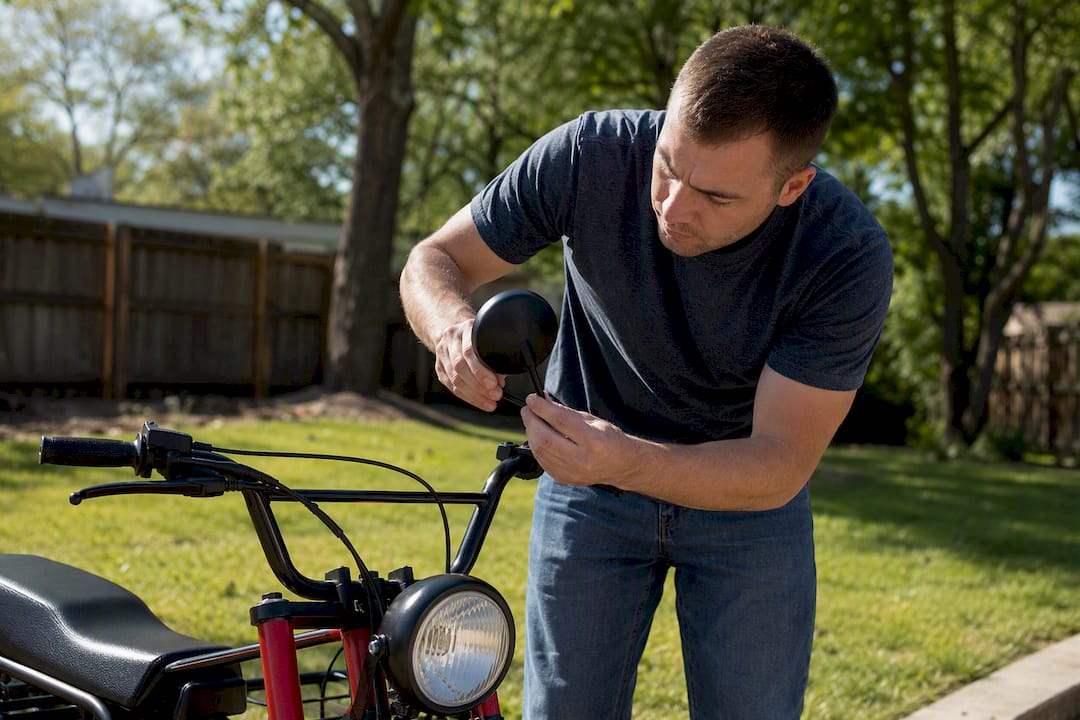
Mirrors loosen with vibration on smaller frames more than on full-size motorcycles, so recheck their mounting hardware regularly. If your state requires periodic emissions testing, California riders in particular, keep your muffler and exhaust system in its original CARB-compliant configuration. Swapping in an aftermarket exhaust for more noise or performance can knock your bike out of compliance and jeopardize your registration at the next renewal.
Keep your paperwork organized, too. Store your title, registration card, and insurance proof somewhere you can grab them fast, because a routine traffic stop without proof of any one of the three puts you right back in the legal gray zone you worked to get out of. Insurance lapses are the most common self-inflicted wound here: a missed payment doesn’t just cancel your coverage, it can flag your registration in some states. Set up autopay if your insurer offers it, and you’ll avoid the paperwork spiral entirely.
Our Take: Buy Smart Instead of Gambling on Conversion
The conventional wisdom on mini bikes treats the equipment checklist as the hard part. It isn’t. Bolting on a headlight and mirrors is a Saturday afternoon project. The paperwork is where riders actually get stuck, and it’s the part nobody warns you about until you’re three weeks into a VIN dispute with your state DMV.
Here’s what we think most buyers get wrong: they fall in love with a cheap off-road mini bike, plan to “make it legal later,” and only discover afterward that their state won’t assign a VIN to a bike that never had one. That’s not a hypothetical. It’s the single most common blocker riders run into, and it can add weeks or months to a timeline that should have taken days.
Our honest read is that if public roads are genuinely part of your plan, the smarter play is buying a machine with a clean paper trail from the start. You’re not just buying convenience. You’re buying certainty that your bike will actually pass registration in your state, on the first attempt, without a DMV clerk telling you no.
— Mario
Ready to Ride? Here’s Where Gokartsusa Fits In
Gokartsusa gives commuters and weekend riders a straighter shot at street-legal ownership than gambling on a stripped-down off-road conversion. Our gas-powered mini bike comes with the documentation trail that makes state registration far less of a fight, and our 49cc V2 model fits riders eyeing moped-class rules in their state.

Not sure which model fits your state’s requirements? Our team can walk you through equipment specs and point you toward the right paperwork questions to ask your local DMV before you buy. Browse our top mini bikes for adults or reach out to customer support with your VIN and title questions before you commit. Getting the right bike from the start beats untangling a conversion mess six months from now.
Sources
- Utah Department of Public Safety — Mini-Motorcycle guidance
- Are Pit Bikes Street Legal? What You Need to Know — DirtLegal
- Mini Motorcycle Guide: Street-Legal Mini Bikes for Adults | Bike EXIF
- Can I Ride My Mini Bike in My Neighborhood? Laws & Penalties - LegalClarity