




TL;DR:
- Most go-kart issues are caused by fuel, spark, or air system problems manageable by owners.
- Proper workspace, tools, and systematic troubleshooting steps are essential for safe and effective repairs.
- Regular safety checks and maintaining clean components help ensure reliable performance and riding safety.
There’s nothing quite like pulling the starter cord on your go-kart and hearing nothing but silence. Or worse, a rough sputter that fades into frustration. Whether your kart has been sitting in the garage all winter or it just started acting up mid-ride, mechanical hiccups are part of the powersports life. The good news? Most go-kart problems have straightforward causes and fixes that you can handle yourself. This guide walks you through everything from workspace prep to final safety checks, so you can get back to the thrill of the track with confidence and zero guesswork.
Table of Contents
- Tools and preparations before you troubleshoot
- Step-by-step troubleshooting: Engine won’t start
- How to address common running issues
- Verification and final safety checks
- A fresh perspective: Why mastering troubleshooting saves more than time
- Explore more go-kart options and gear
- Frequently asked questions
Key Takeaways
| Point | Details |
|---|---|
| Stale fuel is common | Old or untreated gas causes most start-up troubles after go-kart storage. |
| Systematic checks work best | Follow a step-by-step process for faster and more accurate troubleshooting. |
| Safety first | Always verify repairs with post-fix inspections before riding. |
| Simple tools suffice | You don’t need advanced gear—basic tools and methodical work fix most common issues. |
Tools and preparations before you troubleshoot
Once you recognize your go-kart needs attention, it’s crucial to get set up for safe and efficient troubleshooting. Rushing into a repair without the right tools is like heading onto a trail without a map. You’ll waste time, risk injury, and possibly make things worse.
Here’s what you’ll want to have on hand before you touch anything:
- Spark plug wrench (sized for your engine)
- Fuel container (clean and clearly labeled)
- Starting fluid (for cold-start testing)
- Carburetor cleaner spray
- Fresh engine oil (correct viscosity for your engine)
- Clean rags and a small parts tray
- Safety gloves and eye protection
- Basic socket set and screwdrivers
Your workspace matters just as much as your tools. Work on a flat, clean surface with good lighting. Keep a fire extinguisher nearby whenever fuel is involved. Ventilation is non-negotiable; gasoline fumes build fast in enclosed spaces.
If your kart has been in storage, pay close attention to the fuel system. Draining stale fuel and cleaning carburetor passages are key before restarting karts that have been sitting. Old gas breaks down into a sticky, varnish-like residue that clogs jets and passages in ways that aren’t always visible to the naked eye. Always use a fresh fuel stabilizer going forward to protect the system during off-season storage.
Familiarizing yourself with go-kart part basics before you start will also save you serious time. Knowing where the carburetor, fuel line, and ignition components sit on your specific model means fewer surprises mid-repair.
| Tool | Purpose |
|---|---|
| Spark plug wrench | Remove and inspect spark plug |
| Carburetor cleaner | Clear clogged jets and passages |
| Fuel container | Drain and replace stale fuel |
| Starting fluid | Test cold-start capability |
| Socket set | Remove covers and access engine |
Pro Tip: Use small labeled containers or a muffin tin to organize bolts and small parts as you remove them. A quick photo before disassembly saves enormous headaches when it’s time to put everything back together.
Step-by-step troubleshooting: Engine won’t start
With tools in hand and the kart safely secured, let’s systematically troubleshoot a go-kart that refuses to start. This is the most common complaint we hear, and in nearly every case, the fix is simpler than riders expect.
Follow these steps in order:
- Check the fuel level and quality. If fuel has been sitting for more than 30 days, drain it completely. Stale fuel is the single biggest reason stored karts won’t fire up.
- Drain and replace the fuel. Use a clean container to collect old gas. Refill with fresh, ethanol-free fuel if available.
- Inspect and clean the carburetor. Spray carburetor cleaner through all visible jets and passages. For karts sitting long, clean carburetor passages and replace oil as part of your restart checklist.
- Change the engine oil. Old oil thickens and can prevent smooth engine rotation. Fresh oil is cheap insurance.
- Examine the spark plug. Remove it with your spark plug wrench. Look for black carbon buildup (fouling), cracks, or a worn electrode. Replace if in doubt; plugs are inexpensive.
- Verify the engine isn’t seized. With the spark plug removed, try rotating the engine flywheel or pull cord slowly by hand. It should move with moderate resistance. If it’s locked solid, you may have a seized engine requiring deeper repair.
- Use the choke for cold starts. Engage the choke fully before your first start attempt. Once the engine fires, gradually open it as the engine warms.
- Test with starting fluid. If the engine still won’t catch, a small spray of starting fluid into the air filter intake can confirm whether the issue is fuel delivery. If it fires briefly with fluid, your carburetor or fuel line is the culprit.
Warning: Never ignore stale fuel. Old gas left in the system can corrode carburetor components and fuel lines, turning a simple fix into a costly repair. Always drain before storage.
Our engine starting tips cover additional nuances for specific engine types. And once you’ve gotten things running again, our post-repair checks guide will help you confirm everything is solid before hitting the track.
Pro Tip: Photograph every connection and component before you remove anything. Reassembly is far less stressful when you have a visual reference.
How to address common running issues
When your go-kart does fire up but performance isn’t right, use this guide to pinpoint running issues. A kart that starts but sputters, bogs down, backfires, or smokes is telling you something specific. Learning to read those symptoms is a real skill.
Here are the most common symptoms and what they usually mean:
- Rough idle or stalling: Dirty carburetor, air leak, or fouled spark plug
- Loss of power under load: Clogged fuel filter, weak spark, or restricted exhaust
- Backfiring: Lean fuel mixture, timing issue, or exhaust leak
- White or blue smoke: Oil burning in the combustion chamber, possible piston ring wear
- Black smoke: Rich fuel mixture, usually a carburetor jet issue
Exhaust smoke color is one of the fastest diagnostic tools you have. White smoke typically means water or oil is burning. Black smoke points to too much fuel. Blue smoke signals oil consumption. Each color tells a different story.
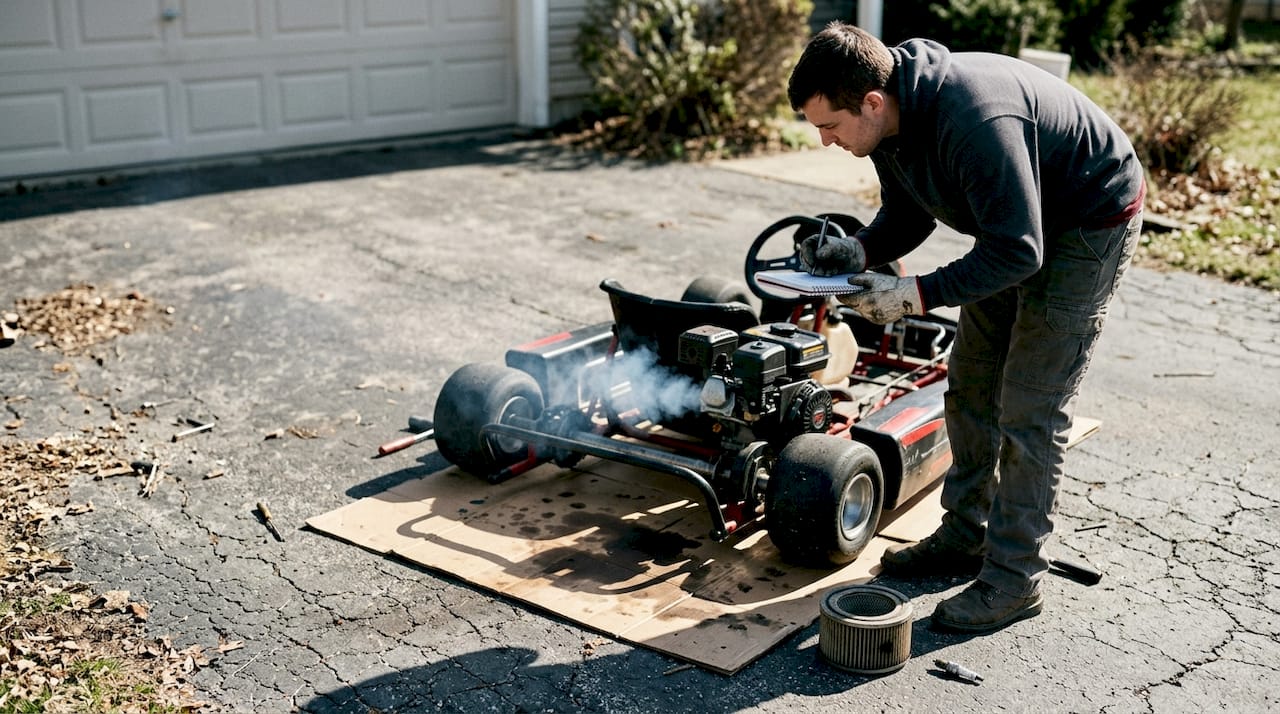
Clean carburetor passages and check for spark plug fouling for performance issues after storage. These two checks alone resolve the majority of running complaints we see from riders returning their karts to action after a break.
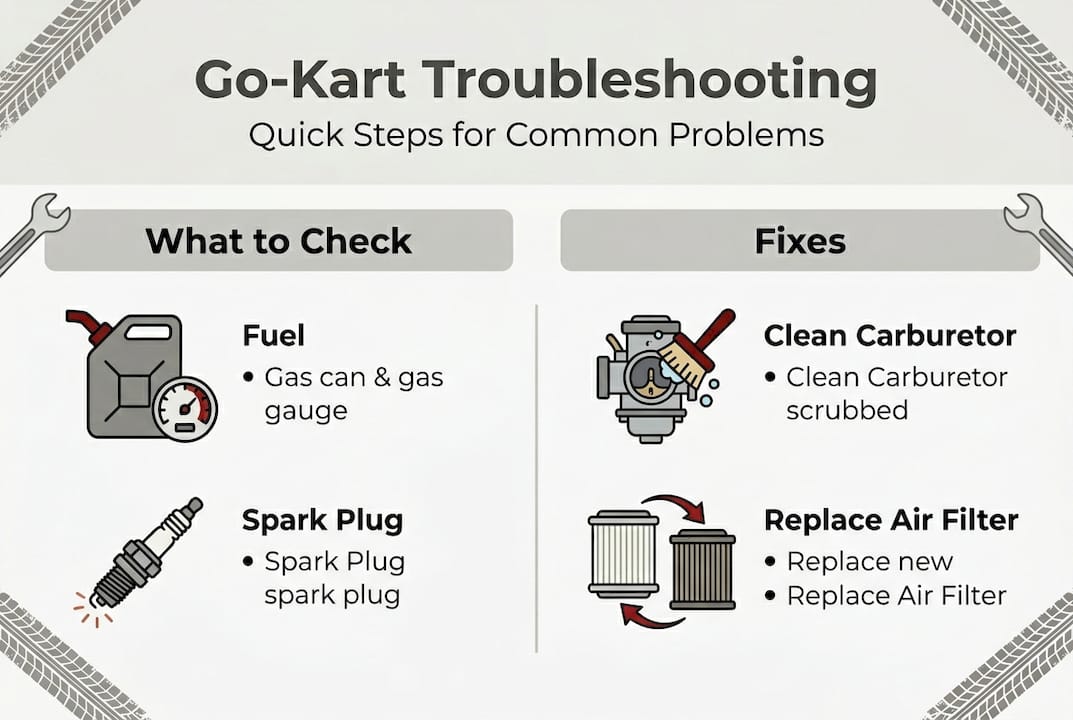
| Symptom | Likely Cause | Best Fix |
|---|---|---|
| Rough idle | Dirty carburetor | Clean jets and passages |
| Power loss | Clogged fuel filter | Replace fuel filter |
| Backfire | Lean mixture or exhaust leak | Adjust mixture, inspect exhaust |
| Black smoke | Rich fuel mixture | Clean or rejet carburetor |
| Blue/white smoke | Oil burning | Check piston rings, valve seals |
If you’re dealing with repeat issues, it may be time to look at performance upgrades that address root causes rather than symptoms. Riders chasing faster laps will also find value in our guide on improving race speed, which covers engine and drivetrain tuning in detail.
Don’t overlook the air filter either. A clogged air filter starves the engine of oxygen and mimics carburetor problems almost perfectly. Clean or replace it as part of every troubleshooting session.
Verification and final safety checks
Once you’ve made your repairs, it’s not enough to simply start the engine. Let’s make sure everything’s truly road-ready before you or anyone else climbs into the seat.
Follow these verification steps after every repair session:
- Restart the engine cold. A successful cold start confirms your fuel and ignition systems are working correctly together.
- Observe idle quality. Let the engine idle for two to three minutes. It should settle into a smooth, consistent rhythm without hunting or stalling.
- Test throttle response. Blip the throttle several times. Response should be immediate and clean, with no hesitation, stumbling, or delay.
- Check for leaks. Look under the kart for fuel, oil, or coolant drips. Even a small leak can become a serious hazard at speed.
- Listen for unusual sounds. Knocking, rattling, or hissing noises after a repair often signal something wasn’t reassembled correctly.
After the engine checks, move on to the physical safety inspection:
- Nuts and bolts: Check that all fasteners are tight, especially on the engine mounts, steering, and axle
- Brakes: Test both front and rear brakes for firm, consistent stopping power
- Tire pressure: Inflate to the manufacturer’s recommended PSI for balanced handling
- Throttle cable: Confirm it moves freely and returns to idle position when released
- Seat and harness: Make sure the seat is secure and any safety harness or belt is functional
Always verify the engine isn’t seized and visually inspect all critical areas after repairs before putting the kart back into service.
Safety reminder: Never operate your go-kart without all covers, guards, and safety shields in place. These components protect both the rider and bystanders from moving parts and heat.
If issues persist after your initial repair attempts, revisit the safety inspections checklist and consider whether a deeper mechanical issue such as compression loss or ignition timing may be at play.
A fresh perspective: Why mastering troubleshooting saves more than time
Here’s something the go-kart community doesn’t talk about enough: the real value of learning to troubleshoot your own kart isn’t just saving money on shop visits. It’s the confidence and connection you build with your machine.
We’ve seen it time and again. Riders who understand their kart at a mechanical level ride better, maintain better, and stay safer. They notice small changes before they become big problems. They don’t panic when something sounds off mid-ride.
The myth that only professional mechanics can fix go-karts holds a lot of riders back. In reality, the vast majority of issues, probably 80% or more, come down to fuel, spark, or air. Those are simple systems that any motivated owner can learn to manage.
Our community’s collective wisdom points to one consistent truth: a systematic approach beats guesswork every single time. And if you’re just getting started with hands-on maintenance, our guide on DIY go-kart assembly builds the foundational knowledge that makes troubleshooting feel natural.
Pro Tip: Keep a simple troubleshooting log. Note the date, symptom, cause, and fix for every issue you encounter. Over time, patterns emerge that give you powerful long-term insight into your kart’s health.
Explore more go-kart options and gear
Building troubleshooting confidence is one of the best things you can do as a go-kart owner. And once you’ve got your current kart running strong, you might find yourself ready to explore what’s next.

At GoKarts USA®, we carry a full lineup of karts and powersports vehicles built for riders of every level. Whether you’re shopping for a young rider just starting out with the Mini Sport Kids ATV, looking for serious off-road capability with the TrailMaster Panther 550 UTV, or want a performance-focused ride like the 200 XRX Deluxe Go Kart, we have options that match your adventure. Browse our catalog and let us help you fuel your next ride.
Frequently asked questions
What is the most common reason a go-kart won’t start after storage?
Stale fuel is the top culprit; always drain old gas and check for gummed carburetor passages before attempting to restart a kart that’s been sitting.
How can I quickly test if my go-kart’s engine is seized?
Remove the spark plug and try rotating the engine flywheel by hand; if it won’t move at all, the engine is likely seized and needs further inspection before any start attempt.
What are fast fixes for a go-kart sputtering or losing power?
Clean carburetor passages and check for spark plug fouling first, then confirm your fuel is fresh and the air filter is clear.
Is it safe to use starting fluid if my go-kart won’t start?
Yes, but use it sparingly and only after completing fuel and spark checks; overusing starting fluid, especially on a warm engine, can cause damage or a dangerous backfire.
Recommended
- Parts of a go-kart: maintain and customize with confidence – GoKarts USA®
- How to upgrade your go kart for better performance – GoKarts USA®
- How to improve go-kart performance for faster laps – GoKarts USA®
- How to Inspect a Go-Kart After the First Hour of Operation: Checking N – GoKarts USA®
- Car owner maintenance checklist: keep your car running smoothly