




You’ve been racing the same track for weeks, but your lap times refuse to budge. Your kart feels sluggish off the line, and competitors glide past you in the corners. The good news is that hidden performance potential exists in your machine. By systematically upgrading your engine, optimizing tire setup, and fine-tuning your chassis, you can unlock faster acceleration, sharper handling, and consistently quicker lap times. This guide walks you through proven modifications tailored for go-kart enthusiasts, novice racers, and parents seeking measurable improvements without guesswork.
Table of Contents
- Preparing Your Go-Kart For Performance Upgrades
- Engine Modifications To Enhance Power And Acceleration
- Optimizing Tires And Chassis For Better Handling And Control
- Maintenance And Tuning Best Practices To Sustain Performance Gains
- Explore High-Performance Go-Karts And Accessories At GoKarts USA®
- How To Improve Go-Kart Performance FAQ
Key takeaways
| Point | Details |
|---|---|
| Engine upgrades and tuning boost power | Carburetor adjustments and exhaust improvements increase acceleration and top speed. |
| Tire and chassis optimization improve handling | Correct tire pressure and chassis flex adjustments enhance cornering grip and stability. |
| Gear ratio tuning balances acceleration and speed | Adjusting sprockets trades quick starts for higher top speeds or vice versa. |
| Regular maintenance sustains performance gains | Consistent checks on jets, brakes, and tire wear prevent unexpected power loss. |
| Step-by-step modifications suit all skill levels | Beginners and experienced racers benefit from methodical, incremental upgrades. |
Preparing your go-kart for performance upgrades
Before diving into modifications, you need a solid baseline. Start by inspecting your kart’s overall condition. Check brake pads for wear, examine the frame for cracks or bends, and ensure steering components move smoothly without play. A compromised foundation undermines any upgrade you attempt.
Next, verify your tire pressure. Many beginners focus on tire pressure and racing line because these fundamentals directly impact grip and control. Use a quality pressure gauge to match manufacturer recommendations, typically between 10 and 14 psi for recreational karts. Incorrect pressure causes inconsistent handling and slower lap times.
Understanding your racing line also matters. The ideal line minimizes distance and maximizes exit speed through corners. Walk the track, identify braking zones, apex points, and acceleration zones. Visualizing the path helps you recognize where performance upgrades will deliver the biggest gains.
Gather essential tools before starting any work:
- Socket and wrench set for engine and chassis adjustments
- Tire pressure gauge for precise inflation checks
- Screwdrivers and Allen keys for carburetor and exhaust work
- Cleaning supplies to remove dirt and debris
- Notebook to log settings and results
A systematic prep routine creates a foundation for effective upgrades. The table below outlines key pre-upgrade checks and their impact on performance.
| Check Item | Purpose | Frequency |
|---|---|---|
| Brake pad thickness | Ensures safe stopping power | Before each session |
| Frame integrity | Prevents structural failure | Weekly |
| Tire pressure | Maintains consistent grip | Before every ride |
| Steering play | Improves precision | Weekly |
| Chain tension | Reduces power loss | Every 3 rides |
Pro Tip: Keep a logbook of your kart’s setup, including tire pressures, gear ratios, and weather conditions. This record helps you identify what works and replicate successful configurations. Refer to a beginner’s guide to go karting for foundational safety and setup principles.
Engine modifications to enhance power and acceleration
Engine tuning unlocks immediate performance gains. The carburetor controls the air-fuel mixture entering the combustion chamber. Carburetor tuning, air intake upgrades, exhaust systems, and gear ratio adjustments significantly boost power and acceleration. Start by adjusting the carburetor’s main jet and idle mixture screw. A richer mixture provides more fuel for power, while a leaner mixture improves efficiency. Experiment in small increments, testing each change on the track.
Upgrading the air intake system increases airflow to the engine. Replace the stock air filter with a high-flow option or install a performance intake manifold. More air allows the engine to burn fuel more completely, translating to stronger acceleration. Pair this with an aftermarket exhaust system that reduces backpressure. A free-flowing exhaust lets combustion gases exit faster, making room for fresh air-fuel mixture and improving overall power output.

Gear ratio adjustments balance acceleration against top speed. Swapping sprockets changes how engine RPM translates to wheel speed. A smaller drive sprocket or larger rear sprocket increases acceleration but lowers top speed. Conversely, a larger drive sprocket or smaller rear sprocket prioritizes top speed over quick starts. The comparison table below shows typical effects.
| Gear Ratio Setup | Acceleration | Top Speed | Best For |
|---|---|---|---|
| Small drive, large rear | High | Low | Tight, technical tracks |
| Balanced ratio | Moderate | Moderate | Mixed track layouts |
| Large drive, small rear | Low | High | Long straights, high-speed circuits |
Follow these steps for reliable engine upgrades:
- Remove the air filter cover and inspect the filter for dirt or damage.
- Replace or clean the filter, then reinstall securely.
- Locate the carburetor’s main jet and adjust it one size richer for initial testing.
- Test ride the kart, noting throttle response and any hesitation.
- Fine-tune the jet size based on performance, aiming for smooth power delivery.
- Install the performance exhaust, ensuring all mounting bolts are tight.
- Swap sprockets to match your track’s characteristics, then test and refine.
Pro Tip: Always make one change at a time and test thoroughly before adding another modification. This approach isolates the effect of each upgrade and prevents confusion. For additional setup insights, explore a mini bike setup guide or learn about go-kart acceleration mods for advanced techniques.
Optimizing tires and chassis for better handling and control
Power means nothing if you can’t put it to the ground effectively. Tire selection and pressure directly influence grip, cornering speed, and lap consistency. Soft compound tires offer maximum grip but wear quickly, while harder compounds last longer with slightly less traction. Match your tire choice to track conditions and racing frequency.
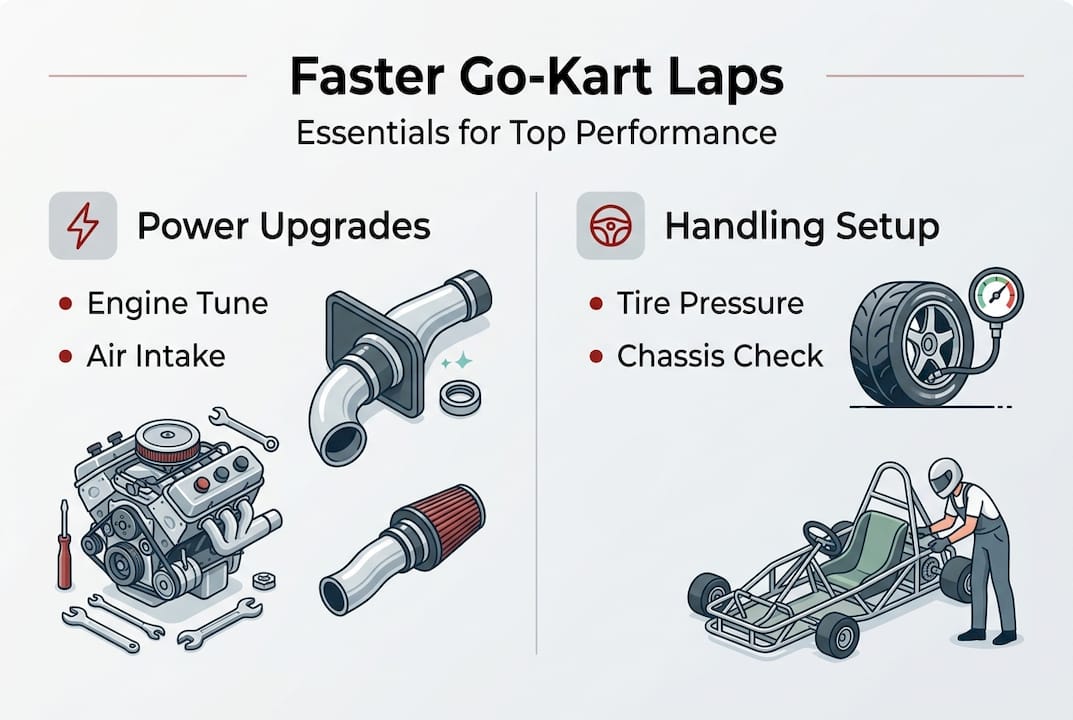
Maintaining correct tire pressure optimizes the contact patch between rubber and pavement. Under-inflated tires flex excessively, causing sluggish turn-in and unpredictable handling. Over-inflated tires reduce the contact patch, leading to less grip and harsher rides. Check pressure before every session and adjust based on temperature changes. The data table below illustrates typical pressure effects.
| Tire Pressure (psi) | Grip Level | Lap Time Impact | Tire Wear |
|---|---|---|---|
| 8-10 | High | Faster in corners | Rapid |
| 10-12 | Optimal | Balanced performance | Moderate |
| 12-14 | Moderate | Faster on straights | Slow |
| 14+ | Low | Slower overall | Very slow |
Chassis setup also plays a critical role. Experts fine-tune chassis flex and carb jetting for track-specific conditions, prioritizing consistency over peak speed. A stiffer chassis responds quickly to steering inputs, ideal for smooth tracks. A more flexible chassis absorbs bumps and maintains tire contact on rough surfaces. Adjust stiffness by changing seat position, adding or removing chassis stiffeners, or altering axle width.
Consider these handling optimization tips:
- Experiment with front and rear tire pressures independently to balance understeer and oversteer.
- Move the seat forward to increase front grip and reduce understeer.
- Widen the rear axle for more stability in high-speed corners.
- Narrow the rear axle for quicker turn-in on tight tracks.
- Test different tire compounds to find the best match for your local track surface.
Consistent handling leads to faster, more controlled laps. Fine-tuning tailored to your track improves performance steadily. For comprehensive tire care, review go-kart tire maintenance practices. Parents seeking safe options for young drivers should consult a kids go-kart safety guide to balance performance with protection.
Maintenance and tuning best practices to sustain performance gains
Upgrades only deliver results if you maintain them properly. Regular checks prevent small issues from becoming major failures. Start with the carburetor. Jets can clog with dirt or debris, disrupting the air-fuel mixture. Remove and clean jets every few rides, especially after dusty track sessions. Inspect the carburetor gaskets for leaks and replace them if they show wear.
Tire wear impacts grip and handling consistency. Rotate tires regularly to ensure even wear across all four corners. Replace tires when tread depth drops below safe levels or when sidewalls show cracks. Worn tires compromise lap times and increase the risk of blowouts during aggressive cornering.
Brake function is non-negotiable for safety and performance. Check brake pads for thickness and replace them before they wear down to the backing plate. Inspect brake lines for leaks or damage, and bleed the system if the pedal feels spongy. Reliable brakes let you brake later into corners, shaving precious tenths off your lap times.
Keep the engine and chassis clean. Dirt and debris accumulate quickly, especially around the engine cooling fins and chain. Use compressed air or a soft brush to remove buildup. A clean engine runs cooler and more efficiently, while a clean chassis prevents corrosion and maintains structural integrity.
Tune carburetor jets for track conditions and temperature. Hotter weather requires leaner jetting to prevent rich running, while cooler conditions may need richer jetting for optimal power. Track your settings in your logbook and adjust as needed. Watch for early warning signs like inconsistent handling, sudden power loss, or unusual engine sounds. Address these immediately to prevent bigger problems.
Proper maintenance and tuning maintain consistency and prevent unexpected failures. Follow these maintenance habits:
- Inspect chain tension and lubrication every three rides.
- Check engine oil level and quality before each session.
- Tighten all bolts and fasteners weekly to prevent loosening from vibration.
- Clean or replace the air filter after every dusty track day.
- Store the kart in a dry, covered area to prevent rust and weather damage.
Pro Tip: Keep a maintenance log with dates, tasks completed, and parts replaced. This record helps you anticipate when components need attention and ensures nothing gets overlooked. Schedule tune-ups at regular intervals, not just when problems arise. For additional safety and maintenance tips, explore go-kart safety accessories that enhance both performance and protection.
Consistent maintenance transforms occasional speed into reliable performance. The fastest kart on the track is the one that finishes every lap without issue.
Explore high-performance go-karts and accessories at GoKarts USA®
Now that you understand how to unlock your kart’s potential, it’s time to explore quality equipment designed for performance and reliability. GoKarts USA® offers a wide selection of go-karts, mini bikes, and ATVs built for enthusiasts at every skill level. Whether you’re upgrading an existing kart or starting fresh, you’ll find models optimized for speed, handling, and safety.

Choose from beginner-friendly options like the mini sport kids ATV 110 gas engine for young drivers building confidence, or step up to powerful models such as the trailmaster storm minibike for experienced riders seeking thrilling performance. Expert support is available to help with upgrades, maintenance questions, and selecting the right accessories to complement your setup. Visit the GoKarts USA homepage to explore the full catalog and take the next step toward faster lap times.
How to improve go-kart performance FAQ
What is the easiest way to improve go-kart speed?
Carburetor tuning and gear ratio adjustments offer the quickest speed gains. Adjusting the main jet enriches the air-fuel mixture for better combustion, while swapping sprockets optimizes acceleration or top speed based on track layout. These changes require basic tools and deliver noticeable results immediately.
How often should I check tire pressure for go-kart performance?
Check tire pressure before every ride for optimal grip and handling. Temperature changes and track conditions affect pressure, so consistent monitoring ensures your kart performs predictably. Maintaining the correct range prevents inconsistent lap times and premature tire wear.
Can upgrading the exhaust system really boost my kart’s power?
Yes, a performance exhaust increases airflow efficiency by reducing backpressure. This allows combustion gases to exit faster, making room for fresh air-fuel mixture and improving overall power output. Pairing an upgraded exhaust with a high-flow air filter maximizes the benefit.
What common mistakes to avoid when tuning a go-kart?
Over-tightening bolts can strip threads or crack components, while neglecting safety checks like brake function and frame integrity creates dangerous situations. Making multiple changes at once prevents you from identifying which modification caused performance shifts. Always adjust one variable at a time and test thoroughly.
Is professional tuning necessary for beginners?
Not always, but expert advice helps maximize results and avoid costly mistakes. Beginners can achieve significant improvements with basic carburetor adjustments, tire pressure optimization, and proper maintenance. As you gain experience, professional tuning becomes valuable for squeezing out the last few tenths in competitive settings. For foundational guidance, consult a go-kart tires guide to understand how tire selection and care impact overall performance.