




Many recreational enthusiasts assume go-karts are simple machines with few moving parts, but the reality involves a sophisticated assembly of structural, powertrain, steering, and wheel components that demand regular attention. Understanding these essential parts transforms routine upkeep from guesswork into confident maintenance and opens doors for meaningful customization. This guide breaks down the critical components that form a go-kart’s foundation, explaining how each system works together to deliver safe, responsive performance on the track or trail.
Table of Contents
- Key takeaways
- Understanding the go-kart frame and structural parts
- Key powertrain components and their role in performance
- Steering system and wheels: precision for handling and safety
- Maintenance essentials and customization tips for enthusiasts
- Explore quality go-kart parts and models at GoKarts USA®
- Frequently asked questions
Key Takeaways
| Point | Details |
|---|---|
| Frame materials and welding | Mild steel frames are beginner friendly with easier welding, while chromoly offers greater strength and lighter weight but requires TIG welding. |
| Frame geometry effects | Frame geometry influences handling by changing stability and maneuverability, with a wider stance increasing stability and wheelbase length affecting weight transfer. |
| Powertrain options | Most recreational go karts use four stroke gasoline engines rated from 6.5 to 9.5 horsepower, with common models including Honda GX series and Predator 212cc. |
| Clutch and drive system | The centrifugal clutch automatically engages as engine RPM increases, and torque converter solutions like the Comet TAV2 are popular for recreational use. |
Understanding the go-kart frame and structural parts
The frame serves as your go-kart’s skeleton, bearing all loads from the driver, engine, and road forces. Most recreational frames use steel tubing with diameters between 1 and 1.75 inches, with wall thickness ranging from 0.065 to 0.120 inches depending on intended use. This tubular construction provides excellent strength-to-weight ratios while allowing for straightforward repairs and modifications.
Two primary materials dominate go-kart frame construction, each with distinct advantages. Mild steel like A36 or 1018 offers easier welding and lower material costs, making it ideal for beginners tackling their first build. The forgiving nature of mild steel allows standard MIG welding equipment to produce strong joints without specialized skills. Chromoly 4130 steel presents a compelling alternative for performance-focused builders, delivering approximately 25-30% weight savings and tensile strength around 90,000 PSI compared to mild steel’s 60,000 PSI. However, chromoly demands TIG welding expertise and proper heat treatment to avoid brittleness at weld joints.
Essential structural components extend beyond the main chassis tubes. The floor pan distributes driver weight and protects from debris, while front and rear bumpers absorb impacts during racing contact or trail obstacles. Seat frames must be positioned to balance weight distribution, typically placing the driver’s center of gravity slightly forward of the rear axle. Roll cages add crucial protection for off-road or competitive applications, though they increase overall weight and complexity.
Pro Tip: Beginners should start with mild steel frames to build welding confidence and mechanical understanding before attempting chromoly construction. The cost difference becomes negligible if improper chromoly welding requires professional repair.
Frame geometry directly influences handling characteristics. A wider stance improves stability but reduces maneuverability in tight spaces, while wheelbase length affects weight transfer during acceleration and braking. When assembling a go-kart frame for younger drivers, shorter wheelbases and lower seat heights enhance control and confidence. Experienced builders often reference detailed plans when building a go-kart frame to ensure proper dimensions and structural integrity.
| Material Property | Mild Steel | Chromoly 4130 |
|---|---|---|
| Tensile Strength | 60,000 PSI | 90,000 PSI |
| Weight Comparison | Baseline | 25-30% lighter |
| Welding Method | MIG or stick | TIG required |
| Cost Factor | Lower | 2-3x higher |
| Beginner Friendly | Yes | No |
With a solid understanding of the frame, next we cover the powertrain components vital for movement and speed.
Key powertrain components and their role in performance
The powertrain transforms fuel into forward motion through a carefully coordinated system of mechanical components. Engine selection forms the foundation of this system, with most recreational go-karts utilizing four-stroke gasoline engines ranging from 6.5 to 9.5 horsepower. Popular models include Honda GX140 through GX270 and the budget-friendly Predator 212cc, each offering reliable performance with readily available replacement parts. The Predator 212cc has become particularly popular among hobbyists due to its modification potential and price point under $150.
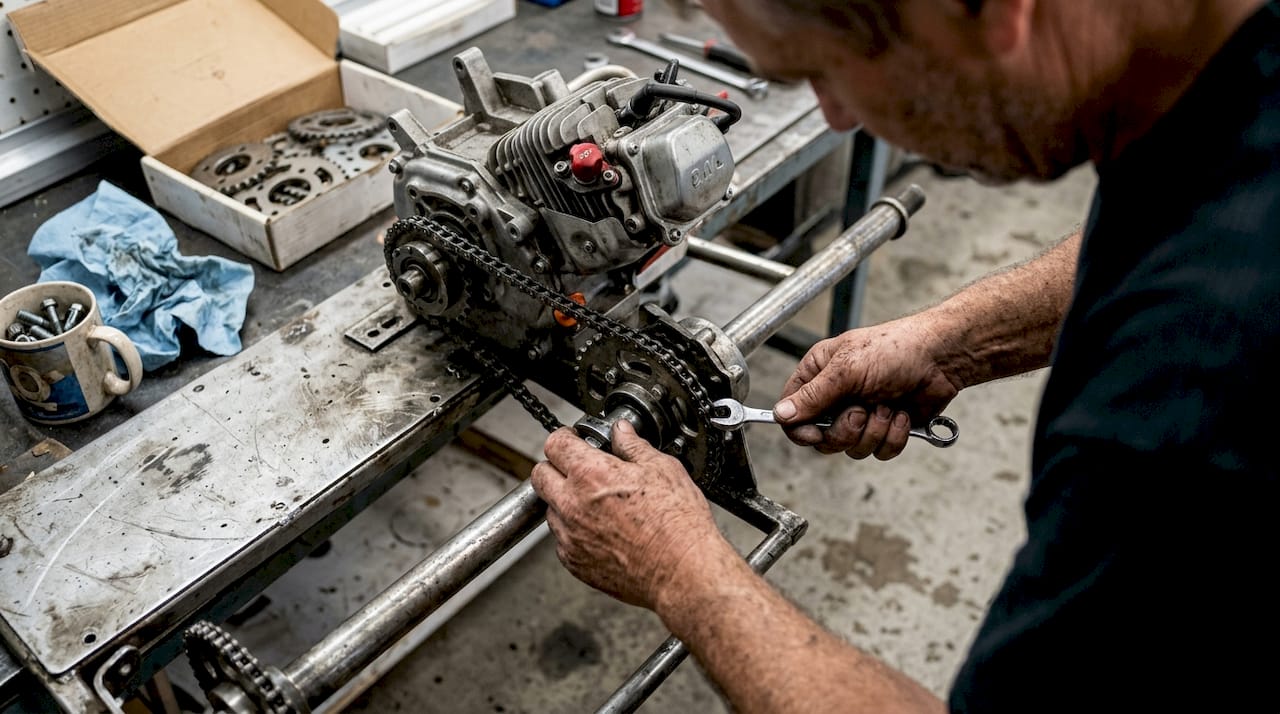
Power transmission begins at the centrifugal clutch, which automatically engages as engine RPM increases. The Comet TAV2 represents the gold standard for recreational applications, featuring a torque converter design that provides smooth acceleration from a standstill. This clutch mounts directly to the engine crankshaft and drives the primary chain, which connects to the rear axle sprocket. Chain selection matters significantly, with #40 chain suitable for engines up to 8 HP and #428 chain recommended for more powerful setups exceeding 10 HP.
Sprocket ratios determine your go-kart’s performance characteristics more than any other single factor. A typical setup pairs a 10-tooth clutch sprocket with a 42 to 54-tooth rear axle sprocket, creating gear ratios near 6:1 that balance acceleration with top speed when running 15-inch diameter tires. Lower ratios like 4:1 prioritize top speed but sacrifice low-end torque, while higher ratios around 8:1 deliver aggressive acceleration at the expense of maximum velocity. Changing sprockets takes minimal time and allows you to tune performance for specific tracks or terrain.
Pro Tip: Chain slack between 1/4 and 3/8 inch prevents premature wear and power loss. Excessive slack beyond 1/2 inch causes violent slapping that damages sprocket teeth and can lead to catastrophic chain failure during operation.
The rear axle assembly completes the powertrain, transferring power to both rear wheels simultaneously. Solid axles provide durability and simplicity, though they can cause inside wheel hop during tight corners. Live axles with a differential allow independent wheel rotation for smoother cornering but add complexity and weight. Axle diameter typically measures 1 inch for recreational karts and 1.25 inches for racing applications, with larger diameters resisting flex under hard acceleration.
| Engine Model | Horsepower | Displacement | Recommended Sprocket Ratio | Typical Use |
|---|---|---|---|---|
| Honda GX160 | 5.5 HP | 163cc | 5:1 to 6:1 | Youth/recreational |
| Predator 212 | 6.5 HP | 212cc | 6:1 to 7:1 | Adult recreational |
| Honda GX270 | 9 HP | 270cc | 5:1 to 6:1 | Racing/performance |
Understanding go-kart powertrain types helps match components to your intended use and skill level.
After powertrain details, we will look at the steering system to understand how to control the kart precisely.
Steering system and wheels: precision for handling and safety
Steering precision separates enjoyable go-karting from frustrating experiences filled with understeer and unpredictable handling. The steering assembly begins with the steering wheel connected to a shaft that rotates the steering column, which links to tie rods measuring 10 to 14 inches in length. These tie rods connect to spindles mounted on 5/8-inch diameter spindle shafts that allow the front wheels to pivot for directional control. Quality tie rod ends with grease fittings ensure smooth operation and extended service life.
Front-end alignment parameters dramatically affect how your go-kart responds to steering inputs. Toe settings control whether front wheels point slightly inward or outward when viewed from above, with toe-out of 1 to 2mm per side improving initial turn-in response. Excessive toe-out causes darty, nervous steering, while toe-in creates sluggish response and tire scrubbing. Caster angle refers to the forward or rearward tilt of the spindle axis, with approximately 6 degrees of positive caster providing self-centering action and stability at speed. Camber adjustments tilt the wheels inward or outward at the top, though most recreational karts run zero to slightly negative camber for even tire wear.
Pro Tip: Proper toe and caster alignment prevents understeer in corners and reduces physical steering effort, making longer sessions less fatiguing while improving safety through predictable handling characteristics.
Wheel hubs differ between front and rear applications due to varying load requirements. Front hubs accommodate 5/8-inch bearings while rear hubs use larger 1.25-inch bearings to handle engine torque and cornering forces. This size difference prevents premature bearing failure and maintains proper wheel alignment under stress. Hub length affects track width, with longer hubs increasing stability but reducing agility in technical sections.
Tire selection and maintenance directly impact safety and performance. Most recreational go-karts run 4.1/3.5-5 sized tires with maximum inflation pressures between 25 and 28 PSI, though actual pressure should be adjusted based on driver weight and track conditions. Lower pressures increase grip on loose surfaces but risk pinch flats and rim damage, while higher pressures reduce rolling resistance on smooth pavement. Rotating tires every 15 to 20 hours of operation promotes even wear and extends service life.
| Alignment Parameter | Recommended Setting | Effect on Handling |
|---|---|---|
| Toe | 1-2mm out per side | Improves turn-in response |
| Caster | 6 degrees positive | Adds stability and self-centering |
| Camber | 0 to -1 degree | Optimizes tire contact patch |
Checking and adjusting front-end alignment:
- Park the go-kart on level ground with wheels pointed straight ahead
- Measure the distance between front tire edges at hub height, front and rear
- Adjust tie rod length until rear measurement exceeds front by 2 to 4mm total
- Verify caster angle using a digital angle gauge on the spindle shaft
- Test drive and fine-tune based on steering feel and tire wear patterns
Mastering go-kart tire maintenance and understanding go-kart steering basics builds the foundation for confident operation.
With steering and wheels covered, next we explore recommended maintenance practices for lasting performance and safety.
Maintenance essentials and customization tips for enthusiasts
Consistent maintenance separates reliable go-karts from those plagued by breakdowns and safety issues. Tires and wheels require inspection every 8 operating hours to check for uneven wear, proper inflation, and loose lug nuts. Chain maintenance follows the same 8-hour interval, involving cleaning, lubrication, and tension adjustment to prevent the destructive slack that causes premature sprocket wear. Engine oil changes every 10 to 15 hours maintain proper lubrication and prevent costly internal damage, while monthly frame inspections catch stress cracks before they compromise structural integrity.
Pro Tip: Never allow chain slack to exceed 1/2 inch measured at the midpoint between sprockets. This seemingly minor oversight causes violent chain whip that can shear sprocket teeth or break the chain entirely during hard acceleration.
Maintenance schedule by component:
- Every 8 hours: inspect tires, check chain tension and lubrication, verify all fasteners
- Every 10-15 hours: change engine oil and check air filter cleanliness
- Every 20 hours: rotate tires, inspect brake pads if equipped, grease steering components
- Monthly: examine frame welds for cracks, test steering alignment, verify seat mounting security
- Seasonally: perform complete disassembly inspection, replace worn bearings, check clutch condition
Customization opportunities abound once you master basic maintenance. Upgrading to a live axle with differential dramatically improves cornering performance by eliminating inside wheel hop, though installation requires frame modifications and adds approximately 15 pounds. Disc brake conversions provide superior stopping power compared to band brakes, particularly important for heavier adult drivers or hilly terrain. Electric motor swaps using systems like the QS138 72V motor producing 34 horsepower transform traditional gas karts into silent, high-torque machines with instant throttle response.
Off-road enthusiasts should consider chassis reinforcement before tackling aggressive terrain. Additional cross bracing between main frame rails prevents flex that leads to stress cracks, while skid plates protect the engine and axle from rock strikes. Suspension upgrades using coilover shocks absorb impacts that would otherwise transfer directly to the frame and driver, though they add complexity and maintenance requirements.
Common maintenance pitfalls to avoid:
- Over-tightening chain tension, which accelerates bearing wear and increases rolling resistance
- Ignoring small frame cracks that propagate into major structural failures
- Using incorrect oil viscosity, particularly in extreme temperatures
- Neglecting to check spindle nut torque, allowing wheels to develop dangerous play
- Mixing chain and sprocket brands with incompatible pitch specifications
Exploring go-kart accessories for 2026 reveals additional upgrades that enhance safety and enjoyment without requiring major mechanical modifications.
Having covered maintenance and upgrades, we now present a brief promo to connect readers to quality go-kart products and resources.
Explore quality go-kart parts and models at GoKarts USA®
Understanding go-kart components becomes more valuable when you have access to quality products that match your maintenance and customization needs. GoKarts USA offers an extensive selection of go-karts, minibikes, and ATVs designed for recreational enthusiasts at every skill level. Whether you need a gas-powered kids ATV with remote start features for young drivers or a powerful TrailMaster Storm minibike for adult adventures, the product lineup emphasizes safety features and reliable performance.

Key advantages of shopping with GoKarts USA:
- Comprehensive selection of powersports vehicles for all ages and experience levels
- Detailed product specifications and color options to inform purchasing decisions
- Seasonal promotions including free shipping and complimentary safety accessories
- Responsive customer support to answer technical questions about maintenance and parts compatibility
Browse the complete catalog at GoKarts USA to find components and complete vehicles that align with your customization projects and recreational goals.
From understanding parts and care to browsing trusted products, let’s finalize with answers to common go-kart questions.
Frequently asked questions
What materials are best for a beginner’s go-kart frame?
Mild steel grades like A36 or 1018 are ideal for beginners because they weld easily with standard MIG equipment and cost significantly less than performance alloys. This material provides adequate strength for recreational use while allowing you to develop fabrication skills without expensive mistakes. Chromoly 4130 offers superior strength and weight savings but demands TIG welding expertise that most novice builders lack.
How often should I maintain the go-kart chain and tires?
Both chains and tires require inspection every 8 operating hours to ensure safe, reliable performance. Chain maintenance involves checking tension, cleaning away debris, and applying appropriate lubricant to prevent premature wear. Tire inspections focus on inflation pressure, tread depth, and unusual wear patterns that indicate alignment problems requiring immediate correction.
What steering adjustments improve handling the most?
Toe-out settings between 1 and 2mm per side combined with approximately 6 degrees of positive caster deliver the most noticeable handling improvements for recreational karts. These adjustments create responsive turn-in characteristics while maintaining straight-line stability at higher speeds. Proper alignment also reduces tire scrubbing that wastes power and accelerates tread wear, making the investment in alignment tools worthwhile for serious enthusiasts.
What upgrades can enhance my go-kart’s performance safely?
Live axle conversions, disc brake systems, and electric motor swaps like the QS138 72V unit producing 34 horsepower represent substantial performance improvements when installed correctly. Each upgrade must maintain proper chain tension and overall weight distribution to avoid introducing new safety hazards. Always verify that frame strength and braking capacity match increased power levels before attempting high-performance modifications that exceed original design specifications.