




TL;DR:
- A four-stroke engine produces power through four synchronized piston strokes—intake, compression, power, and exhaust—over two crankshaft revolutions, resulting in smooth and reliable operation. It uses a separate oil lubrication system that enhances durability and reduces emissions, making it ideal for applications like lawn mowers, go-karts, and motorcycles. Understanding each stroke and component aids in proper maintenance, troubleshooting, and efficient engine performance.
A four-stroke engine is an internal combustion engine that produces power through four distinct piston strokes: intake, compression, power, and exhaust. Each complete cycle spans two crankshaft revolutions, covering 720 degrees of rotation, with useful work delivered only during the power stroke. That single fact explains why four-stroke engines feel smooth and reliable compared to their two-stroke counterparts. You find them everywhere from lawn mowers and generators to go-karts and motorcycles, and understanding how they work gives you a real advantage whether you are studying engines, planning a build, or maintaining your own powersports vehicle.
What is a four-stroke engine cycle?
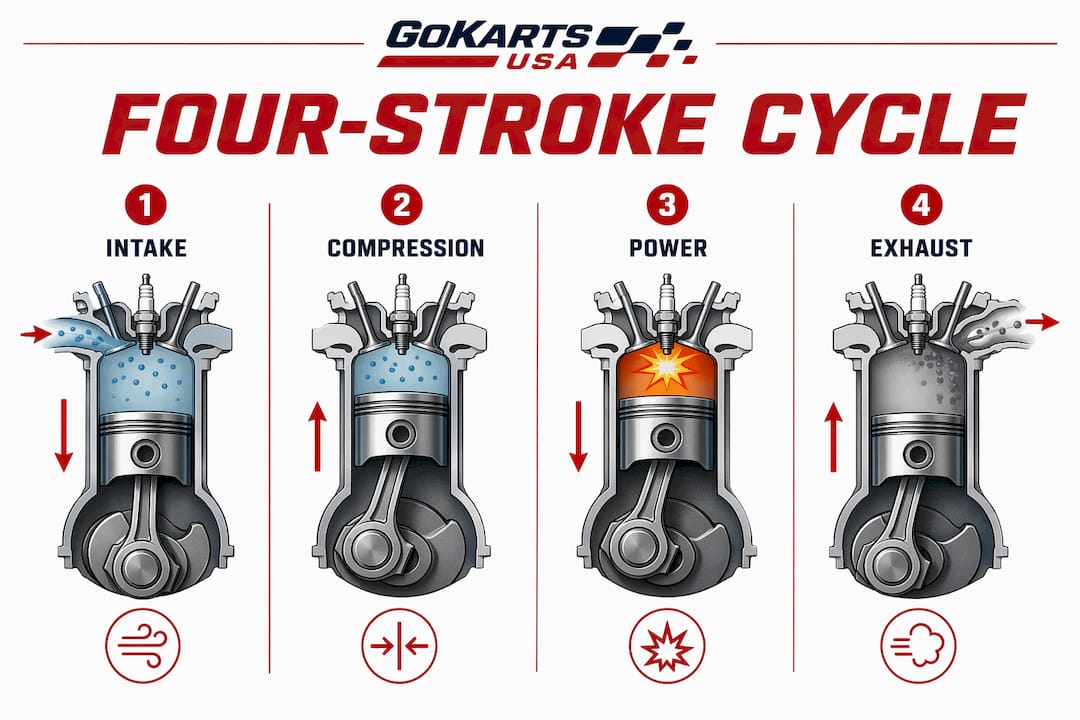
The four-stroke engine cycle is the sequence of events that converts fuel into motion. Each stroke corresponds to one full travel of the piston, either downward or upward inside the cylinder. Knowing what happens at each stage makes every maintenance decision and repair choice far more logical.
Stroke 1: intake
The cycle begins with the intake stroke. The piston moves down from top dead center (TDC) toward bottom dead center (BDC), and the intake valve opens. Atmospheric pressure pushes an air-fuel mixture into the cylinder through the carburetor or fuel injector. The exhaust valve stays closed throughout this stroke, keeping the combustion chamber sealed on one side.
Stroke 2: compression
Once the piston reaches BDC and starts moving back up, the intake valve closes. Both valves are now shut, and the piston compresses the mixture between itself and the cylinder head. Pressure and temperature rise sharply during this stroke. Higher compression ratios produce more energy during ignition, which is why performance engines are often built with tighter compression specs.
Stroke 3: power
Just before the piston reaches TDC on the compression stroke, the spark plug fires. The ignited mixture expands rapidly, and expanding gases drive the piston back down toward BDC with significant force. This is the only stroke that produces mechanical work. Every other stroke exists to set up this moment or clean up after it.
Stroke 4: exhaust
With the piston at BDC after the power stroke, the exhaust valve opens and the piston travels back up toward TDC. This upward movement pushes spent gases out through the exhaust port and into the exhaust system. Once the piston reaches TDC again, the exhaust valve closes, the intake valve opens, and the entire sequence restarts.
Pro Tip: Anchor your mental picture of each stroke to TDC and BDC. If you know where the piston is at the start and end of each stroke, valve timing and ignition timing become much easier to understand during diagnostics or tuning.
The numbered sequence matters because it is easy to lose track of which stroke is which when you are working on an engine for the first time. Here is the order in plain terms:
- Intake: piston down, intake valve open, mixture enters
- Compression: piston up, both valves closed, mixture compressed
- Power: spark fires, piston driven down, work produced
- Exhaust: piston up, exhaust valve open, gases expelled
How does a four-stroke engine compare to a two-stroke?
The most direct answer: a two-stroke engine fires once per crankshaft revolution, while a four-stroke fires every two revolutions. That difference shapes everything from power delivery to maintenance schedules and emissions output.
Two-stroke engines feel punchy and lightweight because they produce a power stroke on every revolution. Four-stroke engines feel smoother and more consistent because the power pulses are spaced further apart and the flywheel carries momentum through the non-power strokes. For recreational and personal-use applications, that smoothness translates directly into reliability and a more predictable ride.
Lubrication is the other major mechanical divide. Four-stroke engines use a separate oil lubrication system with an oil sump, distributed by splash or pump. Two-stroke engines mix oil directly into the fuel, which means the oil burns during combustion. The four-stroke approach keeps oil out of the combustion chamber, reducing emissions and extending engine life. It also means you maintain oil separately from fuel, which is a straightforward habit once you get used to it.
Four-stroke engines generally offer better emissions control and fuel economy than two-stroke engines, despite producing fewer power strokes per revolution. That efficiency advantage is why most modern lawn equipment, go-karts, and ATVs have moved to four-stroke designs.
| Feature | Four-stroke engine | Two-stroke engine |
|---|---|---|
| Power stroke frequency | Every 2 crankshaft revolutions | Every 1 crankshaft revolution |
| Lubrication | Separate oil sump | Oil mixed into fuel |
| Emissions | Lower | Higher |
| Fuel efficiency | Better | Lower |
| Typical applications | Go-karts, lawn mowers, motorcycles, ATVs | Chainsaws, dirt bikes, older outboards |
| Maintenance complexity | Oil changes required separately | Simpler, but oil ratio must be precise |
Two-stroke engines still have their place, particularly where weight and power-to-weight ratio matter more than emissions or fuel economy. For most hobbyists, parents buying a first ATV, and anyone building a project vehicle, the four-stroke is the more practical and durable choice. You can explore engine type comparisons across go-kart categories to see how this plays out in real vehicle selection.
What are the essential parts of a four-stroke engine?
A four-stroke engine is a coordinated system of mechanical components, each timed precisely to support the cycle. Understanding the parts helps you diagnose problems faster and make smarter decisions when building or servicing an engine.
The core components and their roles:
- Piston: Travels up and down inside the cylinder, compressing the mixture and transmitting force from combustion to the crankshaft through the connecting rod.
- Crankshaft: Converts the piston’s linear motion into rotational motion that drives the wheels, blades, or generator output.
- Intake and exhaust valves: Open and close at precise moments to let the air-fuel mixture in and push exhaust gases out. Valve timing controls the efficiency of gas exchange across every cycle.
- Camshaft: Driven by the crankshaft via a timing chain or belt, the camshaft operates the valves in sync with piston position. A misaligned camshaft throws off the entire cycle.
- Spark plug: Fires at the top of the compression stroke to ignite the compressed air-fuel mixture. Worn spark plugs cause misfires and rough running.
- Flywheel: Stores rotational energy and releases it during the intake, compression, and exhaust strokes. Flywheel momentum carries the crankshaft through the three non-power strokes, which is why single-cylinder engines still run smoothly.
- Oil sump and lubrication system: Stores and circulates oil to reduce friction between moving parts. Without proper lubrication, bearing surfaces and cylinder walls wear rapidly.
Pro Tip: When diagnosing a rough-running four-stroke engine, check the spark plug first. Its condition tells you a lot about combustion quality. A black, sooty plug points to a rich mixture. A white or blistered plug signals a lean condition or overheating.
The relationship between the camshaft and crankshaft is particularly worth understanding. The camshaft rotates at exactly half the speed of the crankshaft, one full camshaft rotation for every two crankshaft rotations. This 2:1 ratio is what keeps valve timing synchronized with the four-stroke cycle. If a timing chain stretches or a timing belt skips a tooth, the valves open at the wrong moment and the engine loses power or fails to start entirely.
Where are four-stroke engines used and why do they excel?
Four-stroke engines are found in lawn mowers, go-karts, motorcycles, and generators, and that breadth of application reflects their core strengths: durability, fuel efficiency, and lower emissions. For anyone using an engine in a personal or recreational context, these qualities matter more than raw power-to-weight ratio.
The practical benefits that make four-stroke engines the preferred choice for most personal-use applications:
- Fuel efficiency: Because combustion is controlled and complete, four-stroke engines extract more energy per unit of fuel than two-stroke designs.
- Lower emissions: The separate lubrication system means no oil burning in the combustion chamber, which dramatically reduces hydrocarbon emissions. This is why four-stroke engines meet modern EPA and CARB standards more easily.
- Durability: Dedicated oil lubrication protects internal components far more effectively than the fuel-oil mix used in two-stroke engines. A well-maintained four-stroke engine can run for thousands of hours.
- Simpler fueling: You use straight gasoline, not a premixed fuel-oil blend. This eliminates the risk of incorrect mixing ratios that can damage a two-stroke engine.
- Predictable maintenance: Oil changes on a schedule, spark plug inspections, and air filter cleaning are the core maintenance tasks. The routine is straightforward and well-documented for most engine models.
For go-kart and ATV owners, the maintenance advantage is real. Checking and changing the oil on a four-stroke engine takes minutes and protects the engine far more effectively than any other single service task. If you want a detailed breakdown of what that looks like in practice, the go-kart maintenance guide from Gokartsusa covers oil intervals, air filter service, and more for four-stroke powered karts.
Key takeaways
A four-stroke engine produces power through four precisely timed piston strokes across two crankshaft revolutions, with combustion occurring only once per cycle during the power stroke.
| Point | Details |
|---|---|
| Four-stroke cycle defined | Intake, compression, power, and exhaust strokes complete one cycle over two crankshaft revolutions. |
| Power stroke is the only working stroke | The other three strokes prepare the cylinder and clear exhaust; only the power stroke produces mechanical work. |
| Separate lubrication system | Four-stroke engines use an oil sump, not fuel-oil mix, which improves durability and reduces emissions. |
| Key parts work in sync | Camshaft, crankshaft, valves, flywheel, and spark plug must all coordinate precisely for the cycle to function. |
| Broad real-world applications | Go-karts, ATVs, lawn mowers, and generators all rely on four-stroke engines for their efficiency and reliability. |
Why the “four-stroke” label trips people up more than it should
I have talked with a lot of people who are new to engines, and the same confusion comes up repeatedly. They hear “four-stroke” and assume it means the engine fires four times per cycle, or that four-stroke engines are somehow more powerful than two-stroke engines in every situation. Neither is true, and the misunderstanding leads to poor purchasing decisions and misplaced maintenance priorities.
The term “four-stroke” refers exclusively to piston movements, not power outputs or firing frequency. Once that clicks, the rest of the engine’s logic falls into place quickly. The crankshaft relationship is the second thing most people underestimate. When I explain that the camshaft runs at half the crankshaft speed, and that this single mechanical ratio keeps the entire valve timing system synchronized, it tends to reframe how people think about engine problems. A rough idle or hard start is often a timing issue, not a fuel issue.
On the lubrication side, I have seen four-stroke engines destroyed by owners who treated them like two-strokes and neglected the oil. The separate oil system is a feature, not a complication. Change it on schedule, use the correct viscosity for your climate, and the engine will reward you with years of reliable service. For anyone building a project vehicle or buying their first powersports machine, I would say this: learn the four-stroke cycle cold before you touch a wrench. Understanding what each stroke is doing tells you exactly what to check when something goes wrong.
— Mario
Ready to experience a four-stroke engine in action?
If you want to put this knowledge to work, there is no better starting point than a machine built around a proven four-stroke powerplant. Gokartsusa carries the Mini Sport Kids ATV with 110cc four-stroke gas engine, a purpose-built machine that combines real engine performance with parental remote start and kill switch safety features. It is the kind of vehicle that makes the four-stroke cycle tangible, not just theoretical.

Whether you are buying for a young rider or exploring your first powersports project, Gokartsusa has the vehicles, parts, and expertise to back you up every mile of the way. Browse the full lineup and find the right four-stroke powered machine for your adventure.
FAQ
What makes an engine a four-stroke engine?
A four-stroke engine completes its power cycle using four piston strokes: intake, compression, power, and exhaust. These four strokes span two full crankshaft revolutions, with power produced only during the third stroke.
How does a four-stroke engine differ from a two-stroke?
A two-stroke engine fires on every crankshaft revolution, while a four-stroke fires every two revolutions. Four-stroke engines also use a separate oil lubrication system rather than mixing oil into the fuel, which improves durability and reduces emissions.
What are the main parts of a four-stroke engine?
The core components include the piston, crankshaft, camshaft, intake and exhaust valves, spark plug, flywheel, and oil lubrication system. Each part plays a timed role in completing the four-stroke cycle efficiently.
Why do four-stroke engines use separate oil?
Four-stroke engines store oil in a dedicated sump and distribute it via splash or pump lubrication, keeping it out of the combustion chamber. This approach reduces emissions, protects internal components, and extends engine life compared to the fuel-oil mix used in two-stroke designs.
What everyday machines use four-stroke engines?
Lawn mowers, go-karts, ATVs, motorcycles, and generators are among the most common applications. Their popularity in these machines comes from the four-stroke engine’s combination of fuel efficiency, lower emissions, and long-term durability.