




An engine cooling system is a network of components that removes excess heat from a running engine, keeps it at its optimal operating temperature, and prevents the kind of damage that turns a fun ride into an expensive repair. According to HowStuffWorks, the system does double duty: it prevents overheating AND keeps the engine warm enough for efficient combustion and emissions control. That balance is everything.
The main parts you need to know:
- Radiator — the heat exchanger that cools hot fluid using airflow
- Water pump — circulates coolant through the entire system
- Thermostat — regulates coolant flow to maintain target temperature
- Hoses and clamps — carry coolant between components
- Cooling fan — pulls air through the radiator when the vehicle is slow or stationary
- Coolant/antifreeze — the fluid that absorbs and transfers heat
- Expansion/overflow tank — holds excess coolant as pressure fluctuates
- Heater core — a small radiator inside the cabin that provides heat
- Radiator cap — seals and pressurizes the system
- Temperature sensors — monitor coolant temp and trigger warnings
Most cars and trucks use a liquid-cooled closed-loop system, where coolant circulates in a sealed circuit. Many small engines — including those on some go-karts, dirt bikes, and motorcycles — use air-cooled systems, which rely on fins and airflow rather than liquid. Both approaches share the same goal: keep combustion heat from destroying the engine.
Key Takeaways
An engine cooling system keeps your engine alive by managing heat — neglect it, and you risk warped heads, blown gaskets, and engine seizure.
| Point | Details |
|---|---|
| Core purpose | The system maintains optimal engine temperature, preventing overheating and supporting efficient combustion. |
| Most critical parts to watch | Hoses, clamps, and drive belts cause the majority of roadside cooling failures — inspect them regularly. |
| Never open a hot radiator cap | Pressurized coolant can flash to steam and cause serious burns; always wait for the engine to cool first. |
| Follow the owner’s manual | Coolant type, flush interval, and part specs vary by engine — the manufacturer’s manual is the authority. |
| Gokartsusa for parts | Gokartsusa stocks cooling hoses, thermostat housings, and powersports vehicles; confirm model fitment before ordering. |
Table of Contents
- What does each cooling system component actually do?
- How does the cooling system work, step by step?
- What types of cooling systems are used in different vehicles?
- How do you recognize a failing cooling system?
- What does cooling system maintenance actually involve?
- Simple checks you can do safely at home
- Why does the type of coolant you use matter?
- A note from our perspective at Gokartsusa
- Gokartsusa has the parts your powersports engine needs
- Sources
What does each cooling system component actually do?
Every part in the cooling circuit has a specific job, and when one fails, the whole system feels it. Here is what each component does and what its failure typically looks like.
| Component | Function | Common Failure Symptom |
|---|---|---|
| Radiator | Transfers heat from coolant to outside air | Overheating, visible leaks, low coolant |
| Water pump | Circulates coolant through the engine and radiator | Rapid overheating, coolant leak at pump |
| Thermostat | Opens/closes to regulate coolant flow | Overheating (stuck closed) or slow warm-up (stuck open) |
| Hoses and clamps | Carry coolant between components | Coolant puddles, steam, swollen hoses |
| Cooling fan | Draws air through radiator at low speeds | Overheating in traffic or at idle |
| Radiator cap | Pressurizes the system to raise boiling point | Coolant boiling over, loss of pressure |
| Expansion tank | Stores overflow coolant | Cracked tank, coolant loss |
| Heater core | Warms cabin air using hot coolant | No cabin heat, sweet smell inside car |
| Coolant | Absorbs and transfers heat, prevents freeze/boil | Corrosion, overheating if low or degraded |
| Temperature sensors | Signal the ECU and dashboard gauge | Incorrect gauge readings, cooling fan not activating |
The Carter Engineered technical guide describes the water pump as the “heart” of the liquid cooling system. A pump with a failing bearing or broken impeller can cause overheating within minutes of startup. Radiators, meanwhile, route hot coolant through aluminum tubes and thin fins so that moving air strips the heat away before the fluid returns to the engine.
The heater core deserves a mention most beginner guides skip. HELLA’s technical documentation points out that modern cooling systems are tightly integrated with HVAC, which means a loss of cabin heat is often the first sign of a cooling fault — not just an inconvenience.
Pro Tip: Most roadside cooling failures trace back to hoses, clamps, or drive belts rather than the radiator itself. A quick visual inspection of these wear items every few months catches the majority of problems before they strand you.
How does the cooling system work, step by step?
The system runs a continuous loop, moving coolant through the engine to absorb heat and then through the radiator to shed it. Here is the sequence:
- Water pump pressurizes the circuit. The pump draws cool coolant from the bottom of the radiator and pushes it into the engine block.
- Coolant flows through engine passages. It travels through cast passages (called water jackets) in the block and cylinder head, absorbing heat from combustion.
- Thermostat controls the exit. When the engine is cold, the thermostat stays closed, keeping coolant circulating inside the engine so it warms up quickly. Once the coolant reaches operating temperature (typically around 195°F–220°F), the thermostat opens and allows hot coolant to flow toward the radiator.
- Radiator rejects the heat. Hot coolant passes through the radiator’s narrow tubes. Air moving through the fins — either from vehicle speed or the cooling fan — pulls heat out of the fluid.
- Fan assists at low speeds. At idle or in slow traffic, vehicle motion alone cannot push enough air through the radiator. The electric or mechanical fan kicks in to maintain airflow.
- Cool coolant returns to the pump. The now-cooled fluid exits the radiator’s bottom tank and the cycle repeats.
The scale of this work is staggering. HowStuffWorks estimates that a car traveling at highway speed dissipates enough heat to warm two average-sized houses. The cooling system handles all of that, continuously, without a break.
The system is pressurized — typically to around 1.0–1.5 bar — which raises the coolant’s boiling point well above 212°F and lets the engine run at higher, more efficient temperatures. Britannica’s automotive cooling entry explains this clearly and carries a firm safety warning: never open the radiator cap on a hot engine. Superheated coolant can flash to steam instantly and cause serious burns.
What types of cooling systems are used in different vehicles?
Not every engine cools itself the same way. The right system depends on the engine’s size, weight constraints, and intended use.
Liquid-cooled closed-loop systems are standard on virtually all modern cars, trucks, and larger powersports engines. Coolant circulates in a sealed circuit, and the system can be precisely tuned for operating temperature. The tradeoff is complexity: more components mean more potential failure points.
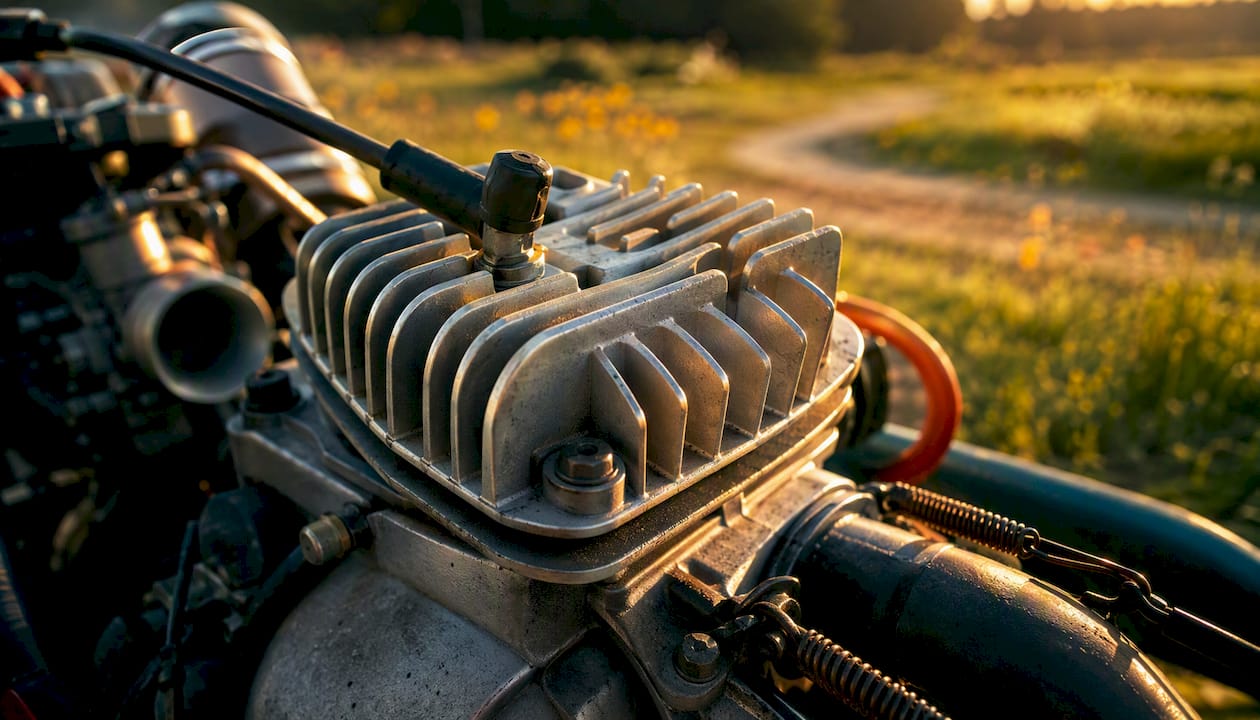
Air-cooled systems strip that complexity away. Fins machined into the engine block and cylinder heads give heat a large surface area to escape from, and airflow — natural or fan-assisted — does the rest. Many small go-kart engines, older motorcycles, and small utility engines use this approach. It is lighter and simpler, but air-cooled engines can develop hot spots and struggle in sustained high-load or high-ambient-temperature conditions.
Raw-water marine systems pull water directly from the body of water the boat is traveling through, circulate it through a heat exchanger, and discharge it. They are effective but require careful winterization and are vulnerable to debris and corrosion.
| System Type | Typical Use | Pros | Cons |
|---|---|---|---|
| Liquid closed-loop | Cars, trucks, larger powersports | Precise temp control, efficient | More components, higher complexity |
| Air-cooled | Small go-karts, some motorcycles, small utility engines | Simple, lightweight, low maintenance | Hot spots, less effective under sustained load |
| Raw-water marine | Boats and personal watercraft | Effective heat rejection on water | Corrosion risk, requires winterization |
Wikipedia’s internal combustion engine cooling article confirms that liquid cooling dominates modern automotive and larger IC engine applications, while air cooling remains common for small engines and some specialty designs. If you are shopping for a powersports vehicle and wondering which system your engine uses, check the spec sheet — small-displacement go-kart and dirt bike engines often run air-cooled, while larger UTVs and performance karts may use liquid cooling.
How do you recognize a failing cooling system?
Cooling problems rarely appear without warning. The symptoms below are your early alerts.
Common warning signs:
- Temperature gauge climbing toward the red zone or spiking suddenly
- Coolant puddles under the vehicle (often sweet-smelling, bright green, orange, or pink)
- Steam or white smoke rising from under the hood
- Sweet smell inside the cabin (heater core leak)
- Loss of cabin heat even when the engine is warm
- Engine overheating specifically under load (towing, climbing hills, stop-and-go traffic)
- Milky or frothy oil on the dipstick (coolant mixing with oil — a serious sign)
Each symptom points to a likely cause. A rising temp gauge with no visible leak often means a stuck thermostat or failing water pump. Coolant puddles usually trace to hose connections, clamps, or a cracked radiator. White smoke from the exhaust — not the tailpipe — suggests a blown head gasket. Milky oil means coolant has entered the oil passages, which demands immediate professional attention. CED Engineering’s engine cooling reference documents how inadequate cooling leads to warped cylinder heads, blown head gaskets, lubrication breakdown, and ultimately engine seizure — consequences that turn a $200 repair into a $3,000 rebuild.
If your engine overheats while driving, follow these steps:
- Turn off the air conditioning immediately to reduce engine load.
- Pull over safely and shut the engine off.
- Do NOT open the radiator cap. Wait at least 30 minutes for the system to cool.
- Check for visible leaks or steam once the engine is cool.
- Call for roadside assistance if the cause is not obvious or the problem persists.
One more thing on safety: coolant is toxic to animals and has a sweet taste that attracts pets. Clean up any spills promptly, store coolant in sealed containers, and dispose of used coolant at a certified recycling facility or auto parts store — never pour it down a drain or onto the ground.
What does cooling system maintenance actually involve?
Staying ahead of cooling problems is far cheaper than reacting to them. Here is a practical maintenance timeline and what each service involves.
- Monthly visual check. Look at the coolant level in the overflow tank (engine cold), inspect hoses for swelling or cracks, and check clamps for rust or looseness.
- Every 12 months or 15,000 miles. Inspect drive belts for wear, check the radiator cap seal, and test coolant concentration with an inexpensive refractometer or test strips.
- Every 30,000 miles or per manufacturer spec. Perform a full coolant flush: drain the old fluid, flush the system with clean water, and refill with the correct coolant mix. Have a shop do a pressure test to check for slow leaks.
- At 60,000–100,000 miles. Water pumps and thermostats typically reach the end of their reliable service life in this range, though many last longer with good maintenance. Inspect both at this interval.
The Carter Engineered maintenance checklist recommends including a fan operation test and a visual hose/clip inspection at every service. Always follow your vehicle manufacturer’s service manual — intervals vary significantly between makes and models, and using the wrong coolant type can void a warranty.
Typical U.S. repair cost ranges (estimates only — get a written quote from an ASE-certified mechanic):
- Coolant flush: $80–$150
- Thermostat replacement: $150–$300 (parts and labor)
- Water pump replacement: $300–$750 (varies widely by engine access)
- Radiator replacement: $400–$900
- Hose replacement (single): $75–$200
These are ballpark figures. Labor rates vary by region, and some engines require significant disassembly to reach the water pump. An ASE-certified mechanic can give you a written estimate before any work begins.
Simple checks you can do safely at home
You do not need a shop to catch most early cooling problems. These checks take about ten minutes and require no special tools.
- Check coolant level (engine cold only). Look at the translucent overflow tank — the level should sit between the MIN and MAX marks. Never open the radiator cap on a warm engine.
- Inspect hoses. Squeeze the upper and lower radiator hoses. They should feel firm but slightly pliable. Soft, mushy, or hard/brittle hoses are overdue for replacement.
- Look for leaks. Check the ground under the vehicle and around hose connections, the water pump, and the radiator for staining or dried coolant residue.
- Watch the temperature gauge. During a normal drive, the gauge should settle in the middle range and stay there. Climbing toward the red or fluctuating is a warning.
- Test the thermostat indirectly. Once the engine reaches operating temperature, carefully feel the upper radiator hose (engine off, system cool enough to touch). If it is cold while the gauge reads hot, the thermostat is likely stuck closed — a classic diagnostic from HowStuffWorks.
- Check fan operation. With the engine at idle and the AC on, the electric cooling fan should run. If it does not, the fan motor or relay may be faulty.
Safety rules that are non-negotiable: wear gloves and eye protection when handling coolant. Never open the radiator cap when the engine is hot — Britannica’s cooling system entry is explicit about the flash-steam risk. Avoid using plain water as a long-term coolant substitute; it offers no freeze protection and accelerates internal corrosion.
DIY is reasonable for topping off coolant, tightening a loose clamp, or replacing a simple hose. Visible coolant in the oil, persistent overheating after basic checks, or a failed pressure test all call for a professional. For powersports-specific maintenance guidance, model fitment matters — always confirm the part number before ordering.
Why does the type of coolant you use matter?
Coolant is not just colored water. It does three jobs at once: it lowers the freezing point of the fluid, raises its boiling point, and carries corrosion inhibitors that protect metal surfaces inside the engine and water pump seals.
The chemistry of those inhibitors is where things get specific. Wikipedia’s cooling entry identifies three main families:
Color is not a reliable guide to coolant type — manufacturers use different dyes, and the same color can mean different chemistries across brands. Mixing incompatible types can reduce corrosion protection and create a gel-like sludge that clogs passages.
The standard mix is an equal proportion of coolant concentrate to distilled water, which provides substantial freeze protection and raises the boiling point in a pressurized system. Plain water works as a short-term emergency top-off, but it loses all corrosion protection and freeze resistance — replace it with the correct mix as soon as possible.
Pro Tip: Always check your owner’s manual for the exact coolant specification. Using the wrong chemistry — even a “universal” formula — can shorten the life of seals and internal passages in some engines, particularly newer aluminum-heavy designs.
For disposal, used coolant is considered hazardous waste. Most auto parts retailers (AutoZone, O’Reilly, Advance Auto Parts) accept used coolant for recycling at no charge.
A note from our perspective at Gokartsusa
At Gokartsusa, we sell powersports vehicles and parts to riders across the country — go-karts, mini bikes, ATVs, dirt bikes, and everything in between. We see both ends of the cooling spectrum every day: small air-cooled engines that need nothing more than clean fins and fresh air, and liquid-cooled performance engines that demand the same attention as any car’s cooling circuit.
The single most common mistake we see powersports buyers make is ordering a cooling part without confirming the engine model and year. A thermostat housing for a 250cc CN250 engine is not interchangeable with one from a different displacement, even if the two machines look similar. Always cross-reference the part number against your engine’s spec plate before you order.
Our honest recommendation: for any cooling repair beyond a coolant top-off or hose clamp tightening, get a written estimate from an ASE-certified mechanic or a powersports technician who knows your specific engine family. The cost of a professional diagnosis is almost always less than the cost of a misdiagnosis.
Gokartsusa has the parts your powersports engine needs
Whether your machine runs a simple air-cooled single-cylinder or a liquid-cooled four-stroke, keeping the cooling system in shape protects your investment and keeps the adventure going.

At Gokartsusa, we carry cooling-related parts for a wide range of small powersports engines — including cooling hoses, thermostat housings, and more. Before you order, confirm your engine model, year, and part number using the product page fitment details. Our team is here to help you get the right part the first time.
Ready to ride? Browse our full lineup of gas-powered go-karts and powersports vehicles, or head to Gokartsusa to check current inventory, financing options, and seasonal deals.
Sources
These are the primary sources behind this article, each worth bookmarking for deeper technical detail:
- How Car Cooling Systems Work | HowStuffWorks
- HOW A COOLING SYSTEM WORKS (Carter Engineered PDF)
- Internal combustion engine cooling — Wikipedia
- Automobile: Cooling system — Britannica
- Engine cooling and lubrication systems — CED Engineering (PDF)
- Car cooling system — HELLA techworld