




Aim for a seat height that puts the balls of both feet on the ground when the rider is seated. For most adult beginners, that lands the seat somewhere between 33 and 37 inches; kids and small adults typically need 18 to 31 inches depending on age and inseam. The inseam length, not height in inches, is what actually decides the fit, and a confident test ride beats any spec sheet.
TL;DR:
- Effective seat height is usually 1 to 3 inches lower than the spec sheet measurement when the bike is seated with suspension compressed under rider weight.
- The inseam measurement, not height in inches, is the key factor for determining the correct seat height for each rider.
- Using the balls of both feet on flat ground while sitting, in riding gear, provides the most reliable test for bike fit.
- Shorter riders can improve fit by using a narrower seat, shaving foam, or mastering the one-foot stop rather than always lowering the bike.
- Taller riders may need to adjust cockpit components or size up to find a comfortable riding position, rather than relying solely on seat height.
Table of Contents
- Why Dirt Bikes Have Tall Seats (And Why the Spec Number Lies a Little)
- Seat Height Chart by Rider Height and Bike Category
- How Do You Measure Your Inseam for a Dirt Bike?
- What Are the Best Options for Shorter Riders?
- Fit and Comfort Tips for Taller Riders
- What Changes When You Modify Seat Height?
- Match Seat Height to Riding Style and Skill Level
- Kids’ Sizing: Age Charts and Growth Room
- Safety Considerations Tied to Seat Height
- Why Fit Beats Spec Sheets Every Time
- Find the Right Fit and Ride It Home
- Sources
- FAQ
Why Dirt Bikes Have Tall Seats (And Why the Spec Number Lies a Little)
Dirt bikes ride tall because they need to. Long-travel suspension and generous ground clearance let a machine soak up roots, whoops, and rocks without bottoming out, and that clearance stacks height into the seat. It’s the trade-off every off-road machine makes: comfort at a stoplight versus survival on a trail.
Here’s the part most buyers miss: the number on a spec sheet is measured with an empty bike sitting on its suspension, fully extended. Put a rider on it, and that suspension travel compresses. The average dirt bike or dual-sport seat height runs about 34.2 inches unloaded, and that figure drops by another inch or more once a rider’s weight settles in.
A few things worth remembering before you shop by the numbers:
- Effective seat height (rider seated) is usually 1 to 3 inches lower than the listed spec, depending on suspension stiffness and rider weight.
- Engine size is a weak predictor of seat height. A 125cc trail bike and a 125cc motocross bike can differ by several inches.
- Two bikes with identical seat-height specs can feel completely different once you’re sitting on them, thanks to seat width and shape.
Seat Height Chart by Rider Height and Bike Category
Matching rider height to a seat-height range narrows the shopping list fast, but treat every number here as a starting point, not gospel. Inseam varies enough between two people of the same height that a chart alone won’t tell you everything. Size guides generally recommend staying within about 2 inches of your target seat height and adjusting from there based on how the bike actually feels underneath you.
Notice the overlap between bands. A rider at 5’6" with a short inseam might sit more comfortably on a bike from the shorter band than one from their “expected” height range, and that’s exactly why the next section matters more than this table.
How Do You Measure Your Inseam for a Dirt Bike?
Forget the tape measure on the bathroom wall for a second. Bike fit runs off inseam, not height, and the wall method takes two minutes to get right.
- Stand barefoot against a wall with your feet about 6 inches apart.
- Slide a hardcover book between your legs, spine up, until it’s snug against your pelvis.
- Mark the wall at the top edge of the book and measure from the floor to that mark. That’s your inseam.
- Subtract roughly 1 to 2 inches to account for boot sole thickness and knee bend, then compare that number against the seat heights on your shortlist.
Once you’re on the actual bike, the balls-of-feet test tells you more than any chart. Sitting on the seat, the balls of both feet should reach the ground with heels lifted slightly. Experienced riders can get away with the one-foot technique, planting one foot flat while the other rests on the peg, but a beginner should never settle for tiptoes on both sides.
Run through this before you commit to a bike: start it cold, stop it hard from low speed, walk it in a slow figure-eight, and dismount without stretching for the ground. If any of those feel shaky, that’s the bike telling you something a spec sheet never will.
Pro Tip: Do the test ride in riding gear, including boots. Boot soles add real height, and a bike that fits in sneakers can suddenly feel too tall once you’re geared up.
What Are the Best Options for Shorter Riders?
Shorter riders have more real options than the internet usually admits, and not all of them involve tools.
- Learn the one-foot stop. Planting one foot while the other stays on the peg is standard technique for plenty of capable riders, not a workaround for beginners.
- Swap to a narrower seat. A slimmer seat profile lets your legs hang straighter down instead of splaying around a wide tank, which can make a bike feel an inch or two shorter without touching the suspension.
- Shave the foam or fit a lower seat. This drops height directly but often sacrifices padding and all-day comfort.
- Install a lowering link. These shorten the rear shock’s effective travel, which drops the seat but also eats into ground clearance.
Lowering can solve a ground-reach problem while quietly cutting into the off-road capability that made the bike fun to ride in the first place. For a lot of riders, mastering the one-foot stop is the better long-term fix, and it costs nothing.
Fit and Comfort Tips for Taller Riders
Taller riders run into the opposite problem: a cockpit that feels cramped long before the seat height itself becomes an issue. Knees jammed against the tank, wrists bent too sharply toward low bars, and a seat-to-peg distance that folds you up like a lawn chair all point to a bike that’s simply too small, regardless of what the seat height says.
Before assuming you need a bigger bike, check these adjustments:
- Taller or firmer aftermarket foam adds an inch or two of height and can improve knee angle.
- A different saddle shape changes how your legs sit relative to the tank, even at the same measured height.
- Repositioning the handlebars or footpegs opens up legroom without touching the seat at all.
If none of that solves the cramped feeling, the honest answer is to size up. Modifying a bike that’s fundamentally too small rarely closes the gap, and a full-size model built for your frame will always outperform a patched-up compromise.
What Changes When You Modify Seat Height?
Every seat-height fix is really a suspension or comfort trade, and it pays to know which one you’re making before you start cutting foam.
- Lowering links shorten shock travel, which drops the seat but also reduces how much bump the suspension can absorb before it bottoms out. They can shift the swingarm angle enough to change the bike’s anti-squat behavior under acceleration.
- Shaved foam is cheap and fast but thins out padding on long rides and can shift your seated position forward or back, changing reach to the bars.
- Professional suspension tuning costs more upfront than a DIY foam job or a bargain lowering link, but it preserves handling characteristics that a quick mechanical fix usually sacrifices.
Pro Tip: If you’re serious about off-road riding rather than just parking-lot comfort, get a suspension shop involved before installing a lowering link. Geometry changes that feel fine in the driveway can behave very differently at speed on a trail.
Match Seat Height to Riding Style and Skill Level
The “right” seat height shifts depending on where you’re actually riding, not just how tall you are.
- Technical trail riding rewards a lower effective reach. Tight turns, log crossings, and slow-speed balance all get easier when your feet are closer to the ground.
- Motocross and fast open-trail riding reward suspension travel and ground clearance more than easy foot-down access, since you’re rarely stopping mid-berm.
- Beginners of any height should lean toward the lower end of their fit range and prioritize confidence over capability. A lower-seat, lower-power bike built for learning beats a taller, faster machine every time for someone still building skill.
- Experienced riders can comfortably stretch into a taller seat height, especially if they’ve already got the one-foot stop dialed in.
The trade-off is simple: chase capability and you accept a taller seat; chase confidence and you accept less suspension travel. Most riders, especially new ones, are better served picking confidence first.
Kids’ Sizing: Age Charts and Growth Room
Sizing a kid’s dirt bike is its own puzzle, because you’re fitting a moving target. A 6-year-old who fits a 50cc bike this spring might outgrow it before the following season, so growth allowance matters as much as the current measurement.
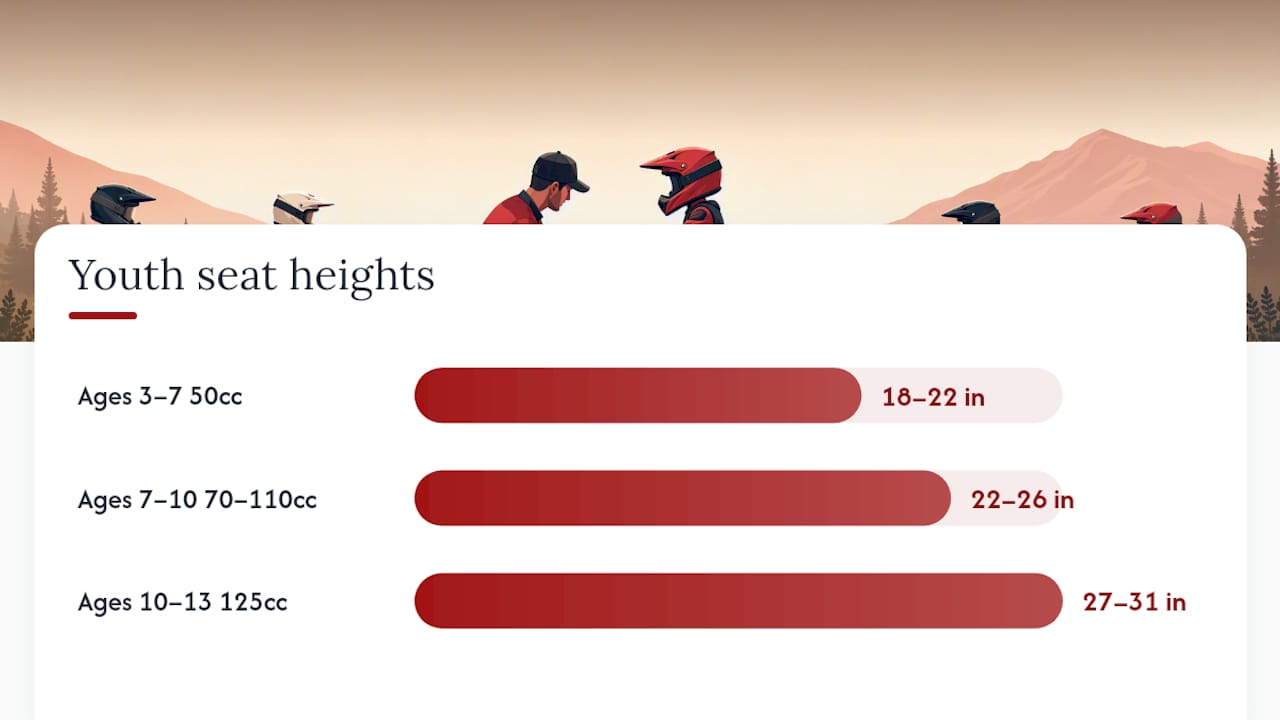
As a starting framework: kids ages 3 to 7 typically fit 50cc bikes with seat heights around 18 to 22 inches, and most of these come with training wheels or a throttle limiter for the first season. Ages 7 to 10 usually move into 70cc to 110cc bikes in the 22 to 26 inch range, often with automatic transmissions that let a young rider focus on balance instead of clutch control. By ages 10 to 13, many kids are ready for 125cc bikes running 27 to 31 inches, assuming their inseam and confidence have both caught up.
Resist the urge to buy two sizes up “for growth.” A bike that’s too tall undermines the same balls-of-feet confidence that matters for adults, and it does it to a rider with far less experience recovering from a wobble. The better approach is buying for the current inseam and planning to resell or hand down the bike in a year or two, which is standard practice in youth motocross circles anyway. A proper youth sizing chart that accounts for inseam alongside age will save you from both mistakes, the too-small bike that gets outgrown in a month and the too-tall bike that gets parked in fear.
Safety Considerations Tied to Seat Height
A seat that’s too tall doesn’t just feel awkward. It changes how a rider responds in the exact moments that matter most.
Picture a sudden loss of balance at a stop sign or a trail intersection. A rider who can plant both feet flat recovers instantly. A rider on tiptoes has a fraction of a second less control, and on uneven ground that fraction is often the difference between a stumble and a bike going down. This is especially true for new riders, who haven’t yet built the reflexes to catch a falling bike with a knee or a shoulder instead of a foot.
The flip side carries its own risk. A bike sized too small for an experienced or heavier rider cramps the cockpit, forces awkward body positioning over rough terrain, and tires out muscles that should be absorbing bumps instead of fighting the geometry. Fatigue from a bad fit compounds over a long ride, and tired riders make more mistakes late in the day than early.
Helmets, boots, and body armor matter, but they’re reactive gear. The seat height and cockpit fit decide how many of those mistakes happen in the first place. Getting the fit right isn’t a comfort upgrade. It’s the first layer of safety equipment on the bike, and it’s the one riders check least often.
Why Fit Beats Spec Sheets Every Time
Most seat-height advice online treats the spec number like a hard science, and that’s the biggest disservice done to new riders and parents alike. A seat height is a single measurement taken on an empty bike sitting still. It says nothing about seat width, foam density, peg position, or how a particular rider’s proportions distribute their weight once they’re actually seated and moving.
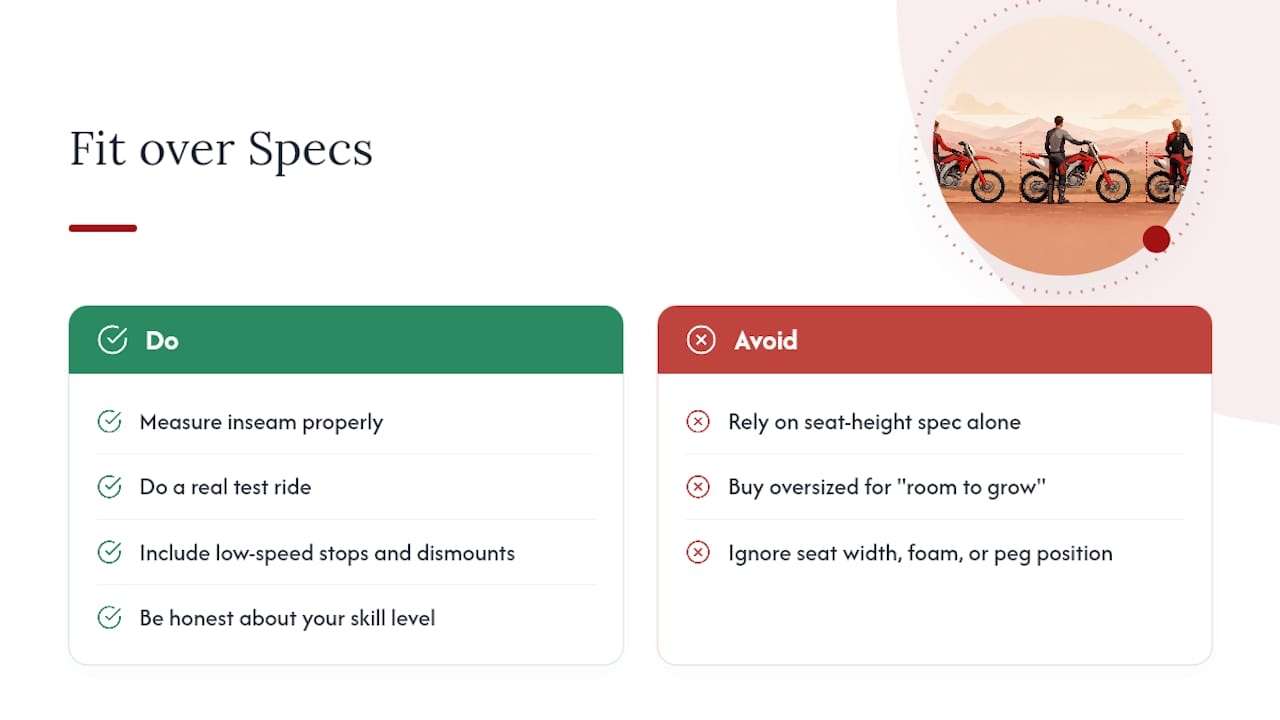
What actually predicts whether someone rides confidently is the combination this article has walked through: inseam measured properly, a real test ride that includes low-speed stops and dismounts, and an honest read on skill level. I’d go further than most guides and argue that riders chronically oversize their first bike, buying “room to grow” instead of a machine they can control today. That instinct comes from a good place, but it trades near-term confidence for a bike that sits in the garage more than it gets ridden.
The one-foot technique gets treated as a workaround in a lot of buying guides, when it’s actually a skill worth teaching early. A rider who’s comfortable planting one foot and controlling the bike on the other side has more model options open to them than someone who insists on flat-footing with both feet every time. That’s not a compromise. It’s a legitimate riding skill that expands what “fits” actually means.
— Mario
Find the Right Fit and Ride It Home
Getting seat height right on paper is one thing. Getting it right in your driveway, with your kid’s inseam and your budget in the mix, is another. The youth and beginner lineup includes sizing resources that go beyond a spec sheet and a selection of models designed to fit growing riders rather than forcing them to grow into the bike.

Start with the youth dirt bike sizing chart to narrow down a seat-height range for your rider’s age and inseam before you shop. If you’re outfitting a younger rider, the Demon Kids Gas Dirt Bike offers an automatic transmission and a low seat height built for riders still mastering balance, while older beginners ready for more room can look at the TrailMaster 125cc Dirt Bike with its larger frame and electric start. Models come with fit details provided to help compare specifications. Browse the current lineup and check stock before you decide.
Sources
A handful of sources back most of the seat-height guidance floating around online, and these three are worth going straight to:
- Motorcycle Seat Height Comparisons (290 different bikes) | AdventureBikeTroop
- What Size Dirt Bike Do You Need For Your Height? - Motocross Hideout
- Dirt bike seat height chart (Seat height comparison table) | DirtBikeEarth
FAQ
What Is the Ideal Seat Height for a Dirt Bike?
The ideal seat height lets the balls of both feet touch the ground while seated, which for most adults falls between 33 and 37 inches; kids and small adults typically need 18 to 31 inches depending on age and inseam.
How Tall Is the Seat on a 250cc Dirt Bike?
Full-size 250cc motocross and enduro models typically run 36 to 38 inches or more, though a 250cc trail-oriented bike can sit several inches lower than a race-focused one.
What Dirt Bike Has a 30-Inch Seat Height?
Several 125cc trail and small enduro models land close to 30 inches, making them a common pick for riders around 5’4" to 5’8" with a shorter inseam relative to their height.
How Tall Should I Be to Ride a YZ125?
Yamaha’s YZ125 sits in the taller motocross range, generally suited to riders around 5’8" and up with an inseam that lets the balls of both feet reach the ground or who are comfortable using the one-foot stop technique.