




TL;DR:
- Suspension controls an ATV’s traction, impact absorption, and stability more than engine horsepower does.
- Proper suspension setup ensures tires stay in contact with the ground, enhancing control across varied terrains.
Most riders obsess over engine power, but here’s the truth: suspension controls your ATV far more than horsepower does. The role of suspension in ATVs goes well beyond soaking up bumps. It determines whether your tires stay in contact with the ground, whether you stay in control through a rocky turn, and whether your machine handles like a precision tool or a runaway cart. Suspension’s core jobs include traction, impact absorption, and stability control, and every one of those jobs directly shapes how your ATV performs. In this guide, we’ll break down how each part works, how to tune it for your terrain, and how to spot problems before they become dangerous.
Table of Contents
- Core functions of ATV suspension systems
- Key suspension components and how they work together
- How suspension travel and geometry influence performance
- Terrain-specific suspension tuning: adjusting compression, rebound, and preload
- Common suspension problems and how to identify them by feel
- Our take: suspension knowledge is the real competitive edge
- Find your next ATV at GokartsUSA.biz
- Frequently asked questions
Core functions of ATV suspension systems
To fully grasp how suspension impacts your ride, first understand its core functions on the trail. Riders often think of suspension as a comfort feature, something that smooths out rough ground so you’re not rattled in the saddle. That’s part of it. But the deeper purpose is control.
Suspension keeps tires on the ground for traction, absorbs trail impacts for machine control, and improves stability across changing terrain. The moment a tire lifts off the ground, you lose steering, braking, and drive. Good suspension prevents exactly that.
Here’s what your suspension system is actually doing every time you hit the trail:
- Traction management: Springs and shocks allow each wheel to move independently, keeping tires pressed against the ground even when terrain rises or falls sharply.
- Impact absorption: Bumps, rocks, and roots send energy into the machine. Suspension absorbs that energy before it reaches your frame and your body, preserving both.
- Stability control: Suspension manages body roll during cornering, brake dive under hard stopping, and squat during acceleration. These aren’t comfort issues; they’re handling issues.
“Think of your suspension as the conversation between your tires and the trail. Every adjustment you make changes what your tires hear — and how well they respond.”
Getting familiar with off-road suspension basics makes every other tuning decision easier and more intentional.
Key suspension components and how they work together
Knowing what suspension does, let’s look inside the system to see how each part shapes your ride. The main players are springs, shock absorbers, and damping mechanisms. They each have a distinct role, and when one is out of balance, the whole system suffers.
Springs carry the weight of the ATV and rider. They define ride height and determine how much energy the terrain can throw at the machine before it transfers to the frame. Spring rate (measured in pounds per inch) tells you how stiff a spring is. A heavier rider or heavier load generally calls for a stiffer spring.
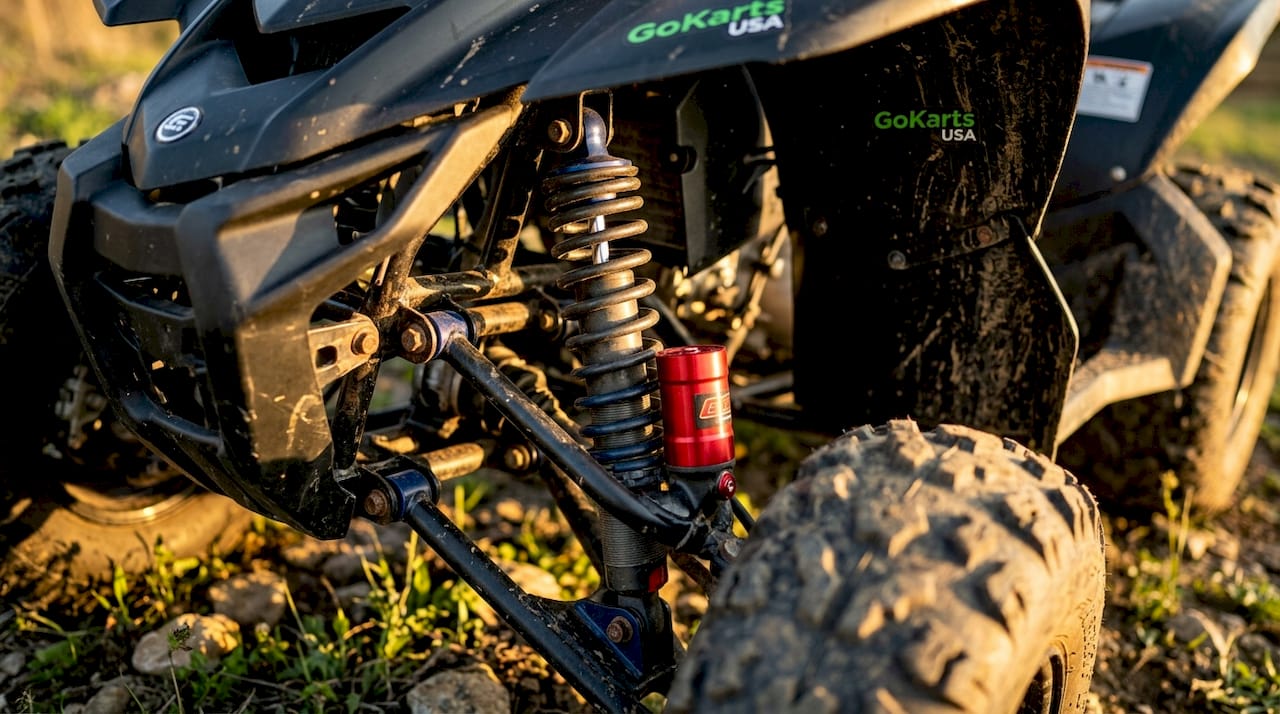
Preload is one of the most misunderstood settings. Adjusting preload changes how compressed the spring is at rest, which raises or lowers ride height and affects sag (how much the suspension compresses under the rider’s weight). What preload does not do is change the spring’s stiffness. Preload changes ride height and sag rather than true spring rate.
Damping is where things get interesting. Your shocks control two damping phases:
- Compression damping: Controls how the shock responds when it compresses, meaning when you hit a bump. Too much compression makes the ride harsh. Too little lets the suspension collapse quickly, which causes instability.
- Rebound damping: Controls how fast the shock extends after compression. Too fast and the suspension bounces the wheel off the ground. Too slow and the suspension “packs down,” never fully recovering between hits.
For a deeper look at how these two phases interact, rebound and compression damping explained is a resource worth bookmarking.
The balance between compression and rebound is what separates a great suspension setup from a frustrating one. You can review suspension safety and tuning tips to build on these fundamentals before making adjustments.
How suspension travel and geometry influence performance
Suspension parts don’t work in isolation. Understanding travel and geometry clarifies their combined effects on how your ATV actually handles.
Suspension travel refers to the total distance a wheel can move up and down. More travel means more room to absorb big hits, which is why long-travel setups are common on desert racers and trail machines built for rough terrain. But there’s a trade-off. Long-travel suspension absorbs large bumps and offers stability at speed but raises the center of gravity. Short-travel setups are more responsive in tight turns but harsher on bigger impacts.
| Feature | Long-travel suspension | Short-travel suspension |
|---|---|---|
| Bump absorption | Excellent | Limited |
| High-speed stability | High | Moderate |
| Cornering response | Slower | Quicker |
| Center of gravity | Higher | Lower |
| Best terrain | Rocky, high-speed trails | Tight trails, sport riding |
Geometry adds another layer. The angles at which your suspension arms and linkages are positioned affect what’s called bump steer, which is the tendency of the steering to pull left or right when the suspension compresses. Poorly designed or worn geometry means your ATV wanders or fights you mid-corner, even with a perfectly tuned shock. For a side-by-side comparison of how these variables affect suspension travel and geometry, the principles translate across all off-road platforms.
Pro Tip: Before chasing damping adjustments, make sure your suspension geometry is in spec. Worn ball joints, bent A-arms, or loose tie rods will make any damping setup feel wrong, no matter how dialed in your shocks are.
Terrain-specific suspension tuning: adjusting compression, rebound, and preload
With core functions and geometry clear, next learn how to tune your suspension for the terrain you ride. This is where knowledge becomes a real advantage on the trail.
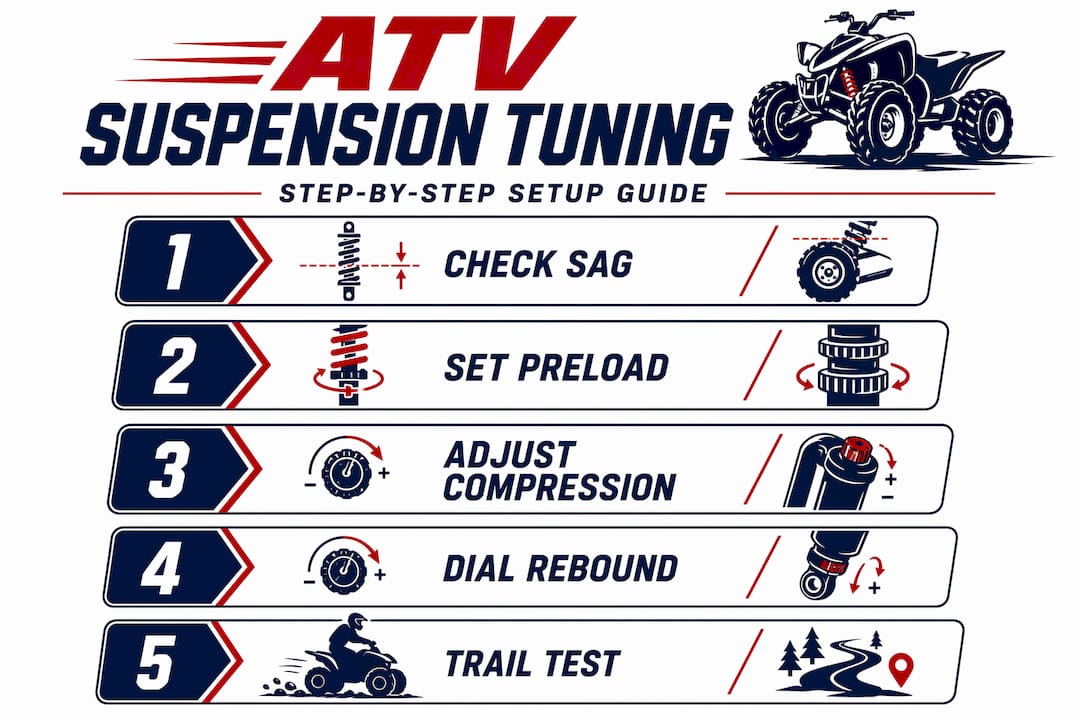
Different terrains demand different suspension setups. Rocky trails generally require stiffer compression and slower rebound to prevent bottoming out and to keep tires planted between jagged obstacles. Muddy trails favor softer compression so the suspension can move freely through unpredictable, energy-absorbing ground. Whooped-out trails need balanced compression with faster rebound to keep the suspension cycling quickly between hits.
Here’s how to approach terrain-specific tuning:
- Set sag first. With you seated in your normal riding position, measure how much the suspension compresses. Most ATVs target 25 to 35 percent of total travel as rider sag. Adjust preload to hit that number.
- Set rebound second. Start with a middle setting, ride a familiar section, and notice whether the machine feels bouncy (rebound too fast) or packed down (rebound too slow). Adjust one click at a time.
- Set compression last. Once rebound feels right, address harshness over small bumps or instability over large ones by adjusting compression damping.
This order matters. Riders who skip straight to compression often create a setup that compensates for a rebound problem rather than solving it. The result is a machine that feels “close” but never quite right.
- For rocks: Stiffen compression by 2 to 3 clicks from baseline. Slow rebound slightly to prevent the wheel from bouncing off sharp edges.
- For mud: Soften compression to let the suspension breathe. Speed up rebound so the wheel recovers quickly from unpredictable drops.
- For whoops: Find the middle on compression. Speed rebound up enough that the suspension fully extends between each successive hit.
For more terrain-based guidance, terrain-specific riding tips pair well with these tuning principles.
Pro Tip: Always tune on a trail section you know well. Familiar terrain lets you isolate what the suspension is doing rather than reacting to surprises in the ground.
Common suspension problems and how to identify them by feel
Knowing how to tune terrain settings, it’s critical to recognize common issues by ride feel for effective fixes. Your ATV will tell you what’s wrong. You just have to know how to listen.
Here are the four most common suspension problems and their likely causes:
- Pogo bounce after bumps: The machine rebounds sharply and the rear or front kicks up. This almost always means rebound is too fast. The shock is extending quicker than the tire can follow the ground.
- Harsh ride over small bumps: You feel every pebble and crack. Compression damping is too stiff, or the spring rate is too high for your weight and terrain.
- Bottoming out: The suspension hits its limit with a loud clunk on medium or large impacts. This is typically a spring rate or preload issue, not a damping problem. You need more spring support, not more damping.
- Instability in corners or under braking: The machine dives, rolls, or wanders unpredictably. This points to imbalanced damping between front and rear, worn geometry components, or mismatched spring rates end to end.
Pogo bounce after bumps usually means rebound is too fast. Harsh small-bump feel often signals excessive compression. Bottoming out suggests spring rate or preload issues that damping alone cannot fix.
The golden rule: adjust one setting at a time. Change a single click, ride the same section, and evaluate. Changing multiple settings at once makes it impossible to know what actually helped.
- Never skip a thorough inspection of bushings, seals, and pivot points before tuning. Worn hardware makes every adjustment feel inconsistent.
- If diagnosing suspension issues feels overwhelming, start with sag. Getting sag right often resolves problems that seemed like damping issues.
Our take: suspension knowledge is the real competitive edge
Here’s something we’ve noticed after years of watching riders chase performance upgrades: the ones who understand their suspension outperform the ones with better machines. A rider on a stock ATV with well-tuned suspension will consistently outhandle and outlast a rider on a more powerful machine that hasn’t been set up properly.
The industry pushes horsepower numbers and engine specs because those are easy to market. Suspension tuning is harder to sell because it requires knowledge, patience, and feel. But the riders who invest in that knowledge? They ride faster, safer, and more confidently. They also spend less money because they’re not wearing out tires, frames, and joints by hammering a poorly set up machine across rough terrain.
We also believe suspension understanding changes how you shop for an ATV. Knowing what travel range, spring rate, and adjustability you need for your terrain means you stop buying by spec sheet and start buying for your actual riding life. That’s a more honest and more rewarding way to invest in your adventure.
Find your next ATV at GokartsUSA.biz
If this guide fired up your curiosity about what the right suspension setup can do for your ride, we’re here to help you find a machine built for it. At GokartsUSA.biz, we carry a strong lineup of ATVs for every rider with suspension systems designed for real trail conditions. Whether you’re gearing up for rocky backcountry or family-friendly trails, we pair honest advice with quality machines and outstanding value.

We back every purchase with the kind of support that trail riders actually need: free shipping, detailed specs, and a team that rides and knows powersports. Spring deals are live right now, including complimentary helmets and accessories on select models. Come see what’s waiting for your next adventure at GokartsUSA.biz.
Frequently asked questions
Why is ATV suspension more important than engine power off-road?
Because suspension preserves tire contact with uneven terrain, which is what provides traction and control. When tires lift off the ground, engine power becomes irrelevant because there’s nothing to drive the machine forward or keep it stable.
What does preload actually do on an ATV suspension?
Preload adjusts sag and ride height by compressing the spring at rest, but it does not change the spring’s stiffness or rate. Think of it as positioning the suspension within its travel range, not making the spring harder or softer.
How do compression and rebound damping differ?
Compression manages shock response to initial impacts when a wheel hits a bump, while rebound controls how quickly the shock extends back to its resting position. Both are critical for maintaining tire contact and ride control.
Can I tune my ATV suspension for different terrains myself?
Yes. By adjusting preload, compression, and rebound based on terrain type, most riders can dial in their suspension without professional help. Start with sag, move to rebound, then compression, and always adjust one setting at a time.
What does it mean when my ATV “packs down” in whoops?
Packing down means rebound too slow prevents the suspension from fully extending between successive hits, so the machine progressively sinks lower in its travel. The result is a harsh, unstable ride with reduced wheel movement and poor traction through the entire whoop section.