




TL;DR:
- Proper gear and adult supervision are essential for beginner ATV safety, especially for children.
- Choose the right-sized ATV based on the rider’s age, height, and weight to prevent injuries.
- Following safe riding practices and avoiding common mistakes reduce the risk of accidents and injuries.
Beginner ATV Safety Guide: Essential Steps for Safe Riding
Every year, thousands of beginner ATV riders sustain injuries that could have been entirely prevented. Children under 16 account for 27% of OHV injuries despite making up only 15% of riders, and the vast majority of those incidents trace back to skipped gear, wrong-sized machines, or zero supervision. That’s not a scare tactic. That’s a call to ride smarter. Whether you just bought your first ATV or you’re a parent sizing up options for your kid, this guide walks you through everything you need: the right gear, the right machine, step-by-step safe riding practices, and the most common mistakes new riders make before they even leave the driveway.
Table of Contents
- ATV safety essentials: Gear and supervision
- Choosing the right ATV for children and beginners
- Safe riding practices: Step-by-step instructions
- Common mistakes and how to avoid them
- The hidden truth about ATV safety all parents should know
- Start your safe ATV journey with the right resources
- Frequently asked questions
Key Takeaways
| Point | Details |
|---|---|
| Always wear safety gear | Helmet, gloves, boots, and clothing greatly reduce ATV injury risks. |
| Supervise young riders | Children under 16 should never ride unsupervised to prevent common accidents. |
| Pick the right ATV size | Using an age-appropriate, properly sized ATV is key to preventing injuries. |
| Avoid high-risk behaviors | Never ride under the influence, carry passengers on single ATVs, or tackle steep terrain beyond your skill. |
| Follow official guidelines | Prioritize proven safety and medical organization recommendations over just manufacturer or state rules. |
ATV safety essentials: Gear and supervision
With the risks set, let’s look at what every beginner and parent must do before starting the engine. Gear is not optional. It’s not a suggestion printed on a waiver. It’s the single most reliable barrier between a great ride and a trip to the emergency room. And when it comes to kids, supervision is that gear’s closest partner.
The gold standard for protection starts with a DOT-approved helmet, eye protection, gloves, long sleeves, pants, and over-the-ankle boots. Each piece serves a specific role. Helmets absorb and redirect impact energy so your skull doesn’t have to. Eye protection keeps debris, dust, and bugs out of your line of sight, which matters especially at trail speeds. Gloves protect your palms during falls and improve grip in wet conditions. Long-sleeved shirts and pants act as abrasion resistance if you slide. Boots with ankle support prevent the twisting injuries that happen when a foot catches the ground unexpectedly.
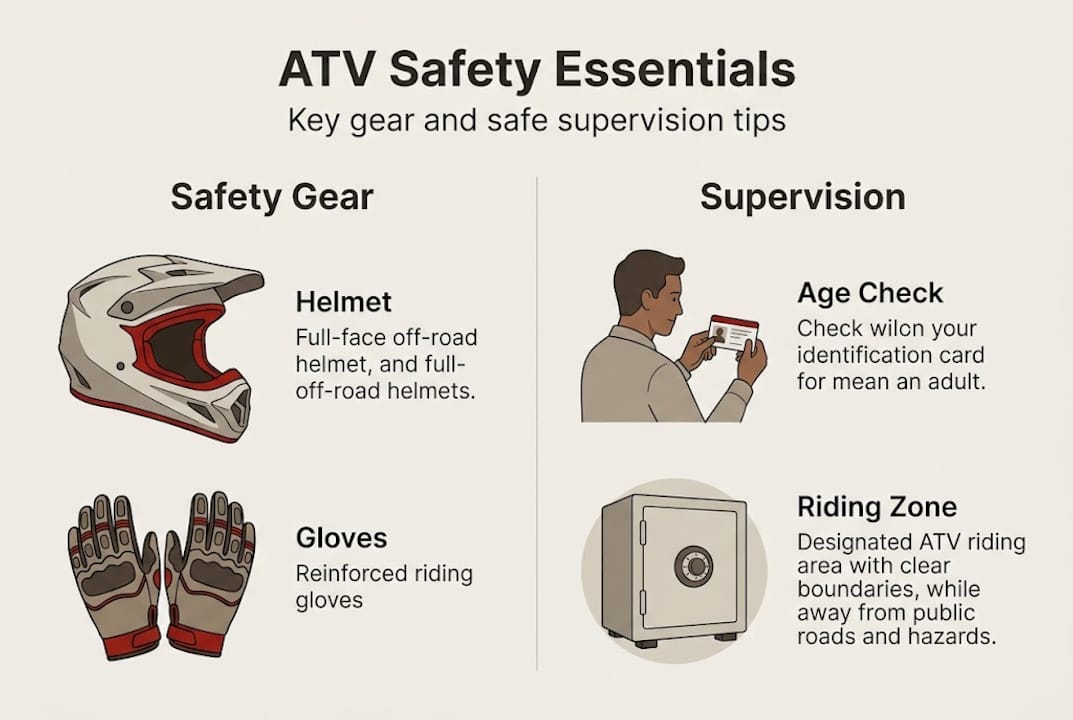
| Gear item | Purpose | Why it matters for beginners |
|---|---|---|
| DOT-approved helmet | Head impact protection | #1 cause of ATV fatalities is head injury |
| Eye protection | Debris and UV shielding | Trail debris travels fast at riding speeds |
| Gloves | Grip and abrasion protection | Hands hit the ground first in most falls |
| Long sleeves and pants | Skin abrasion resistance | Road rash on trails is serious and painful |
| Over-the-ankle boots | Ankle and foot stability | Foot injuries are extremely common in rollovers |
| Chest and back protector | Impact and spine protection | Highly recommended for young and new riders |
Supervision is the other non-negotiable. Children under 16 should never ride unsupervised, period. Young riders lack the reaction time, judgment, and physical strength to handle unexpected terrain changes or mechanical surprises. An adult should always be within eyeline, not just earshot.
“Letting a child ride alone, even in a backyard, removes the one safety net that matters most when things go wrong. Supervision isn’t about distrust. It’s about being there when split seconds count.”
Age-appropriate supervision also means structured riding zones. Open fields and flat trails are starting points. Steep inclines, water crossings, and wooded paths are for experienced riders only. Build the environment around the rider’s skill level, not the other way around.
Pro Tip: Make gear-wearing a non-negotiable ritual before every ride, not just the first few. Kids respond well to consistency. If putting on a helmet is always step one before the engine starts, it becomes habit fast. You can even frame it as “suiting up” the same way athletes do before a game.
For a broader foundation, check out these essential ATV tips and this smarter riding safety guide to round out your understanding before heading to the trail.
Choosing the right ATV for children and beginners
Now that you know what gear and supervision are needed, picking the right machine is just as critical. A beginner on the wrong ATV is like a new driver behind the wheel of a race car. The power and size difference becomes dangerous the moment something unexpected happens.
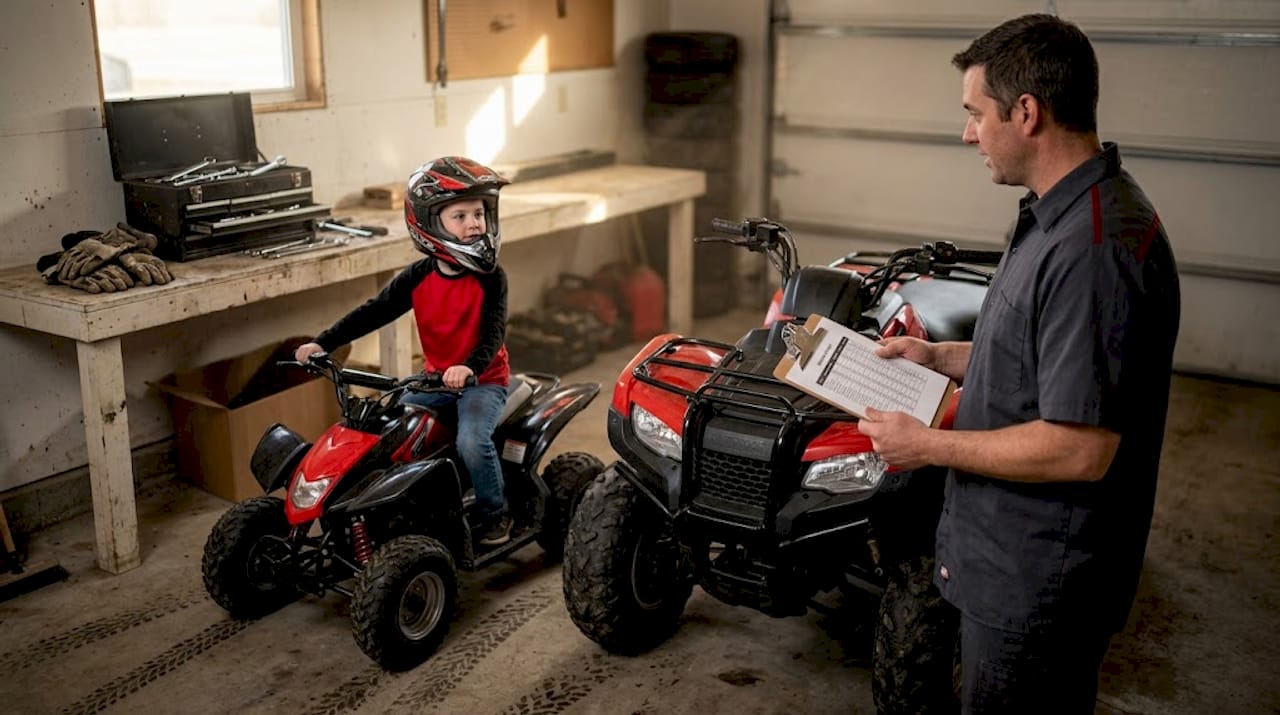
Children on adult-sized ATVs are a primary injury factor in ATV-related incidents. Adult ATVs produce far more torque and speed than a child can safely manage, and their physical dimensions make proper control nearly impossible for smaller bodies. The controls are spaced for adult arm length. The weight is too much to shift when leaning into a turn. The throttle response is tuned for experienced hands.
Here’s a general framework for matching rider age and size to ATV engine displacement:
| Rider age | Body size | Recommended engine size | ATV type |
|---|---|---|---|
| 6 to 9 years | Under 4’6" | 50cc or less | Youth electric or 50cc |
| 10 to 12 years | 4’6" to 5’0" | 50cc to 90cc | Youth gas or electric |
| 13 to 15 years | 5’0" to 5’6" | 90cc to 125cc | Youth performance |
| 16 and older | Adult height | 200cc and up | Adult entry-level |
These are not arbitrary numbers. They reflect what a rider of that size can physically control. The CPSC and SVIA both publish sizing guidelines, and manufacturers are required to follow minimum age recommendations on their models. But here’s where many parents slip up: they assume that if the manufacturer labels something as a “youth model,” it’s automatically safe for their child. That’s not always true. Always verify the engine size against the rider’s actual weight and height, not just age.
Here’s a straightforward process to make the right selection:
- Measure your child’s height and inseam before shopping.
- Check the manufacturer’s minimum age and weight recommendations for each model.
- Have your child sit on the ATV in person if possible. Both feet should touch the ground or be very close.
- Test that your child can easily reach and operate the throttle, brake, and handlebars without stretching.
- Cross-reference with CPSC and SVIA published guidelines, not just the sales tag.
- Choose a model with a throttle limiter or speed restrictor so you can control maximum speed as the child learns.
Pro Tip: Parents often focus on what their child will “grow into.” Resist that logic. An ATV that’s too large right now is dangerous right now. Fit to today’s body, not next year’s.
Explore our guide to entry-level ATVs for kids and use our ATV buying checklist to make a confident, well-informed purchase.
Safe riding practices: Step-by-step instructions
With the right ATV and gear secured, let’s get into what safe operation actually looks like. Beginner riders often think safety means going slow. It means more than that. It means building habits that become automatic, even when the trail gets tricky.
Here’s the sequence we recommend for every ride, especially in the early months:
- Pre-ride inspection: Check tire pressure, fuel level, brake function, and throttle return before every ride. Loose parts or low tires are quiet problems until they suddenly aren’t.
- Mounting and dismounting: Always mount from the left side, just like a horse. Step on the footpeg, swing your right leg over, and settle your weight evenly. Dismount in reverse. Never jump on or off a moving ATV.
- Riding posture: Sit centered with feet firmly on footpegs. Keep knees bent and elbows slightly out. Your body is a suspension system. Staying relaxed and upright helps the ATV respond predictably.
- Starting and throttle control: Always start on flat ground. Apply throttle gradually. New riders often over-accelerate out of nervousness. Practice smooth, steady inputs.
- Braking technique: Use both brakes evenly and progressively. Hard, sudden braking causes skids and tip-overs. Slow down before turns, not during.
- Stopping safely: Come to a full stop, shift to neutral or park, set the parking brake if available, then dismount.
Rollovers are a leading cause of ATV fatalities, and they most often happen during sharp turns at speed, on steep slopes, or when a rider overcorrects. Teaching riders to slow before turning, shift body weight into turns, and avoid slopes above their skill level prevents most rollovers before they happen.
“The throttle is not a binary switch. It’s a tool. Beginners who treat it like an on-or-off switch are the ones most likely to lose control before the first corner.”
Passenger rules are another area where mistakes are costly. Single-rider ATVs must carry only one person, no exceptions. Adding a passenger shifts the weight balance significantly, alters braking distance, and limits steering control. If your family wants to ride together, invest in a side-by-side UTV designed for multiple occupants.
Pro Tip: Establish a “ride debrief” with your child after every session. Ask what felt good and what felt uncertain. Kids who talk about their riding build faster self-awareness and better judgment over time. This takes five minutes and pays off enormously.
For ongoing skill development, our riding safety tips offer the next level of guidance.
Common mistakes and how to avoid them
Even if you follow the steps above, it’s easy to slip up. Let’s cover mistakes almost every beginner makes, and how you can avoid them before they cost you.
The most frequent errors we see from new riders and parents include:
- Skipping gear on short rides: “It’s just around the block” is the most common line before a preventable injury. Distance doesn’t determine danger. Terrain and speed do.
- Riding without supervision: Kids who ride alone, even briefly, have no safety net when something unexpected happens. Falls happen fast. Help needs to be immediate.
- Allowing passengers on single-rider models: This one bears repeating. No passengers means no passengers. It doesn’t mean one small child or “just a quick ride.”
- Using adult ATVs for young riders: Parents sometimes rationalize this as a cost-saving move or assume their child is “mature enough.” Maturity doesn’t change physics.
- Ignoring the terrain: New riders often ride on the same trails as experienced riders without realizing the difficulty gap. Start flat. Stay flat until skills are solid.
- Overconfidence after early success: The second and third rides tend to produce more incidents than the first, because early caution fades quickly.
“Never ride under the influence of alcohol or drugs. ATVs require full attention, fast reflexes, and clear judgment. Impairment removes all three.”
Each of these mistakes has an easy fix. Enforce gear as a non-negotiable before the ATV moves. Stay within visual range of young riders. Match the machine to the rider’s size every single time. And treat trail difficulty like a ladder: start at the bottom, move up only when skills are proven.
One mistake that often gets underestimated is nighttime or low-visibility riding. Many new riders assume their ATV’s headlights are enough. They’re not designed for trail navigation at speed in complete darkness. Stick to daylight hours until experience is well-established.
For age-specific guidance, our youth ATV safety guide and ATV safety for kids resources break down the specifics in even more detail.
The hidden truth about ATV safety all parents should know
Here’s something most guides won’t tell you directly: following the law is not the same as riding safely. State laws on ATV age minimums and gear requirements vary widely, and some are surprisingly permissive. Relying on what’s “legal in your state” can leave real gaps in your child’s protection.
Some manufacturers permit youth models starting at age 6, but the American Academy of Pediatrics advises against children under 16 riding full-size ATVs at all. That’s a meaningful gap between what’s allowed and what’s medically recommended. We believe in erring on the side of caution, always.
What expert parents do differently is simple but powerful: they treat CPSC and SVIA guidelines as the floor, not the ceiling. They don’t ask “Is this allowed?” They ask “Is this actually safe for my child right now?” That mindset shift changes everything. It means choosing a 90cc model over a 125cc even if the child technically meets the age requirement for the larger one. It means adding a chest protector even when no law requires it.
For a side-by-side comparison of youth riding options, our ATV vs mini bike safety guide is a useful starting point for parents weighing their options.
The adventure is out there. Your job as a parent or new rider is to meet it prepared, not just permitted.
Start your safe ATV journey with the right resources
You’ve got the knowledge. Now it’s time to put it into action with the right equipment.

At GokartsUSA.biz, we carry a full lineup of youth and beginner-friendly ATVs designed with safety, fit, and fun in mind. From 50cc youth models built for small riders to entry-level adult ATVs with throttle limiters and reliable braking systems, our catalog is built around the same principles in this guide. We also offer protective gear bundles, seasonal deals, and free shipping on many models nationwide. Whether you’re starting your child on their first machine or stepping into the sport yourself, we’re here as your pit crew, trail guides, and fellow riders every step of the way. Browse our selection and ride with confidence from day one.
Frequently asked questions
What is the most important ATV safety rule for beginners?
Proper protective gear and never riding alone are the top two rules for beginner safety. For riders under 16, continuous adult supervision is also non-negotiable.
Can my child ride an adult-sized ATV if they are strong enough?
No. Children on adult ATVs face significantly higher injury risk regardless of strength. Always match the machine to the rider’s age, height, and weight.
How can I tell if an ATV is the correct size for my child?
Check the CPSC sizing charts and confirm your child can reach all controls comfortably and touch the ground while seated. A proper fit means full control, not just the ability to climb on.
Are passengers allowed on beginner ATVs?
Single-rider ATVs must carry only the operator, with no exceptions. If you want multiple riders, a purpose-built multi-seat UTV is the right choice.
What age is safest for kids to start ATV riding?
Youth models are approved from age 6 by some manufacturers, but medical organizations recommend against full-size ATVs for anyone under 16. Always prioritize CPSC and SVIA guidelines over minimum legal age requirements.