




TL;DR:
- Suspension absorbs impacts, improves safety, control, and reduces driver fatigue on rough terrains.
- Fully suspended go-karts are better for varied terrains and longer, safer family rides.
- Prioritize suspension and safety features over speed or appearance for lasting enjoyment.
Most first-time go-kart buyers focus on engine size, speed ratings, or color options. Suspension rarely makes the shopping list. That’s a mistake that costs families in comfort, safety, and long-term enjoyment. Not every go-kart comes with suspension, and the difference between a suspended and unsuspended kart is not subtle, especially when kids are riding backyard trails, gravel paths, or uneven terrain. This guide breaks down exactly what go-kart suspension does, which types matter most for families, and how to choose the right setup so every ride is safer, smoother, and a lot more fun.
Table of Contents
- What does suspension do in a go-kart?
- Types of go-kart suspension and their impact
- Suspension vs. no-suspension: Performance trade-offs
- How to choose the right go-kart suspension for your family
- Our take: Why most families underestimate go-kart suspension
- Ready to get rolling? Find your perfect family go-kart
- Frequently asked questions
Key Takeaways
| Point | Details |
|---|---|
| Suspension boosts safety | A good suspension system dramatically improves ride comfort and safety for kids and families. |
| Key types compared | Solid axle, coilover, and double A-arm suspensions offer different balances of comfort and handling. |
| Know your terrain | Suspension matters most for off-road, backyard, or bumpy courses where control and fatigue reduction are critical. |
| Choose wisely for kids | Parents should prioritize models with full suspension, proper age/weight ratings, and safety features. |
What does suspension do in a go-kart?
Suspension is the system of springs, shock absorbers, and linkages that connects a go-kart’s frame to its wheels. Its primary job is to absorb the energy from bumps, rocks, and dips in the terrain rather than sending all of that energy straight into the driver’s body. On a smooth, flat track, you might not notice its absence. On a backyard course, a gravel driveway, or a dirt trail, you will feel every single bump without it.
Without suspension, the entire chassis becomes a rigid unit. Every imperfection in the ground transmits directly through the frame, through the seat, and into the driver. For adults, that means discomfort and fatigue. For children, it means faster exhaustion, reduced control, and a higher risk of losing their grip on the wheel or footrests. A child who is fighting vibration and impact is not focusing on steering, braking, or looking ahead.
Here is what a solid suspension system actually does for your go-kart:
- Absorbs impacts from bumps, rocks, roots, and terrain changes before they reach the driver
- Maintains tire contact with the ground for better traction and steering response
- Improves control by keeping the chassis stable through corners and rough patches
- Reduces driver fatigue so kids and adults can ride longer and stay more alert
- Enhances overall safety by lowering the chance of the driver being jolted or losing control
Pro Tip: If your family plans to ride anywhere other than a perfectly paved surface, treat suspension as a non-negotiable safety feature rather than an optional upgrade.
“For children and recreational karting, suspension reduces fatigue, provides smoother rides on bumpy surfaces, and enhances safety; preferred by parents for younger drivers.”
You can learn more about keeping young riders protected in our kids’ go-kart safety guide, and if you’re still exploring which vehicle fits your family, reviewing the different types of go-karts is a great starting point.
Types of go-kart suspension and their impact
Now that you know why suspension matters, let’s break down the main suspension types and how they affect handling in real go-karts. Not all suspension systems are built the same, and the type you choose will directly shape the riding experience, maintenance demands, and suitability for younger drivers.
The most common suspension types found on go-karts include solid axle with coilovers, independent double A-arm, swingarm setups, and adjustable coilover configurations. Each serves a different purpose, and each comes with its own set of trade-offs.
Solid axle with coilovers is the most straightforward design. A coilover combines a coil spring and shock absorber into one unit. It is relatively simple to maintain and affordable to replace, making it a practical choice for recreational family karts. The ride is comfortable on mild terrain, though the solid axle limits how independently each wheel can respond to the ground.
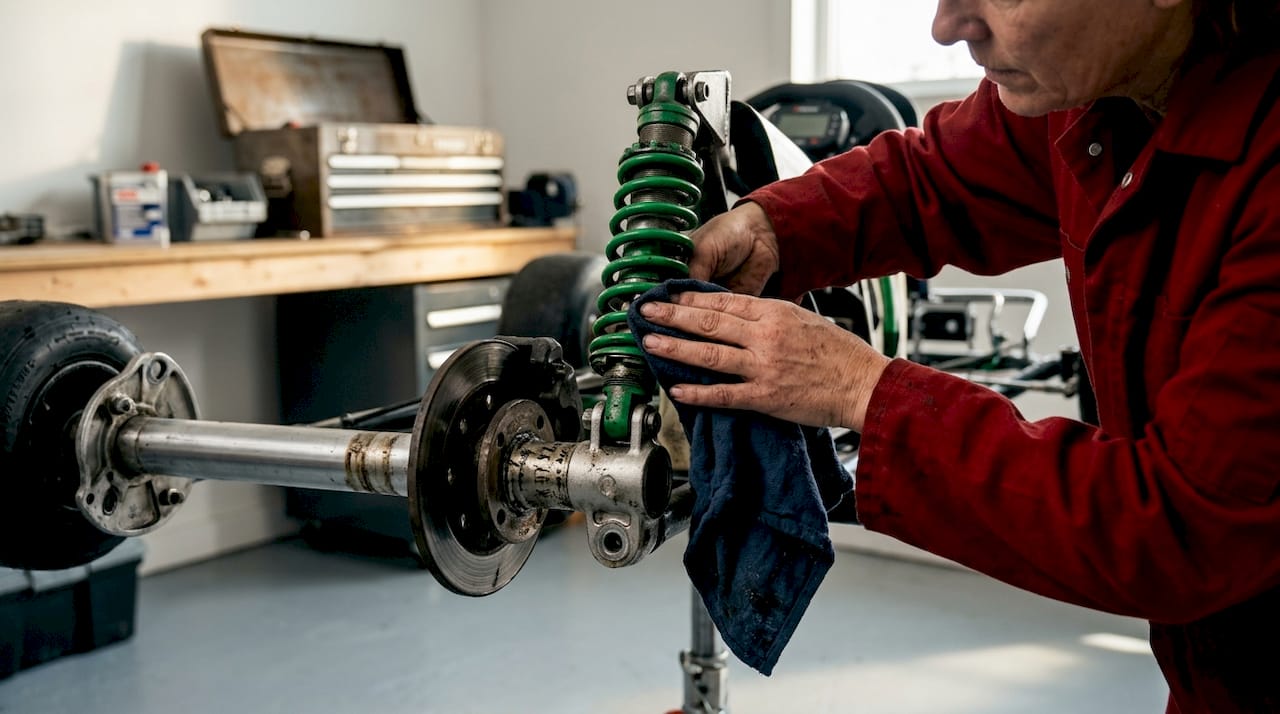
Independent double A-arm suspension is more advanced. Each wheel moves independently, which means one wheel can absorb a bump without affecting the other side of the kart. This translates to noticeably better handling through corners and on rough terrain. It is a popular choice on more performance-focused or off-road karts.
Swingarm suspension is commonly used at the rear of the kart. It pivots from a fixed mounting point, allowing the wheel to travel up and down with terrain changes. It is durable and well-suited for karts that take on moderate off-road use.
Adjustable coilovers allow riders or parents to change the spring preload and shock stiffness to match rider weight or terrain type. This adds a layer of customization that growing kids and enthusiast parents will appreciate over time.
| Suspension type | Complexity | Ride comfort | Handling quality | Best for |
|---|---|---|---|---|
| Solid axle with coilovers | Low | Good | Moderate | Beginners, flat terrain |
| Independent double A-arm | High | Excellent | Advanced | Off-road, older kids |
| Swingarm (rear) | Low to medium | Good | Moderate | Mixed terrain use |
| Adjustable coilovers | Medium | Customizable | Variable | Enthusiasts, growing riders |
For families choosing between these options, here are a few honest trade-offs to consider:
- Simpler setups like solid axle coilovers are easier to repair and less likely to need professional service
- Independent setups offer the best ride quality but come at a higher cost and more maintenance
- Adjustable systems are excellent for riders who change in weight or skill level over time
- All suspended karts beat unsuspended karts for safety when terrain is uneven
It’s also worth noting that some fully suspended karts feature roll cages and are built for riders aged 13 and up with weight limits around 150 lbs. These specs are not arbitrary. They reflect careful engineering decisions around safety margins and structural integrity. For parents browsing affordable go-kart options or looking at the top go-karts for kids, matching the suspension type to the rider’s age and size is just as important as matching the engine.
Suspension vs. no-suspension: Performance trade-offs
Understanding the types of suspension is only half the story. How does actually having or not having suspension change the go-karting experience? The answer depends on where you ride, how often, and who is behind the wheel.
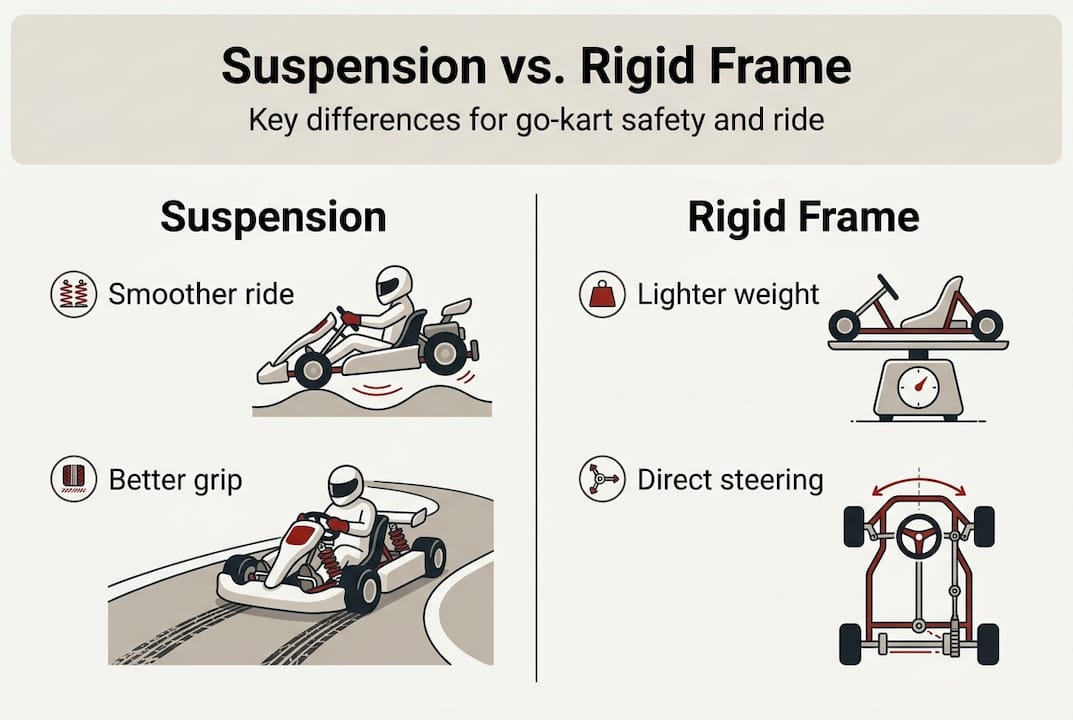
Unsuspended karts, sometimes called “rigid frame” karts, are the standard in competitive racing on smooth asphalt tracks. The lack of suspension actually helps precision handling at high speeds on flat surfaces because the chassis behaves predictably. However, research into go-kart design suggests that weight distribution optimization in unsuspended karts, such as a rear weight bias around 140 kg, can improve cornering stability and traction on controlled surfaces. This works fine for seasoned adult racers on prepared tracks. It does not translate well to a seven-year-old on a bumpy lawn.
For recreational family use, the suspended kart wins on nearly every point that matters.
| Feature | With suspension | Without suspension |
|---|---|---|
| Ride comfort | Smooth, absorbed impacts | Jarring, all bumps felt |
| Driver fatigue | Low, especially over long rides | High, especially for kids |
| Terrain versatility | Excellent on varied ground | Best on flat, smooth surfaces |
| Control on rough terrain | Maintained, tires stay grounded | Reduced, tires can skip |
| Safety for young riders | Higher, less jolting | Lower, more physical strain |
| Maintenance needs | More components to service | Simpler, fewer parts |
When does an unsuspended kart make sense? Here are the situations where skipping suspension is a legitimate choice:
- Competitive track racing where smooth surfaces make suspension unnecessary and rigidity improves handling
- Budget-focused buyers using the kart on flat, paved, or prepared surfaces only
- Low-maintenance priorities where fewer mechanical components mean fewer repair trips
- Adult riders who understand the limitations and ride accordingly
Pro Tip: For family fun on diverse terrain, suspension is a wise investment. The added cost upfront is far smaller than the cost of a shortened riding session, a frustrated child, or a safety incident caused by fatigue and poor control.
The MotoTec Mud Monster 98cc is a real-world example of what full suspension looks like in a family-focused kart. Built for ages 13 and up, it combines a full suspension system with safety-centric design to keep recreational riders comfortable and in control on the kinds of surfaces most families actually ride on. Understanding go-kart performance features and reviewing go-kart safety tips will help you connect those specs to your real-world riding goals.
How to choose the right go-kart suspension for your family
With the big picture in mind, here’s how you can confidently choose a go-kart suspension setup that fits your family’s needs. This is not about finding the most technically advanced option. It’s about finding the right match for your terrain, your riders, and your budget.
Follow these steps before you buy:
- Assess your terrain. Is your primary riding space flat pavement, grass, gravel, or mixed dirt trails? The rougher and more varied the surface, the more important a full, independent suspension system becomes.
- Consider driver age and weight. Younger and lighter riders fatigue faster and have less physical resilience to repeated impact. Match the kart’s suspension rating and weight limits to your child’s current size, not their projected growth.
- Define your riding style. Casual weekend laps around a backyard course have different demands than trail riding through wooded terrain. Recreational trail use calls for more capable suspension.
- Choose your suspension type. For most families starting out, a solid axle coilover setup offers a strong balance of comfort, cost, and reliability. For more adventurous terrain, step up to an independent or adjustable setup.
- Verify safety features alongside suspension. Suspension alone does not make a kart safe. Look for roll cages, padded seats, secure harnesses, reliable brakes, and appropriate speed governors for young riders.
For parents narrowing down their choices, here are the must-have features to look for in a family go-kart:
- Full or partial suspension system rated for the intended terrain
- Roll cage or protective frame structures, especially for younger drivers
- Clear weight and age limits that match your child now, not in two years
- Adjustable components that grow with the rider
- Braking systems that are easy for smaller hands and lighter frames to operate
Models like the MotoTec Mud Monster with full suspension set the standard for what families should expect from a safety-first, off-road capable kart. When you’re ready to start comparing models, our guides on choosing a safe kids’ go-kart, essential safety features, and the benefits of youth go-karts give you a thorough framework for making the right call.
Remember: a child’s skill level, fatigue tolerance, and body size all change quickly. Choosing a kart with adjustable suspension and solid safety specs today means the kart grows with your rider rather than becoming a liability.
Our take: Why most families underestimate go-kart suspension
After walking through the practical steps, here is our perspective as enthusiasts, parents, and experts on where suspension truly fits in your buying priorities.
We hear it often. A parent picks a kart based on engine size or how sharp it looks in a color photo. Suspension gets a quick glance, maybe a “nice to have” checkbox. Then the kart arrives, the kid takes it out on the lawn, and within twenty minutes the complaints start. Too bumpy. My arms are tired. I don’t want to ride anymore. That is not a child being dramatic. That is fatigue talking, and fatigue in a young driver is a real safety risk.
The true cost of skipping suspension is not measured in speed. It is measured in how long your child actually rides, how confident they feel on varied terrain, and how many close calls you avoid because the kart absorbed an impact instead of the driver’s spine. We have seen families spend more on helmets and gear than on kart quality, and then wonder why the excitement fades after a few weekends.
Here’s what we know from real experience: suspension is the feature that turns a go-kart from a novelty into a lasting adventure tool. A child who rides comfortably rides more often. A child who rides more often builds skill, builds confidence, and asks to go back outside. That is exactly the family go-kart bonding experience we are all chasing.
The data backs this up. As confirmed through real product design standards, suspension reduces fatigue and enhances safety in ways that parents consistently recognize as the deciding factor in long-term satisfaction. Fancy speed numbers get attention in the showroom. Suspension quality determines whether the kart stays fun for years.
Our advice is straightforward: if you are buying for a child or a mixed-age family, prioritize suspension and safety features over raw performance specs. The ride quality you give your child today shapes how they feel about the sport tomorrow.
Ready to get rolling? Find your perfect family go-kart
If this guide has made one thing clear, it is that the right suspension setup transforms your go-karting experience from a rough, tiring ride into a smooth adventure your whole family will want to repeat every weekend.

At GokartsUSA.biz, we carry a strong lineup of vehicles built with family riders in mind. The Mini Sport Kids ATV is a fantastic starting point for younger adventurers who need reliability and manageable power. For families ready to step up, the TrailMaster Taurus 200GX delivers impressive performance with comfort built in. And if you want to browse everything we offer and find the model that fits your terrain, your riders, and your budget, explore all go-kart options and take advantage of our seasonal deals, free shipping, and expert support team ready to help you make the right call.
Frequently asked questions
Is suspension necessary for beginner or kid go-karts?
Suspension is strongly recommended for kid karts and recreational use because it ensures smoother, safer rides and reduces driver fatigue, especially on uneven or off-road surfaces where rigid frames transfer every bump directly to the rider.
What is the best go-kart suspension type for families?
For most families, simple coilover or independent double A-arm suspensions deliver the best balance of comfort, adjustability, and safety for kids riding on varied terrain without requiring advanced mechanical maintenance.
Are suspended go-karts slower than unsuspended karts?
There are no definitive lap time comparisons between the two, but weight distribution optimization in rigid frame karts can improve cornering on smooth tracks, while suspended karts prioritize safety, comfort, and control for recreational riders over outright speed.
Can I add suspension to an unsuspended go-kart?
Retrofitting suspension onto a rigid frame kart is technically difficult and often costs more than buying a purpose-built suspended model, so purchasing a kart designed with suspension from the factory is almost always the better route.
What other safety features should parents consider?
Beyond suspension, parents should look for roll cages, age and weight-appropriate ratings, secure harnesses, easy-to-operate brakes, and speed governors that match the skill level and physical size of their young drivers.