




Picking a go-kart for your child feels exciting until the safety questions start piling up. Is it fast enough to be fun but slow enough to be safe? Does it have the right restraints? Will your kid actually fit? The good news is that go-karting injury rate sits at roughly 0.7 per 100,000 sessions, with 78% of those injuries classified as minor. Most serious incidents involve other recreational vehicles entirely. This guide walks you through the features, certifications, and inspection steps that make the difference between a safe ride and a risky one.
Table of Contents
- Understanding go-kart safety: Data, risks, and misconceptions
- Checklist: What to require in a safe go-kart
- Step-by-step: How to assess safety when choosing a go-kart
- Common mistakes and how to avoid them
- Final safety check: Verifying you made the right choice
- Find the safest go-kart models and accessories
- Frequently asked questions
Key Takeaways
| Point | Details |
|---|---|
| Check certifications | Always look for ASTM, UL, and CPSC labels to confirm real safety compliance. |
| Inspect physical safety features | Ensure seat belts, padded controls, and remote shutoff are present and working. |
| Match age and size | Pick go-karts and features appropriate for your child’s age and body type. |
| Supervise every ride | Adult involvement and regular checks are essential for safe go-kart fun. |
| Avoid common mistakes | Don’t skip certifications or allow unsupervised rides; these errors increase risk. |
Understanding go-kart safety: Data, risks, and misconceptions
Before we examine the features themselves, let’s look at what the real risks are and clear up some safety myths. Many parents assume go-karts are inherently dangerous for young kids, but the data tells a more reassuring story.
“The go-karting injury rate is approximately 0.7 per 100,000 sessions, with 78% of incidents classified as minor. The majority of severe childhood recreational vehicle injuries actually involve golf carts, not go-karts.”
That context matters. Go-karts designed for youth use, when paired with proper supervision and certified safety features, carry a relatively low risk profile. What actually drives injury risk upward is the absence of certified restraints, improper sizing, and unsupervised operation.
Here’s what the data and experts consistently highlight:
- Supervision matters more than age alone. Interestingly, adult drivers can be riskier than children in some scenarios because adults tend to push speed limits more aggressively.
- Certified features prevent most severe outcomes. A roll cage, seat belt, and speed governor together address the top injury causes.
- Fit is a safety feature. A go-kart that’s too large for your child creates real control problems. Review youth go-kart age guidelines before you shop.
- Not all recreational vehicles are equal. Golf carts, ATVs, and dirt bikes carry statistically higher injury rates than properly certified youth go-karts.
For a broader overview of buying go-karts safely, start with understanding which certifications actually apply to the model you’re considering. The toy safety standards from ASTM provide the clearest framework for evaluating youth recreational vehicles.
Checklist: What to require in a safe go-kart
Once you know the real risks, it’s vital to ensure your go-kart covers every important safety feature. Use this checklist as your buying baseline.
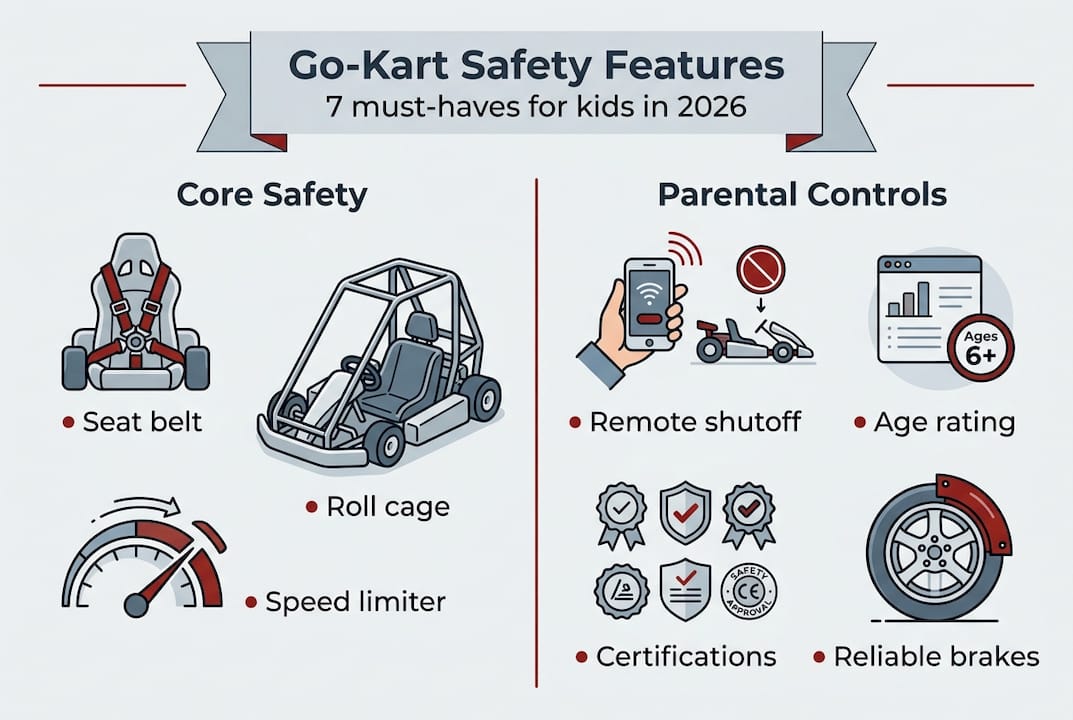
Every safe go-kart for kids or beginners should include these non-negotiable features:
- Seat belt or harness: A three-point or five-point harness keeps your child secured during sudden stops or turns.
- Roll cage or roll bar: Protects the driver if the kart tips. This is especially critical for younger riders.
- Speed governor: Limits top speed so you can match performance to your child’s skill level.
- Padded steering wheel and controls: Reduces impact injury if the driver lurches forward.
- Reliable disc or drum brakes: Responsive braking is the single fastest way to prevent a collision.
- Parental remote shutoff: Lets you cut the engine instantly from a distance. Non-negotiable for young beginners.
- Age and weight-appropriate sizing: A kart that fits properly gives your child real control over steering and braking.
When it comes to certifications, look for these labels on any model you consider:
| Certification | What it covers |
|---|---|
| ASTM F963 | Mechanical hazards, flammability, toxicity for youth products |
| UL 2272 | Electric battery safety, short-circuit and fire protection |
| CPSC/CPSIA | Federal consumer product safety compliance for children’s items |
These key safety certifications are not optional extras. They represent the minimum standard for any go-kart marketed to children. A model missing these labels has not been independently tested for the hazards that matter most.
For more guidance on picking the right model, our guide on how to choose a kids go-kart breaks down top options by age group. You’ll also want to review go-kart safety accessories like helmets and padding that complement built-in features. The safe toy features resource from ASTM also offers a helpful breakdown of what each standard actually tests.
Pro Tip: Before finalizing any purchase, search the CPSC recall database for the specific model name and year. Manufacturers occasionally issue safety updates or recalls that retailers don’t always advertise prominently.
Step-by-step: How to assess safety when choosing a go-kart
A checklist is vital, but step-by-step inspection ensures no detail is left unchecked. Here’s how to use that checklist in the real world.
- Verify safety certification labels. Look for ASTM F963, UL 2272, or CPSC/CPSIA markings on the frame or in the product documentation. If they’re absent, walk away.
- Inspect physical guards and restraints. Pull on the seat belt. Check that the roll cage has no sharp edges or loose welds. Padding should be firm and securely attached.
- Check age and weight ratings. Every certified model lists a recommended age range and maximum weight. Match these to your child, not just their enthusiasm.
- Test the brakes and speed limiter. Ask the seller to demonstrate both. Brakes should engage smoothly without pulling to one side. The speed limiter should cap acceleration noticeably.
- Review parental controls. Confirm the remote shutoff range and test it. A shutoff that only works within 10 feet isn’t useful in an open yard.
- Examine padding and structural integrity. Sit in the kart yourself if possible. Check for flex in the frame, loose bolts, or cracked plastic near the footwell.
- Confirm accessories and visibility aids. Reflectors, bright color options, and flag mounts all improve visibility during outdoor use.
Here’s a quick reference for what’s required versus optional:
| Feature | Required | Optional |
|---|---|---|
| Seat belt or harness | Yes | |
| Roll cage | Yes | |
| Speed governor | Yes | |
| Remote shutoff | Yes (for beginners) | |
| Disc brakes | Yes | |
| Safety flag | Yes | |
| Reflectors | Yes | |
| Helmet included | Yes |
Remember that safety certifications cover mechanical hazards, flammability, toxicity, and age-compatibility risks. A kart that passes all four categories is genuinely safer, not just labeled that way for marketing. Learn more about youth go-kart benefits and review our beginner go-kart tips for first-time buyers.
Pro Tip: Ask the seller for a live demonstration before you buy. Watching the speed limiter and remote shutoff work in real time tells you far more than a product description ever will.
Common mistakes and how to avoid them
A careful inspection is only part of choosing safely. To really protect your family, avoid these common pitfalls parents often overlook.
- Ignoring certifications. The most frequent mistake. A low price tag is not a substitute for ASTM or CPSC compliance. Always check the label.
- Misjudging age and size. A kart built for a 12-year-old is not safe for a 7-year-old, even if the child is tall. Fit affects steering control directly.
- Skipping the remote shutoff. Parents often assume they can run fast enough to intervene. You can’t. A remote shutoff is your actual emergency brake.
- Using go-karts on public roads. Youth go-karts are not street-legal. Public road use exposes your child to traffic hazards the kart was never designed to handle.
- Skipping helmet use. A helmet is not optional. Even at low speeds, a head impact on pavement is serious.
- Buying off-brand products without documentation. Cheap, unbranded karts rarely carry legitimate certifications. If the seller can’t provide documentation, the product hasn’t been tested.
Remember: Only use go-karts on private property or designated tracks, and always look for official safety certifications before purchase. As the go-kart safety guide notes, home use should focus on certifications and fit, while tracks often rely on protective gear and waivers.
The fix for most of these mistakes is simple: slow down the buying process. Spend 10 minutes verifying certifications and fit before you spend hundreds of dollars on the wrong model. Our roundup of affordable go-karts includes only certified options, and our guide to best go-kart types helps you match the right style to your family’s needs.
Final safety check: Verifying you made the right choice
Even after choosing carefully, maintaining safety is an ongoing responsibility. Use this post-purchase checklist to stay vigilant and confident.
- Inspect all safety features before first use. Confirm that seat belts, brakes, and the remote shutoff all function correctly out of the box.
- Review the manual with your child. Go through the rules together. Kids who understand why a rule exists follow it more consistently.
- Set clear rules for usage and supervision. Define where the kart can be used, at what speed, and who must be present. Write it down if needed.
- Schedule regular maintenance. Check brake pads, tire pressure, and bolt tightness every 10 to 15 hours of use. A loose bolt can become a serious hazard fast.
- Update safety gear as kids grow. Helmets and padding that fit a 6-year-old won’t protect an 8-year-old properly. Recheck fit every season.
Here’s a compelling reason to stay current: go-karts with parental controls and recent certifications result in 40% fewer accidents compared to uncertified models used without supervision. That’s not a minor difference. It’s the gap between a fun afternoon and an emergency room visit.
ASTM and UL certifications include ongoing compliance with changing safety benchmarks, which means the standards themselves evolve. Checking for updated guidelines annually keeps your family aligned with the latest protections. Our guide on go-kart safety technology covers the newest features worth looking for in 2026 models.
Find the safest go-kart models and accessories
Now that you’re armed with knowledge and checklists, choosing a certified, safe go-kart is your next step. At GokartsUSA.biz, every model in our youth lineup is selected with the features from this guide in mind: certified restraints, speed governors, and parental controls included.

If you’re ready to browse, the Mini Sport Kids ATV is a popular starting point for younger riders, offering a manageable engine size with solid safety features built in. For families looking for a step up, the Storm 200 Minibike delivers more power with the controls and build quality that experienced beginners need. Both ship with free delivery and come with complimentary safety accessories during current promotions. Browse the full catalog and filter by age group to find the right fit for your family.
Frequently asked questions
What is the most important feature for go-kart safety?
A combination of certified seat belts, a remote shutoff, and reliable brakes provides the strongest protection. Look for models carrying ASTM F963 and CPSC compliance labels as your baseline.
How can I verify a go-kart is safe for my child?
Check for ASTM, UL, and CPSC certification labels on the frame or in the product manual, then confirm the kart’s age and weight rating matches your child. ASTM and CPSC testing covers the most critical mechanical and chemical hazards for children.
Are electric go-karts safer than gas models?
Both types can be equally safe when properly certified. Electric models specifically need UL 2272 certification to confirm that the battery system is protected against fire and short-circuit risks.
What common mistakes do parents make with go-karts?
The most frequent errors include skipping certification checks, choosing a kart that’s too large for the child, and allowing unsupervised use. The go-kart safety guide identifies missing certifications and lack of supervision as the top contributing factors in preventable incidents.
How often should I check go-kart safety features?
Inspect brakes, restraints, and the remote shutoff before every single ride. ASTM and UL compliance standards evolve over time, so reviewing product updates or recalls at least once a year is also a smart practice.