




TL;DR:
- Understanding off-road angles such as approach, breakover, and departure is essential for selecting the right vehicle and trail safety. Lockers, LSDs, and traction aids significantly improve vehicle capability by enhancing wheel traction in difficult conditions. Familiarity with terminology like airing down tires and skid plates helps families make safer, smarter decisions for off-road adventures.
Misreading a trail is one thing. Misunderstanding the vocabulary that describes it is another thing entirely. Whether you’re a seasoned rider who still gets tripped up when someone shouts “lock it up!” on a rocky climb, or a parent trying to figure out what engine size is actually safe for your ten-year-old, off-road terminology can feel like a foreign language. The good news is that once you understand these terms, everything from buying decisions to trail safety gets sharper, smarter, and a whole lot more fun.
Table of Contents
- Off-road angles: Approach, breakover, and departure explained
- Lockers, LSDs, and traction aids: The backbone of off-road capability
- Airing down tires and skid plates: Practical upgrades for more adventures
- Youth off-road vehicles: Engine size, CPSC guidelines, and terminology for safe family fun
- Why off-road jargon matters more than tech specs
- Find your next off-road adventure vehicle
- Frequently asked questions
Key Takeaways
| Point | Details |
|---|---|
| Off-road angles matter | Understanding approach, breakover, and departure angles helps prevent damage and choose the right vehicle. |
| Traction upgrades explained | Lockers and LSDs offer different benefits for challenging terrain and daily use. |
| Airing down boosts grip | Reducing tire pressure is a simple way to gain traction on soft surfaces. |
| Youth safety guidelines | Follow CPSC recommendations for engine sizes, helmets, and training for kids. |
| Terminology unlocks confidence | Knowing the lingo helps you shop, ride, and connect safely with off-road communities. |
Off-road angles: Approach, breakover, and departure explained
When most people think about buying an off-road vehicle, they focus on horsepower, suspension travel, and price. But three geometric measurements quietly determine whether your rig will crawl over obstacles or get stuck on them. These are approach angle, breakover angle, and departure angle.
The approach angle is the maximum angle a vehicle can climb without the front bumper hitting the ground. Picture rolling toward a steep dirt bank. The approach angle tells you exactly how steep that bank can be before your front end bottoms out and kills your momentum. Vehicles with high ground clearance and short front overhangs naturally earn better approach angles.
The departure angle works in reverse. It is the maximum angle a vehicle can descend without the rear end dragging or hitting the ground. Tow hitches, spare tire mounts, and long rear overhangs are notorious for killing departure angle ratings. Even a few degrees of difference matters when you’re dropping off a ledge on a trail.
Then there is the one that catches most riders off guard: the breakover angle. This is the maximum angle of a peak or hump the vehicle can cross without the underside hitting. It is the middle-ground measurement, and it directly depends on your wheelbase and ground clearance. You can use a breakover angle calculator to estimate your specific vehicle’s rating before hitting unfamiliar terrain.
Here is a quick visual reference for all three:
| Angle | What it measures | Key factor |
|---|---|---|
| Approach | Front entry onto an incline | Front overhang length |
| Breakover | Cresting a peak or ridge | Wheelbase and clearance |
| Departure | Rear exit off a decline | Rear overhang length |
To put this into real-world terms, imagine driving over a rounded boulder field. A vehicle with a poor breakover angle will high-center, meaning the chassis rests on the rock while all four tires lose contact with the ground. That is not just frustrating; it can damage oil pans, skid plates, and exhaust systems. Understanding these numbers before you ride helps you choose the right trail and the right machine.
Here are the key real-world applications for these angles:
- Rock crawling demands high breakover angles and strong approach angles.
- Sand dunes prioritize departure and approach to avoid nose-diving.
- Forest trails with roots and ridges challenge breakover most frequently.
- Steep descents push departure angle limits, especially on heavier rigs.
Pro Tip: A shorter wheelbase improves breakover angle significantly, but it also reduces stability at speed. Youth ATVs and smaller trail vehicles benefit from shorter wheelbases for obstacle clearance, while longer wheelbases offer smoother high-speed rides. Match the wheelbase to your primary terrain, not just your preference.
Pairing this knowledge with a solid safe riding guide ensures that geometric understanding translates directly into safer decisions on the trail. Building a foundation with geometric terms, let’s move into the mechanical features that drive off-road success.
Lockers, LSDs, and traction aids: The backbone of off-road capability
Traction is everything off-road. And the system that manages how your wheels receive power is called the differential. Standard open differentials send power to the wheel with the least resistance, which sounds logical but causes major problems in mud or on rocks because one spinning, planted wheel gets all the torque while the stuck wheel gets nothing.
That’s where locking differentials come in. Lockers force both wheels on an axle to rotate at the same speed, regardless of traction conditions. If one wheel is dangling in the air and the other is planted, both receive equal power. The result is dramatically improved traction in extreme conditions like rock crawling, deep mud, and steep climbs. Understanding 4x4 differentials in detail helps you appreciate why this matters so much.
There are three primary types of lockers:
- Selectable lockers are manually activated by the driver, usually via a switch or lever. These give you full control over when to lock up and when to leave the differential open for normal driving.
- Automatic lockers engage independently when wheel slip is detected. They disengage automatically on smooth roads, which makes them convenient but occasionally unpredictable during cornering.
- Manual lockers require physical engagement, typically through a cable or linkage. These are durable and reliable but demand more awareness from the rider.
Limited-slip differentials (LSDs) sit between open diffs and full lockers. An LSD transfers more torque to the wheel with better traction but does not lock both wheels completely. Think of LSDs as the balanced choice for mixed terrain riders who want improved traction without sacrificing cornering behavior on hardpack or pavement.
Electronic traction aids, meanwhile, use sensors and brake intervention to mimic locking behavior without any mechanical changes. They work well for mild conditions and casual trail riding, but they typically can’t match the raw capability of a mechanical locker in extreme scenarios.
| System | Best use | Trade-off |
|---|---|---|
| Full locker | Rock crawling, extreme mud | Difficult cornering when locked |
| LSD | Mixed terrain, general off-road | Limited extreme traction |
| Electronic traction aid | Mild trails, casual riding | Slower response, heat sensitive |
Pro Tip: If you’re comparing two ATVs for a family purchase and one has an electronic traction control system while the other has a selectable locker, the selectable locker usually wins for serious off-road use. For casual family trails, the electronic system is perfectly adequate and easier to manage.
Deciding between an ATV and another powersports vehicle also shapes which traction system is most relevant. Our breakdown of ATV vs mini bike safety can help you think through the right choice for your family’s riding style. If mini bikes are catching your eye, the mini bike beginner guide walks you through the basics with the same clarity we’re building here. After understanding traction, let’s look at how tire and underbody modifications further enhance off-road adaptability.
Airing down tires and skid plates: Practical upgrades for more adventures
Two of the most talked-about yet frequently misunderstood upgrades in off-roading are tire pressure management and underbody protection. Neither requires expensive shop time. Both can make a massive difference on the trail.
Airing down means reducing tire pressure to increase the contact patch for better traction on loose terrain like sand, mud, and rocks. When you deflate a tire partially, the sidewall flexes and the footprint of the tire gets wider and longer. That extra contact area grips terrain that would otherwise cause a hard, round tire to bounce or spin out.
Here is where and when airing down makes the biggest difference:
- Sand dunes and beaches: Dropping from 30 PSI down to 12-15 PSI can prevent sinking and bogging dramatically.
- Muddy trails: Soft tires dig in and grip instead of hydroplaning over the surface.
- Rocky terrain: A aired-down tire wraps around rock faces, giving traction where a hard tire would slip.
- Snow: Similar to sand, lower pressure spreads weight and improves traction.
The important detail most guides skip: you must air back up before returning to pavement. Running low-pressure tires on hard roads generates heat, wears tires unevenly, and can cause dangerous handling. Always carry a portable air compressor or a CO2 inflation kit for the return trip.
Skid plates are protective panels mounted under the vehicle to shield the oil pan, transmission, fuel tank, and other critical components. Rock strikes, stumps, and even aggressive whoops (rhythmic mounds on a trail) can send debris into vulnerable underside components without warning. A quality skid plate turns a potential engine-killing impact into a harmless scrape.
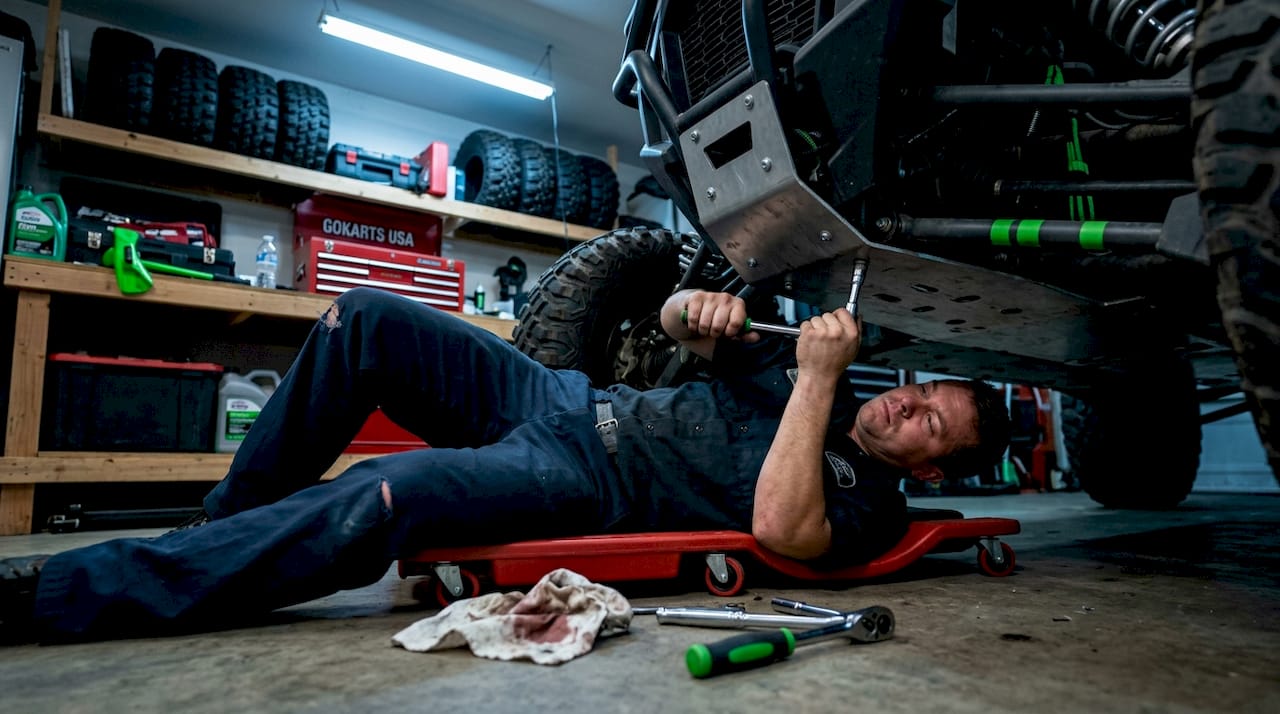
Pro Tip: Many entry-level off-road vehicles come with minimal plastic belly skids that look protective but offer little real defense. If you’re hitting rocky trails with any regularity, upgrading to aluminum or steel skid plates is one of the smartest investments you can make. Check what’s included with your vehicle before your first serious ride.
For families thinking about youth vehicles, proper sizing matters just as much as protective equipment. Our guide on go-kart size and age breaks down the relationship between rider height, weight, and vehicle dimensions. And if you’re leaning toward ATVs for younger riders, the resource on entry-level ATVs for kids covers what to look for when safety is the top priority. Now that we’ve covered technical upgrades, many readers are parents shopping for youth vehicles. Let’s break down child-focused terminology and safety guidelines.
Youth off-road vehicles: Engine size, CPSC guidelines, and terminology for safe family fun
Parents researching youth ATVs often encounter a wall of numbers and abbreviations. Engine displacement in cc (cubic centimeters), throttle limiters, CPSC guidelines (Consumer Product Safety Commission), and gear terminology can feel overwhelming fast. We want to make this simple and clear.
The CPSC recommends age-based engine sizes for youth ATVs: under 70cc for children under 12, and no more than 90cc for riders still in that under-12 age range. Helmets are always required, passengers are prohibited on single-rider ATVs, and rider training courses are strongly encouraged before any solo riding begins.
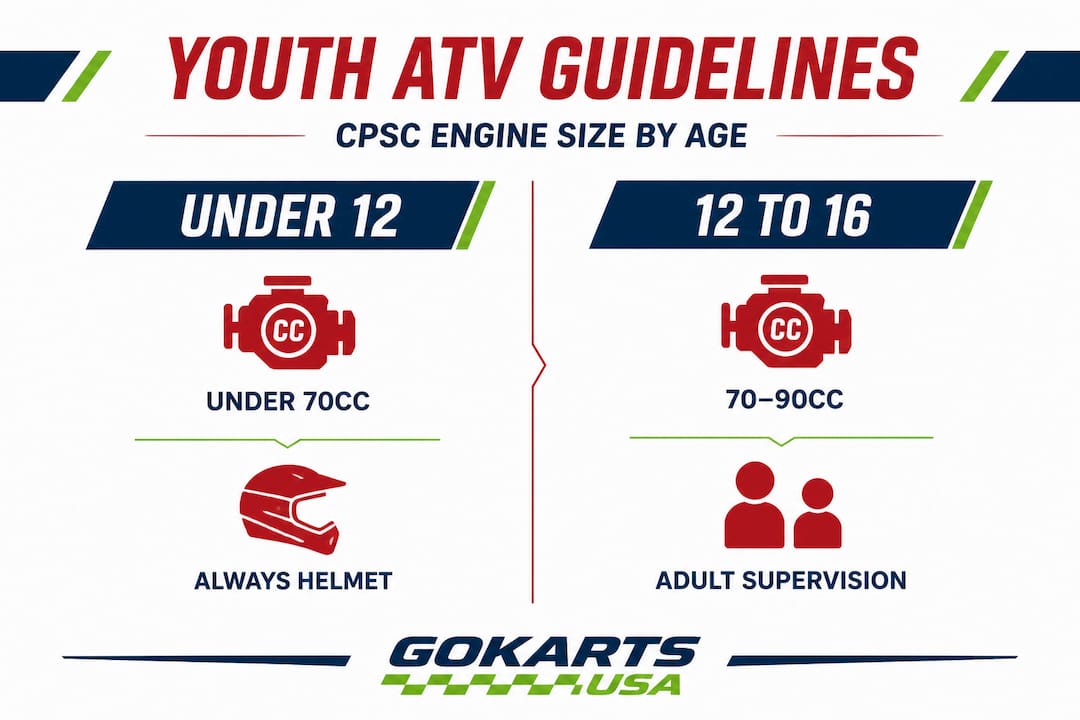
| Rider age | Recommended engine size | Key safety requirement |
|---|---|---|
| Under 6 | Not recommended | Adult supervision always |
| 6 to 11 | Up to 70cc | Helmet, full gear, supervision |
| 12 to 15 | 70cc to 90cc | Helmet, training course |
| 16 and older | 90cc to 150cc+ | Helmet, adult awareness |
Here are key youth riding terms every parent should know:
- Throttle limiter: A mechanical device that restricts maximum engine speed, allowing parents to cap how fast a youth vehicle can go.
- Kill switch: An emergency cutoff that immediately kills the engine, often attached to a tether worn by the rider.
- Automatic transmission: Standard on most youth ATVs; no clutch required, making operation simpler and safer for beginners.
- Training wheels: Some youth ATVs include these stabilizers to prevent tipping during learning phases.
- Heel guards: Footrest attachments that prevent feet from sliding into moving parts.
Pro Tip: Ignoring CPSC age and engine guidelines does not just raise injury risk; it can also affect insurance coverage and product warranty terms. Always match the vehicle to the rider’s age, size, and experience, not what they think they’re ready for.
Our dedicated youth ATV safety guide covers these specifications in even more depth. And for parents starting with go-karts rather than ATVs, the kids go-kart safety tips resource helps narrow down the right choice for your child’s first ride. With key terms for youth vehicles covered, let’s wrap up with real-world wisdom you won’t find in standard manuals.
Why off-road jargon matters more than tech specs
Here is something we have seen play out more times than we care to count: a rider buys a genuinely capable machine, ignores the terminology in the manual, and ends up either stranded or with a repair bill that hurts. The specs looked great on paper. The misunderstanding was in the language.
The most expensive ATV on the market cannot protect you if you don’t know what a breakover angle is before cresting a sharp ridge. Knowing the term means you know to scout the obstacle first, check your wheelbase, and decide whether to cross it or go around it. That decision tree only works if the vocabulary is already in your head.
We see the same pattern with families. Parents invest in solid safety gear and quality youth vehicles, but skip the shared vocabulary. When a parent can’t explain to a child what a kill switch is for or why the throttle limiter is set where it is, the safety conversation breaks down. Shared terminology is shared understanding, and shared understanding is what builds confidence on the trail.
Most manuals do cover these terms, but they bury them in dense technical language and treat definitions as afterthoughts. The real-world context, knowing when to air down, when to lock the diff, when your departure angle is about to become a problem, that context only comes from genuinely engaging with the vocabulary. Read our overview of ATVs for kids to see how we translate technical knowledge into practical family guidance.
The riders who thrive off-road are not always the ones with the most powerful rigs. They are the ones who understood the terrain, understood their machine, and knew exactly what to do when conditions got tough.
Find your next off-road adventure vehicle
You have done the learning. Now let’s talk about the riding. At GoKarts USA®, we believe every great adventure starts with the right machine and the confidence to operate it safely.

If you’re looking for a youth-friendly option built around CPSC safety guidelines, the Mini Sport Kids ATV is an excellent starting point. With a 110cc gas engine, automatic transmission, and a throttle limiter built in, it puts everything we covered today into practice. For families who want a versatile ride beyond single-track trails, the TrailMaster Taurus golf cart offers comfort, reliability, and the freedom to explore wider terrain together. Browse our full lineup and let the adventure find you.
Frequently asked questions
What does approach angle mean for off-road vehicles?
The approach angle indicates the steepest incline your vehicle can climb without the front bumper striking the ground, making it a critical measurement for trail selection.
Why is airing down tires important for off-roading?
Lowering tire pressure increases the tire’s contact patch, which dramatically improves traction on loose terrain like sand, mud, or rocks where a hard tire would bounce or spin.
What engine size is safe for youth off-road vehicles?
The CPSC recommends under 70cc for children under 12 and up to 90cc for older youth riders; helmets are always required and adult supervision is strongly advised for every ride.
What’s the difference between lockers and LSDs?
Locking differentials force both wheels on an axle to spin at the same speed for maximum traction, while LSDs transfer torque more flexibly to balance traction across mixed terrain conditions.
Recommended
- - GoKarts USA®
- ATV safety explained: essential tips for smarter riding – GoKarts USA®
- Understand go-kart terminology for safe, smart choices – GoKarts USA®
- Top benefits of ATVs for outdoor fun and family recreation – GoKarts USA®
- Vehicle branding explained: transform your ride with overlays
- Tips to maintain wheels and tires - CDC Detailing