




TL;DR:
- Understanding go-kart parts and terminology helps buyers make confident, informed decisions.
- Safety features like roll cages, kill switches, and proper harnesses are essential before purchasing.
- Engine size and power should match the rider’s age and skill level to ensure safe, fun family rides.
Shopping for a go-kart for the first time feels exciting until the product descriptions start throwing words like “chassis flex,” “sprocket,” and “torque” at you. Most families assume go-kart terms work just like car terms. They don’t. Go-karts are a unique breed of machine, and their vocabulary reflects that. Knowing what these words actually mean puts you in control, whether you’re buying your child’s first kart or planning a weekend adventure with the whole family. We put this guide together so you can walk into any purchase with real confidence, not just a guess.
Table of Contents
- Key go-kart parts and their names explained
- Breaking down go-kart chassis, frames, and handling terms
- Go-kart engines, power, and performance terms for families
- Safety, accessories, and must-know terms before buying
- A fresh take: The most misunderstood go-kart terms and what really matters
- Shop with confidence: Find the right go-kart and gear
- Frequently asked questions
Key Takeaways
| Point | Details |
|---|---|
| Learn essential terms | Knowing the right terminology helps you choose a safe and reliable go-kart for your family. |
| Chassis design matters | Go-karts rely on their frame flex and setup for handling and turning in place of a car’s differential. |
| Safety first for families | Critical safety features like seat belts, kill switches, and roll cages should guide your purchase. |
| Match power to experience | Select engine sizes and power levels that are appropriate for kids or new drivers. |
| Accessories improve the ride | Understanding accessory terms helps you customize comfort and safety before you buy. |
Key go-kart parts and their names explained
Before you can make a smart choice, you need to know what you’re looking at. Go-karts share some names with cars, but the parts work very differently. Let’s break down the terms you’ll see most often.
The chassis is the main frame of the kart. Think of it as the skeleton everything else attaches to. Unlike a car frame, a go-kart chassis is designed to flex intentionally, and that flex plays a big role in how the kart handles turns. The axle is the shaft that connects the rear wheels and transfers power from the engine to the ground. A sprocket is a toothed wheel that works with the chain to move that power from the engine to the axle. You won’t find a sprocket in a standard car, but it’s central to how go-karts drive.
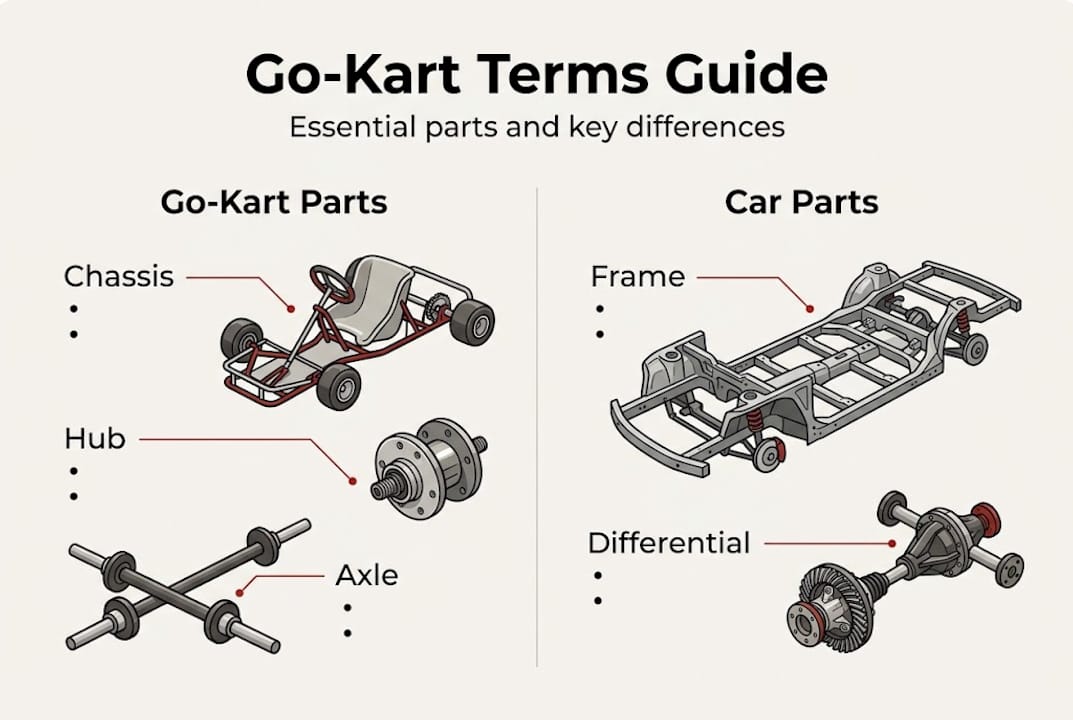
The hub is the component that connects each wheel to the axle or spindle. The tie rod links the steering wheel to the front wheels, controlling direction. These two parts directly affect how safe and responsive a kart feels, especially for younger or newer riders. You can explore a full go-kart parts breakdown to see how each piece fits together.
Here’s a quick comparison to help you see the differences clearly:
| Go-kart term | Car equivalent | Key difference |
|---|---|---|
| Chassis | Frame/unibody | Designed to flex for turning |
| Sprocket | Transmission gear | Chain-driven, exposed |
| Axle | Rear axle | Solid, no differential |
| Hub | Wheel hub | Simpler, bolt-on design |
| Tie rod | Tie rod | Similar function, simpler build |
One thing that surprises many families is that go-karts have no differential, meaning the rear wheels are locked together on one solid axle. In a car, the differential lets each rear wheel spin at a different speed through turns. In a kart, chassis flex and setup handle that job instead. It’s a clever engineering solution, but it means go-kart handling feels nothing like driving a car.
Pro Tip: Many buyers confuse the go-kart axle with a car’s rear axle and expect similar behavior. Because go-karts use a solid axle with no differential, the kart actually lifts the inner rear wheel slightly through corners. This is normal and intentional. Knowing this helps you understand why types of go-karts handle so differently from one model to the next, and why go-kart tire basics matter more than most people expect.
Breaking down go-kart chassis, frames, and handling terms
The chassis is where go-kart engineering gets genuinely fascinating. For families, understanding a few key chassis terms can be the difference between a kart that’s fun and one that’s frustrating or unsafe.
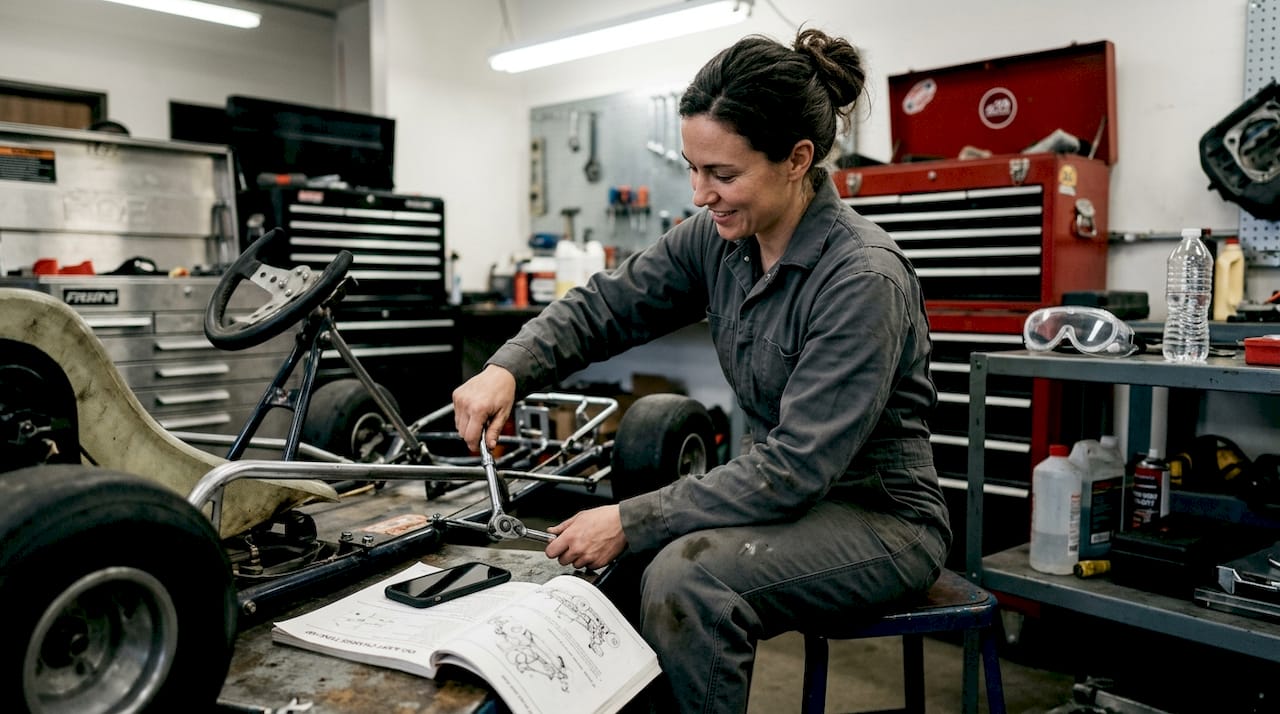
Rigidity and stiffness describe how resistant the chassis is to bending under load. A stiffer chassis transfers more force directly to the wheels, which can improve grip on smooth tracks. Flex, on the other hand, refers to how much the frame bends during cornering. More flex generally means better grip on rough or uneven surfaces, which matters a lot for backyard or recreational riding.
Wheelbase is the distance between the front and rear axles. A longer wheelbase gives more stability at higher speeds, while a shorter wheelbase makes the kart more nimble and easier to turn. For kids and beginners, a shorter wheelbase often means a more responsive, easier-to-control ride.
Here’s how these terms affect real-world handling:
| Chassis term | What it means | Effect on ride |
|---|---|---|
| High rigidity | Frame resists bending | Better on smooth surfaces |
| High flex | Frame bends slightly | Better on rough terrain |
| Long wheelbase | More distance front to rear | More stable at speed |
| Short wheelbase | Less distance front to rear | More responsive, easier turns |
The reason chassis design matters so much comes back to that solid axle we mentioned. Because go-karts have no differential mechanism, the frame itself must compensate for the difference in wheel speed through corners. A well-tuned chassis lifts the inner rear wheel just enough to allow smooth turning. Too stiff, and the kart pushes wide. Too flexible, and it feels loose and unpredictable.
“The chassis in a go-kart does the work that a differential does in a car. Getting that balance right is what separates a great ride from a frustrating one.”
For families focused on performance features in go-karts, understanding chassis terms helps you ask the right questions before buying. And if you ever want to dial in the ride after purchase, knowing these basics makes improving go-kart performance a much less intimidating process.
Go-kart engines, power, and performance terms for families
Engine terminology is where many parents feel most lost. Words like “displacement,” “horsepower,” and “torque” sound technical, but they’re actually straightforward once you break them down.
Displacement refers to the size of the engine, measured in cubic centimeters (cc). A 50cc engine is small and gentle, ideal for young children. A 125cc or larger engine produces significantly more power and is better suited for teens or adults. Horsepower measures how much work the engine can do over time. More horsepower means higher top speed. Torque measures pulling force, which affects how quickly the kart accelerates from a stop. For younger riders, strong torque can actually feel more intense than high horsepower.
The clutch is a critical component that connects and disconnects the engine from the drivetrain. Go-karts use either a centrifugal clutch, which engages automatically as engine speed rises, or a torque converter, which adjusts smoothly across a range of speeds. Centrifugal clutches are common on kids’ karts because they require no manual input.
Here’s what to consider when choosing an engine for family use:
- Match displacement to the rider’s age and weight, not just their enthusiasm.
- Look for a governor or speed limiter that lets you cap the top speed.
- Choose a centrifugal clutch for beginners since it’s automatic and forgiving.
- Prioritize torque control over raw horsepower for younger riders.
- Check whether go-kart performance upgrades are available if your child grows into a faster ride.
Higher power is not always better for families. A 200cc kart can reach speeds that are genuinely dangerous for a child with no experience. Matching the engine to the rider protects everyone and keeps the adventure fun rather than frightening. Proper maintaining your go-kart routines also keep the engine running safely over time.
Pro Tip: A simple way to check if a go-kart is too powerful for a beginner is to look at the kart’s top speed relative to the rider’s age. Most safety guidelines recommend no more than 15 mph for children under 8, and no more than 25 mph for kids aged 8 to 12. If the kart’s listed top speed exceeds those numbers without a governor, keep looking.
Safety, accessories, and must-know terms before buying
Safety terms are the most important vocabulary in this entire guide. No amount of performance knowledge matters if you skip this section.
A roll cage is a protective frame that surrounds the driver and reduces injury risk if the kart tips or rolls. Not every go-kart includes one, but for younger riders and off-road use, it’s a feature we strongly recommend. The kill switch is an emergency shutoff that cuts engine power instantly. It should be easy to reach from the driver’s seat and, on kids’ karts, ideally accessible to a parent nearby as well.
A seat belt on a go-kart works differently than in a car. Most kart seat belts are simple lap belts or five-point harnesses. Five-point harnesses offer far more protection and are worth the extra cost for children. Bumpers are protective bars mounted at the front and rear of the kart to absorb impact during low-speed collisions. Footpegs or footrests keep the driver’s feet in a safe, controlled position away from moving parts.
Because go-karts have no differential, the chassis and safety features work together to protect riders during turns and unexpected maneuvers. Understanding both systems helps you evaluate any kart more confidently.
Here’s a quick pre-purchase safety checklist:
- Roll cage or protective frame present
- Working kill switch within easy reach
- Seat belt or harness included and properly rated
- Front and rear bumpers installed
- Footpegs or footrests secured and positioned correctly
- Speed governor or remote cut-off available for kids’ models
- Helmet compatibility confirmed with your existing gear
For a deeper look at getting started safely, our safe entry-level karting guide walks you through everything step by step. You can also browse must-have go-kart accessories to make sure your setup is complete before the first ride. And if you want to understand why safety matters most in the broader context of go-karting, that resource is worth your time.
A fresh take: The most misunderstood go-kart terms and what really matters
Here’s something we’ve learned from years of helping families find the right kart. Most people spend too much time worrying about terms like “chassis stiffness ratings” or “gear ratio optimization” and not nearly enough time on the basics that actually protect their family.
The truth is, you don’t need to memorize every engineering term to make a great choice. What you need is a clear understanding of safety features, engine size relative to rider age, and how the chassis flex system affects control. Those three areas cover 90% of what matters for recreational family use.
Some sellers lean heavily on technical jargon to make a kart sound more impressive than it is. A high-sounding displacement number or a vague reference to “professional-grade chassis tuning” can distract you from asking whether the kart actually has a kill switch or a speed limiter. We believe simple knowledge beats memorized jargon every time. Staying focused on the terms covered in this guide and revisiting confident go-kart maintenance practices will serve your family far better than chasing specs that only matter on a race track.
Shop with confidence: Find the right go-kart and gear
Now that you’ve got the terminology down, it’s time to put that knowledge to work. At GokartsUSA.biz, we make it easy to find a kart that matches your family’s needs, experience level, and budget.
If you’re shopping for a younger rider, the Mini Sport Kids ATV is a great starting point, built with safety and fun in mind. Need to complete your setup with the right accessories? Our pocket bike footpegs and other parts help you customize for comfort and safety. Browse our full lineup of all go-kart options to find the perfect fit. We’re here as your pit crew and fellow riders, ready to fuel your family’s next adventure.
Frequently asked questions
What does ‘chassis flex’ mean in go-karting?
Chassis flex describes how a go-kart frame bends slightly during turns to compensate for the lack of a differential, helping the kart corner smoothly without locking up the rear wheels.
What safety features should I check before buying a go-kart for my child?
Always look for a roll cage, a working kill switch, a seat belt or harness, sturdy front and rear bumpers, and a parental remote cut-off or speed governor before committing to any purchase.
Is a higher horsepower always better for kids’ go-karts?
Not at all. Too much power creates real safety risks for beginners, so matching engine size to age and experience level is always the smarter move.
What are the main differences between go-kart and car parts?
Go-karts use a solid rear axle with no differential, rely on chain-driven sprockets instead of a transmission, and feature a flexible chassis that handles cornering in ways a car frame never needs to.