




TL;DR:
- Matching go-kart size to a child’s age and development is crucial for safety and confidence.
- Racing standards and track regulations enforce age-appropriate kart classes based on physical and developmental milestones.
- Selecting the correct size supports skill building and prevents accidents caused by controlling mismatched karts.
Picking a go-kart for your child feels exciting, and it should be. But many families walk into that decision believing any kart that looks cool will do the job. That assumption creates real risks. Children grow fast, their coordination develops in stages, and a kart that’s too big or too powerful can shake their confidence, reduce their control, and increase the chance of accidents. Industry standards, racing authorities, and safety experts all agree: matching go-kart size to your child’s age and developmental stage is not optional. It is the foundation of both safety and genuine fun.
Table of Contents
- The science behind size: How age and growth impact go-kart fit
- Regulations and standards: What racing classes and tracks require
- Choosing the right size: Practical age-based selection guide
- Common mistakes: Pitfalls to avoid when choosing go-kart sizes
- What most families miss about go-kart sizing and age
- Find the best go-kart for each age at GoKarts USA
- Frequently asked questions
Key Takeaways
| Point | Details |
|---|---|
| Age determines go-kart size | Matching your child’s age to go-kart size is vital for safety, comfort, and skill development. |
| Racing classes set age rules | Experienced organizations require age-based separation for go-kart power and speed levels. |
| Avoid sizing ‘up’ too soon | Buying a bigger go-kart for your child to ‘grow into’ can compromise safety and enjoyment. |
| Always check for a proper fit | Test seating and controls before purchasing or renting to ensure your child can safely operate the go-kart. |
The science behind size: How age and growth impact go-kart fit
Children are not small adults. A five-year-old and a twelve-year-old may both love the idea of racing, but their bodies, reflexes, and judgment are worlds apart. Leg length, arm reach, grip strength, and reaction time all change dramatically between ages 5 and 14. A kart sized for a teenager will have a seat position, steering wheel distance, and pedal placement that simply does not match a younger child’s body. That mismatch forces kids to overreach, strain, or guess at controls, which is exactly when accidents happen.
Adjustable seats and movable pedals help a great deal with growing children. However, those features can only stretch so far. A kart built for a 12-year-old is not just “bigger.” It typically carries more power, higher speeds, and heavier chassis weight than a younger child can safely manage. Even with the seat slid forward, the fundamental speed and weight characteristics of the kart remain unchanged.
Rental tracks understand this well. They sort drivers into entry-level go-karting for kids categories based on age and physical size, not just height alone. Those categories exist because age and height charts guide proper pedal kart matching, and rental tracks apply junior and adult class divisions with speed limits and required supervision to enforce exactly that standard.
Here is a quick look at the physical milestones that shape fit requirements:
- Ages 4 to 6: Limited grip strength, short legs, minimal spatial awareness at speed
- Ages 7 to 11: Rapidly improving coordination but still developing depth perception and reaction time
- Ages 12 to 14: Near-adult reflexes in many cases, but still growing into full body control
- Ages 14 and up: Approaching adult physical capability, ready for more powerful machines
“An ill-fitting go-kart does not just feel uncomfortable. It removes a child’s ability to react quickly and precisely, which is the single most important safety tool they have while driving.”
Pro Tip: Before any purchase or rental, have your child sit in the kart and check three things. Their elbows should be slightly bent when holding the wheel. Their feet should rest flat on the pedals without stretching. And they should be able to turn the wheel smoothly in both directions without leaning their body.
Regulations and standards: What racing classes and tracks require
Racing authorities do not leave age-appropriate sizing to guesswork. Organizations like CIK-FIA (Commission Internationale de Karting under the FIA) have built entire class structures around age and developmental capability. These are not arbitrary categories. They are built from years of competition data, injury records, and performance research.
The CIK-FIA class system enforces strict age minimums tied directly to performance levels. The 60 Mini class serves drivers under 12, featuring lighter and slower karts. The OKN-Junior class covers ages 12 to 14, stepping up speed and chassis weight accordingly. The OK-N class opens at age 14 and beyond, matching young drivers ready for adult-level performance. Allowing an 11-year-old to race in the OKN-Junior class has been widely criticized as unsafe by coaches and officials throughout the sport.
These classes reflect what we know about why age matters in youth go-karts: speed management, reaction time, physical strength, and decision-making all develop on a timeline that cannot be rushed by enthusiasm alone.
Recreational facilities use the same logic. Most family tracks separate young drivers into clearly defined age groups and match speed limits and supervision requirements to each group. This is not about limiting fun. It is about creating conditions where real skill can build safely and confidently.
| Age group | Racing class equivalent | Typical speed range | Supervision required |
|---|---|---|---|
| Under 7 | Beginner/Pedal karts | Under 10 mph | Direct adult supervision |
| 7 to 11 | Youth/Junior class | 10 to 25 mph | Track staff or parent nearby |
| 12 to 14 | OKN-Junior equivalent | 25 to 45 mph | Supervised track environment |
| 14 and up | Adult/OK-N equivalent | 45 mph and above | Standard track rules apply |
“Racing classes exist because experience taught us that matching power to age is not a preference. It is a prerequisite for safe development.”
Pro Tip: When visiting a local karting facility, ask specifically which class your child qualifies for based on age and weight combined, not just height. Many tracks use weight as an additional safety parameter, especially for motorized junior karts. This is the same standard used in the parent go-kart safety guide we recommend to every family starting out.
Choosing the right size: Practical age-based selection guide
Knowing the standards is one thing. Choosing the right kart at the store or online is another. Let’s make this practical. Here is a clear framework families can use to match a go-kart to their child’s age and physical stage right now.
| Age range | Recommended kart type | Height range | Max speed to look for | Key feature |
|---|---|---|---|---|
| 4 to 6 years | Pedal or low-power electric | 36 to 48 inches | Under 10 mph | Adjustable seat, safety belt |
| 7 to 11 years | Youth gas or electric motor | 48 to 58 inches | 10 to 25 mph | Speed limiter, roll cage |
| 12 to 14 years | Junior motor kart | 58 to 65 inches | 25 to 45 mph | Disc brakes, padded frame |
| 14 and up | Adult kart or advanced junior | 65 inches and above | 45 mph and beyond | Full safety harness, performance tires |
These ranges align with what age and height charts recommend for matching pedal karts and motorized karts to growing kids, with adjustable seating considered alongside overall chassis fit.
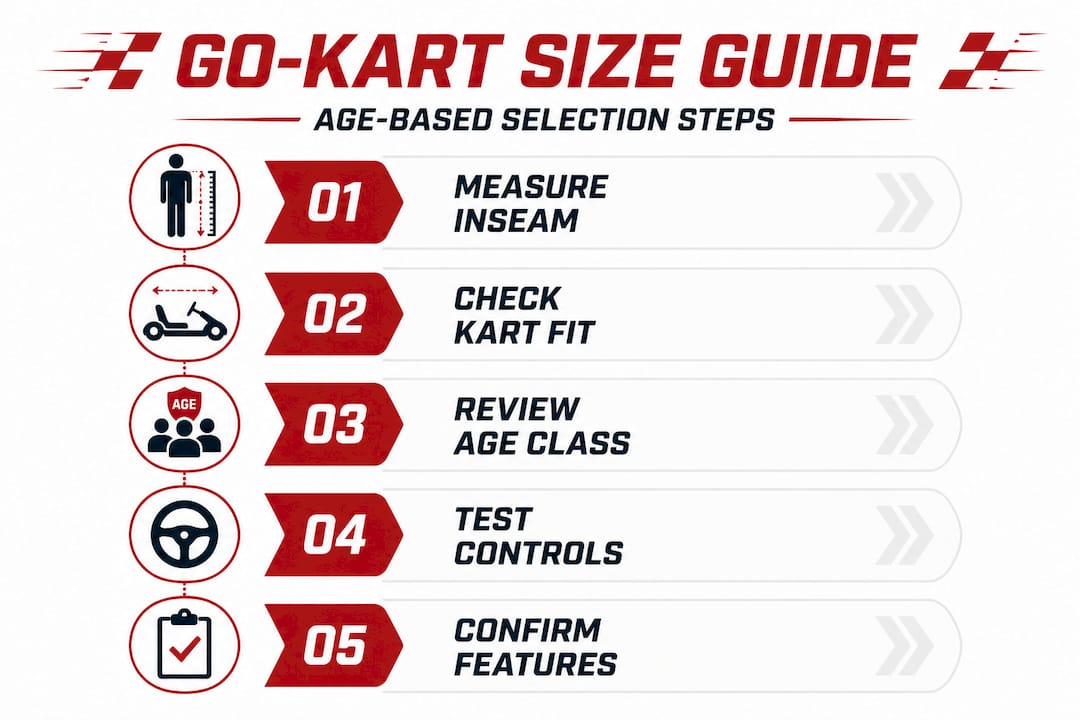
Checking fit before purchase is straightforward when you know what to look for. Follow these steps:
- Seat test: Have your child sit fully in the seat with their back against the seat pad. There should be no gap between their lower back and the seat.
- Pedal reach: Both feet should reach the gas and brake pedals with a slight bend in the knee. Flat-footed contact with straight legs means the kart is too small. Tiptoeing means it is too large.
- Steering check: Arms should reach the wheel with a comfortable bend at the elbow. No leaning forward or stretching should be needed.
- Sight line: The child should be able to see clearly over the front of the kart without craning their neck upward.
Our go-kart buying guide for kids walks through each of these checkpoints in more detail, and our 2026 kids go-kart safety guide adds updated manufacturer sizing standards across popular models.
Pro Tip: If you are buying online and cannot do a physical sit-test first, use your child’s inseam measurement. Measure from the floor to their crotch while standing. That number, compared against the kart’s listed seat-to-pedal distance, is the most reliable way to judge fit remotely.
Common mistakes: Pitfalls to avoid when choosing go-kart sizes
Even well-meaning parents fall into predictable sizing traps. Understanding these mistakes ahead of time can save you money, prevent frustration, and most importantly, keep your child safe.
Buying big so they can grow into it. This is the most common mistake we see. Parents reason that a slightly oversized kart represents better long-term value. In practice, an oversized kart puts children in a position where they cannot control the vehicle properly right now. Strained pedal reach, reduced steering leverage, and heavier handling all combine to make driving harder and less enjoyable, which can actually discourage kids from the sport entirely.
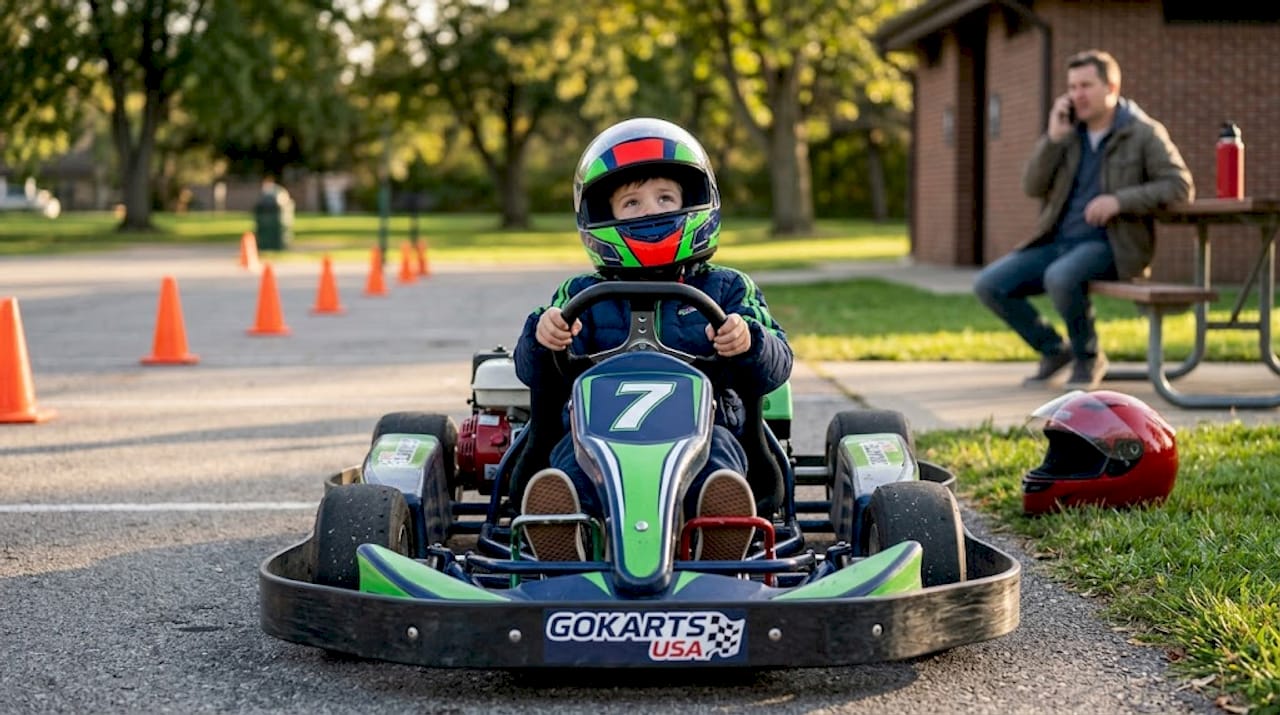
Skipping junior sizing to keep up with friends. Kids are competitive by nature, and when an older sibling or neighborhood friend drives a faster kart, younger children naturally want the same thing. But 11-year-olds jumping to faster classes has been specifically criticized as unsafe by racing officials and coaches, because the speed and handling demands outpace developmental readiness regardless of how mature the child seems.
Assuming adult karts are fine once a teen hits a growth spurt. Physical height is only one piece of the picture. Reaction time, judgment under pressure, and physical strength all need to catch up too. The distinction between adult and kids go-kart differences goes well beyond size alone, covering braking systems, engine power curves, and chassis response characteristics.
Here is a short list of warning signs that a kart is the wrong size for your child:
- They frequently have to stretch or strain to reach the pedals
- They cannot complete a full steering lock in either direction easily
- They seem tense or anxious when driving, even in a safe environment
- They tire out quickly from the physical effort of driving
- They have difficulty braking smoothly and consistently
“The fastest way to kill a child’s love for go-karting is to put them in a kart they cannot control. The sport should build confidence, not shake it.”
Reviewing the must-have kids go-kart safety features checklist before purchase is one of the smartest things a family can do. It covers throttle limiters, safety harness types, bumper design, and roll protection, all elements that matter more when the kart and child are properly matched in size.
What most families miss about go-kart sizing and age
Here is a perspective we hold strongly at GoKarts USA, one that sometimes surprises families: keeping your child in the correct age-appropriate kart is not holding them back. It is the fastest route to genuine skill.
The “bigger is better” logic sounds reasonable on the surface. Push your child into faster equipment sooner, and they will adapt faster, right? The data and real-world experience say otherwise. When children drive karts matched precisely to their physical and developmental stage, they learn to control the vehicle completely. They build muscle memory for braking points, cornering feel, and throttle management. That foundation transfers beautifully when they eventually move into more powerful machines.
Families who rush the progression often end up with kids who rely on the machine’s power rather than developing their own technique. When those kids step into a truly competitive environment later, the skill gaps become obvious. Patience at the junior level creates better, more confident drivers at every level that follows.
We have heard countless stories from parents who initially felt frustrated keeping a 10-year-old in a youth kart when the child wanted something faster. Then the child hit 12, moved into a junior class kart, and absolutely flew. The foundation was already built. The transition was effortless rather than terrifying.
The youth go-kart safety technology built into age-appropriate karts is not a limitation. It is what allows kids to push their own limits safely, to learn from small mistakes rather than dangerous ones, and to fall in love with the sport on their own terms. That is the real adventure.
Find the best go-kart for each age at GoKarts USA
Choosing the right go-kart for your child’s age and size is one of the best investments in outdoor adventure you will ever make. At GoKarts USA, we are here to be your pit crew through every step of that process.

Our catalog includes everything from youth electric karts with speed limiters for younger riders to powerful junior gas karts for teens ready to push their skills. Families looking for versatile outdoor fun will also love our kids ATV with parental controls, designed with built-in safety features that grow with your child. For families who want to ride together, check out our family go-kart options that seat multiple riders and bring everyone into the adventure at once. Browse by age, size, and experience level, and if you ever need guidance, our team is ready to help you find the perfect fit.
Frequently asked questions
Can my 10-year-old use an adult go-kart if they are tall for their age?
No, regardless of height, a 10-year-old lacks the developmental maturity and coordination needed for adult go-karts. The CIK-FIA age minimums for junior classes start at 12, and even that jump requires careful evaluation of skill and readiness.
What’s the safest go-kart option for young children under 7?
Choose a pedal or electric go-kart with adjustable seats, speed limiters, and supervisory controls for this age group. Age and height charts specifically recommend these features for young riders, along with direct adult supervision at all times.
At what age can kids move up to faster, more powerful go-karts?
Most racing classes and manufacturers set 12 as the minimum for junior classes, but skill and confidence should always be factored in alongside age. The OKN-Junior class covers ages 12 to 14, with full adult classes beginning at 14, and parental judgment remains essential at every transition point.
Why can’t children switch to bigger karts just to keep up with friends?
Moving to bigger or faster go-karts early exposes kids to unnecessary danger and is actively discouraged by racing officials and safety experts. The risk of early class jumping is well-documented, with 11-year-olds in faster junior classes specifically flagged as a safety concern by governing bodies worldwide.