




TL;DR:
- Choosing the right ATV for beginners is crucial, as proper sizing significantly reduces injury risks among youth riders. Safety features like low engine displacement, automatic transmission, and adjustable throttle limiters help new riders develop skills confidently and prevent accidents. Starting on appropriately sized ATVs fosters safer riding habits, enjoyment, and lifelong skill development.
Picking the right ATV for a new rider feels straightforward until you realize how much is riding on that decision. The 2024 OHV Annual Report from the CPSC shows that 13% of all OHV fatalities between 2019 and 2021 involved riders under 16, and more than 90% of those child accidents happened on adult-sized machines. That one statistic should stop every parent and first-time buyer in their tracks. Beginner ATVs exist precisely to close that gap, pairing right-sized power with smart safety features so that new riders build real confidence without unnecessary risk.
Table of Contents
- The dangers of adult-sized ATVs for beginners
- What makes beginner ATVs safer and easier to control?
- Growth, skills, and rider development: Why the right start matters
- Beginner ATVs: Balancing cost, fun, and peace of mind
- Why safety-first is the game-changer for family ATV fun
- Ready to start riding? Safe, fun beginner ATVs await
- Frequently asked questions
Key Takeaways
| Point | Details |
|---|---|
| Right size reduces risk | Choosing the correct size ATV for beginners greatly lowers accident and injury rates. |
| Beginner features add safety | Features like small engines and automatic transmissions boost control and rider confidence. |
| Skills grow with safer ATVs | Age-appropriate beginner models help new riders build safe habits step by step. |
| Affordable family fun | Beginner ATVs are budget-friendly and open the door to outdoor adventures for all ages. |
The dangers of adult-sized ATVs for beginners
There is a common belief floating around that a bigger ATV is simply a better ATV. Parents sometimes reason that buying a larger machine means their child will not outgrow it too fast. New adult riders assume a higher-powered quad will be more exciting from day one. Both assumptions are understandable, but both are genuinely dangerous when applied to inexperienced riders.
Adult ATVs typically produce 250cc to 700cc of engine power. They weigh anywhere from 400 to 800 pounds. The handlebars sit high, the throttle response is aggressive, and the torque curve punishes any rider who has not yet developed the muscle memory to handle it. For a child or a nervous beginner, that combination is not exciting. It is overwhelming. The rider loses the ability to react quickly when the terrain shifts, and a machine that is too heavy to lean into a turn becomes nearly impossible to control at speed.
The data tells a sobering story. The 2024 OHV Annual Report identifies wrong-size ATVs as a primary risk factor in youth accidents, with over 90% of child incidents directly tied to adult-sized models. Emergency room visits related to ATV injuries number in the tens of thousands every year, and a disproportionate share involve young or first-time riders who were simply placed on machines their bodies and skills could not manage.
Understanding the difference between youth vs adult ATVs is not just a matter of preference. It is a matter of survival.
| ATV category | Typical engine size | Average weight | Recommended rider age |
|---|---|---|---|
| Youth beginner | Under 70cc | 150 to 250 lbs | Ages 6 to 11 |
| Youth intermediate | 70 to 90cc | 250 to 350 lbs | Ages 12 to 15 |
| Adult entry-level | 150 to 250cc | 350 to 500 lbs | Ages 16 and up |
| Adult full-size | 250cc and above | 500 to 800 lbs | Experienced adults |
“The wrong-size ATV is not just uncomfortable for young riders. It is one of the leading preventable causes of serious injury and death in the youth powersports category.” — CPSC OHV Safety Division
The core problem comes down to three factors: size, weight, and power. A machine that is physically too large for a rider means feet may not reach the ground properly, making stops and balance corrections nearly impossible. Excess weight makes the ATV harder to steer and dramatically harder to recover from a tip. And raw power in the hands of an untrained rider is like handing someone a sports car for their very first driving lesson. The thrill disappears fast when control is gone.
What makes beginner ATVs safer and easier to control?
Beginner ATVs are not simply smaller versions of adult machines. They are purpose-built tools designed around the physical and developmental needs of new riders. Every core feature serves a specific safety function, and together those features create an environment where learning feels natural rather than frightening.
Here is what sets a quality beginner ATV apart:
- Smaller engine displacement. Beginner ATVs feature engines under 70cc for younger riders and 70 to 90cc for teens, delivering enough power for real trail fun without the dangerous torque surges of adult machines.
- Automatic transmission. No clutch management means the rider focuses entirely on steering, braking, and terrain awareness. This single feature dramatically lowers the cognitive load for new riders and reduces panic-induced mistakes.
- Low seat height. When a rider can place both feet flat on the ground, they gain instant stability and the psychological confidence that comes with feeling grounded. Tip recovery becomes something the rider can actually manage.
- Lightweight frame construction. Lighter ATVs respond more predictably to steering input, and if the machine does tip, a child or smaller adult has a real chance of managing the situation rather than being pinned.
- Adjustable throttle limiters. Many beginner models allow parents to cap the top speed electronically, so the machine grows with the rider rather than demanding full-skill operation from day one.
Pro Tip: When shopping for a youth ATV, always check whether the model includes a throttle limiter or remote kill switch. Those two features alone give parents meaningful control over the riding experience without standing over the rider the entire time.
We encourage every new buyer to look closely at entry-level ATV features before making a final decision. A comparison between models with and without safety-focused engineering reveals just how much these features matter in real-world riding.
| Feature | Beginner ATV | Adult ATV |
|---|---|---|
| Engine size | Under 90cc | 250cc to 700cc+ |
| Transmission | Automatic | Manual or semi-auto |
| Seat height | Low (18 to 24 inches) | High (30 to 36 inches) |
| Weight | 150 to 350 lbs | 400 to 800 lbs |
| Throttle limiter | Standard on most models | Rarely included |
| Target rider | Ages 6 to 15 or new adults | Experienced riders |
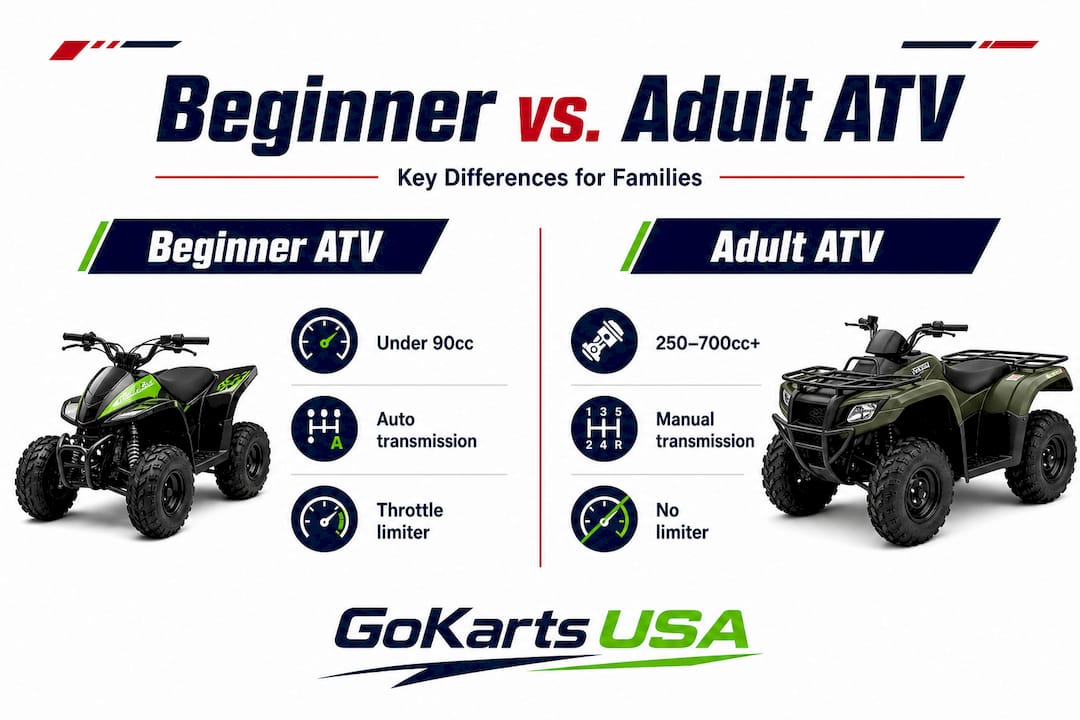
The affordable youth ATV guide we put together breaks down the best options available right now, so you can match the machine to your rider without second-guessing yourself.
Growth, skills, and rider development: Why the right start matters
Starting on the correct ATV is not just about avoiding injury today. It shapes how a rider develops for years to come. Riders who begin on appropriately sized machines build genuine muscle memory, learn how throttle and brake inputs affect the machine, and develop the spatial awareness that eventually makes them safe on more powerful equipment.
Think of it like learning to swim. You do not start in the deep end. You build technique, confidence, and comfort in shallow water, and that foundation is what makes diving into the deep end safe and exciting later on. The same logic applies to powersports.
The age and engine guidelines supported by ATV safety research break down clearly:
- Ages 6 to 11: Under 70cc engine, adult supervision always required, flat terrain and open areas recommended
- Ages 12 to 15: 70 to 90cc engine, adult supervision strongly encouraged, gradual introduction to varied terrain
- Ages 16 and older: Entry-level adult models (150 to 250cc), supervised initially, progressive skill-building before solo trail riding
When young riders graduate from one stage to the next on schedule, they carry real skills with them. They know how to read terrain. They know how to brake before a corner, not inside it. They understand that a throttle is a conversation, not a command. These habits do not develop on machines that are too powerful and too heavy to allow for controlled mistakes.
Controlled mistakes are actually a healthy part of learning. When a rider on a properly sized ATV makes an error, the consequences are manageable. The machine is light enough to catch. The speed is low enough to stop quickly. The rider walks away with a lesson rather than a trip to the emergency room.
We put together entry-level riding tips that walk through exactly how to help a new rider build skills progressively. Pair those tips with the right machine from our youth ATV guide, and you have a clear path from first ride to confident trail explorer.
One more critical point worth calling out: Supervision is not optional for young riders. Research consistently shows that unsupervised riding dramatically increases accident risk, particularly for children under 12. A parent or experienced adult on the trail is not just company. They are a critical safety layer.
Beginner ATVs: Balancing cost, fun, and peace of mind
Here is a truth that surprises many first-time buyers: beginner ATVs are not just safer. They are also smarter financially. Entry-level youth models typically cost significantly less than full-size adult ATVs, both at the point of sale and over time in maintenance and parts.

A youth ATV running a small displacement engine uses less fuel, requires less frequent oil changes, and puts less wear on tires and brakes because it operates at lower speeds and weights. When something does need attention, parts are generally straightforward and affordable. For a family new to the powersports world, that lower cost of ownership makes it much easier to enjoy the experience without financial stress.
The family ATV benefits go well beyond the dollar figure too. There is something genuinely powerful about a family riding together outdoors. Kids develop independence and physical coordination. Parents get to be part of the adventure rather than watching from the sidelines. Those memories on the trail are the kind families talk about for decades.
Key benefits families consistently report after investing in a beginner ATV:
- Increased outdoor activity time for children who might otherwise default to screens
- A shared family hobby that grows as riders develop new skills
- Strong lessons in responsibility, since maintaining a vehicle teaches real-world care and ownership
- Affordable entry into a community of riders that spans all ages and skill levels
Pro Tip: Before your first ride, invest in a quality helmet and consider an ATV safety course. Helmets reduce death risk by 42%, and inexperienced riders account for 35% of all ATV injuries. That combination of proper gear and basic training is the single most impactful thing a family can do before hitting any trail.
Smart families also look into coverage options early. Our post on ATV insurance savings explains how to protect your investment and your rider without overcomplicating the process. A little planning upfront saves a lot of stress later.
Why safety-first is the game-changer for family ATV fun
We hear a version of the same concern fairly often. A parent says something like, “I want my kid to have real fun, not a watered-down version of it.” We understand that instinct completely. Nobody buys an ATV hoping for a boring afternoon. But here is what we have learned from years of watching families begin their riding journeys: the riders who start on the right machine have more fun, not less.
When a child is on an ATV they can actually control, their face lights up. They are steering confidently. They are exploring. They are pushing their limits in a healthy way because those limits are set at the right distance for their current skill level. Compare that to a child on an oversized machine who is white-knuckling the handlebars, terrified to apply throttle, and just trying to survive the experience. That is not fun for anyone.
The real thrill of ATV riding comes from competence. It comes from knowing your machine, reading a trail, and making good decisions at speed. None of that develops when a rider is overwhelmed from the start. Safety-first is not the cautious choice. It is the choice that leads to a lifelong love of the sport.
We also believe firmly that most ATV accidents are preventable. The right size machine, the right safety gear, and adult supervision for young riders are not burdensome restrictions. They are the foundation for the kind of essential ATV safety steps that turn nervous beginners into confident, skilled riders. Every great rider started somewhere smart, not somewhere reckless.
Our perspective is simple. Fun and safe are not opposites. Done right, they are the same thing.
Ready to start riding? Safe, fun beginner ATVs await
If this article has sparked the excitement of getting your family out on the trails, we are ready to help you take the next step. At GokartsUSA.biz, we have put serious thought into every beginner ATV model we carry, selecting machines that deliver real adventure with the safety features families need.

The Mini Sport Kids ATV is one of our most popular choices for younger riders, offering a 110cc gas engine, automatic transmission, and a low seat height that gives kids immediate confidence from their very first ride. For families looking for a smooth, capable machine that bridges the gap between youth and adult performance, the TrailMaster Taurus 200GX delivers reliable power and outstanding value. Browse our full selection, take advantage of our free shipping offers, and reach out to our team anytime. We are your pit crew, your trail guides, and your fellow riders from day one.
Frequently asked questions
What engine size is safest for beginner ATV riders?
For ages 6 to 11, under 70cc is recommended; for ages 12 to 15, a 70 to 90cc engine provides a safe and manageable level of power while still delivering real trail performance.
How much safer are beginner ATVs compared to adult ATVs for kids?
Over 90% of child ATV accidents involve adult-sized machines, which means choosing a properly sized beginner ATV removes the single biggest risk factor in youth riding injuries.
Can helmets really reduce ATV accident risks for beginners?
Absolutely. Helmets cut fatal injury risk by 42%, making a quality helmet the most important and affordable piece of safety equipment any new rider can own.
Are beginner ATVs affordable for families?
Yes. Beginner ATVs are generally priced well below full-size models and carry lower ongoing maintenance costs, making them an accessible and family-friendly entry point into the powersports lifestyle.
Is supervision important for young beginner ATV riders?
Supervision is critical, especially for riders under 12, because an experienced adult on the trail provides real-time guidance, immediate response in emergencies, and the kind of steady encouragement that builds lasting safe riding habits.