




Slapping a “fits ages 6 and up” label on a go-kart or ATV sounds reassuring, but it tells you almost nothing about whether that vehicle will actually fit your child safely. Generic age labels miss the real story: a tall seven-year-old and a small ten-year-old need very different setups, and putting either rider in the wrong vehicle means reduced control, greater fatigue, and a higher chance of an accident. This guide cuts through the oversimplification, giving you the detailed measurements, expert-backed size charts, and real-world techniques you need to make a confident, safe powersports purchase for your family.
Table of Contents
- Why sizing matters in powersports vehicles
- How to use model-specific powersports size guides
- Go-karts: Sizing for safety and comfort
- Accessories: Matching covers and extras with dimensional fit
- The overlooked role of seat positioning and adjustments
- What most guides miss about powersports sizing
- Find your family’s perfect fit at GoKarts USA®
- Frequently asked questions
Key Takeaways
| Point | Details |
|---|---|
| Proper fit equals safety | Selecting the right size powersports vehicle is crucial for safety and control, especially for young riders. |
| Check all measurements | Always use manufacturer charts and match your child’s age, weight, and relevant body measurements. |
| Accessories matter too | Choose covers and transport gear by measuring your vehicle dimensions and comparing against product specs. |
| Test and adjust often | Test-fit seats and adjust positioning to ensure handling remains safe as riders grow and gain experience. |
Why sizing matters in powersports vehicles
Correct sizing is not just about comfort on the trail. It is about whether your rider can physically operate the controls when it matters most. When a child sits too far from the steering wheel or footpegs, their arms and legs lose leverage. Their reaction time slows, their steering becomes imprecise, and braking force drops. The result is a vehicle that feels fun at low speeds but becomes dangerous the moment anything unexpected happens.
Most parents assume that buying “a little big” is the smart, budget-friendly move. Let the kid grow into it, right? Experienced riders and safety professionals disagree sharply. Understanding go-kart size and age compatibility shows just how much improper fit changes the way a vehicle handles from the very first ride. Oversized machines place control surfaces too far from smaller riders, which forces awkward body positions and early muscle fatigue.
For ATVs, the stakes are equally high. Youth ATV size guidance typically uses both age bands and weight limits, and the rule is always to apply whichever factor is more restrictive. An eight-year-old who weighs as much as a twelve-year-old should follow the weight guideline, not the age guideline. This nuanced approach to kids ATV sizing is what separates a safe ride from a risky one.
“Always use the more restrictive factor—if your child’s weight exceeds what the age band recommends, follow the weight limit. Never assume the age band alone is sufficient.”
- Weight limits are non-negotiable; exceeding them changes vehicle handling and can void warranties.
- Age recommendations reflect cognitive and motor development, not just physical size.
- Height and reach determine whether your rider can comfortably operate every control.
- Published payload capacity accounts for the total load, including gear and clothing.
Pro Tip: Weigh your child in full riding gear, including helmet, boots, and any protective padding, before comparing to a vehicle’s payload rating. Gear can add five to fifteen pounds that most parents forget to factor in.
How to use model-specific powersports size guides
Once you understand why fit is so critical, the next step is knowing how to read manufacturer spec sheets. These documents are packed with numbers that seem technical at first glance, but each measurement directly translates to how the vehicle will interact with your rider’s body.
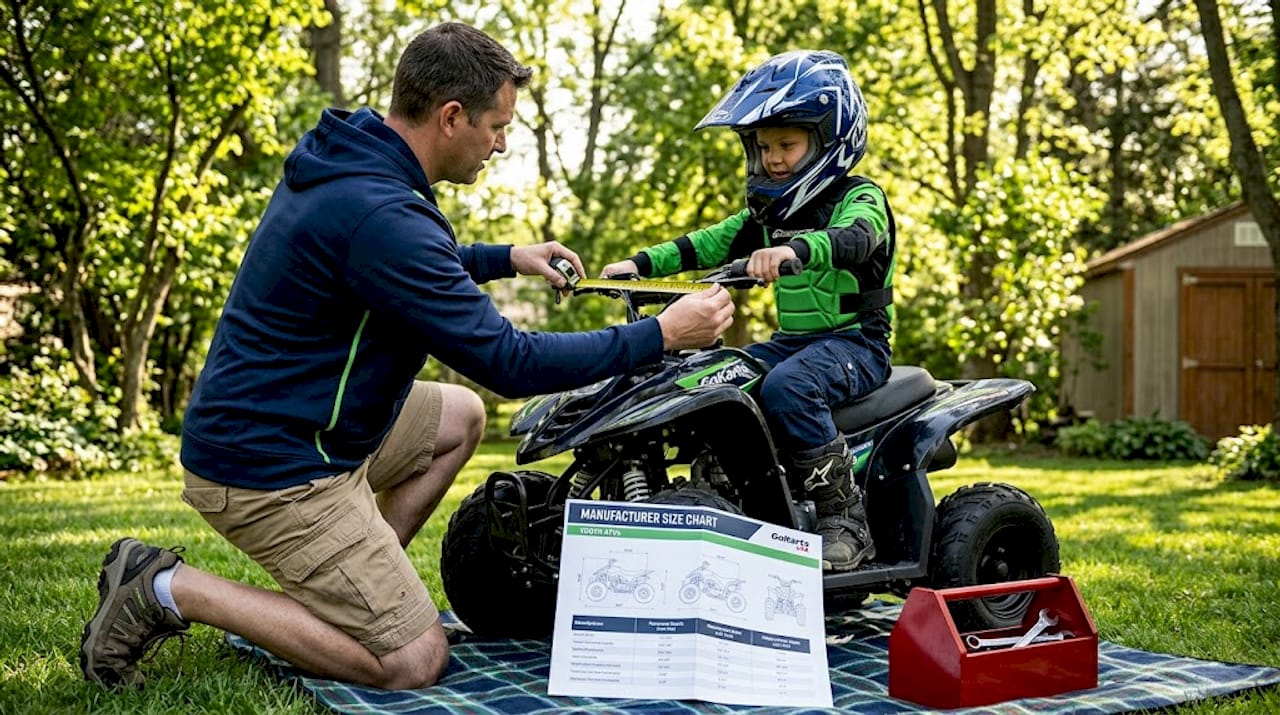
Start with the five key dimensions every spec sheet should include: overall length, overall width, overall height, wheelbase (the distance between front and rear axles), and seat height (the height from the ground to the top of the seat). Together, these numbers paint a picture of the vehicle’s physical footprint and how accessible the controls will be.
Here is a simple workflow:
- Measure your rider’s inseam length and compare it to the vehicle’s seat height. Your rider should be able to touch the ground with at least one foot flat.
- Check the overall width against the space you have for storage, transport, and riding trails.
- Review the wheelbase. A longer wheelbase means greater straight-line stability but reduced agility on tight turns.
- Confirm the payload capacity covers the rider’s weight in full gear.
- Cross-reference every number against the manufacturer’s recommended age and weight range.
For a concrete example, the 2026 Polaris Outlaw 110 publishes full dimensional specs alongside its recommended rider profile. Reviewing those numbers before purchase lets you confirm whether the vehicle suits your specific child, not just a theoretical “average” rider in that age group.
| Dimension | Why it matters | What to compare it to |
|---|---|---|
| Seat height | Ground reach and confidence | Rider inseam length |
| Wheelbase | Stability vs. maneuverability | Intended riding environment |
| Overall width | Trail and storage fit | Available trail or storage width |
| Payload capacity | Safe total weight limit | Rider weight in full gear |
| Overall length | Trailer and transport fit | Trailer or truck bed dimensions |
For families who also want to protect their investment with service coverage, resources like Honda vehicle coverage provide a useful model for understanding what extended warranties can cover, a smart consideration when buying any youth powersports vehicle.
“Manufacturer specs are your starting point, not your finish line. Use them to shortlist candidates, then verify fit in person whenever possible.”
Go-karts: Sizing for safety and comfort
The same measurement-first approach applies when selecting a go-kart, and in some ways the fit criteria are even more exacting. A go-kart seat is the primary contact point between rider and machine. It transmits every vibration, every turn, every braking force directly to the driver’s body. If the seat is wrong, the driver loses feel for the kart and loses control.
Forget universal sizing charts that simply label seats as “small,” “medium,” or “large.” A proper kart seat size chart is based on four body measurements: hip width (the widest point across the hips), back height (from the seat pan to the top of the shoulder), seat depth (from the back of the seat to the front edge), and waist measurement. Each of these dimensions corresponds to a specific part of the seat that affects both comfort and safety.
Here is what the data actually tells us about loose versus snug seat fit:
| Seat condition | Handling effect | Safety implication |
|---|---|---|
| Too loose | Driver slides during cornering | Reduced steering feel, injury risk |
| Correctly snug | Driver moves with kart as one unit | Maximum control, consistent feedback |
| Too tight | Restricted breathing and movement | Fatigue, discomfort, impaired reaction |
| Over-padded to compensate | Masks incorrect seat size | False security, still compromises control |
That last row is critical. Many parents discover a seat is slightly too wide and simply add more padding. This is a common mistake. Padding can shift, compress unevenly, or add thickness that changes how the driver sits relative to the steering wheel and pedals. Choosing the right size seat from the start is always the safer route. Our safe go-kart buying guide walks you through this in more detail, reinforcing why proper sizing protects both the rider and the investment.
- Measure hip width with the rider seated, not standing.
- Back height should be measured with the rider sitting upright against a flat surface.
- Check that the rider’s back sits fully against the seat without a gap at the lower back.
- Confirm feet reach the pedals fully extended without the knees locking straight.
The connection between importance of size for kids and long-term enjoyment is real. Kids who feel confident and in control enjoy the sport more, develop better skills faster, and stay safer throughout their progression.
Pro Tip: Have your child sit in the seat before you purchase if possible. They should be able to hold the steering wheel with a slight bend in their elbows, with their back fully supported. That natural, relaxed driving position is the gold standard.
Accessories: Matching covers and extras with dimensional fit
Getting the vehicle fit right is a major win, but the work does not stop there. Accessories like covers, storage solutions, and transport equipment need to match your vehicle’s exact dimensions just as carefully as the vehicle itself matches your rider.
ATV and go-kart covers are a perfect example where generic sizing creates real problems. A cover that is too small strains at the seams, leaves critical areas exposed, and can tear under wind or rain. A cover that is too large pools water, flaps in the wind, and can scratch paint or plastic panels through constant movement. Neither outcome protects your investment.
The right approach is straightforward but requires your vehicle’s actual measurements:
- Record your vehicle’s overall length, overall width, and overall height from the spec sheet.
- Compare those numbers to the cover manufacturer’s size ranges.
- Select a cover that is equal to or slightly larger than your vehicle’s dimensions—never smaller.
- Confirm the cover has tie-down straps or elastic edges that keep it secure in wind.
- Revisit sizing if you add significant accessories like racks or a windscreen that change the vehicle’s profile.
The Formosa ATV Cover Sizing Chart illustrates this methodology clearly, listing specific dimension ranges for each size tier and guiding buyers to compare their ATV’s length, width, and height directly before selecting. Their medium size, for example, covers vehicles up to 65 inches long, 40 inches wide, and 34 inches tall. Their extra-large option extends to 89 inches by 47 inches by 40 inches. These are not interchangeable.
| Cover size | Max length | Max width | Max height |
|---|---|---|---|
| Medium | 65 in | 40 in | 34 in |
| Large | 78 in | 44 in | 37 in |
| Extra-large | 89 in | 47 in | 40 in |
A study of warranty claims on recreational vehicles consistently finds that weather damage from improper covers is among the leading causes of avoidable wear. Matching your cover to your vehicle’s precise dimensions is one of the simplest ways to protect a significant purchase for years of adventure ahead.
The overlooked role of seat positioning and adjustments
Even after you confirm correct seat size and vehicle fit, there is one final layer that most guides skip entirely: seat positioning. Where the seat sits within the kart’s chassis changes how weight is distributed, which in turn changes how the kart steers and handles.
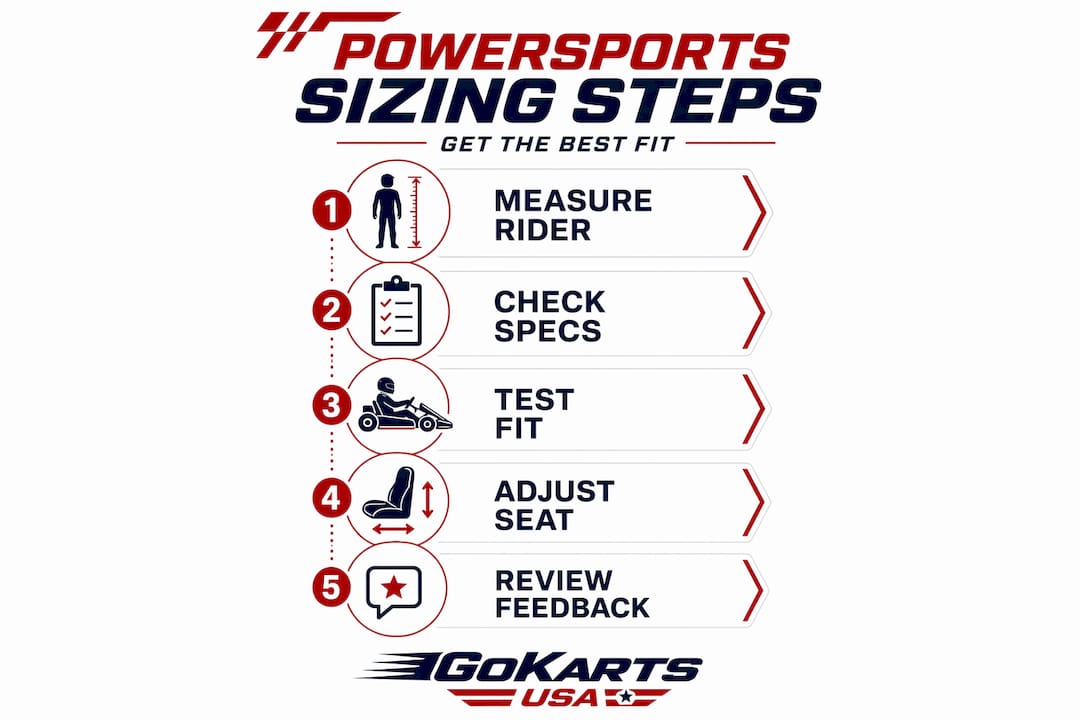
Moving the seat forward shifts weight toward the front axle, which increases front grip and reduces understeer (a condition where the kart pushes wide rather than turning sharply). Moving it back does the opposite, adding rear grip and reducing oversteer (where the rear of the kart slides out). These are subtle but meaningful effects, especially as young riders develop confidence and push into faster corners.
Here is a practical adjustment workflow:
- Start with the manufacturer’s default seat position as your baseline. Do not skip this step—it exists for good reason.
- Take the kart through several laps or a consistent test loop at a moderate pace.
- Note whether the front or rear feels like it is losing grip first. Front grip loss suggests moving the seat slightly forward; rear grip loss suggests moving it back.
- Adjust by the smallest increment possible, typically one mounting hole at a time.
- Retest after each adjustment before making any further changes.
One detailed seat positioning guide for go-karting stresses this disciplined, incremental approach. The guide notes that small changes can have surprisingly large effects, and that jumping straight to large adjustments often creates new problems rather than solving the original one.
For families managing this process at home, our parent go-kart safety guide provides a comprehensive framework for setup decisions, maintenance checks, and safe riding habits that support your rider’s growth from first ride to advanced skill.
Pro Tip: Keep a simple log of seat position settings and your child’s feedback after each session. Over months of riding, patterns emerge that help you fine-tune the setup without second-guessing every adjustment.
What most guides miss about powersports sizing
We have helped thousands of families find the right vehicle, and here is what we keep seeing: most size guides treat sizing as a one-time event. Measure once, buy once, done. Real ownership does not work that way.
Children grow. Skills evolve. A seat position or vehicle size that felt perfect at the start of one season may feel cramped or sluggish six months later. We encourage families to revisit sizing at the start of every season, not because something went wrong, but because growth and progress naturally change the equation. A child who has moved from beginner to confident intermediate rider will benefit from a setup that matches their new skill level and physical size.
The other thing guides consistently overlook is what we call “transport fit.” Getting your vehicle to the riding area matters as much as how it performs once it arrives. Your trailer, truck bed, or enclosed transport needs to accommodate the vehicle’s full dimensions including any added accessories. Families often buy a great vehicle only to discover it barely fits their trailer or cannot be loaded safely. Checking transport compatibility at the time of purchase saves real headaches later.
Finally, we want to encourage you to trust the test-fit process over rigid rules. Charts are tools, not guarantees. Sitting your child in a seat, checking their reach to the controls, and watching how naturally they settle into the driving position tells you more than any number on a page. Trust the data and the experience you get from direct observation. That combination is what fuels lasting adventure, season after season.
For families who want to stay sharp on everything safety-related, our resource on go-karting safety for families covers the full picture, from gear selection to track etiquette, ensuring every ride is as safe as it is thrilling.
Find your family’s perfect fit at GoKarts USA®
You have the knowledge. Now it is time to put it to work. At GoKarts USA®, every vehicle in our lineup is backed by detailed specifications, clear age and weight guidance, and a team that genuinely loves helping families get the right fit the first time.

If you are searching for a youth ATV that checks every sizing box, the Mini Sport Kids ATV is a standout. Built around a 110cc gas engine and designed with young riders firmly in mind, it balances performance and safety in a package sized for real kids, not a fictional average. Explore our full selection at GoKarts USA and use the spec details on every product page to match your rider with confidence. Adventure is waiting, and we are here to make sure it fits.
Frequently asked questions
How do I check if a youth ATV is the right size for my child?
Match both your child’s weight and age to the manufacturer’s size chart, giving priority to whichever is more restrictive, and confirm your child does not exceed the vehicle’s published weight limit. The Kids ATV Size Chart explains how engine-size bands use both factors together to determine the safest fit.
What measurements do I need for fitting a go-kart seat?
Measure hip width at the widest point, back height, seat depth, and waist to ensure the seat fits snugly and supports proper control. The Kart Seat Size Chart warns that over-padding a loose seat instead of choosing the correct size compromises both safety and handling feel.
Is it okay to buy a larger ATV or go-kart for kids to grow into?
No. Oversized powersports vehicles reduce control and meaningfully increase accident risk, so you should always select based on current measurements and published size guidelines rather than anticipated growth.
How should I pick a cover or trailer for my ATV or go-kart?
Compare your vehicle’s exact length, width, and height to the cover’s or trailer’s specs and choose a fit that matches or is slightly larger, never smaller. The Formosa ATV Cover Sizing Chart uses this equal-to-or-slightly-larger approach as its core methodology for all size tiers.