




TL;DR:
- Riding an ATV safely depends on proper preparation, safety gear, and mastering body position and throttle control.
- Systematic skill development through progressive practice on different terrains reduces accidents and builds confidence.
Plenty of confident riders have felt it: the moment a simple turn or an unexpected slope shifts from thrilling to terrifying in a split second. A slight miscalculation, a panicked grab at the throttle, or a stiff body leaning the wrong way can turn a great trail day into a costly mistake. The truth is, riding an ATV well isn’t just about courage or horsepower. It’s about technique, preparation, and knowing how your body and machine work together. This guide breaks down exactly what you need to know, from gearing up before you leave home to conquering hills and mud with real confidence.
Table of Contents
- Pre-ride essentials: Gear, training, and trail checks
- Mastering core riding techniques: Body position and throttle control
- Handling terrain: From hills to mud and loose surfaces
- Developing skill: A progression plan for all levels
- Why cautious, deliberate practice outperforms thrill-seeking
- Ready to ride safer and smarter? Explore your next steps
- Frequently asked questions
Key Takeaways
| Point | Details |
|---|---|
| Preparation is critical | Equipping the right safety gear and training sets you up for a secure ride. |
| Body position matters | Leaning and shifting weight are essential for stability and control. |
| Smooth controls prevent accidents | Gradual throttle and braking reduce the risk of losing traction or control. |
| Adapt to the terrain | Modify your riding approach for hills, mud, and various ground conditions. |
| Progression leads to mastery | Step-by-step skill building makes challenging terrain both safer and more enjoyable. |
Pre-ride essentials: Gear, training, and trail checks
To start building good ATV habits, safety and preparation must come first. Too many riders skip this stage, assuming their experience on other vehicles carries over. It rarely does, at least not completely.
Proper protective gear is non-negotiable. Every rider, regardless of skill level, should suit up with the right equipment before turning a single key. Here’s what belongs in your kit every single time:
- DOT-approved helmet: This is your most critical piece of gear. Make sure it fits snugly and carries the Department of Transportation certification stamp.
- Eye protection: Goggles or a full-face shield protect against debris, dust, and UV exposure.
- Gloves: Sturdy, padded gloves improve grip and protect your hands during a fall.
- Boots: Over-the-ankle boots with reinforced toes prevent foot and ankle injuries on rough terrain.
- Long sleeves and pants: Abrasion-resistant riding gear protects your skin far better than denim or cotton alone.
Beyond gear, safety training is one of the smartest investments you can make. ATV safety courses build the foundation that separates controlled riders from reactive ones, teaching DOT-compliant protective habits alongside approved-area riding standards. The Motorcycle Safety Foundation and similar organizations offer courses specifically designed for off-highway vehicles that cover everything from basic controls to hazard recognition.
Always wear a helmet and ride only on approved trails. No shortcut, convenience, or peer pressure is worth the consequences of skipping either.
Trail research matters just as much as gear. Before you load up the ATV, check the status of your intended trail, study the map, review any posted rules, and note any seasonal closures or permit requirements. Conditions change after storms, and what looked rideable last month might now be closed or unsafe. Our beginner ATV safety guide offers an in-depth breakdown of pre-ride planning for those who are just getting started.
| Pre-ride item | Why it matters | What to check |
|---|---|---|
| DOT-approved helmet | Prevents fatal head injury | Fit, certification stamp, no cracks |
| Trail status | Avoids closures and hazards | Local land agency website or app |
| ATV fluid levels | Prevents mechanical failure | Oil, coolant, brake fluid |
| Tire pressure | Affects handling and traction | Manufacturer-recommended PSI |
| Emergency kit | Addresses medical and mechanical issues | First aid, tools, phone charge |
Pro Tip: Keep a small emergency kit strapped to your ATV at all times. Include a basic first-aid kit, a multi-tool, a tire repair kit, and a fully charged phone. That one habit has gotten more than a few riders out of serious trouble deep on a trail.
Mastering core riding techniques: Body position and throttle control
Once you’re ready to ride, mastering your body’s interaction with the machine comes next. This is where most riders have the biggest room for improvement, and where the biggest gains in control and confidence come from.
Correct body positioning isn’t a suggestion. It’s what keeps you in contact with the machine when the terrain pushes back. Here’s a step-by-step breakdown for the three most common situations:
- Cornering: Shift your weight to the outside footpeg, lean your upper body slightly into the turn, and keep your eyes looking through the corner to where you want to go. Avoid leaning away from the turn, which is a natural but counterproductive instinct.
- Climbing hills: Move your weight forward toward the handlebars. This keeps the front wheels planted and gives you traction control. Apply throttle smoothly and steadily. Never gun it mid-climb.
- Descending hills: Shift your weight back toward the rear of the seat. This prevents the front end from diving. Use engine braking (downshifting or reducing throttle gradually) before you begin the descent, not during it.
Throttle and brake control deserve just as much attention as positioning. Smooth inputs are the key to staying planted: lean into turns, use forward weight for uphill traction, and prioritize gradual acceleration over abrupt throttle. Jerky throttle and hard braking are the fastest ways to lose rear traction or pitch the front end. Practice squeezing, not grabbing, both the throttle and the brakes.
| Situation | Correct technique | Common mistake |
|---|---|---|
| Turning | Weight outside, eyes forward, lean in | Leaning away from the turn |
| Uphill | Body forward, steady throttle | Sudden throttle surge mid-climb |
| Downhill | Weight back, engine braking first | Grabbing front brake on the slope |
| Rough terrain | Stand on pegs, loose grip, absorb bumps | Rigid body, locked arms |
Smart riding strategies consistently point to one theme: reduce high-risk dynamics such as abrupt throttle and uncontrolled speed by managing your velocity before entering a maneuver, not after. Get your speed right before the corner, not in it. Settle the machine before the hill, not halfway up it. These small mental shifts make a dramatic difference in outcome. You can find practical entry-level ATV tips to reinforce these fundamentals if you’re still building your baseline.
Pro Tip: Spend 15 minutes on flat, open ground practicing weight shifts from front to back and side to side while moving slowly. This muscle memory exercise makes the correct response automatic when terrain gets demanding.
Handling terrain: From hills to mud and loose surfaces
With the fundamental techniques in place, it’s crucial to see how they apply to real-world terrain. Every surface has its own personality, and adapting your technique is what separates riders who look effortless from those who are constantly fighting the machine.
Hills are the terrain feature that humbles the most riders. Hill control technique demands appropriate weight transfer forward going uphill and back going downhill, paired with conservative speed discipline. Here’s what a controlled hill climb looks like in practice:
- Survey the hill from the bottom. Look for ruts, loose rock, and where the grade changes.
- Approach with enough momentum to carry you up, but not so much that you overshoot.
- Commit to the line and maintain steady throttle. Do not stop partway up unless you have no choice.
- If you must stop, apply the brakes gently and consider backing down rather than attempting a tight turn on a slope.
- On descent, set your speed before the edge. Let the engine help slow you rather than relying solely on the brakes.
Mud and loose surfaces demand a completely different mindset. The temptation to hit the throttle hard when you feel the tires slipping is almost universal among new riders. It’s also almost universally wrong. Mud riding technique focuses on sustained momentum, smooth throttle roll-on, and keeping the wheels as straight as possible to maintain directional grip. Spinning the wheels digs you deeper and pitches the rear unpredictably.
- Maintain a consistent speed through muddy sections rather than stopping and starting.
- If you feel the machine sinking, keep the throttle steady and steer straight.
- Scout any puddle or bog you can’t see the bottom of by walking it first.
- Avoid hard braking in mud. Let the machine slow naturally or use light, progressive pressure.
A sobering reality: a significant portion of ATV accidents on variable terrain involve either improper body position or panic throttle response. The natural instinct to react fast and forcefully is almost always the wrong instinct on an ATV. Deliberate, calm inputs win every time. For families with young riders, reviewing the best practices for kids’ ATV use adds another layer of context to terrain awareness.
Pro Tip: When you approach an unfamiliar section, stop the ATV, get off, and walk it. That 60-second walk has prevented more stuck and flipped ATVs than any riding skill.
Developing skill: A progression plan for all levels
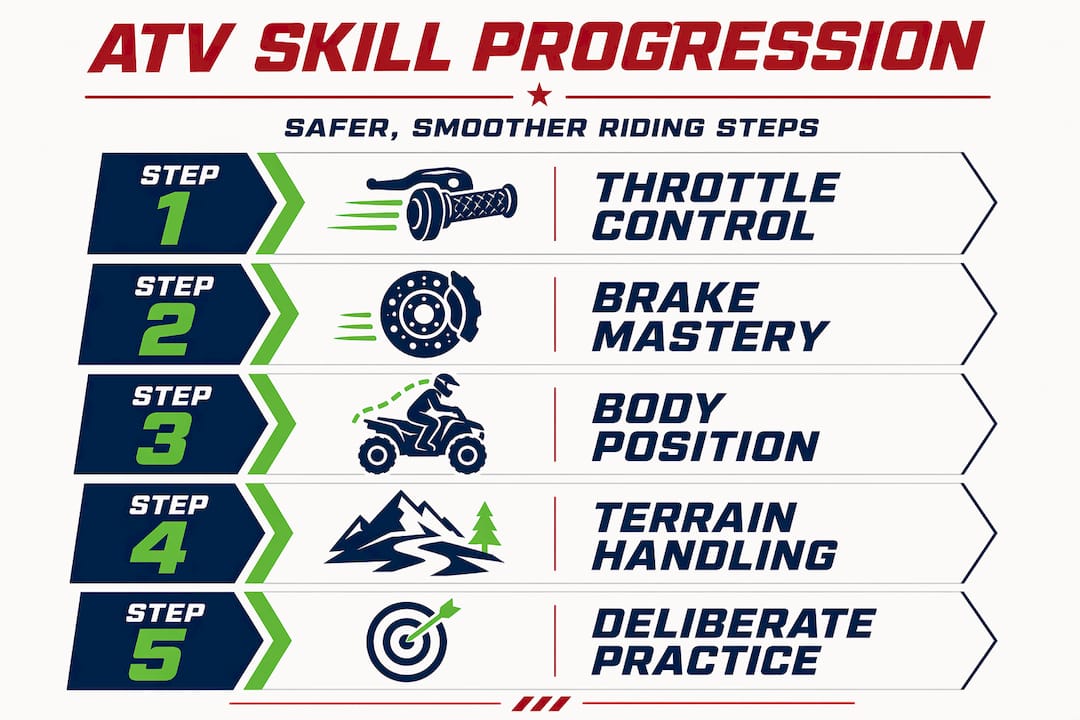
Conquering terrain is easier when you build skills systematically, no matter your starting point. Riding improvement isn’t random. It follows a logical sequence, and rushing past one stage creates gaps that surface later as accidents or bad habits.
Here’s a practical three-stage progression you can start using today:
-
Beginner stage: Focus entirely on throttle and brake control at low speeds in a flat, open area. Practice stopping smoothly, accelerating gradually, and steering in wide arcs. The goal at this stage is controlled, predictable inputs. Know you’re ready to advance when you can start, stop, and turn consistently without jerking or over-correcting.
-
Intermediate stage: Introduce body-position drills into your practice. Work on leaning correctly through turns at moderate speeds. Begin riding on slightly varied terrain, like gentle grades and packed gravel, to start applying weight-shifting habits. Add line selection: choosing your path through a section before entering it, not while you’re in it. This stage is also the right time to take a formal ATV safety course if you haven’t already.
-
Advanced stage: Now you introduce controlled terrain challenges. Ride hills, mud, and loose surfaces in a structured way, meaning start with mild examples of each and only step up difficulty when the current level feels fully managed. Practice emergency stops, tight maneuvering, and low-speed technical obstacles.
A skill-building approach for off-highway riders consistently supports this sequence: first master throttle and brake at safe speeds, then add body positioning for turns, then take on terrain challenges in controlled settings. This isn’t cautious thinking. It’s efficient skill-building.
| Stage | Focus | Common mistake | How to measure progress |
|---|---|---|---|
| Beginner | Throttle and brake control | Rushing to difficult terrain | Smooth, consistent stops and starts |
| Intermediate | Body position and line selection | Skipping formal training | Controlled turns at moderate speed |
| Advanced | Terrain challenges | Overestimating readiness | Navigating hills and mud without panic inputs |
Pro Tip: Pick one skill per session and drill it repetitively rather than trying to practice everything at once. Focused repetition builds muscle memory far faster than scattered riding sessions.
Our beginner ATVs guide outlines which machines pair best with each stage of this progression, which matters more than most riders realize.
Why cautious, deliberate practice outperforms thrill-seeking
Having explored the step-by-step skills roadmap, it’s worth reflecting on something experienced riders consistently wish they’d understood earlier: going all-out is not the fastest path to becoming a skilled, fulfilled rider. It’s often the fastest path to a hospital visit or a wrecked machine.
We’ve seen it repeatedly in the powersports community. A rider shows up full of enthusiasm, skips the basics, and either gets hurt or develops ingrained bad habits that take years to undo. The myth is that intensity equals improvement. In reality, controlled, repeated practice of correct technique is what creates the automatic, confident responses that make hard riding look easy.
The real consequences of rushed learning are tangible. Injuries from improper technique cost riders trail time, money, and sometimes much more. Mechanical damage from aggressive, uncontrolled riding adds up fast too. Blown tires, bent frames, and worn-out drivetrains are often the result of panic inputs and poor terrain management, not unavoidable trail conditions.
Small, focused sessions build the kind of skill that feels effortless. When a steep descent or a muddy stretch triggers the right response automatically, that’s when riding becomes genuinely thrilling rather than just risky. As we tell every rider who asks: discipline isn’t boring. It’s the fastest route to real mastery and the kind of fun that lasts a lifetime.
Safe off-road riding isn’t about slowing down your adventure. It’s about building the skills that let you chase bigger adventures without unnecessary setbacks. Every trail you complete cleanly is a trail you get to ride again.
Ready to ride safer and smarter? Explore your next steps
Practice is always easier when you have the right machine matched to your skill level and goals.

At GokartsUSA.biz, we believe that the right equipment is the foundation of every great ride. Whether you’re just starting your journey or looking to help a younger family member develop their skills with proper safety features built in, we’ve got you covered. Our kids’ ATV with parental controls is a perfect example of matching the right machine to the right rider, giving young adventurers the freedom to learn while giving parents the peace of mind to let them. Explore our full lineup of ATVs, check out our seasonal deals, and take the next step toward smarter, more confident riding.
Frequently asked questions
What is the most common mistake new ATV riders make?
Most new riders rely on abrupt throttle and poor body positioning, which dramatically increases the risk of losing control during turns and on varied terrain.
How do I choose the right ATV safety gear?
Select DOT-compliant protective gear including a certified helmet, goggles, padded gloves, ankle-supporting boots, and abrasion-resistant clothing for full-body protection on every ride.
How should I handle riding on steep hills?
Use forward and back weight transfer by leaning forward going uphill for traction and leaning back on descents for stability, always prioritizing gentle, controlled braking over sudden stops.
What should I do if my ATV starts to bog down in mud?
Maintain steady momentum with smooth throttle, keep the wheels as straight as possible, and avoid panic braking or sudden throttle bursts that will dig you deeper into the mud.
Why is practicing on easy terrain recommended when starting out?
Easy terrain lets you master throttle, brake, and body positioning under low-pressure conditions, building the muscle memory and confidence you need before tackling more demanding obstacles.