




If your shipment arrives damaged, do these six things before the driver leaves: inspect every piece, note all damage on the proof of delivery (POD), photograph everything, retain the packaging, send written notice to the carrier, and file a formal written claim. Miss any one of them and you risk losing your right to recover.
Here is the urgent checklist:
- Inspect before you sign. Count every piece and check for visible damage while the driver is still present.
- Note damage on the POD. Write specific descriptions (“3-inch crush on upper-left corner of crate, box 2 of 4”) before you sign. A clean signature is treated as acceptance of good condition.
- Photograph everything. Wide shots of the full shipment, close-ups of each damaged area, the trailer interior, and the seal number.
- Retain all packaging. Keep crates, boxes, dunnage, and strapping exactly as received until the carrier authorizes disposal in writing.
- Send immediate written notice. Email or fax the carrier and your insurer the same day, especially for concealed damage.
- File a written claim within the deadline. Federal law sets a 9-month floor for interstate shipments, but carrier notice windows for concealed damage can be as short as 5 days.
Pro Tip: Set a calendar reminder the day freight ships. The 9-month federal filing window sounds generous, but concealed-damage notice requirements can expire within a week of delivery — and most shippers don’t discover hidden damage until days later.
The single most important rule: A signed, clean POD is the carrier’s best defense. Your detailed, specific damage notation on that document is your strongest opening move.
Key Takeaways
Filing a freight damage claim successfully comes down to three things: documenting damage at delivery before you sign, submitting a written demand with a specific dollar amount within the 9-month federal window, and never disposing of freight or packaging without written carrier authorization.
| Point | Details |
|---|---|
| Document at delivery | Note specific damage on the POD before signing; a clean signature is treated as acceptance of good condition. |
| File within 9 months | Federal law sets a 9-month floor for written claims on interstate shipments; concealed-damage notice windows can be as short as 5 days. |
| Include a dollar amount | A valid claim must identify the shipment, assert liability, and demand a specific dollar figure per 49 CFR § 370.3. |
| Pay freight charges separately | Never deduct a claim from the freight invoice; carriers treat offsets as breach of contract and suspend claim processing. |
| Hold all packaging | Disposing of damaged goods or packaging before written carrier authorization is grounds for immediate denial. |
Table of Contents
- What is a freight damage claim, and what types exist?
- Who can file a claim, and what deadlines apply in the U.S.?
- What should you do at delivery to protect your claim?
- What documents does a strong claim package include?
- How do you actually file a freight damage claim?
- What happens after you submit a claim?
- How does carrier liability work, and how is your recovery calculated?
- Why do claims get denied, and how do you appeal?
- How good packing and documentation prevent damage and strengthen claims
- Our perspective on handling damaged shipments
- Sources
What is a freight damage claim, and what types exist?
A freight damage claim is a formal written demand submitted to a carrier or insurer asserting that cargo was lost, damaged, or short-delivered during transit, and requesting a specific dollar amount in compensation. The term “cargo claim” is the recognized industry label; “freight damage claim” is the common shorthand most shippers use. Either way, the legal mechanism is the same: you are putting the carrier on notice and demanding reimbursement.
Four claim types cover the vast majority of situations:
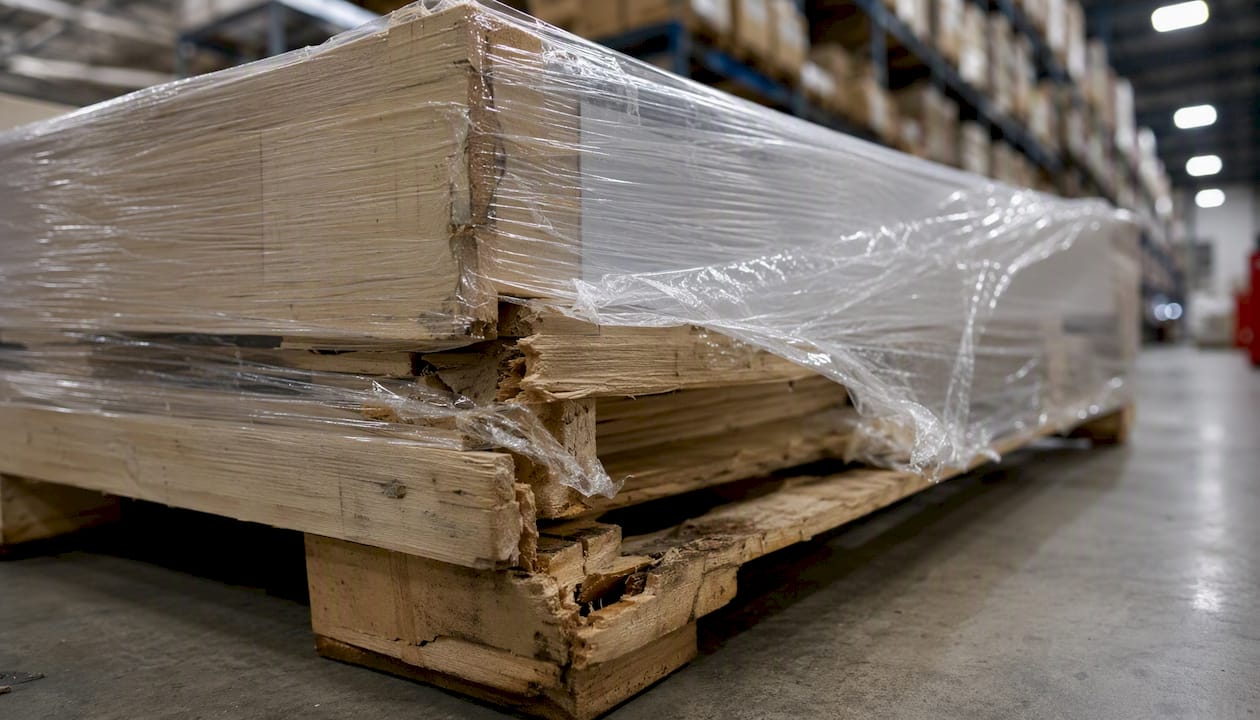
Visible damage is exactly what it sounds like: crushed corners, broken pallets, torn shrink wrap, or bent frames you can see the moment freight is unloaded. Document it on the POD before signing.
Concealed damage is discovered after the packaging is opened. The outside looks fine; the contents are broken. This is the most time-sensitive category because carrier notice windows typically run only 5–15 days from delivery, and some bills of lading set even shorter windows.
Shortage means fewer pieces arrived than the BOL lists. Count every unit on the dock, not just the pallet count.
Total loss applies when cargo is destroyed beyond repair or never arrives at all. The recoverable amount is the invoice value at destination, minus any salvage.
Who files depends on who holds financial interest. The shipper files when they retain title (FOB origin terms). The consignee files when title passed at origin and they bear the loss. A third-party broker or billed party may file when they paid the freight charges and absorbed the loss. When in doubt, the party who suffered the actual financial damage has standing.
Who can file a claim, and what deadlines apply in the U.S.?
Any party with a direct financial interest in the cargo may file: the shipper, the consignee, the billed party, or an authorized representative such as a freight broker or third-party logistics provider. FOB terms on the BOL are the fastest way to determine who holds title at the moment of loss, which usually determines who files.
Federal deadlines under the Carmack Amendment
The Carmack Amendment (49 U.S.C. § 14706) governs interstate motor carrier liability and sets the federal floor for claim filing:
- 9 months from delivery (or reasonable delivery date for loss) to submit a written claim.
- 2 years from the date of a written denial to file a lawsuit in federal court.
- Carrier regulations under 49 CFR Part 370 govern how carriers must process, acknowledge, and resolve claims.
Statutory callout: Under 49 U.S.C. § 14706 and 49 CFR Part 370, carriers cannot contractually shorten the 9-month filing window below the federal floor — but they can and do set shorter notice windows for concealed damage in their tariffs and BOL terms.
Concealed-damage notice windows are where most shippers get burned. Carrier tariffs commonly require written notice within 5, 10, or 15 days of delivery for damage that was not visible at receipt. Check your BOL and the carrier’s tariff the day freight arrives, not the day you open the box.
- FedEx Freight: allows up to nine months from shipment date to submit a cargo claim.
- UPS Supply Chain Solutions: follows similar federal timelines but requires transportation charges to be paid before claim processing begins.
- Rail and air carriers: operate under different statutory frameworks (Carmack covers motor and rail; air cargo falls under the Montreal Convention or carrier tariffs).
Pro Tip: Always check the specific BOL and carrier tariff for concealed-damage notice requirements. The federal 9-month window does not override a carrier’s shorter contractual notice period for concealed damage — and courts have upheld those shorter windows.
What should you do at delivery to protect your claim?
The dock is where claims are won or lost. Follow this sequence while the driver is still present:
- Do a full count first. Verify the number of pieces against the BOL before touching anything. Shortages must be noted before the driver leaves.
- Inspect every piece visually. Check all six sides of each carton or crate. Look for punctures, crush damage, moisture staining, and broken banding.
- Photograph wide, then close. Start with a full shot of the shipment on the dock, then photograph each damaged area from 12 inches. Capture the trailer interior and the seal number before unloading begins.
- Write detailed damage notes on the POD. Be specific and measurable: “Crate 1 of 2: upper-left corner crushed approximately 4 inches, internal bracing visible through breach. Crate 2 of 2: forklift puncture on right side panel, 6-inch diameter.” Vague entries like “damaged” carry almost no weight with a claims adjuster.
- Sign the POD only after your notations are complete. Never sign a clean POD and add notes later — carriers treat a clean signature as acceptance of good condition.
- Hold the freight and all packaging in place. Do not move, repair, or dispose of anything until the carrier authorizes it in writing.
When to refuse delivery: Refuse only when damage is so severe that accepting the freight creates a safety risk or makes the goods completely unusable. Refusal stops the delivery clock and forces the carrier to handle the freight, which can simplify the claim. For partial damage, accepting with detailed POD notations is usually the better path because it preserves your ability to use undamaged portions and keeps the freight under your control for inspection.
Pro Tip: Ask the driver to countersign your damage notations on the POD. Not all drivers will, but when they do, it eliminates any dispute about whether the damage was noted at delivery.
What documents does a strong claim package include?
Carriers expect a complete, organized package. Missing even one key document is a common reason claims are delayed or denied. Here is what to gather:
| Document | What It Proves | Where to Get It |
|---|---|---|
| Original Bill of Lading (BOL) | Shipment terms, declared value, carrier acceptance | Shipper’s records or carrier portal |
| Signed POD with damage notations | Damage was present at delivery and noted before signing | Carrier delivery receipt |
| Commercial or purchase invoice | Original value of the goods | Accounts payable / vendor |
| Packing list | Contents, quantities, and packaging method | Shipper’s records |
| Freight invoice | Transportation charges paid (required by some carriers) | Carrier billing |
| Timestamped photos | Visual evidence of damage condition and extent | Your device’s photo library |
| Repair or replacement estimate | Dollar amount of loss | Licensed repair shop or vendor |
| Third-party inspection report | Independent confirmation of damage cause and extent | Carrier-appointed or independent surveyor |
A clear, itemized dollar calculation — invoice value minus salvage, plus repair costs, supported by actual invoices — makes the claim harder to discount and speeds settlement. Vague or estimated figures invite low settlement offers.
- Retain originals. Carriers may request originals for high-value claims. Scan everything before you submit.
- Timestamps matter. Photos taken after packaging is removed but before any repair attempt carry more weight than photos taken days later.
- Third-party inspection reports carry significant authority. If the carrier sends an inspector, be present and take your own notes simultaneously.
Pro Tip: *Create a “claims folder” in your file system or TMS the moment a shipment is booked. Drop every document — BOL, packing list, origin photos — into it before the freight ships.
How do you actually file a freight damage claim?
A valid written claim under 49 CFR § 370.3 must do three things: identify the shipment, assert that the carrier is liable, and demand a specific or determinable dollar amount. A damage photo or a POD notation alone does not meet this standard. You need a formal written demand.
The submission flow looks like this:
- Step 1: Calculate your claim amount. Invoice value at destination, minus salvage value, plus documented repair costs. Attach the invoices that support each number.
- Step 2: Complete the carrier’s claim form. Errors or vague entries on the Standard Freight Loss and Damage Claim Form can delay or defeat a claim. Fill every field accurately.
- Step 3: Submit through the carrier portal or via email. Portal submission is preferred because it timestamps your filing automatically.
- Step 4: Retain proof of submission. Screenshot the confirmation page or save the email with timestamp. This is your evidence that you filed within the deadline.
- Step 5: Pay your freight charges separately. Do not deduct your claim amount from the freight invoice. UPS Supply Chain Solutions and most other carriers require transportation charges to be paid in full before claim processing begins. Offsetting the freight bill is often treated as a contractual breach and will stall your claim.
Carrier-specific filing
FedEx Freight handles cargo claims through its online claims portal, where you upload supporting documents after submitting the initial claim. Required documents typically include the BOL, POD, commercial invoice, photos, and repair estimates. FedEx Freight allows nine months from shipment date to file.
UPS Supply Chain Solutions uses its cargo claims form and requires the same core document set. UPS emphasizes retaining original packaging for inspection and paying all transportation charges before the claim moves forward.
For FedEx parcel shipments, the FedEx online claims portal handles proof uploads and status tracking in one place.
What happens after you submit a claim?
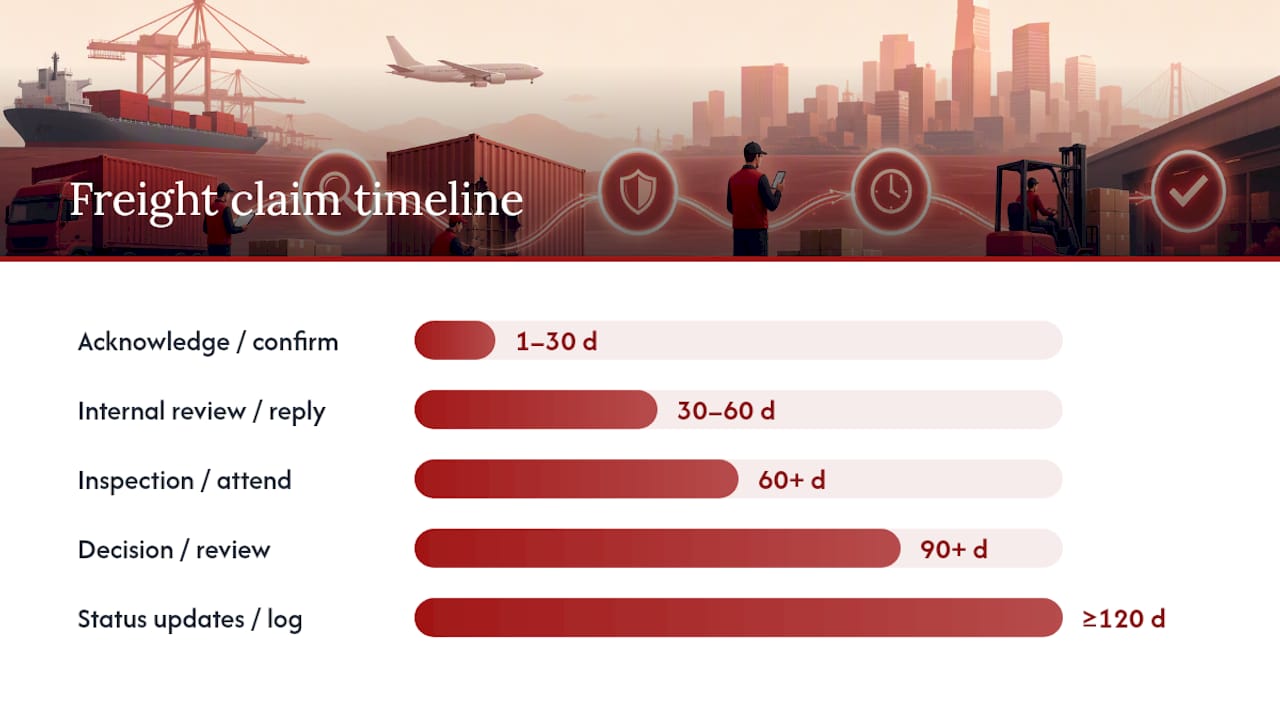
Once your claim is in the carrier’s system, a defined regulatory process kicks in. Under 49 CFR Part 370, carriers must acknowledge receipt within 30 days and either pay, decline, or make a written settlement offer within 120 days. If the claim remains unresolved at 120 days, the carrier must send you a status update every 60 days until it is resolved.
Here is what the carrier is doing during that window:
| Milestone | Expected Carrier Action | Your Action |
|---|---|---|
| Days 1–30 | Acknowledge receipt in writing | Confirm acknowledgment; note the claim number |
| Days 30–60 | Internal review; may request additional documents | Respond promptly to any document requests |
| Days 60– | Driver interview; possible on-site inspection or third-party survey | Be present for any inspection; take parallel notes |
| Days 90– | Issue payment, settlement offer, or written denial | Review offer carefully; accept, negotiate, or appeal |
| Beyond 120 days | Send status updates every 60 days if unresolved | Track dates; document every communication |
The three most common outcomes are full payment at the claimed amount, a partial settlement offer (often based on a per-pound released-value cap or a disputed salvage calculation), and outright denial. A settlement offer is not a final answer — you can negotiate, supply additional documentation, or request reinspection before accepting.
A properly documented claim package is often resolved within 60–120 days. Complex disputes or cases that proceed to litigation under Carmack can take six months to several years.
How does carrier liability work, and how is your recovery calculated?
The Carmack Amendment (49 U.S.C. § 14706) imposes strict liability on interstate motor carriers for cargo loss and damage. “Strict” means you do not need to prove the carrier was negligent — only that the cargo was in good condition when tendered, damaged when delivered, and that you suffered a specific dollar loss.
The three proof elements
- Good condition at origin. Your BOL notation, origin photos, and packing checklist establish this. A BOL that says “shipper load and count” or “said to contain” weakens this element — carriers use those notations to argue they never verified condition.
- Damaged at delivery. Your POD notations, delivery photos, and the carrier’s own inspection report establish this.
- Dollar amount of loss. Invoice value at destination minus salvage, plus documented repair costs. A clear, itemized calculation supported by actual invoices is harder for the carrier to discount.
Recovery is capped at the actual market value of the goods at destination, not replacement cost. If you declared a higher value on the BOL and paid the applicable rate, you may recover up to that declared amount. If no value was declared, many carriers apply a released-value limit — often $0.10 to $0.50 per pound for LTL shipments — which can be far below actual invoice value. Always check your carrier’s tariff and consider purchasing declared value coverage or separate cargo insurance for high-value shipments.
This section provides practical guidance only, not legal advice. For exact statutory language, refer to 49 U.S.C. § 14706 and 49 CFR Part 370, or consult a transportation attorney.
Why do claims get denied, and how do you appeal?
Most freight claim denials are procedural, not factual. The cargo was genuinely damaged, but the claimant made a mistake that gave the carrier a clean exit. The most common reasons:
- Signing a clean POD. The single most frequent denial trigger. No damage notation = carrier argues goods were accepted in good condition.
- Missing the concealed-damage notice window. Waiting more than 5–15 days to report hidden damage often voids the claim entirely.
- Incomplete documentation. Missing invoices, no repair estimate, or photos taken after packaging was discarded.
- Disposing of damaged goods or packaging before the carrier authorizes it. Carriers treat this as destruction of evidence and deny immediately. Always hold freight and packaging until you receive written authorization.
- Deducting the claim from the freight invoice. UPS and most carriers treat an offset as a contractual breach and suspend claim handling until freight charges are paid in full.
How to appeal a denial
- Request a written denial with specific reasons. You cannot appeal effectively without knowing the stated grounds.
- Supply the missing documentation if the denial was based on incomplete evidence. Many carriers will reopen a claim when the gap is filled.
- Request reinspection if the denial disputes the extent or cause of damage.
- Negotiate. A settlement offer below your claimed amount is still negotiable. Counter with your itemized calculation and supporting invoices.
- Escalate within the carrier. Move from the claims representative to the claims manager, then to corporate claims or legal.
- File suit under Carmack. You have two years from the date of written denial to file in federal court. At this stage, involve a transportation attorney.
Pro Tip: When appealing, attach a one-page cover memo that lists each denial reason and the specific document you are providing to address it. Claims managers respond faster to organized, point-by-point rebuttals than to general letters of disagreement.
How good packing and documentation prevent damage and strengthen claims
The best freight damage claim is one you never have to file. The second best is one you win quickly because your origin documentation is airtight.
For heavy or fragile goods — including crate-shipped go-karts, ATVs, and mini bikes — these practices make the biggest difference:
- Crate and brace properly. Internal blocking, bracing, and foam padding prevent movement during transit. Shrink-wrap the crate after loading and band it to the pallet. Gokartsusa ships vehicles in purpose-built crates; you can see exactly how vehicles are packed and braced before they leave the warehouse.
- Label handling instructions on the BOL and the crate. “This Side Up,” “Do Not Stack,” and “Fragile” notations on both the BOL and the physical crate create a paper trail if a carrier ignores them.
- Photograph the packed-to-ship condition. Take photos of the open crate showing the vehicle and internal bracing, then photos of the sealed crate with labels visible. These are your origin-condition evidence.
- Note serial numbers and condition on the BOL. A BOL that lists the vehicle’s serial number and notes “new, unassembled, no pre-existing damage” is far stronger than a generic commodity description.
- Select the right service level and declared value. For high-value powersports vehicles, paying for declared value coverage or purchasing separate cargo insurance is almost always worth the cost relative to the vehicle’s price.
- Retain packing checklists. A signed packing checklist from the warehouse team, timestamped and filed with the shipment record, closes the loop on origin condition.
For a deeper look at how recreational vehicles are transported and what to check at delivery, the transport guide for recreational vehicles covers labeling, service selection, and pre-ship documentation in detail.
Pro Tip: Create a simple origin-photo workflow: open crate photo → packed vehicle photo → sealed crate photo → label photo. Store all four in a shared claims folder tied to the shipment’s BOL number. When damage occurs, you have a timestamped, origin-to-destination photo trail that is very difficult for a carrier to dispute.
Our perspective on handling damaged shipments
When a powersports vehicle arrives damaged, the instinct is to get frustrated and start making calls. We get it — you ordered something exciting, and it showed up broken. But the first 30 minutes after delivery are the most important minutes in the entire claims process, and spending them on the phone instead of documenting the damage is the most expensive mistake you can make.
At Gokartsusa, our team walks customers through the same sequence every time: photograph before you touch anything, write specific damage descriptions on the POD, and hold the crate and all packaging. We have seen claims recovered that looked hopeless on paper, simply because the customer had a clear photo of the sealed crate taken before unloading and a detailed POD notation. We have also seen airtight cases fall apart because someone discarded the packaging before the carrier’s inspector arrived.
Our shipping guide explains exactly how we pack and ship every vehicle, which gives you a baseline for what “undamaged” looks like when you open the crate. If you receive a vehicle from us and something is wrong, contact our customer support team with your BOL number, your POD photos, and your damage photos ready. That combination gets things moving fast.
The cargo claim process rewards preparation and patience in equal measure. Document everything, meet every deadline, and never dispose of evidence without written authorization. Those three habits cover the vast majority of what separates a paid claim from a denied one.
Sources
These are the primary references to consult when you are ready to act:
- 49 CFR § 370.3 — Filing of claims
- File a Cargo Claim | FedEx Freight
- Cargo Claims Forms | UPS Supply Chain Solutions
- How to File a Freight Claim: Shipper Guide (2026) | O Trucking
- How to Complete and Submit a Freight Loss and Damage Claim Form - LegalClarity
This article is general information, not a substitute for advice from a qualified lawyer. Consult a qualified legal professional about your own circumstances before acting on anything here.