




TL;DR:
- Your vehicle’s actual towing limit depends on the lowest rating among its components, not just the advertised capacity.
- Always weigh loaded trailers and use VIN-based tools to verify specific vehicle ratings before towing.
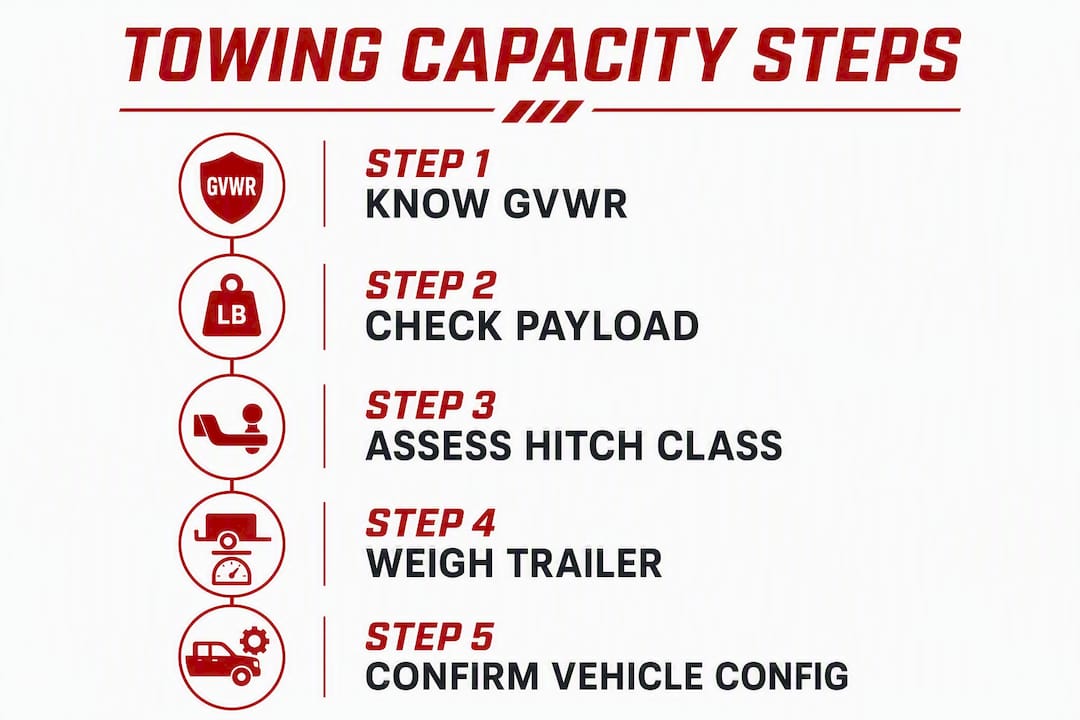
Towing capacity is the maximum loaded trailer weight a vehicle is rated by its manufacturer to pull. Treat it as a hard safety ceiling, not a target. Exceed it and you risk brake failure, transmission overheating, loss of steering control, and dangerous trailer sway. Before you hitch up, run through these four checks:
- Trailer GVWR (loaded weight): Use the Gross Vehicle Weight Rating, not the dry weight listed on the sticker.
- Vehicle payload and GCWR: Confirm how much weight your tow vehicle can carry and how much combined weight the drivetrain is rated to move.
- Hitch rating: Your hitch must be rated at or above the trailer’s loaded weight.
- Weigh when in doubt: A certified truck scale removes all guesswork and costs only a few dollars.
The weakest link in the chain sets your real limit. That might be the hitch, the payload, or the axle, not the big number on the window sticker.
Table of Contents
- What does towing capacity actually cover?
- Key ratings and terms you need to understand
- How manufacturers determine towing capacity
- How to calculate whether your vehicle can safely tow a specific trailer
- Where to find your vehicle’s official towing and payload numbers
- Hitch classes and the weakest-link rule
- What happens when you exceed towing capacity?
- Actionable towing checklist for every trip
- The real towing limit is almost always the weakest link
- Key Takeaways
- Why most towing mistakes are avoidable
- Useful sources and tools to check next
What does towing capacity actually cover?
Towing capacity covers the trailer plus everything inside it: water, propane, batteries, gear, and passengers riding in the trailer. It does not cover just the trailer’s frame and walls. That distinction trips up a lot of drivers.
Here is a scenario that plays out constantly. You find a travel trailer marketed at 6,000 lb. That is the dry weight, also called Unloaded Vehicle Weight (UVW). Fill the fresh-water tank, load the propane, add camping gear and a few bikes, and that same trailer can easily hit 7,500 lb. That 1,500 lb difference is the gap between a safe trip and a dangerous one.
Manufacturer towing numbers also carry a hidden assumption: one driver, roughly 150 lb, and a specific vehicle configuration. Add a passenger, a dog, a loaded truck bed, and a full fuel tank, and your available towing capacity shrinks before you even back up to the trailer. Always plan around loaded weights, not the numbers in the brochure.
Key ratings and terms you need to understand
These ratings appear on stickers, in owner’s manuals, and in manufacturer tow guides. Knowing which one limits your setup is the whole game.
- GVWR (Gross Vehicle Weight Rating): The maximum loaded weight of the tow vehicle itself, set by the manufacturer. Never exceed it.
- GVW (Gross Vehicle Weight): The actual current weight of the tow vehicle with all occupants, cargo, and fuel. GVW must stay below GVWR.
- GCWR (Gross Combined Weight Rating): The maximum total weight of the tow vehicle plus the trailer, fully loaded. This is often the first ceiling you hit.
- Curb weight: The weight of the vehicle with standard equipment and fluids, but no passengers or cargo.
- Payload capacity: GVWR minus curb weight. This is how much weight you can add to the tow vehicle, including passengers, cargo, and tongue weight from the trailer.
- GAWR (Gross Axle Weight Rating): The maximum weight each axle is rated to carry. Overloading one axle is possible even when total weight looks fine.
- Tongue weight: The downward force the trailer hitch applies to the tow vehicle’s receiver. It counts directly against payload.
- GTW (Gross Trailer Weight): The actual loaded weight of the trailer at the time of towing. GTW must stay below the vehicle’s published towing capacity.
| Rating | What it limits | Who sets it |
|---|---|---|
| GVWR | Maximum loaded tow-vehicle weight | Manufacturer |
| GCWR | Maximum combined weight (vehicle + trailer) | Manufacturer |
| Payload capacity | Cargo + passengers + tongue weight in the tow vehicle | Manufacturer (GVWR minus curb weight) |
| GAWR | Weight on each axle | Manufacturer |
| Towing capacity | Maximum trailer GTW | Manufacturer |
| Tongue weight limit | Downward force on the hitch | Hitch manufacturer |
Manufacturers often note that payload is the first ceiling real-world drivers hit, because tongue weight eats into it immediately. Add two passengers and a loaded truck bed, and you may run out of payload before you get anywhere near the advertised tow rating.
Pro Tip: Before every trip, subtract your actual passenger and cargo weight from your payload capacity. What is left is the maximum tongue weight you can accept. That number often surprises drivers who assumed payload was not their concern.
How manufacturers determine towing capacity
The published tow rating on your window sticker is not a rough estimate. It comes from a standardized testing process governed by SAE J2807, the Society of Automotive Engineers standard that most major manufacturers follow. SAE J2807 defines the test conditions: a specific grade climb, a trailer with a defined frontal area, controlled ambient temperature, and a single driver. The result is a repeatable, comparable number.

What the standard does not account for is your exact configuration. Engine choice, rear axle ratio, transmission cooler, and whether you ordered the factory tow package all change the number. Tow packages typically add an upgraded radiator, a transmission cooler, higher-capacity alternators, integrated trailer brake wiring, and different axle ratios. The same truck model, one with the tow package and one without, can carry ratings that differ by thousands of pounds.
Industry tow-rating guides confirm that base trims and top trims of the same model can show dramatically different numbers. A base half-ton truck might have a significantly lower towing rating than the same model equipped with a max tow package, which substantially increases towing capacity. That variance is real, and it is why model-level marketing numbers are a starting point, not a final answer.
How to calculate whether your vehicle can safely tow a specific trailer
This is where most drivers either get it right or get into trouble. Work through these steps before you commit to a trailer.
- Record the trailer’s GVWR. Find it on the trailer’s certification label, not the sales listing. If you plan to load the trailer, use the GVWR, not the dry weight. A trailer marketed at 6,000 lb dry can weigh 7,500 lb loaded.
- Find your vehicle’s GCWR, curb weight, and payload capacity. These live on the driver’s doorjamb sticker, in the owner’s manual tow chapter, or on the manufacturer’s towing guide for your exact trim and axle ratio.
- Calculate available trailer weight using GCWR math. Subtract your actual loaded tow-vehicle weight (curb weight plus passengers, cargo, and fuel) from the GCWR. That result is your available trailer weight. Compare it to the trailer’s GVWR and to your published towing capacity. Use the lower number.
- Check tongue weight. Tongue weight should be 10–15% of the loaded trailer weight. Verify that this figure fits within both your hitch’s tongue weight limit and your remaining payload capacity.
- Apply a safety margin. Experienced towers routinely stay 10–20% below the published maximum to account for sustained grades, hot weather, headwinds, and degraded trailer brakes.
Worked example
Say your truck has a GCWR and curb weight that result in an available trailer weight calculation somewhat below the published towing capacity. Your calculated payload after passengers and cargo leaves a limited margin for tongue weight. A trailer with a high tongue weight percentage may exceed your remaining payload, making it unsafe for this configuration even if it is under the published tow rating.
The 80% rule: Many experienced towers cap themselves below their published towing capacity to maintain a safety margin. This buffer helps account for variables not reflected in the official rating.
When in doubt, weigh your loaded trailer at a certified truck scale. Most weigh stations and many truck stops offer this service, and the cost is minimal compared to the risk of guessing wrong.
Where to find your vehicle’s official towing and payload numbers
The most reliable source is the driver’s doorjamb sticker. Open the driver’s door and look for the tire and loading information label. It lists GVWR, GAWR for front and rear axles, and payload capacity. That sticker is specific to your vehicle as built.
The owner’s manual tow chapter goes further. It breaks down towing capacity by engine, axle ratio, and whether the tow package is installed. Ford’s official towing guidance, for example, specifies trailer frontal area limits alongside weight limits, noting that vehicles with the Trailer Tow Package should not exceed 55 ft² of trailer frontal area. Aerodynamics affect real-world performance even when weight is within spec.
Manufacturer websites also offer VIN-based towing calculators and build-sheet lookups. Enter your VIN and the tool returns the ratings for your exact configuration. Dealer build sheets, available from your selling dealer, confirm the same information.
Pro Tip: Screenshot or print the tow rating page from the manufacturer’s VIN tool and keep it in your glove box. When you rent or borrow a trailer, you have the exact numbers on hand without having to dig through the manual at a campground.
Hitch classes and the weakest-link rule
Your hitch is not just a connector. It is a rated component, and it can limit your real tow capacity below the vehicle’s own rating. The rule is simple: your actual tow limit is the lowest rating among all components in the chain.

| Hitch class | Typical receiver size | General GTW range | Common applications |
|---|---|---|---|
| Class I | 1¼ inch | Up to 2,000 lb | Small cars, light cargo carriers |
| Class II | 1¼ inch | Up to 3,500 lb | Compact SUVs, small trailers |
| Class III | 2 inch | Up to 8,000 lb | Full-size SUVs, half-ton trucks |
| Class IV | 2 inch | Up to 10,000 lb | Heavy-duty trucks, large trailers |
| Class V | 2½ inch | Above 10,000 lb | Commercial and maximum-duty towing |
Every hitch also carries a separate tongue weight rating. A Class III hitch rated at 8,000 lb GTW might have a tongue weight limit of 800 lb. If your trailer produces 900 lb of tongue weight, the hitch is over its limit even if the trailer’s GTW is within range.
Above roughly 5,000 lb of trailer weight, manufacturers generally require or strongly recommend a weight-distributing hitch. These systems use spring bars to redistribute tongue weight forward across the tow-vehicle’s front axle, restoring steering feel and reducing rear sag. At that same threshold, trailer brakes become a practical necessity and are legally required in many states.
Safety callout: Match every piece of hardware to the trailer’s GVWR, not just the tow vehicle’s rating. The trailer coupler, ball size, hitch pin, and safety chains must all be rated for the loaded trailer weight. A 2-inch ball on a trailer rated for a 2 5/16-inch ball is an unsafe mismatch regardless of what the vehicle can pull.
What happens when you exceed towing capacity?
Pushing past your trailer towing limits is not just a mechanical inconvenience. It creates compounding hazards that can develop quickly and leave little room to recover.
Mechanical risks build with every mile over the limit. Brakes overheat on sustained downgrades when the trailer’s momentum overwhelms stopping power. Transmission fluid temperatures spike when the drivetrain labors under excess load, accelerating wear and risking sudden failure. Tires on both the tow vehicle and trailer carry more weight than their load ratings allow, raising the risk of blowout. Frame and suspension components absorb stress they were not engineered to handle.
Operational risks show up the moment you need the vehicle to respond. Stopping distances increase substantially with an overloaded trailer. Steering becomes sluggish because the rear of the tow vehicle is pushed down and the front loses contact pressure. Trailer sway, the side-to-side oscillation that can flip both vehicles, becomes far more likely when tongue weight is wrong or total weight is excessive.
Legal and administrative consequences add another layer. In the United States, a Commercial Driver’s License (CDL) is required when the combined vehicle weight exceeds 26,001 lb, or when the towed vehicle alone exceeds 10,001 lb. Individual states enforce trailer weight limits at weigh stations, and penalties for overweight commercial rigs are significant. For recreational towers, the liability exposure in an accident involving an overloaded setup is severe. Check your state’s specific rules before hauling heavy loads.
For a broader look at keeping your recreational vehicles and gear safe on the road, the RV safety guide from Gokartsusa covers practical pre-trip and on-road habits worth reviewing.
Actionable towing checklist for every trip
Safe towing is a habit, not a one-time calculation. Run through this checklist before you leave the driveway.
Pre-tow checks
- Weigh the loaded trailer at a certified scale and confirm GTW is below your towing capacity and GCWR math allows it.
- Verify tongue weight is 10–15% of GTW and within both hitch and payload limits.
- Inspect the hitch ball, coupler, hitch pin, and safety chains for wear, proper size match, and secure attachment.
- Check tire pressure on both the tow vehicle and trailer, and confirm load ratings match or exceed axle loads.
- Verify the trailer brake controller is calibrated and functioning if the trailer has electric brakes.
- Confirm all trailer lights (brake, turn, running) work before pulling out.
On-road habits
- Increase following distance to at least double your normal gap. A loaded trailer adds stopping distance you cannot recover.
- Use lower gears on long downgrades to let engine braking share the load with your brakes.
- Avoid sudden lane changes. Trailers amplify lateral inputs and can initiate sway.
- Slow down in crosswinds, especially with tall or box-shaped trailers. Wind loads are not in the weight rating.
Maintenance habits
- Check transmission fluid condition and level before long towing trips. Consider an aftermarket transmission cooler if you tow regularly.
- Inspect trailer wheel bearings and brake pads on a schedule, not just when something feels wrong.
- Schedule a drivetrain inspection after any trip where you pushed near the rated limits.
Pro Tip: If your trailer GTW is above 5,000 lb and you do not have a weight-distributing hitch, book a professional hitch setup appointment before the trip. The cost is far less than the repair bill for a sway event or a blown rear suspension.
For guidance on transporting smaller recreational vehicles like ATVs and go-karts, the transport guide from Gokartsusa covers load securement and best practices in detail.
The real towing limit is almost always the weakest link
The most common mistake drivers make is checking only the advertised maximum towing capacity and assuming that number applies to their exact truck on their exact trip. KBB’s towing guide and CURT’s towing capacity resource both stress the same point: your real limit is the lowest value among towing capacity, GCWR, payload, hitch rating, and tire load ratings.
Consider two quick examples. A half-ton truck with a 10,000 lb tow rating but only 1,400 lb of payload cannot safely tow a 9,000 lb trailer that produces 1,350 lb of tongue weight, because passengers and bed cargo have already consumed most of that payload. In a second scenario, a driver installs a Class III hitch rated at 6,000 lb on a truck rated to tow 8,500 lb. The hitch is now the ceiling, full stop.
Configuration matters just as much as the rating itself. The same truck model with a standard axle ratio and without the tow package may be rated 3,000–4,000 lb lower than the version with the factory tow package. Checking the model-level maximum from a dealer ad and assuming it applies to your specific VIN is one of the most reliable ways to end up in an unsafe situation.
Pro Tip: Weigh your tow vehicle loaded (passengers, cargo, fuel) and your trailer loaded separately at a certified scale. Add those two numbers and compare to your GCWR. That single check tells you more about your real-world safety margin than any sticker.
Key Takeaways
Towing capacity is a hard safety ceiling set by the manufacturer, and your real-world limit is always the lowest rating among your vehicle, hitch, payload, and trailer hardware.
| Point | Details |
|---|---|
| Use loaded trailer weight | Always compare trailer GVWR (not dry weight) to your towing capacity and GCWR math. |
| Payload caps towing first | Tongue weight counts against payload; passengers and cargo reduce how much trailer you can safely pull. |
| Apply a 10–20% safety margin | Staying below the published maximum accounts for grades, heat, headwinds, and degraded brakes. |
| Weakest link sets the limit | Vehicle rating, hitch rating, payload, and tire load ratings all apply; the lowest one is your ceiling. |
| Verify your exact VIN | Model-level marketing numbers can differ by thousands of pounds from your specific trim and configuration. |
Why most towing mistakes are avoidable
There is a pattern in how towing accidents happen. It is rarely a driver who ignored every warning. More often, it is someone who trusted the dry weight on the trailer’s sales listing, assumed the dealer’s advertised max tow number applied to their exact truck, and never checked whether tongue weight was eating into their payload. Three small oversights, and suddenly a family trip becomes a roadside emergency.
The fix is not complicated. Weigh everything loaded. Pull up the manufacturer’s VIN-based towing calculator before you buy or rent a trailer. Subtract your actual passenger and cargo weight from your payload before you calculate tongue weight. These are five-minute habits that change the math entirely.
What I find underappreciated is how often payload, not towing capacity, is the real constraint. Drivers obsess over the big tow number on the window sticker and never look at the payload sticker on the doorjamb. A truck rated to tow 12,000 lb with only 1,600 lb of payload is not a 12,000 lb towing machine the moment you add two adults, a dog, and a loaded bed. It is a truck with maybe 900 lb of tongue weight capacity left, which limits you to a trailer well under 9,000 lb, given the 10% tongue weight guideline.
The other habit worth building is the pre-trip scale stop. Certified truck scales are at most weigh stations and many truck stops. The cost is a few dollars. The information you get, actual loaded weights on both the vehicle and the trailer, is the only number that tells you with certainty whether your setup is within limits. No calculation based on estimates gives you that confidence.
Useful sources and tools to check next
These are the primary references and tools worth bookmarking before your next tow.
- Towing Capacity Guide: Everything You Need to Know — Kelley Blue Book’s comprehensive breakdown of towing ratings, safety risks, and the 80% rule.
- How to Measure Towing Capacity, GVWR, GCWR — CURT’s technical guide covering the weakest-link principle and how to calculate real available tow weight.
- What Is Towing Capacity? A Complete Guide — TowingSpecs’ guide covering dry vs. loaded weight, payload constraints, and weight-distributing hitch thresholds.
This article provides general information about towing capacity and trailer weight guidelines. Always verify your specific vehicle’s ratings with the manufacturer, your owner’s manual, or a qualified professional before towing.
Ready to haul your powersports gear to the trails? Gokartsusa carries a full lineup of go-karts, ATVs, mini bikes, and dirt bikes built for adventure. Whether you are loading up a kids’ ATV for a weekend ride or grabbing a gas-powered go-kart for the whole family, we ship nationwide with free shipping and seasonal deals you will not find anywhere else.