




TL;DR:
- Follow designated routes, yield to non-motorized users, and carry necessary safety equipment on all motorized trail rides.
- Proper planning, machine inspection, and adherence to land-specific rules ensure a safe and responsible off-road experience.
Trail-riding etiquette for motorized off-road vehicles is the set of safety, legal, and land-stewardship behaviors that keep riders safe, keep trails open, and protect the environment for everyone who uses them. Three rules sit above everything else: stay on designated routes, yield to non-motorized users and uphill traffic, and carry required safety equipment including a functioning spark arrestor. Burn those three into memory before your next ride.
- Stay on designated routes. Cross-country travel is prohibited on National Forest land and most BLM land.
- Yield appropriately. Motorized riders yield to hikers, cyclists, and horses; downhill riders yield to uphill traffic.
- Carry required equipment. A spark arrestor, working muffler, and functional brakes are mandatory on public lands.
Table of Contents
- What is trail riding etiquette, and why does it matter legally?
- How to plan a trail ride before you leave home
- On-trail behavior: yielding, passing, and communicating with other users
- Group riding etiquette and why certified training matters
- Quick U.S.-specific rules and how land managers differ
- Your before-you-ride and on-trail quick checklist
- Key Takeaways
- The freedom to ride is worth protecting
- A note on riding with purpose
- Authoritative U.S. resources to bookmark now
What is trail riding etiquette, and why does it matter legally?
The legal stakes are real. The U.S. Forest Service requires all motorized vehicles on public lands to carry a spark arrestor, a functioning muffler or silencer, and working brakes. Riding without them can result in fines and removal from the trail system. Operating any OHV while impaired by alcohol or drugs is illegal across every public land system in the country, full stop.
Earbuds and headphones are prohibited or strongly discouraged in many riding areas because they prevent you from hearing approaching traffic, wildlife, or distress calls from your group. Helmet rules and passenger age restrictions vary by state, but many jurisdictions require helmets for riders under 18 and prohibit carrying passengers on single-rider machines. Utah’s OHV program, for example, requires registration stickers and adult supervision for riders under 18 on public trails.
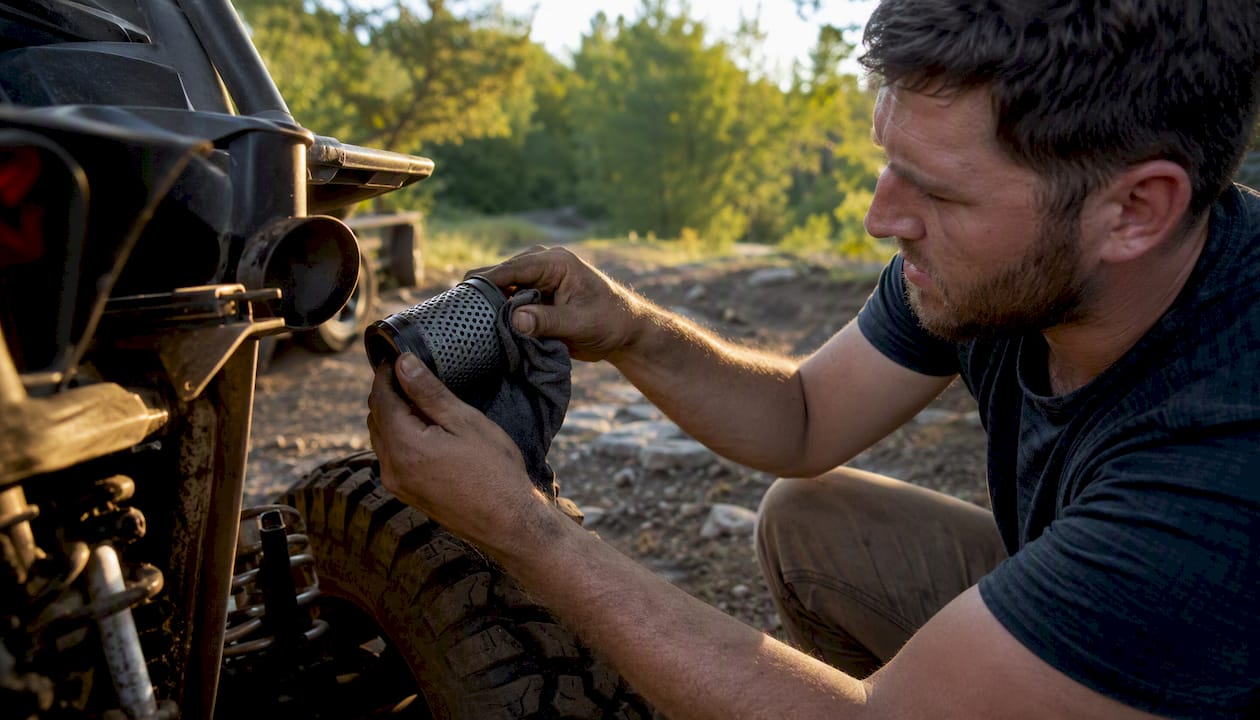
Pro Tip: Check your spark arrestor before every ride. A clogged or missing unit is one of the most common reasons riders get turned away at trailheads on National Forest land.
| Equipment / Behavior | Typical Status on Public Lands |
|---|---|
| Spark arrestor | Required (federal) |
| Working muffler/silencer | Required (federal) |
| Functional brakes | Required (federal) |
| Earbuds/headphones | Prohibited or discouraged |
| Riding impaired | Illegal on all public lands |
| Helmet (under 18) | Required in most states |
How to plan a trail ride before you leave home
Good rides start with good planning. A few minutes of research prevents the frustration of arriving at a trailhead only to find it closed, restricted, or off-limits to your vehicle class.
- Pull the Motor Vehicle Use Map (MVUM). The USFS MVUM shows every road and trail open to motor vehicles by class and season. Download it before you go; cell service on National Forest land is unreliable.
- Inspect your machine. Check spark arrestor, brakes, tires, lights, and fluid levels. Our ATV safety checklist walks through every pre-ride inspection point.
On-trail behavior: yielding, passing, and communicating with other users
Right-of-way on multiuse trails follows a clear hierarchy: motorized riders yield to everyone else. Hikers and runners get the right of way over cyclists, and cyclists yield to horses. When two motorized riders meet on a narrow trail, the downhill rider pulls over to let the uphill rider pass, since stopping and restarting on a climb is harder and more dangerous.
Passing requires patience. Pull completely off the trail, shut down or idle your engine, and signal clearly before moving. A quick wave or a short horn tap alerts riders ahead. For group rides, agree on hand signals before you leave: a raised fist means stop, a pointed finger indicates a hazard, and a flat hand low to the ground signals slow down.
Horses deserve special attention. When you encounter an equestrian, stop your machine, turn off the engine if possible, and speak calmly so the horse can identify you as a human. Move to the downhill side of the trail if you can; horses are less likely to bolt away from a lower object. Never rev your engine near livestock or horses.
Pro Tip: When approaching a blind corner, slow to a speed where you can stop within your visible distance. Dust hanging in the air ahead of you is a reliable sign that another rider just passed through.
| Trail User | Who Yields to Them | Key Action |
|---|---|---|
| Hiker / runner | Everyone | Pull off, stop, let them pass |
| Mountain biker | Motorized riders | Slow, signal, give space |
| Equestrian | Everyone | Stop engine, speak calmly, stay low |
| Uphill motorized rider | Downhill motorized rider | Downhill pulls off to let uphill pass |
Group riding etiquette and why certified training matters
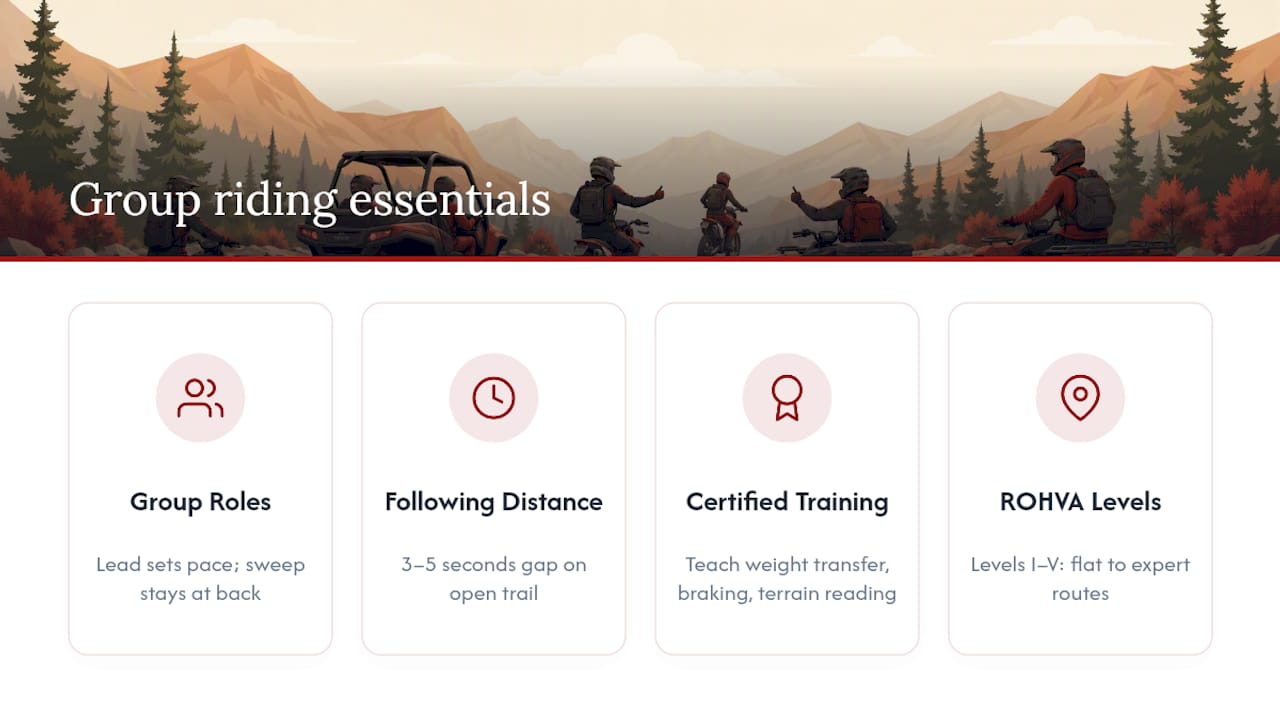
Group rides are more fun and safer when everyone knows their role. The lead rider sets the pace and navigates; the sweep rider stays at the back and never passes a stopped rider without confirming they’re okay. Space your group so each rider can see the one ahead without eating their dust, typically 3–5 seconds of following distance on open trail.
Certified training courses like the ATV RiderCourse and the ROV Basic DriverCourse teach vehicle-specific skills that trail experience alone doesn’t cover: weight transfer, emergency braking, and reading terrain. Riders who complete them make better decisions under pressure and set the standard for everyone riding with them.
Agree on a meeting point before you split up. If a rider separates from the group, the buddy system means someone always knows where to look. The BLM recommends riding with a partner as a baseline safety practice, especially in remote areas.
Pro Tip: If you’re mentoring a new rider, ride behind them for the first few miles. You’ll spot bad habits (late braking, cutting corners, riding the edge) before they become dangerous patterns.
ROHVA’s ROV-specific guidance also describes trail difficulty levels from Level I (flat, open terrain) through Level V (technical, expert-only routes). Matching your skill and vehicle to the right level is one of the most practical things you can do before any group ride. For younger riders joining the group, our guide on teaching kids ATV riding safely covers supervision, sizing, and skill progression.
Quick U.S.-specific rules and how land managers differ
Federal requirements apply broadly, but the agency managing your trail matters.
- U.S. Forest Service: — Spark arrestors, designated routes, and MVUM compliance are non-negotiable. Seasonal closures are common in spring mud season and fire season.
- Bureau of Land Management: — Similar equipment rules; some BLM areas require a Recreation Permit. Check the local field office page before traveling.
Pro Tip: When you’re riding in a new state or crossing into a new National Forest, call the local ranger district or field office the week before your trip. Rules change seasonally, and a two-minute phone call beats a surprise closure at the trailhead.
Your before-you-ride and on-trail quick checklist
Responsible riders treat this checklist the way pilots treat a preflight check. Screenshot it, print it, or save it to your phone.
Before you ride:
- Download or print the MVUM for your riding area
- Confirm no active closures or permit requirements
- Inspect spark arrestor, exhaust, brakes, tires, and fluids
- Pack first-aid kit, tools, recovery gear, water, and communications
- Tell someone your route and expected return time
- Wash your machine if it carried mud from a previous ride
On the trail:
- Ride single file on narrow trails
- Yield to hikers, cyclists, and horses without exception
- Slow down at blind corners and creek crossings
- Pull completely off the trail to pass or be passed
- Leave gates exactly as you found them (open or closed)
- Pack out all trash, including others’ litter when you can
The USFS is direct: riders who damage trails through poor behavior risk losing access for everyone. That’s not a hypothetical. Trail closures happen, and they’re hard to reverse.
Key Takeaways
Responsible motorized trail riding comes down to three things: legal compliance, respect for other users, and active land stewardship on every single ride.
| Point | Details |
|---|---|
| Required equipment | Spark arrestor, working muffler, and functional brakes are mandatory on U.S. public lands. |
| Right-of-way hierarchy | Motorized riders yield to hikers, cyclists, and horses; downhill riders yield to uphill riders. |
| Plan before you go | Download the USFS MVUM, verify closures, and match your vehicle class to the trail designation. |
| Get certified | ATV RiderCourse and ROV Basic DriverCourse build skills that trail experience alone doesn’t teach. |
| Stewardship protects access | Staying on designated routes and volunteering with trail clubs keeps trails open for future rides. |
The freedom to ride is worth protecting
Here at Gokartsusa, we believe the best ride is one you can talk about at the trailhead afterward, with your machine intact, the trail in good shape, and everyone in your group accounted for. Trail etiquette isn’t a set of rules designed to slow you down. It’s the shared code that keeps public land open to riders like us.
We’ve seen what happens when riders ignore the rules: trails close, permits get pulled, and entire riding areas disappear from the map. That’s a loss for every family loading up an ATV or dirt bike for a weekend adventure. The riders who follow proper trail conduct, complete their training, and give back through volunteer work are the ones who keep those adventures possible.

Gokartsusa carries a full lineup of trail-ready machines built for responsible fun, from the Mini Sport Kids ATV with parental remote kill switch to the Sport Kart offroad go-kart for riders ready to explore. Every machine we sell comes with the expectation that you’ll ride it right.
A note on riding with purpose
Most trail-etiquette articles treat the rules as a compliance checklist. I think that misses the point entirely.
The riders who genuinely understand off-road trail etiquette rules aren’t following them to avoid fines. They follow them because they’ve seen what a well-maintained trail feels like under the wheels and what a wrecked one looks like after a season of bad decisions. There’s a real difference, and experienced riders feel it immediately.
The ATV RiderCourse and ROV Basic DriverCourse don’t just teach you to operate a machine. They teach you to read terrain, anticipate hazards, and make decisions before a situation becomes an emergency. That kind of preparation is what separates a rider who has fun from one who becomes a cautionary story. Invest in the training. Ride within your ability. And when you see a new rider making a mistake, say something. The trail community is only as strong as the standards we hold each other to.
Authoritative U.S. resources to bookmark now
These are the primary sources every motorized trail rider should have saved before any trip.
- USDA Forest Service — 03511307 (spark arrestor, muffler, brakes guidance)
- Off-highway Vehicle Touring — U.S. Forest Service
- Motorized use - LEI | USDA Forest Service
- BLM — ATV tips
- TreadLightly! — ATV tips
- ROHVA — ROV safety and tips (May 2024)
- ROHVA — Respect the outdoors
- Utah OHV law highlights brochure
Bookmark your managing agency’s closure and map pages directly. Rules update seasonally, and the agency page is always more current than any third-party guide.