




TL;DR:
- Speed limiters on youth go-karts and ATVs restrict engine RPM, reducing top speed and crash energy. They help lower injury risk by enabling adult supervision and building motor skills safely. Proper use, maintenance, and layered safety measures are essential for effective child protection.
Speed limiters on youth go-karts and ATVs work by capping the engine’s maximum RPM, which directly lowers top speed and reduces the energy released in a crash. The American Academy of Pediatrics recommends children under 16 never operate adult-sized ATVs, and the CPSC draws a firm line at 5 mph: products that stay under that threshold let an adult walk alongside and supervise in real time. Gokartsusa builds that thinking into its youth lineup, offering models with adjustable throttle governors and parental remote kill switches so you control the adventure from day one.
Three things you can do right now: set the throttle limiter to a conservative speed for your child’s age, confirm the limiter is installed and functioning before the first ride, and pair every session with a properly fitted helmet and direct adult supervision.
Table of Contents
- Why speed limiters protect kids: how the technology actually works
- What the research and safety data say about speed limits and child safety
- How do you choose the right speed cap for your child’s age and skill?
- Installing, testing, and maintaining a speed limiter safely
- What safety measures should you use alongside a speed limiter?
- Speed limiters build confidence and motor skills, not just caution
- Common myths about speed limiters and kids’ enjoyment
- Speed limiters also reduce noise and environmental impact
- Key Takeaways
- Speed, safety, and the freedom to learn
- Gokartsusa has limiter-ready youth models waiting for your family
- Authoritative sources and further reading
Why speed limiters protect kids: how the technology actually works
A throttle governor is the most common limiter type. It is a mechanical stop or cable adjustment that prevents the throttle from opening fully, which caps maximum RPM and top speed without cutting engine power abruptly. The ride still feels responsive; it just cannot exceed the set ceiling.
Exhaust restrictors take a different approach. A small plate or insert reduces exhaust flow, which lowers peak power output across the entire RPM range. The effect is a softer power curve rather than a hard speed ceiling. This method is harder to defeat by feel alone, though a determined teenager with basic tools can remove the insert.
Electronic governors use a sensor and control module to cut ignition or fuel delivery when RPM climbs past a programmed limit. They tend to be more tamper-resistant than mechanical stops and can sometimes be adjusted through a dealer’s diagnostic tool rather than a wrench.
Parental remote kill switches are a separate layer entirely. They do not limit speed during normal riding; they cut the engine instantly when you press a button, typically within a range of 30–100 feet depending on the model. The Gokartsusa Mini Sport Kids ATV (110cc) includes a parental remote start/kill as a standard feature, which means you can stop the vehicle the moment a situation looks unsafe.
What the research and safety data say about speed limits and child safety
Roughly 25% of ATV-related emergency-room-treated injuries involve children under 16, according to CPSC annual reports. That figure alone makes the case for speed regulation: lower speed means lower crash energy, shorter stopping distances, and more time for an adult to intervene.
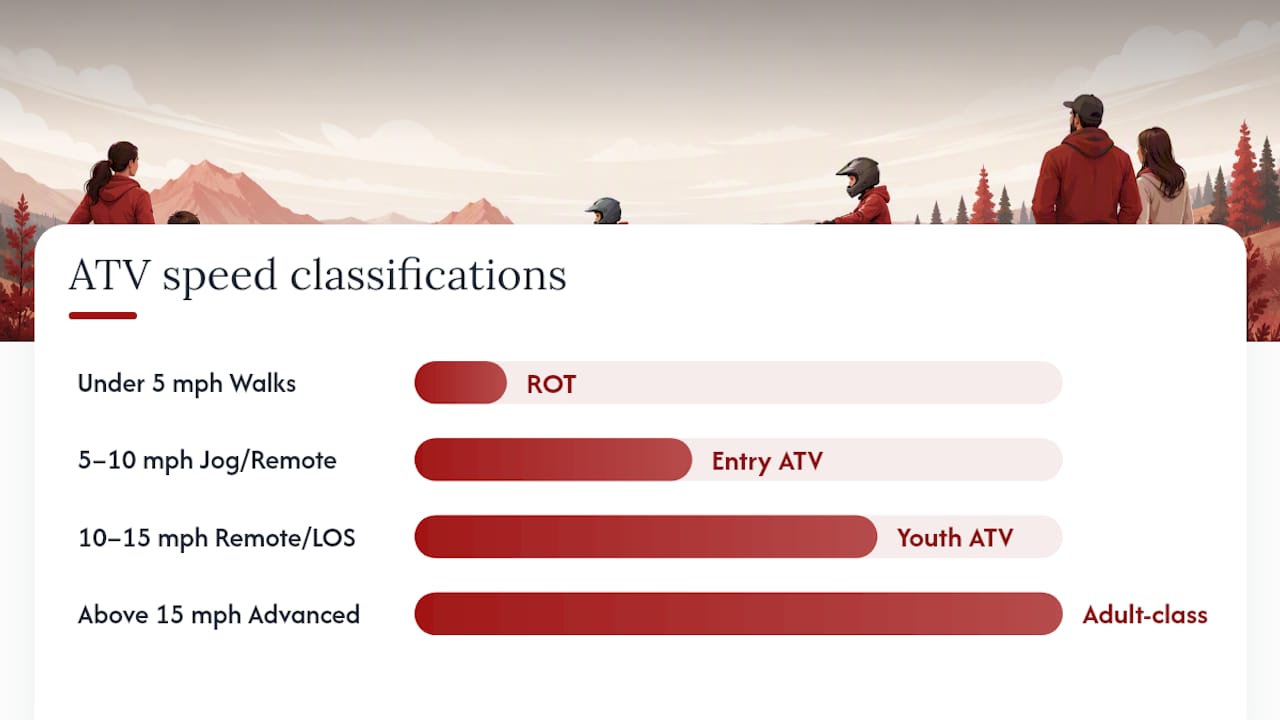
The CPSC’s guidance on youth ATV categorization establishes 5 mph as the threshold that separates ride-on toys from youth ATVs. Below 5 mph, an adult walking at a normal pace can stay alongside the child. Above it, the vehicle outpaces walking supervision quickly. That is why the CPSC’s detailed classification criteria treat speed as one of the primary indicators of off-highway use potential.
| Speed cap | Supervision model | Typical vehicle class |
|---|---|---|
| Under 5 mph (8 km/h) | Adult walks alongside | Ride-on toy (ROT) |
| 5–10 mph (8–16 km/h) | Adult jogs or uses remote kill | Entry youth ATV / go-kart |
| 10–15 mph (16–24 km/h) | Remote kill + line-of-sight required | Youth ATV, supervised trail |
| Above 15 mph (24 km/h) | Not recommended for beginners | Adult-class or advanced youth |
Limiters are not foolproof. The Consumer Federation of America raised concerns in the Federal Register that speed-limiting devices can be defeated by children and may have reported failure modes. That is an honest reality: a mechanical stop can be loosened, an exhaust insert can be pulled, and an electronic module can be bypassed by someone who knows what they are looking for. Technology reduces risk; it does not replace supervision and training.
How do you choose the right speed cap for your child’s age and skill?
Conservative defaults protect beginners and build confidence. The table below reflects guidance from CPSC resources and extension safety programs.
| Age band | Recommended top speed | Vehicle class |
|---|---|---|
| 4–6 years | Under 5 mph (8 km/h) | Ride-on toy |
| 6–10 years | 5–8 mph (8–13 km/h) | Entry youth go-kart or mini ATV |
| 10–13 years | 8–12 mph (13–19 km/h) | Youth ATV or mid-size go-kart |
| 13–16 years | 12–15 mph (19–24 km/h, supervised) | Youth ATV, certified model |
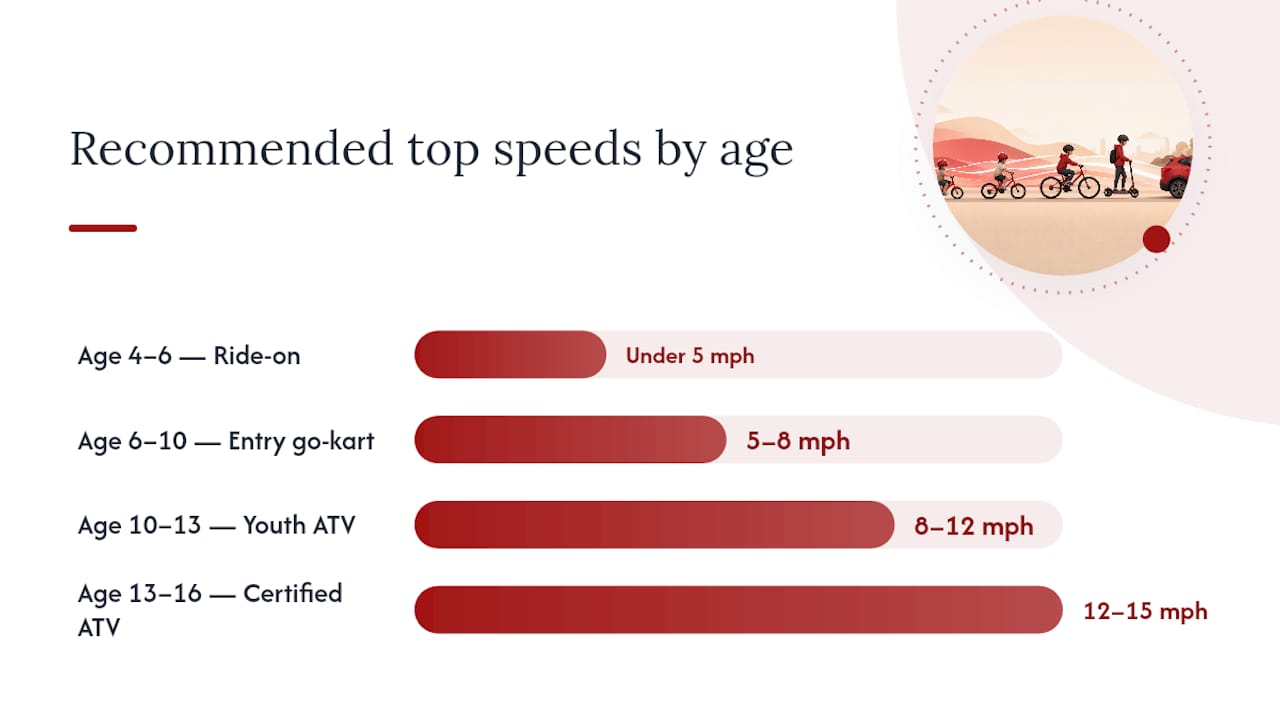
These are starting points, not ceilings. A cautious 12-year-old on unfamiliar terrain should stay at the lower end. A confident 10-year-old who has completed a safety course and rides on a flat, clear surface may be ready to move up one band after several supervised sessions.
When selecting a limiter type, work through these questions:
- Can the limiter be adjusted without tools, or does it require a dealer visit? Dealer-adjusted limits are harder for kids to defeat.
- Is the limiter tamper-evident? Look for seals or locking hardware.
- Does the manufacturer’s warranty cover limiter adjustment or removal?
- Does the model include a remote kill switch as a backup?
- Is the vehicle certified under ANSI/SVIA voluntary standards for its youth category?
The Gokartsusa Sport Kart Kids Gas Go Kart (2.5hp) suits ages 8 and up and offers available throttle control, making it a practical fit for the 6–10 age band when set conservatively. The Mini Sport Kids ATV (110cc) with parental remote start/kill fits the 10–13 band and adds the remote layer that mechanical governors alone cannot provide. For a full kids’ go-kart buying guide, Gokartsusa’s resource library walks you through every decision point.
Installing, testing, and maintaining a speed limiter safely
Before the first ride, confirm these steps:
- Read the manufacturer’s installation instructions completely. Never assume a limiter is pre-set at a safe level from the factory.
- Ask your dealer whether they are authorized to adjust the limiter and whether doing so affects the warranty.
- Set the limiter to the most conservative speed for your child’s age band.
- Run a controlled test on flat, open ground. Use a phone GPS app (Google Maps navigation or Speedometer GPS apps) to verify actual top speed matches the set limit.
- Check throttle feel: the pedal or lever should reach its mechanical stop before the engine hits full RPM.
- Log the date and setting in a maintenance notebook.
For ongoing maintenance, inspect the limiter hardware every 10 riding hours or monthly, whichever comes first. Look for loosened cable stops, missing exhaust insert hardware, or any sign the governor bracket has been bent or removed. Signs of tampering include fresh tool marks on fasteners, a noticeably faster top speed than the previous session, or a child who is suddenly reluctant to let you inspect the vehicle.
Pro Tip: Mark the throttle cable stop with a small dab of nail polish or paint pen after setting it. If the mark is broken or smeared, the stop has been moved.
What safety measures should you use alongside a speed limiter?
A limiter is one layer. Alone, it is not enough.
Required gear for every ride: a properly fitted, DOT-certified helmet; eye protection (goggles or a face shield); gloves; and over-the-ankle boots. Long sleeves and pants add abrasion protection that matters even at low speeds.
Behavior rules carry equal weight:
- One rider only. No passengers, ever, on vehicles designed for a single occupant.
- No stunts, jumps, or attempts to lift wheels.
- A visibility flag on trail rides so other riders and adults can spot the child from a distance.
- Ride only in daylight or well-lit areas.
Training should match the limiter’s speed setting. A child riding at 6 mph needs practice with steering, braking, and turning before the cap moves up. The Gokartsusa guide to teaching kids ATV riding safely outlines a skill-building progression that pairs naturally with gradual speed increases. Terrain matters too: flat, clear surfaces with no traffic are the right starting environment. Rough ground, slopes, and mixed-use areas increase rollover risk regardless of speed.
Speed limiters build confidence and motor skills, not just caution
A child who learns to steer, brake, and turn at 6 mph builds genuine muscle memory. The throttle response, the weight shift in a corner, the feel of the brakes engaging — all of that transfers directly to higher speeds later. Rushing that process by removing the limiter early does not accelerate skill development; it removes the margin for error that makes learning safe.
Psychologically, a child who masters a limited vehicle earns the speed increase. That progression builds real confidence, the kind grounded in demonstrated ability rather than bravado. Parents who use limiters as a teaching tool rather than a restriction report that children ask for more speed only after they feel genuinely ready, because the controlled environment gave them an honest sense of their own skill level.
Common myths about speed limiters and kids’ enjoyment
Myth: “Limiters ruin the fun.” A child riding at 8 mph on a well-chosen trail is having a genuine adventure. The thrill of powersports comes from the sensation of movement, the freedom of the outdoors, and the pride of operating a real vehicle. Speed is one variable, not the whole experience.
Myth: “My kid will get bored and just remove it.” Boredom is a training and terrain problem, not a limiter problem. A varied practice environment with new skills to learn keeps engagement high at any speed setting.
Myth: “Limiters are only for very young kids.” The CPSC’s guidance applies to children under 16. A 14-year-old on an unfamiliar vehicle in a new environment benefits from a conservative starting speed just as much as a 7-year-old does.
Myth: “A limiter means the vehicle is underpowered.” A throttle governor does not reduce the engine’s displacement or torque at lower RPM. The vehicle still pulls, steers, and brakes with full mechanical capability; it simply cannot reach its maximum RPM ceiling.
Speed limiters also reduce noise and environmental impact
Lower top speed means lower sustained RPM, which translates directly to reduced engine noise. For families riding in neighborhoods, campgrounds, or shared outdoor spaces, that matters. Neighbors and fellow campers notice the difference between a youth ATV screaming at full throttle and one running at a governed pace.
Fuel consumption drops at lower RPM as well. A governed engine running well below its power peak burns less fuel per hour of operation, which reduces emissions and extends the time between fill-ups. Neither benefit is the primary reason to use a limiter, but both are real and worth knowing.
Key Takeaways
Speed limiters reduce crash energy, extend supervision range, and build skills progressively — but only when combined with proper PPE, adult oversight, and terrain selection.
| Point | Details |
|---|---|
| 5 mph (8 km/h) threshold matters | CPSC guidance sets a low speed threshold (5 mph or 8 km/h) as the point at which adult walking supervision becomes practical. |
| 25% of ATV injuries involve children | A significant portion of ATV-related ER injuries affect children under 16 — limiting speed directly reduces crash severity. |
| Layer your controls | Combine a throttle governor or exhaust restrictor with a parental remote kill switch for the strongest protection. |
| Limiters can be defeated | Mechanical governors are tamper-able; use dealer-adjusted or electronic limiters and inspect hardware regularly. |
| Gokartsusa limiter-ready models | The Mini Sport Kids ATV (110cc) with remote kill and the Sport Kart Kids Gas Go Kart (2.5hp) are built for this layered approach. |
Speed, safety, and the freedom to learn
The conventional wisdom treats speed limiters as a reluctant compromise — something you use until your child “earns” full power. That framing gets it backwards. A limiter is not a restriction on fun; it is the architecture that makes fun sustainable. A child who crashes at 20 mph may not ride again. A child who masters 8 mph, then 12 mph, then 15 mph over two seasons has built a relationship with the machine that will serve them for life.
What parents underestimate is how much of the powersports experience exists below the speed ceiling. The smell of the engine, the vibration through the handlebars, the satisfaction of a clean corner — none of that requires full throttle. The families who get the most out of youth powersports are the ones who treat the limiter as a curriculum, not a cage.
The technology has real limits, as the CFA’s documented concerns make clear. But the answer to an imperfect tool is not to abandon it. It is to use it as one part of a system that includes your presence, your judgment, and your willingness to keep the adventure going at a pace your child can actually handle.
Gokartsusa has limiter-ready youth models waiting for your family

Gokartsusa offers two standout options for parents who want speed control built in from the start. The Mini Sport Kids ATV (110cc) with Parental Remote Start/Kill gives you real-time engine control from up to 100 feet away, paired with an adjustable throttle limiter. The Sport Kart Kids Gas Go Kart (2.5hp) suits ages 8 and up with available throttle control and a frame built for learning. Both ship with free shipping and include accessory bundle options so you can add a helmet and gear in the same order.
Before you buy, run through this quick checklist: confirm the limiter type and whether it is dealer-adjusted, verify the remote kill switch range, check that the model carries youth-category labeling, and add a DOT-certified helmet to your cart. For a deeper look at matching your child to the right vehicle, the Gokartsusa kids’ powersports safety guide covers every decision point. Shop the full youth lineup at Gokartsusa and find the model that fits your child’s age, skill, and terrain today.
Authoritative sources and further reading
The claims in this article draw on the following primary sources. Each one is worth reading directly, because regulatory guidance and voluntary standards do get updated.
- Guidance for Categorizing Youth ATVs | CPSC.gov
- Guidance for Categorizing Youth All-Terrain Vehicles (ATVs)
- ATVs and youth: matching children and vehicles
- Federal Register, Volume 89 Issue 15 (Tuesday, January 23, 2024)
- All-Terrain Vehicles (ATVs) — FAQ | CPSC.gov
- Voluntary standards for All-Terrain Vehicles | CPSC.gov