




TL;DR:
- Children need safety gear because their developing bones and growth plates are more vulnerable to injury. Properly fitted, activity-specific protective equipment reduces the risk of long-term damage and immediate injuries. Consistent use and maintenance of gear are essential for effective child safety during recreational activities.
Safety gear is defined as protective equipment designed to absorb and distribute impact forces, reducing the severity of injuries children sustain during recreational and sports activities. The question of why kids need safety gear has a clear answer: children’s bodies are still developing, making their bones, joints, and growth plates far more vulnerable to lasting damage than adult tissue. Up to 50% of sports injuries in children are preventable with the right protective equipment. That single fact should shape every decision you make before your child rides, skates, or races. At Gokartsusa, we see this truth play out every day with families who love the thrill of outdoor adventure and want to protect the kids who share it with them.
Why kids need safety gear: the physiology behind the protection
Children’s bodies are not simply smaller versions of adult bodies. Their skeletons contain growth plates, which are soft cartilage zones near the ends of long bones that harden into solid bone only during late adolescence. A hard impact that a fully developed adult skeleton absorbs with a bruise can fracture or permanently damage a child’s growth plate, affecting limb development for years.
Safety gear distributes impact forces over a wider surface area, reducing the peak pressure at any single point on the body. This energy distribution is the core mechanical reason helmets, knee pads, and wrist guards work. Without that distribution, a fall that sends all force into one small joint can cause an injury that sidelines a child for months.
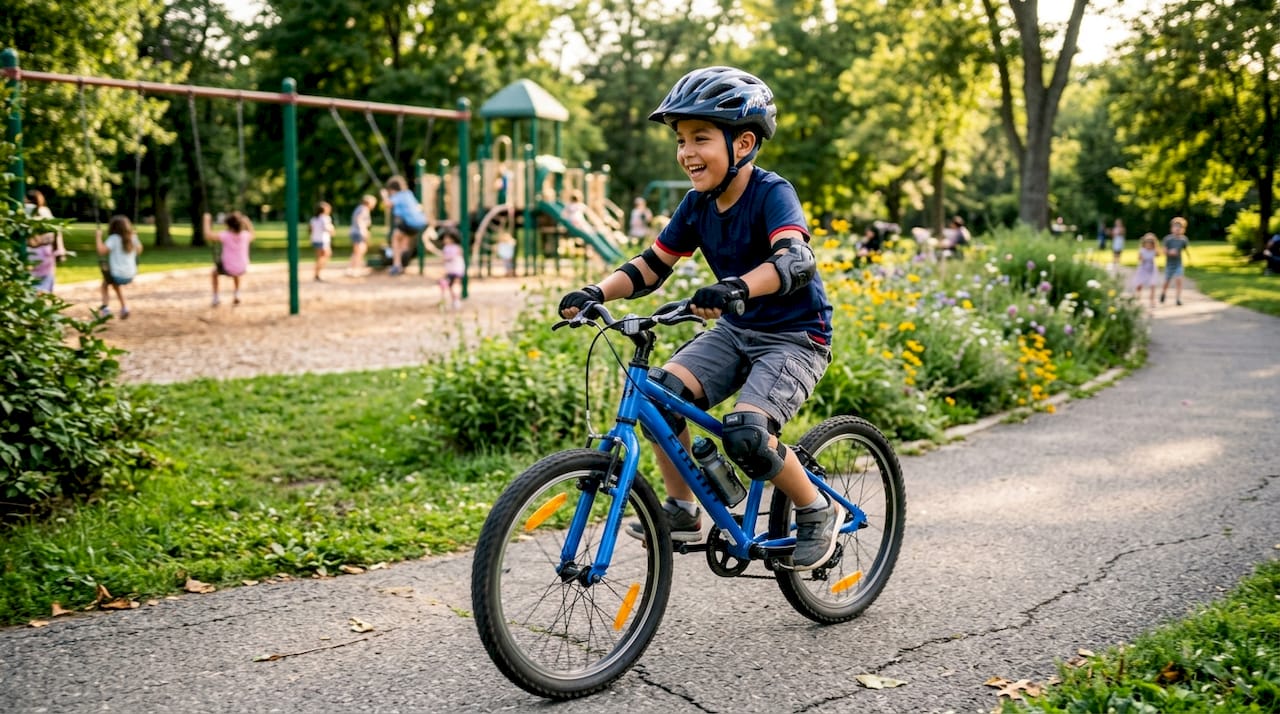
Helmets protect the skull and brain from concussive force. Knee and elbow pads cushion joints that children instinctively extend when they fall. Wrist guards prevent the fractures that happen when a child catches themselves on an outstretched hand. Each piece of gear targets a specific vulnerability in a child’s anatomy.
- Helmets reduce the risk of traumatic brain injury by absorbing and spreading impact energy through a foam liner.
- Knee pads protect the patella and surrounding cartilage from direct strikes on hard surfaces.
- Elbow pads guard the olecranon, the bony tip of the elbow that takes the brunt of sideways falls.
- Wrist guards stabilize the wrist joint and reduce fracture risk during forward falls.
- Mouthguards protect teeth and reduce jaw impact force in contact sports and high-speed activities.
Pro Tip: If your child complains that pads feel bulky, look for low-profile youth models with moisture-wicking liners. Comfort drives compliance, and a pad your child actually wears beats a premium pad sitting in the garage.
What types of safety gear are essential for different activities?
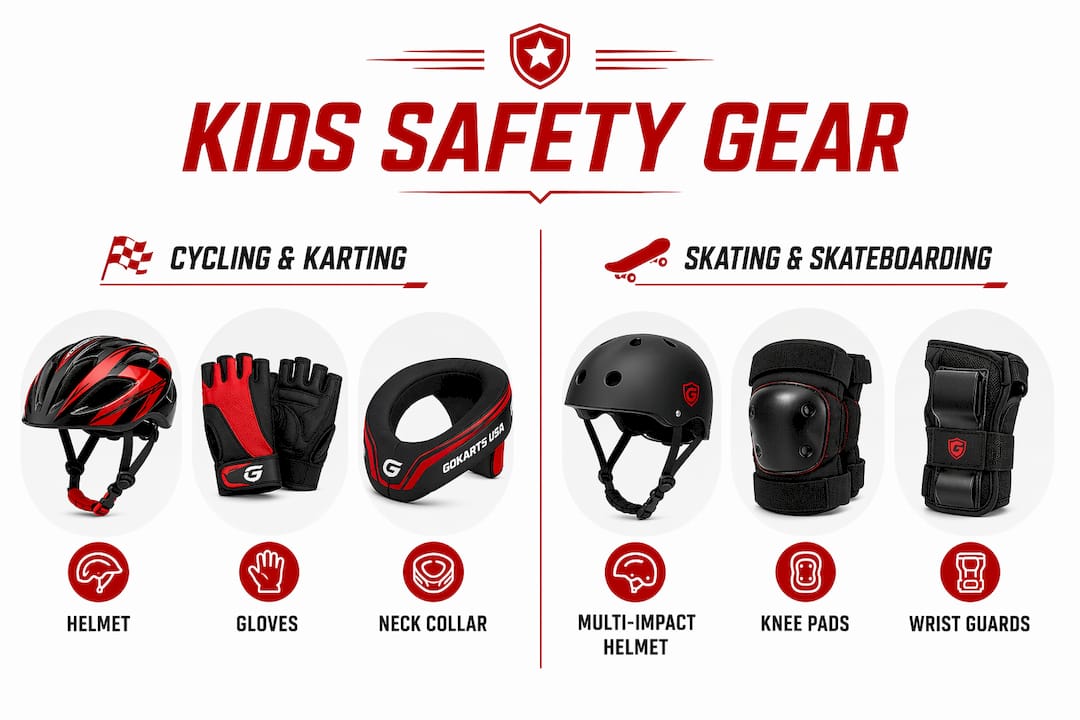
Protective equipment must be activity-specific because design features vary greatly between disciplines, and the wrong gear can fail to protect at all. A skateboard helmet, for example, is built to withstand multiple low-speed impacts, while a bicycle helmet is engineered for a single high-speed impact. Using a bike helmet for skateboarding means the foam liner may degrade after the first fall, leaving your child unprotected on the second.
Cycling and go-karting
For cycling and go-karting, a properly certified helmet is non-negotiable. Go-kart riders also benefit from a neck collar or balaclava, gloves for grip and abrasion protection, and closed-toe shoes with ankle support. Parents shopping for their first kids’ gas go-kart should treat the helmet as part of the purchase, not an afterthought.
Skating and skateboarding
Skating demands a multi-impact certified helmet plus a full pad set covering knees, elbows, and wrists. Hard-shell pads perform better on concrete than soft foam versions. Wrist guards are the single most impactful piece of gear for skaters because wrist fractures are the most common skating injury.
Team and contact sports
Football, hockey, and lacrosse require sport-specific helmets with face guards, shoulder pads, and mouthguards. A football helmet offers zero protection in a cycling crash because its energy management system is calibrated for a completely different impact profile. Always match the helmet certification to the sport.
| Activity | Core gear required | Key certification to check |
|---|---|---|
| Cycling | Helmet, gloves, closed-toe shoes | CPSC 1203 |
| Go-karting | Full-face helmet, gloves, neck collar | Snell or DOT rated |
| Skateboarding | Multi-impact helmet, knee/elbow/wrist pads | ASTM F1492 |
| Football | Sport helmet, shoulder pads, mouthguard | NOCSAE certified |
| Hockey | Full cage helmet, shoulder/shin pads, gloves | HECC certified |
For families who love the freedom of off-road riding, the go-karting safety guide from Gokartsusa covers activity-specific gear requirements in detail.
Why proper fit and maintenance matter as much as the gear itself
Gear that does not fit correctly offers no real protection. Ill-fitting protective gear is dangerous, and buying oversized equipment for a child to “grow into” is one of the most common and costly mistakes parents make. A helmet that rocks forward covers the forehead instead of the crown of the skull, leaving the most vulnerable part of the brain exposed. Knee pads that slip during a fall provide no cushioning at the moment of impact.
Gear that goes unused or fits poorly offers no protection and can actually increase risk by creating a false sense of security. OSHA’s 2026 PPE standards reinforce this point directly. Fit is not a comfort preference. It is a safety requirement.
Follow this routine to keep gear in working condition:
- Check the helmet fit monthly. The helmet should sit level, cover the forehead two finger-widths above the eyebrows, and not rock side to side or front to back when the chin strap is fastened.
- Inspect straps and buckles before every ride. Frayed straps or cracked buckles compromise the entire system.
- Examine the shell and liner for cracks. Even hairline cracks in the outer shell signal that the foam liner has compressed and lost its protective capacity.
- Replace helmets after any significant impact. Helmets require replacement after impacts even when visible damage is absent, because the foam liner crushes on first use and cannot recover.
- Resize gear every season. Children grow fast. Pads and helmets that fit perfectly in spring may be dangerously small by fall.
Pro Tip: Write the purchase date on the inside of every helmet with a permanent marker. Most manufacturers recommend replacement every three to five years regardless of visible wear, and that date reminder removes all guesswork.
How can parents encourage kids to wear safety gear consistently?
Consistent use is the variable that determines whether safety gear actually prevents injuries. Children who wear protective gear consistently develop a safety-first mindset that carries into adulthood. The challenge for parents is building that habit before resistance sets in.
The single most powerful tool you have is your own behavior. Adults wearing helmets dramatically increases children’s compliance with gear use. When your child sees you clip your helmet before every ride, the message is clear: this is what our family does. No lecture required.
- Establish a non-negotiable household rule. The “no helmet, no ride” rule applies to every household member, every time, without exceptions. Consistency removes the negotiation entirely.
- Let kids choose their gear. Children who pick their own helmet color or pad design feel ownership over the equipment and are far more likely to wear it without complaint.
- Teach the reason, not just the rule. Explain in plain terms that the helmet protects their brain, and the brain controls everything they love to do. Kids respond to concrete explanations better than abstract warnings.
- Use positive reinforcement early. Praise gear use specifically: “You remembered your wrist guards without being asked” lands better than a generic “good job.”
- Address resistance without dismissing it. If a child says gear is uncomfortable, take the complaint seriously and find a better-fitting option. Dismissing discomfort teaches kids to hide it rather than solve it.
The kids’ safety gear guide from Gokartsusa walks parents through age-appropriate gear choices that balance protection with the comfort kids actually need to keep wearing them.
Key Takeaways
Children’s safety gear prevents injury by distributing impact forces away from vulnerable growth plates, joints, and the brain, and its effectiveness depends entirely on correct fit, consistent use, and regular replacement.
| Point | Details |
|---|---|
| Physiology drives the need | Children’s growth plates and developing bones make them far more vulnerable to impact than adults. |
| Activity-specific gear is required | A helmet certified for one sport cannot reliably protect in a different activity with a different impact profile. |
| Fit is a safety requirement | Oversized or loose gear shifts during impact and fails to protect the areas it is designed to cover. |
| Replace after every impact | Helmet foam compresses on first use and cannot recover, even when the outer shell looks undamaged. |
| Model the behavior you want | Parents who wear helmets consistently raise children who wear helmets consistently. |
Gear is the last line of defense, not the first
Here is the part most safety articles skip: gear is the final layer of protection, not the foundation. Safety gear sits at the bottom of the hierarchy of controls, meaning it only activates when every other safeguard has already failed. The first layers are environment design, safe technique training, and supervision. A child who has never been taught how to fall safely, or who rides on a surface full of hazards, is relying entirely on gear to compensate for gaps that gear was never designed to fill.
I have watched parents invest in top-tier helmets and then let kids ride on cracked, uneven surfaces with zero instruction on speed control. The gear looked right. The situation was not. That gap is where injuries happen.
The other thing I have seen parents underestimate is risk compensation. Wearing full gear can cause children to take riskier actions because they feel invincible. Your job as a parent is to reinforce that gear reduces consequences. It does not eliminate them. Keep that conversation going alongside every gear check.
The families who get this right treat safety as a culture, not a checklist. Gear is part of that culture. So is the conversation before the ride, the route you choose, and the skills you teach. All of it works together.
— Mario
Ready to ride right with Gokartsusa?
At Gokartsusa, we believe adventure and safety belong together. Every vehicle we carry is selected with active families in mind, and that means thinking about protection from the start, not as an add-on.
Parents looking for a first powersports vehicle built for younger riders will find the Sport Kart Kids Gas Go-Kart a strong starting point. It is designed for ages 8 and up, with a 2.5hp 4-stroke engine and a frame sized for real control, not just fun. Pair it with the right helmet and pads, and you have a setup that lets kids experience the thrill of the ride with the protection they need. Check out the full kids’ safety checklist to make sure your family is ready before the first lap.
FAQ
Why do children need safety gear more than adults?
Children’s bones contain growth plates that are softer and more vulnerable to fracture than adult bone. A single hard impact can damage these plates and affect long-term limb development, making protective gear especially critical during childhood.
What is the most important piece of safety gear for kids?
A properly fitted, activity-specific helmet is the most critical piece of child safety equipment. Head injuries carry the highest risk of permanent harm, and a certified helmet is the most direct way to reduce that risk.
How often should a child’s helmet be replaced?
Replace a helmet after any significant impact, even if no visible damage appears. The foam liner compresses on first use and cannot recover its protective capacity. Most manufacturers also recommend replacement every three to five years regardless of impact history.
Can kids wear the same helmet for multiple activities?
No. Helmets are engineered for the specific impact profiles of individual sports. A bicycle helmet used for skateboarding may fail to protect after the first fall, and a skateboard helmet does not meet the standards required for go-karting or contact sports.
How do I get my child to wear safety gear without a fight?
Let your child choose their own gear color or design to build ownership. Apply a firm household rule that covers all family members, and model the behavior yourself by wearing your own helmet every time. Children follow consistent adult behavior far more reliably than they follow verbal instructions.