




TL;DR:
- A kids go-kart safety checklist includes essential protective gear, proper fit, and pre-ride mechanical checks to prevent accidents. Proper training on track rules and safety features like harnesses and kill switches also reduces risks, ensuring children can enjoy karting safely. Prioritizing smooth inputs and correct fit builds safe driving habits for young drivers while safety-focused karts offer additional protection.
A kids go-kart safety checklist is the structured set of steps that protects young drivers before, during, and after every session on the track. Mandatory DOT-approved helmets, gloves, closed-toe shoes, and supplemental gear like neck braces form the foundation of any responsible karting setup. Proper kart fit, pre-ride mechanical checks, and a solid safety briefing complete the picture. This guide walks you through every item on that checklist so your child can experience the thrill of karting with confidence and real protection behind them.
1. What essential protective gear must every child wear?
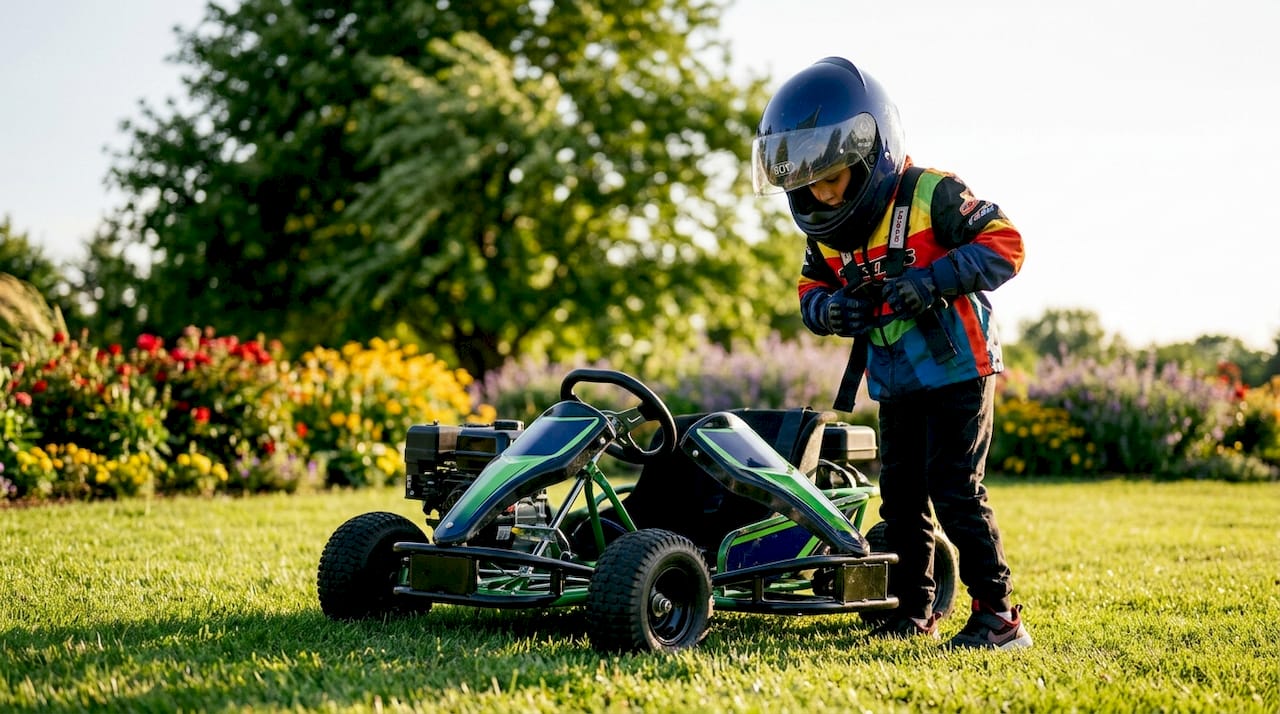
Protective gear is the first and most visible layer of go-kart safety for kids. Mandatory safety gear includes a DOT-approved helmet, gloves, and closed-toe shoes with solid tread. Many venues and competitive karting organizations also require neck braces and rib protectors for added protection against higher-impact crashes.
Each piece of gear serves a specific purpose:
- DOT-approved helmet: Reduces the risk of head injury in a collision or rollover. Look for a full-face helmet that covers the chin, not just a bicycle-style lid.
- Gloves: Improve grip on the steering wheel and protect hands from abrasion if a child braces during a slide.
- Closed-toe shoes: Prevent foot injuries from pedal contact and provide traction when entering and exiting the kart.
- Neck brace: Limits excessive neck movement during sudden stops or impacts.
- Rib protector or padded suit: Absorbs impact force to the torso, which is especially relevant for younger, lighter children.
Gear condition matters as much as gear selection. Check helmet straps for fraying, inspect gloves for worn palms, and replace any item that shows visible damage. Sharing helmets between multiple children without sanitizing the liner is a hygiene risk worth avoiding.
Pro Tip: Buy a helmet one size snug rather than roomy. A helmet that shifts during a spin provides far less protection than one that stays locked in place.
2. How to ensure the go-kart fits your child properly
Kart fit is a safety issue, not just a comfort issue. Improper pedal reach causes operator error, which is one of the leading causes of accidents in youth karting. A child who cannot fully depress the brake pedal cannot stop the kart reliably.
Key fit criteria to check before every session:
- Pedal reach: Your child should press each pedal fully without stretching or lifting off the seat.
- Steering wheel grip: Both hands should reach the wheel comfortably at the 9 and 3 o’clock positions.
- Seat position: Adjustable sliding seats accommodate children as they grow over several years, maintaining proper control without buying a new kart each season.
- Weight limits: Never exceed the manufacturer’s stated maximum. Exceeding the weight limit risks motor stress and snapped drive belts, both of which can cause sudden, dangerous failures.
- Speed governor: Karts with adjustable speed governors let you set a safe top speed that matches your child’s current skill level.
Braking systems also factor into fit and safety. Disc brakes offer stronger, more consistent stopping power than drum brakes, particularly on outdoor tracks where debris and moisture affect performance. Confirm the brake type before purchasing or renting.
Pro Tip: Have your child sit in the kart and simulate pressing both pedals before the engine starts. If they hesitate or strain, adjust the seat before the session begins.
3. What pre-ride checks should parents run before every session?
Mechanical failures cause accidents that proper inspection prevents. Tires and brakes are the most common points of failure in youth karts, and both are easy to check in under five minutes.
Run through this sequence before each ride:
- Tire pressure and tread: Soft tires reduce grip and increase the chance of a slide. Check pressure against the manufacturer’s spec and look for uneven wear or embedded debris.
- Brake responsiveness: Press the brake pedal firmly with the kart stationary. It should feel firm and engage quickly. A spongy pedal signals air in the line or worn pads.
- Harness integrity: Pull each strap and check buckles for cracks or fraying. A harness that fails in a collision provides no protection.
- Kill switch function: Test the kill switch before starting the engine. For electric karts, confirm the remote kill switch responds correctly from the parent’s position.
- Battery and motor condition (electric karts): Check the charge level and listen for unusual sounds during startup. A motor that whines or stutters needs inspection before use.
Daily pre-ride maintenance is not optional. Skipping it because “we just rode last weekend” is how small problems become dangerous ones. Keep a simple checklist on your phone or posted in your garage so nothing gets missed.
Pro Tip: Run the go-kart maintenance checklist as a routine with your child. Teaching them to inspect their own kart builds responsibility and makes them more aware of how the machine works.
4. How can children be prepared to drive safely with track rules?
Driver knowledge is as critical as physical gear. Safety briefings covering flag signals, pedal operation, and emergency procedures are mandatory before a child’s first ride, and they typically run 10–20 minutes. That time investment directly reduces the risk of confusion on the track.
Every child should understand these core flag signals before driving:
- Yellow flag: Slow down and hold position. No overtaking.
- Red flag: Stop the kart immediately and safely.
- Blue flag: A faster kart is approaching. Move aside.
- Black or checkered flag: Session is ending or the driver must report to the pits.
Beyond flag knowledge, smooth physical inputs define safe driving. Teaching children gradual steering and braking reduces spins and collisions far more effectively than any mechanical upgrade. Jerky steering and hard braking into corners are the two most common causes of loss of control in beginner kart drivers.
Supervision and gradual skill development matter just as much as the briefing itself. Start children on low-speed sessions with wide tracks before introducing tighter layouts or faster karts. Respect for other drivers on the track is a rule, not a suggestion.
Pro Tip: After the briefing, ask your child to explain each flag back to you in their own words. Having kids summarize flag meanings confirms real understanding, not just passive listening.
5. What safety features should parents prioritize when buying a kids go-kart?
The kart itself is a safety device when it is built right. Parents shopping in 2026 should evaluate safety features with the same attention they give to engine size or price. The right features reduce risk without limiting the fun.
| Feature | Why it matters |
|---|---|
| Four or five-point harness | Better harnesses secure shoulders and torso, not just the lap, reducing injury in impacts |
| Remote kill switch | Allows parents to stop the kart instantly if the child loses control |
| Speed governor | Sets a safe top speed matched to the child’s skill level and confidence |
| Roll cage | Protects the driver in off-road or backyard environments where tip-overs are more likely |
| Tire type | Knobby tires suit grass and dirt; slick or semi-slick tires suit paved tracks |
A four or five-point harness is the single most important passive safety feature in a kids go-kart. Lap belts alone allow the torso to pitch forward in a frontal impact. For younger children especially, a full harness is non-negotiable. Pair that with a remote kill switch and a speed governor, and you have a kart that gives parents real control over the experience. For guidance on choosing a kids go-kart with the right features, Gokartsusa offers a detailed breakdown of what to look for by age and skill level.
Key Takeaways
A complete kids go-kart safety checklist covers protective gear, proper kart fit, pre-ride mechanical checks, driver education, and safety-focused kart features working together to prevent accidents.
| Point | Details |
|---|---|
| Gear is non-negotiable | DOT-approved helmets, gloves, and closed-toe shoes are the minimum for every session. |
| Fit prevents operator error | Adjustable seats and correct pedal reach are the leading factors in safe kart control. |
| Pre-ride checks save lives | Inspect tires, brakes, harnesses, and kill switches before every single ride. |
| Briefings build real knowledge | Have children explain flag signals back to you to confirm they truly understand. |
| Harness and governor are top features | A four or five-point harness and speed governor are the most critical purchase priorities. |
Why smooth inputs matter more than engine power
Parents often focus on engine size when shopping for a kids go-kart. That instinct is understandable, but it targets the wrong variable. After years of watching young drivers on the track, the clearest pattern is this: the children who stay safe and improve fastest are the ones who learn smooth inputs first, not the ones with the most powerful karts.
Smooth and gradual steering and braking are more effective for safety and control than raw engine power. A child who learns to brake progressively and steer with intention will handle a faster kart safely when the time comes. A child who learns on an overpowered machine without that foundation develops bad habits that are genuinely hard to break.
The other thing I see parents underestimate is adjustable seating. It sounds like a minor comfort feature. It is actually a control feature. A child who cannot reach the pedals fully is not driving the kart. The kart is driving them. Insist on proper fit every single session, not just the first one.
My honest advice: treat the safety briefing as a test, not a formality. Sit with your child afterward and ask them what the yellow flag means. Ask them what they do if the kart feels out of control. If they cannot answer clearly, go back through it together. That five-minute conversation is worth more than any accessory you can buy. The go-kart safety guide for parents at Gokartsusa covers this in depth and is worth reading before your child’s first session.
— Mario
Gokartsusa has the right kart for your child’s first adventure
At Gokartsusa, we build our kids’ lineup around the safety features that matter most to parents: adjustable seats, reliable harnesses, speed governors, and kill switches that give you real control. Every kart we carry is selected with young drivers in mind, from the engine size to the braking system.

The Sport Kart Kids Gas Go Kart is one of our most trusted options for parents who want a well-engineered, safety-focused ride for children ages 8 and up. It features a 2.5hp 4-stroke engine, adjustable seating, and a harness system designed to keep young drivers secure. Browse our full selection at Gokartsusa and find the kart that fits your child’s size, skill level, and sense of adventure.
FAQ
What is the minimum age for kids to go-karting?
Most tracks and manufacturers recommend a minimum age of 5–8 years, depending on the kart type and track layout. Always verify the specific age and height requirements of the venue or kart model before your child rides.
What helmet standard is required for kids go-karting?
A DOT-approved helmet is the minimum standard required at most karting venues and by leading safety organizations. Full-face helmets offer the best protection by covering the chin and jaw, not just the top of the head.
How often should a kids go-kart be inspected?
Tires and brakes should be physically checked before every single ride. A full mechanical inspection, including the harness, motor, and drive components, should happen at least once a month for karts used regularly.
Can a child go-kart without a safety briefing?
No. Safety briefings covering flag signals, pedal operation, and emergency procedures are mandatory before a first ride at any responsible venue. Skipping the briefing removes the child’s ability to respond correctly to track hazards.
What is the difference between a lap belt and a five-point harness?
A lap belt secures only the hips, allowing the torso to pitch forward in a frontal impact. A four or five-point harness secures the shoulders and torso as well, significantly reducing injury risk in a collision.