




TL;DR:
- Parental controls such as speed limiters and remote kill switches are essential tools that complement supervision in keeping youth ATV riding safe. These mechanical and electronic features restrict speed, manage riding areas, and allow parents to shut down the machine remotely, reducing injury risks. Effective safety relies on a combination of built-in controls, proper rider training, and strict supervision to ensure responsible off-road experiences.
Most parents who hand their child the keys to a youth ATV believe that good judgment and a “be careful” conversation are enough. They are not. The role of parental controls in ATVs goes far beyond supervision. It means using real mechanical and electronic tools built into the machine to manage speed, restrict range, and shut down the engine when things go sideways. Children’s bodies and brains simply are not wired for the split-second decisions that rough terrain demands. This guide walks you through the features, strategies, and laws you need to turn adventure into something genuinely safe.
Table of Contents
- Key takeaways
- Why parental controls are critical in managing youth ATV risk
- Understanding parental control features on youth ATVs
- Practical supervision strategies that work alongside controls
- Legal requirements and best practices for youth riders
- My honest take on parental controls and youth ATV safety
- Find the right youth ATV with built-in parental controls
- FAQ
Key takeaways
| Point | Details |
|---|---|
| Controls beat caution alone | Mechanical and electronic parental controls are non-negotiable complements to behavioral supervision. |
| Speed limiters save lives | Throttle restrictors cap power to match a child’s current skill level, reducing crash risk significantly. |
| Supervision has legal backing | Most states prohibit riders under 16 on adult ATVs and require helmets and active adult oversight. |
| Right-sized ATVs matter | Matching engine size and seat height to your child’s age and body reduces loss-of-control incidents. |
| Progressive training works | Enrolling kids in safety courses and building skills gradually produces safer, more confident riders. |
Why parental controls are critical in managing youth ATV risk
Children are not small adults on ATVs. Their underdeveloped psychomotor skills and natural risk-taking tendencies combine to create a genuinely dangerous gap between what an ATV can do and what a young rider can handle. A machine with no speed cap does not know its rider is ten years old.
The numbers are sobering. Children under 16 account for a disproportionate share of ATV-related emergency room visits every year. The terrain reads the same to the engine whether the hands on the handlebars belong to an adult or a child. That is exactly why the role of parental controls in ATVs has become so central to any honest parent guide to ATV safety.
“Children need line-of-sight supervision to mitigate ATV injury risks effectively, but supervision alone is not enough. Technical controls must accompany adult presence to create real safety margins.” — MySouthernHealth ATV Safety Advisors
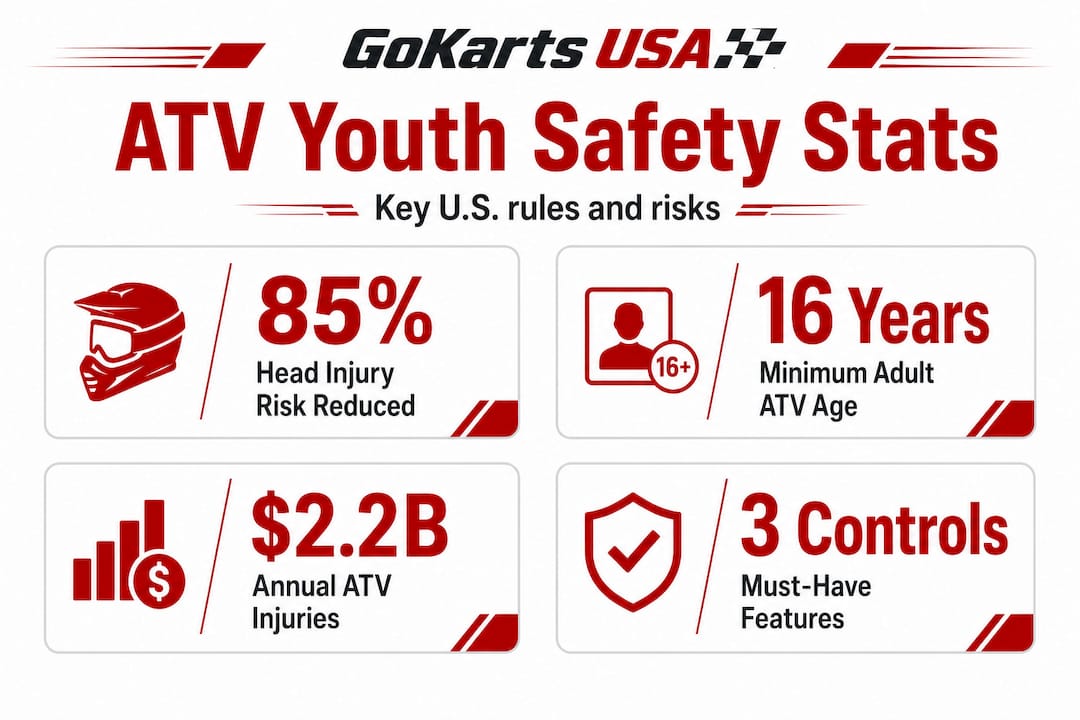
Helmets are a powerful example. Helmets reduce head injury risk by up to 85 percent, yet many youth ATV incidents still result in serious harm because speed was never controlled at the source. Parental controls like speed limiters, remote kill switches, and geo-fencing close the gap that gear alone cannot.
A common misconception is that a cautious child does not need mechanical limits. In reality, mechanical safety controls are essential complements to behavioral supervision, not optional extras. Even the most obedient child can panic on an unexpected downhill grade or get distracted by a friend. The machine needs to have its own built-in ceiling.
Understanding parental control features on youth ATVs
The best parental controls for ATVs are the ones built directly into the machine, not bolted on as afterthoughts. Here is how the main features work and what to look for.
Speed limiters and throttle restrictors are the most fundamental tools. A throttle restrictor physically caps how far the throttle cable can travel, which limits the engine’s top output. You set it once, and the machine cannot exceed that speed no matter how hard your child twists the grip. Speed control settings can be adjusted as a rider’s skills improve, making this a feature that grows with your child rather than becoming obsolete.
Remote start and kill switches give you real-time authority over the machine from a distance. If your child drifts toward a hazard or ignores a boundary, you press a button and the engine stops. This is not a hypothetical feature. It is the kind of tool that prevents the worst-case scenarios parents imagine when they first consider buying a youth ATV. Many quality youth models now include a wireless remote that clips to your belt.
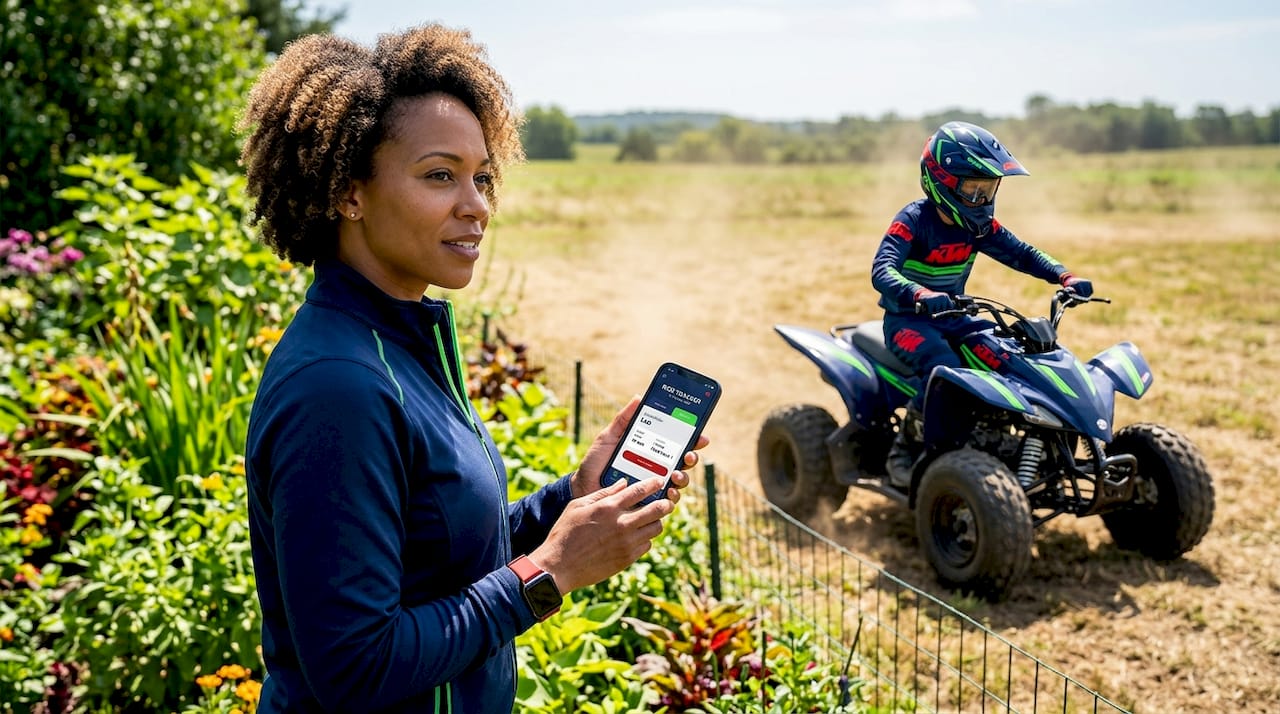
Geo-fencing and ride-area restrictions are emerging in more app-connected youth ATVs. This technology lets you define a geographic boundary on a phone app. When the ATV crosses that boundary, the system either alerts you or cuts power. For parents supervising riding on a large property, this feature adds a second layer of awareness that visual supervision alone cannot provide.
The table below compares common parental control features across entry-level, mid-range, and premium youth ATVs to help you evaluate your options.
| Feature | Entry-level youth ATV | Mid-range youth ATV | Premium youth ATV |
|---|---|---|---|
| Throttle restrictor | Yes | Yes | Yes |
| Remote kill switch | Rarely | Often | Yes |
| App connectivity | No | Sometimes | Yes |
| Geo-fencing | No | Rarely | Sometimes |
| Adjustable speed limit | Manual only | Manual or electronic | Electronic with app |
Matching the ATV’s power to your child’s size matters just as much as its electronic features. Youth ATVs with 150cc or smaller engines are appropriate for younger and less experienced riders. A child who cannot comfortably reach both controls from the seat is on the wrong machine, regardless of the parental control features installed.
Pro Tip: Start your child’s speed limiter at the absolute minimum setting for the first several rides. Only increase it after they demonstrate consistent throttle control, smooth turns, and reliable braking, not just confidence or enthusiasm.
Practical supervision strategies that work alongside controls
Parental controls are the floor, not the ceiling, of your safety plan. Parental guidance in off-roading is most effective when technology and active adult presence work together, not when one substitutes for the other.
Here is a practical framework for supervising young riders that combines rule-setting with the controls built into their machine.
-
Stay within line of sight. For children under 16, active continuous supervision is the standard recommended by safety authorities. You need to be close enough to observe terrain changes and rider behavior in real time, not watching from a porch.
-
Set non-negotiable rules before every ride. Helmet on before the engine starts. No passengers on a single-rider machine. No riding on public roads. No riding after dark. These are youth ATV usage rules that do not flex based on mood or occasion.
-
Enroll in a safety course. Progressive skill development under instruction produces riders who understand the machine, not just riders who can steer it. Many states offer ATV safety courses specifically for youth, and some even reduce insurance costs for certified young riders. See the parent’s guide to teaching ATV skills for a structured approach.
-
Use the remote kill switch as a teaching tool. If your child ignores a boundary or takes a turn too fast, use the kill switch immediately. Then walk over, explain what happened, and reset expectations before restarting. This turns the control into a conversation, not just a punishment.
-
Inspect the ATV before each session. Check tire pressure, throttle response, brake function, and the remote kill switch battery. A pre-ride checklist takes four minutes and catches the issues that cause incidents. Good maintenance habits also teach children to respect their equipment.
-
Build progressive challenges. Start on flat, open ground. Move to mild grades only after mastery. Introduce varied terrain gradually. Teaching pace rules and spacing builds responsible habits that stick, instead of relying on adrenaline to drive decisions.
Pro Tip: Create a simple “ready to ride” checklist your child fills out themselves before each session. Helmet, gloves, boots, ATV check. When kids own the ritual, they internalize the safety culture, not just the rules.
Legal requirements and best practices for youth riders
Understanding the law is part of being a responsible parent in the off-roading world. Most states set clear youth ATV usage rules backed by real consequences, and compliance is not just about avoiding fines. It is about building a safety framework that protects your child and your family.
The table below summarizes key legal and safety standards that apply in most U.S. jurisdictions.
| Requirement | Standard or common rule | Why it matters |
|---|---|---|
| Minimum riding age | 16 for adult ATVs; youth models for younger riders | Matches machine power to developmental stage |
| Helmet use | Mandatory in most states for riders under 18 | Helmets reduce head injuries by up to 85% |
| Engine size limits | 90cc or less for riders under 12 in many states | Prevents overpowered machines for small riders |
| Supervision requirement | Adult supervision required for under 16 | Reduces uncontrolled risk-taking |
| Road restrictions | Youth riders prohibited on public roads | Separates off-road vehicles from traffic |
| Safety training | Required or strongly recommended in many states | Builds foundational skills before independent riding |
The American Academy of Pediatrics recommends that children under 16 never operate adult-sized ATVs, and the Consumer Product Safety Commission publishes engine-size guidelines matched to age ranges. State laws typically prohibit anyone under 16 from operating an adult ATV, which means buying a correctly sized youth model is a legal obligation, not just a preference.
Riding only in designated off-road areas, away from public roads and unfamiliar terrain, is another layer of legal and practical protection. Supervised riding areas often have maintained trails, marked hazards, and the presence of other adults who share a commitment to responsible riding culture.
My honest take on parental controls and youth ATV safety
I have spent years watching families navigate the excitement of getting their kids into off-roading, and I have seen a pattern that worries me every time. Parents invest in quality gear, they read the safety guides, and they genuinely believe their attentive presence is enough. Then their child gets on a machine with no throttle restrictor set, and the first hard turn changes everything.
In my experience, the biggest risk is not a reckless child. It is a well-meaning parent who trusts behavior over mechanics. Kids want to please you. They also want to go faster. When those two impulses collide on an ATV with no speed limit set, behavior loses. Every time.
What I have found actually works is treating parental controls as the starting point of every conversation about your child’s riding, not the fallback plan. The remote kill switch does not replace your presence. The throttle restrictor does not replace your rules. But without those mechanical limits, your rules have no enforcement mechanism the moment you look away.
I also think we underestimate how much children benefit from riding within limits they can feel. A properly restricted ATV teaches throttle control because the machine responds predictably. A child who learns on an unrestricted machine learns to fight the machine instead. The impact of supervision on ATV safety is real, but it multiplies when the machine itself is calibrated to the rider.
Be the parent who sets the limiter low and raises it slowly. Your kid will thank you later, even if they do not thank you now.
— Mario
Find the right youth ATV with built-in parental controls

At Gokartsusa, we know that handing your child their first ATV is one of the most exciting moments in family adventure. We also know that peace of mind matters just as much as the thrill. That is why we are proud to offer the Mini Sport Kids ATV with 110cc engine, featuring a factory-installed parental remote start and kill switch. You stay in control while your child builds confidence and skills. Explore our full selection of youth ATVs built with safety features parents trust, and check out the Gokartsusa beginner ATV safety guide for deeper reading. Adventure is waiting. Let’s make sure it is safe.
FAQ
What does a parental control on a youth ATV actually do?
Parental controls on youth ATVs include features like throttle restrictors, remote kill switches, and app-based geo-fencing that allow parents to limit speed, restrict riding areas, and shut off the engine remotely.
How do I set ATV limits for my child’s age and skill level?
Start with the throttle restrictor at its lowest setting and increase it only after your child consistently demonstrates smooth throttle control, proper braking, and confidence on varied terrain over multiple sessions.
What age can a child legally ride an ATV?
Most states prohibit riders under 16 from operating adult ATVs. Youth ATVs with appropriately sized engines are available for younger riders, with many states recommending engines of 90cc or less for children under 12.
Does supervision replace the need for mechanical parental controls?
No. Children’s limited motor skills and developmental tendencies mean that behavioral supervision alone cannot prevent all incidents. Mechanical controls and supervision must work together.
Are helmets required for youth ATV riders?
Helmet laws vary by state, but most require helmets for riders under 18. Regardless of local law, helmets reduce the risk of head injuries by up to 85 percent and should be treated as non-negotiable for every ride.