




TL;DR:
- Transporting recreational vehicles involves choosing among drive-away, tow-away, or flatbed hauling methods to suit the RV type and owner experience. Proper preparation, including draining tanks and documenting condition, is essential to prevent damage claims and legal issues during transit. Planning ahead, verifying insurance coverage, and selecting the right method ensure safe, cost-effective RV transportation.
Transporting recreational vehicles is defined as moving motorhomes, travel trailers, and towable campers from one location to another using professional or DIY methods. Knowing how to transport recreational vehicles correctly protects your investment, keeps you legally compliant, and gets your rig to the destination without damage. The three core RV transport methods are drive-away, tow-away, and hauling on a flatbed or Removable Gooseneck trailer. Each method suits a different RV type, budget, and owner skill level. Understanding which one fits your situation before you book a carrier saves time, money, and real headaches on the road.
What are the main methods to transport recreational vehicles?
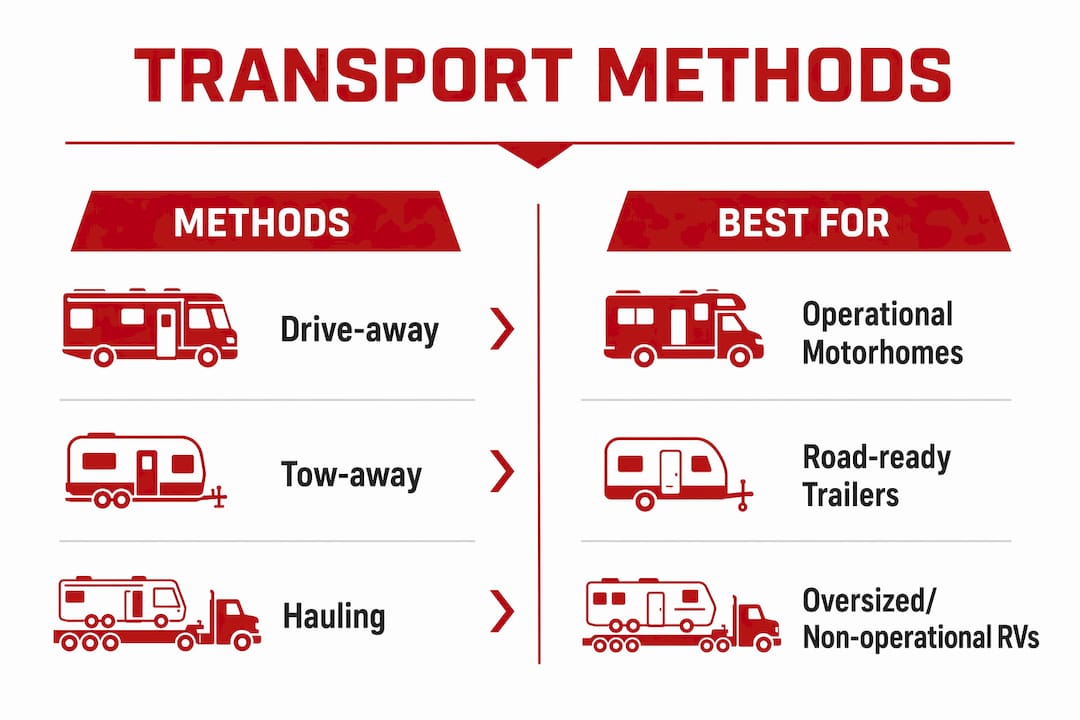
Three primary methods cover nearly every RV transport scenario: drive-away, tow-away, and hauling. Choosing the wrong one for your rig type creates permit problems, damage claims, and unexpected costs.
Drive-away
The drive-away method involves hiring a licensed driver to operate your motorized RV directly to the destination. This works well for Class A, B, and C motorhomes that are fully operational. The tradeoff is real: every mile adds wear to your engine, tires, and drivetrain. Carriers typically require a minimum fuel level and a clean mechanical inspection before accepting a drive-away assignment.

Tow-away
Tow-away transport uses a heavy-duty truck to pull your trailer or fifth wheel to the destination. This method suits operational towable units that are road-ready and within standard legal dimensions. The tow vehicle must meet the trailer’s gross combined weight rating, or instability at highway speeds becomes a genuine risk. Owners who lack experience with towing compatibility requirements benefit most from hiring a professional service rather than attempting this themselves.
Hauling on flatbed or RGN trailers
Hauling on a flatbed or Removable Gooseneck trailer is the right call for oversized, non-operational, or unusually long RVs. RGN trailers handle loads exceeding 48 feet or units with unusual weight distribution. Flatbeds accommodate units under 13.5 feet tall without special height permits. Any RV taller than 13.5 feet requires state-specific oversize permits and, in many cases, pilot vehicles to escort the load.
| Method | Best for | Key limitation |
|---|---|---|
| Drive-away | Operational motorhomes | Adds mileage and engine wear |
| Tow-away | Road-ready trailers and fifth wheels | Requires matched tow vehicle ratings |
| Flatbed hauling | Standard-size non-operational RVs | Height limit of 13.5 feet |
| RGN hauling | Oversized or extra-long RVs | Requires permits and pilot vehicles |
Open-air transport is the most common and economical option, but it exposes the RV to road debris and weather. Enclosed or flatbed transport is the better choice for luxury or high-value units where paint and exterior condition matter.
How should you prepare your recreational vehicle before transport?
Preparation is the step most owners rush, and it is the step that causes the most damage claims. A properly prepared RV protects you legally and physically during transit.
- Empty all tanks. Drain the black, gray, and freshwater tanks completely. Carriers require this to meet weight compliance, and full tanks can leak under the vibration of transport.
- Turn off propane at the valve. Close the main propane valve and disconnect any external power supplies. This is a non-negotiable safety requirement for every carrier.
- Remove all personal belongings. Clear the interior of loose items, clothing, food, and anything unsecured. Vibrations during transport will throw objects around and cause interior damage.
- Retract and lock all slide-outs. Slide-outs must be fully retracted and locked before flatbed or RGN transport. Secure all roof vents in the closed position as well.
- Use painter’s tape on cabinet latches. Painter’s tape on cabinet and drawer latches prevents them from popping open during transit and damaging the interior.
- Document everything with photos and video. Walk around the entire RV and record its condition before handoff. This documentation is your protection if a damage claim arises.
- Check tire pressure and disable auto-leveling. Correct tire pressure reduces the risk of a blowout during hauling. Disable any automatic leveling systems so they do not activate unexpectedly during transport.
Pro Tip: Film a continuous walkthrough video of the interior and exterior immediately before the carrier takes possession. Timestamped video is far harder to dispute than photos alone.
Carriers also require fuel at or below one-quarter tank for drive-away shipments. Check with your specific carrier for their exact fuel policy before drop-off. For more on getting your powersports vehicle ready for any adventure, the vehicle maintenance guide from Gokartsusa covers practical prep steps that apply across recreational vehicles.
What are the key cost factors and legal requirements for RV transport?
Cost and compliance go hand in hand when moving an RV across state lines. Ignoring either one leads to delays, fines, or voided insurance.
RGN transport runs $3.50 to $6.00 per loaded mile, depending on distance, RV dimensions, and the number of permits required. That rate means a 1,000-mile haul on an RGN can cost between $3,500 and $6,000 before permits and pilot vehicle fees. Distance is the biggest single cost driver, but RV height, width, and weight all affect the final number.
Legal height is capped at 13.5 feet in most states. Any RV exceeding that limit requires specialized oversize permits, and many states mandate pilot vehicles to escort the load. Route planning becomes a legal exercise when your RV is oversized. Some states restrict oversized transport to specific hours or ban it on certain roads entirely.
Personal RV insurance policies often suspend coverage the moment a commercial carrier takes possession of the vehicle. This is a detail that catches owners off guard. Confirm that the transporter’s cargo insurance covers your RV’s full replacement value before signing any handoff documentation. Get the policy number and coverage limits in writing.
Seasonal timing also affects cost. The peak transport season runs from august through december, when demand is highest and availability tightest. Booking outside that window typically yields better pricing and shorter wait times. If your schedule allows flexibility, shipping in late winter or early spring is the most cost-effective window.
For a deeper look at professional hauling services and regulatory requirements for non-standard vehicle transport, CVC and More provides detailed guidance on what carriers and owners need to confirm before a shipment moves.
What expert tips and common mistakes should owners know?
Most transport problems trace back to a handful of preventable errors. Knowing them in advance puts you ahead of the majority of RV owners.
- Verify exact dimensions before booking. Not providing exact dimensions is the most common mistake and the one most likely to cause permit issues and delivery delays. Measure length, height, and weight yourself and confirm against the manufacturer spec sheet.
- Choose enclosed or flatbed for high-value RVs. Open-air transport saves money but leaves your RV exposed. For a luxury coach or a brand-new fifth wheel, the extra cost of enclosed transport is worth it.
- Match your tow vehicle to the trailer’s ratings. Gross Combined Weight Ratings and brake controller compatibility are technical requirements, not suggestions. An incorrectly matched tow vehicle creates dangerous instability at highway speeds.
- Confirm insurance before signing. Check whether your personal policy suspends during commercial transport and verify the carrier’s cargo coverage matches your RV’s value.
- Book outside peak season when possible. Fewer shipments in late winter reduce wait times and often lower the per-mile rate.
- Secure every interior item. Even a short haul creates enough vibration to damage unsecured dishes, electronics, and furniture. Treat the interior like it will be shaken continuously for hours.
Exact, pre-transport dimensions are the single most overlooked detail in RV shipping. Carriers who receive incorrect measurements face permit rejections mid-route, and the owner pays for the delay. Measure twice, ship once.
Pro Tip: Ask your carrier for a copy of their cargo insurance certificate before the pickup date. A reputable transporter provides it without hesitation.
Understanding recreational vehicle types also helps you match the right transport method from the start. A Class B camper van and a 45-foot Class A diesel pusher have completely different transport requirements, and knowing your RV category prevents costly mismatches.
Key takeaways
Safe, cost-effective RV transport requires matching the right method to your RV type, completing thorough preparation, and confirming insurance and permits before the carrier takes possession.
| Point | Details |
|---|---|
| Choose the right method | Drive-away suits motorhomes; tow-away fits road-ready trailers; RGN handles oversized units. |
| Prepare the RV completely | Empty tanks, retract slide-outs, remove belongings, and document condition with video before handoff. |
| Understand cost drivers | RGN transport costs $3.50–$6.00 per loaded mile; distance, size, and permits all affect the final price. |
| Confirm insurance coverage | Personal policies often suspend during commercial transport; verify the carrier’s cargo coverage in writing. |
| Time your shipment wisely | Booking outside the august-to-december peak season reduces cost and improves availability. |
Why preparation matters more than the transport method itself
I have seen owners spend weeks comparing carriers and rates, then hand over an RV with full tanks, loose items rattling around inside, and zero photo documentation. The carrier choice matters far less than what you do before the truck arrives.
The single most expensive mistake I have witnessed is an owner discovering that their personal insurance suspended the moment a commercial driver took the wheel. One cracked windshield turned into a months-long dispute because neither the owner nor the carrier had confirmed coverage limits in writing. That situation is entirely avoidable.
My honest recommendation: if you are not confident about towing compatibility, do not attempt it yourself. Professional delivery services reduce risk significantly when owners lack experience with Gross Combined Weight Ratings and brake controller requirements. The cost of a professional carrier is almost always less than the cost of a roadside incident or a damage claim.
On timing, I always tell owners to ship in late winter or early spring if their schedule allows. The savings are real, the wait times are shorter, and carriers are more attentive when they are not juggling peak-season volume.
Document everything. Film everything. Confirm insurance in writing. Those three habits prevent the vast majority of post-transport disputes.
— Mario
Adventure starts at the campsite, not the driveway
Once your RV arrives safely, the real fun begins. Gokartsusa carries a full lineup of gas-powered outdoor vehicles that are perfect for families who want to extend the adventure beyond the campsite. From the Sport Kart Kids Gas Go Kart built for riders ages 8 and up, to the Gas Powered Mini Bike for ages 12 and up, there is something for every rider in the family.

Gokartsusa ships nationwide and backs every vehicle with dedicated customer support. Whether you are setting up base camp in the mountains or exploring open trails, these machines are built to fuel the freedom that makes the RV lifestyle worth every mile. Visit Gokartsusa to find the right ride for your next outdoor adventure.
FAQ
What are the three main RV transport methods?
The three primary methods are drive-away, tow-away, and hauling on a flatbed or Removable Gooseneck trailer. Each suits a different RV type and operational condition.
How much does it cost to transport an RV?
RGN transport typically costs $3.50 to $6.00 per loaded mile, depending on distance, RV dimensions, and permit requirements. Flatbed and drive-away rates vary but are generally lower for standard-size units.
Does my RV insurance cover commercial transport?
Personal RV insurance policies often suspend coverage during commercial transport. Confirm the carrier’s cargo insurance covers your RV’s full value before signing any handoff paperwork.
What is the legal height limit for RV transport?
The legal height limit is 13.5 feet in most states. RVs exceeding that height require specialized oversize permits and, in many cases, pilot vehicles to escort the load.
When is the best time to ship an RV?
Booking outside the peak season from august through december yields better pricing and shorter wait times. Late winter and early spring are the most cost-effective windows for RV transport.