




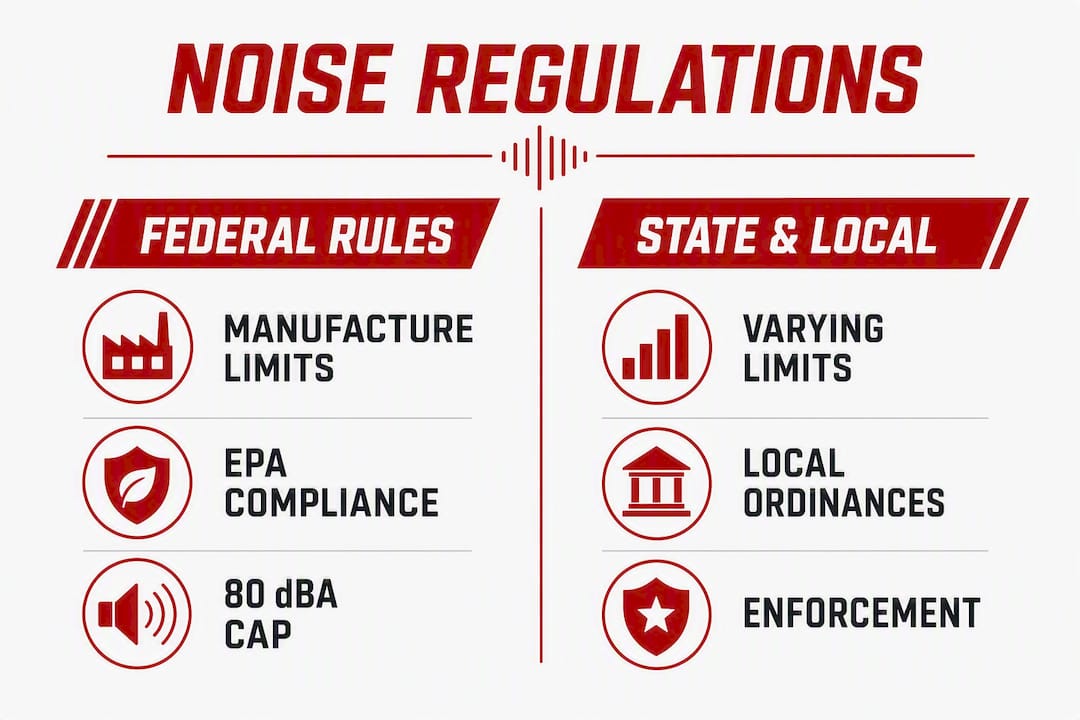
A powersports noise ordinance is a jurisdictional law that limits how loud motorcycles, ATVs, UTVs, dirt bikes, and similar vehicles may be while in use. These rules operate on two levels: federal standards set by the U.S. Environmental Protection Agency govern how loud a vehicle may be when it leaves the factory, while state and local “in-use” ordinances govern how loud it may be when you ride it on public roads, trails, or near residential areas.
Here is what you need to do right now:
- Check your muffler label. Factory-installed mufflers carry a certification label. If yours says “competition use only,” it is likely illegal on public roads in most states.
- Carry proof of compliance. Keep your purchase receipt, installation records, and any manufacturer certification paperwork with the vehicle.
- Know who enforces what. For on-road violations, contact your local police department or sheriff. For off-highway vehicle (OHV) complaints, reach out to your city or county code enforcement office. For manufacturer defects, the EPA handles federal certification issues.
The Moab City ordinance is a widely cited local example: it aligns its in-use limits with federal decibel numbers and prohibits operating any vehicle that exceeds those sound levels on public roads. That combination of federal benchmarks and local enforcement is the model most U.S. jurisdictions follow.
Table of Contents
- What is a powersports noise ordinance under federal law?
- How state statutes and local ordinances vary across the U.S.
- How authorities actually measure powersports vehicle noise
- What modifications commonly trigger citations
- How enforcement works and what to do if you receive a citation
- What “unreasonable,” “disturbing,” and “excessive” noise mean in local codes
- How to inspect your vehicle and reduce noise before you ride
- Key Takeaways
- Why compliance protects riders and the whole community
- Ride legal with compliant parts from Gokartsusa
- Useful sources and where to find your local rules
What is a powersports noise ordinance under federal law?
The EPA’s authority over vehicle noise comes primarily from 40 CFR §205.152, which sets manufacture-time noise emission standards for motorcycles and certain off-road vehicles. These limits apply at the point of sale and certification, not at the roadside.
| Vehicle Type | Model Year | Limit | Measurement Distance |
|---|---|---|---|
| Street motorcycles | 1986 and later | 80 dBA | 50 feet |
| Off-road motorcycles | 1986 and later | 82 dBA | 50 feet |
| Street motorcycles | Pre-1986 | — | 50 feet |
These numbers represent the A-weighted decibel (dBA) readings a new vehicle must not exceed when tested under controlled conditions before it reaches the market. The federal rule also covers aftermarket exhaust components: 40 CFR §205.166 requires that replacement exhaust systems designed for federally regulated street motorcycles must not cause the motorcycle to exceed the original noise emission levels.
Federal EPA standards are primarily about manufacturer certification. Local in-use laws are the dominant enforcement reality for owners. A vehicle that passed federal testing when new can still be cited locally if the exhaust has been modified or has fallen into disrepair.
That distinction matters practically. Owning a factory-compliant vehicle does not shield you from a local citation if your muffler has corroded, if you have installed an aftermarket pipe, or if a baffle has been removed. Federal certification is the floor, not the ceiling, and local governments build their own rules on top of it.
How state statutes and local ordinances vary across the U.S.
State and local rules diverge sharply on four axes: the numeric dB threshold, the measurement distance, the test standard referenced, and whether the rule distinguishes between new and pre-1986 vehicles.
- Measurement distance ranges from 20 inches (SAE J1287 tailpipe test) to 25 feet and 50 feet depending on the jurisdiction and test method.
- Test standards vary between SAE J1287 (stationary tailpipe test, common for OHVs) and SAE J1169 (in-motion test, common for street motorcycles).
- Numeric limits for OHVs typically fall between 82 and 101 dBA depending on vehicle class and state.
- Preemption rules determine whether a city can set stricter limits than the state.
Wisconsin’s state rule sets a relatively high limit for certain off-highway vehicles, measured on the A scale, a figure that illustrates how OHV limits often run higher than street motorcycle limits because OHV use typically occurs farther from residential areas.
Colorado Revised Statutes §25-12-110 sets OHV sound levels using the SAE J1287 test standard and explicitly prevents localities from adopting more restrictive OHV noise standards than the state level. That preemption clause is significant: a Colorado county cannot simply decide to lower the OHV limit below what the state sets, even if residents push for it.
Riverside County, California illustrates a different preemption dynamic. California’s Vehicle Code preempts local regulation of on-road motor vehicle exhaust noise, so the county cannot set its own street motorcycle limits. Off-highway vehicles and vehicle sound systems, however, remain locally regulable, with OHV limits referencing SAE J-1287 and thresholds reaching 96 to 101 dBA depending on vehicle class.
Moab, Utah takes a community-health-driven approach. Moab’s 2021 ordinance cites research linking noise pollution to anxiety, depression, high blood pressure, and heart disease as the policy rationale. It aligns its in-use motorcycle limits with federal dB numbers while prohibiting operation of any vehicle that exceeds those levels on public roads.
Statistic callout: Wisconsin’s state OHV noise rule sets a limit of 96 dBA on the A scale for certain off-highway vehicles, a threshold that reflects the higher ambient noise environments where OHV use typically occurs compared to residential streets.
How authorities actually measure powersports vehicle noise
A-weighting (dBA) is the standard for vehicle noise measurement because it filters the sound spectrum to approximate how human hearing perceives loudness, emphasizing frequencies between roughly 1,000 and 4,000 Hz where the ear is most sensitive. A raw decibel reading without A-weighting would overcount low-frequency rumble and undercount the mid-range frequencies that actually disturb people.
Two test standards dominate enforcement:
SAE J1287 is a stationary tailpipe test. The sound level meter is placed 20 inches from the tailpipe outlet at a 45-degree angle. The engine is revved to a specified RPM (typically a percentage of maximum rated RPM), and the peak reading is recorded. This test is widely used for OHVs and is the method referenced in Colorado’s CRS and Riverside County’s OHV rules.
SAE J1169 is an in-motion test conducted at a set speed (often 35 mph) with the meter positioned at a fixed distance from the vehicle’s path. It is more commonly used for street motorcycle enforcement.
A sound level meter reading is only as reliable as the calibration behind it. Officers and technicians must calibrate meters before and after each test session, document environmental conditions (background noise levels, nearby reflective surfaces), and demonstrate proper training. These chain-of-custody factors directly affect whether a reading holds up in an administrative hearing or court.
Moab’s testing guidance references both the SAE J1287 stationary test and the importance of controlled test conditions. If you receive a citation based on a meter reading, you have the right to request documentation of the meter’s calibration records and the officer’s training credentials. A reading taken near a concrete wall or in high ambient background noise may be challengeable.
What modifications commonly trigger citations
The most frequent source of powersports noise citations is not a factory vehicle running normally. It is a modified exhaust. Across U.S. jurisdictions, the prohibitions cluster around three behaviors.
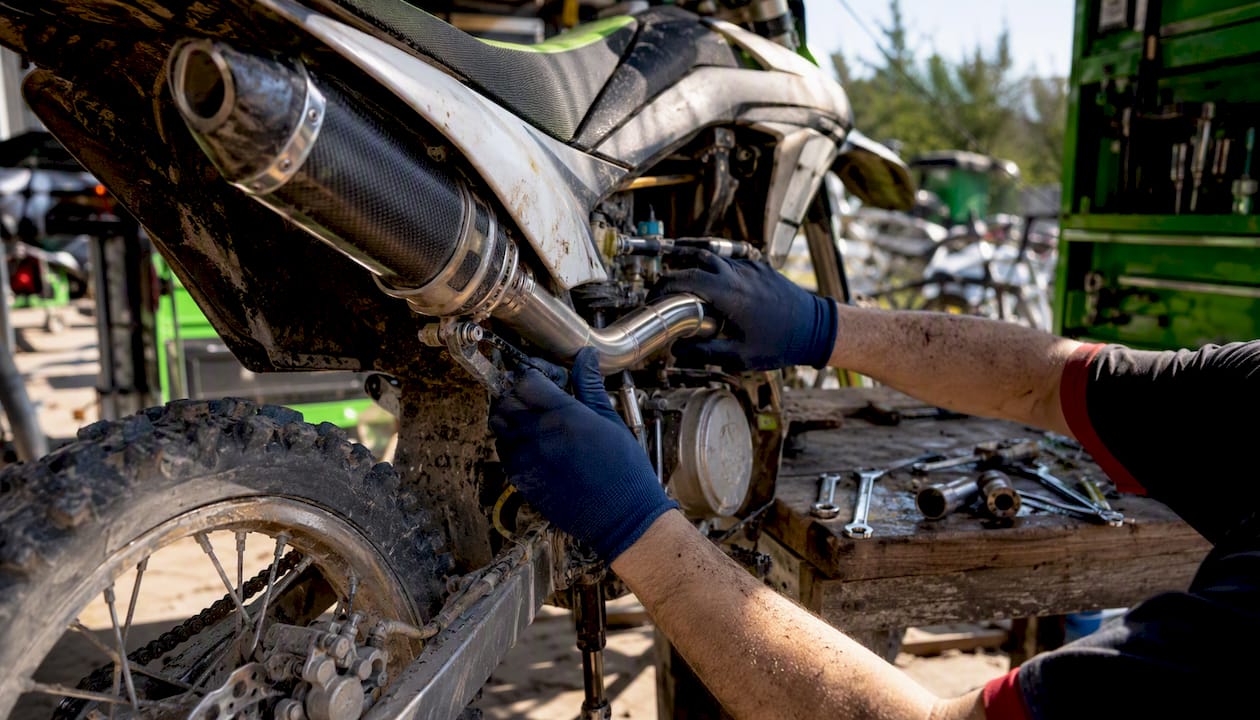
Removing or disabling the factory muffler is unlawful in virtually every state. The Noise Pollution Clearinghouse’s summary of federal CFR noise rules confirms that many U.S. jurisdictions make it explicitly unlawful to remove or render a factory-installed muffler inoperative. Even partial removal, such as punching out baffles, typically qualifies.
Installing competition-only exhaust components on public roads is a separate and serious violation. Oregon Administrative Rule 340-035-0030 prohibits operating a motorcycle or using an exhaust component labeled “competition use only” on any property other than a motorsports facility. Oregon is not alone: this restriction appears in state rules and municipal codes across the country. The label on the part is itself evidence of the violation.
Altered systems that produce unusual cracking, popping, or chattering can trigger citations even when the overall dB reading is borderline. Some municipal codes specifically prohibit exhaust systems that produce “unusual” or “excessive” mechanical noise regardless of whether a meter test is conducted.
Pro Tip: Before purchasing any aftermarket exhaust component, check the manufacturer’s label carefully. If it says “for competition use only,” “closed-course use only,” or “not for use on public roads,” installing it on a street-legal or trail-legal vehicle exposes you to citation, impoundment, and potential fines in most U.S. jurisdictions.
To restore compliance: reinstall the factory-baffled muffler, retain your purchase receipts and original paperwork, and use only manufacturer-certified or EPA-compliant replacement parts. A documented maintenance record can be critical evidence if you need to rebut a citation alleging an altered exhaust.
How enforcement works and what to do if you receive a citation
Enforcement of powersports noise restrictions follows three common modes. Officers may issue discretionary citations based on a “reasonable person” judgment that a vehicle is producing excessive noise, without using a meter. They may conduct objective meter tests at traffic stops using SAE J1287 or J1169 procedures. Or municipal code enforcement officers may conduct stationary tests on parked or idling vehicles in response to a complaint.
If you want to report a suspected violation, follow these steps:
- Record the time, date, and exact location of the incident.
- Note the vehicle type, color, and license plate number if visible.
- Photograph or video the vehicle if it is safe to do so, capturing any visible exhaust modifications.
- Check whether the muffler label is visible and note what it says.
- Contact your local police non-emergency line for on-road violations, or your city/county code enforcement office for OHV or off-road violations.
- Request that the responding officer conduct a meter test if the vehicle is still present.
- Ask for the case number and follow up in writing.
If you receive a citation, document everything immediately: the officer’s name and badge number, the meter model and serial number if a test was conducted, and the exact code section cited. EPA guidance on in-use enforcement emphasizes that maintenance records and manufacturer labels are critical evidence to rebut allegations of an altered exhaust.
Penalties escalate. Municipal ordinances commonly use tiered fine structures, with county-level examples showing escalation from roughly $500 for a first offense to $750 for a second and $1,000 for subsequent violations. Repeated violations can result in vehicle impoundment or a mandatory court appearance. Appeals typically proceed through the municipal administrative hearing process, and a well-documented compliance record significantly improves your position.
What “unreasonable,” “disturbing,” and “excessive” noise mean in local codes
Municipal codes use two fundamentally different enforcement standards, and understanding which one applies in your jurisdiction changes how you prepare.
Numeric standards set a specific dBA threshold. If your vehicle exceeds it under the applicable test method, the violation is objective and largely independent of officer judgment. These standards are easier to contest because the measurement process itself can be challenged on calibration, distance, or environmental grounds.
Reasonableness standards define a violation as noise that is “disturbing, excessive, or offensive to persons of normal sensitivity.” The Poway, California noise abatement code is a representative example: it uses this language alongside numeric limits, giving officers discretion to cite a vehicle even when a meter test is not conducted. Many jurisdictions rely on this standard precisely because carrying and calibrating a sound level meter at every traffic stop is impractical.
Quiet-hour rules add another layer. Most municipalities define a nighttime window, typically 10:00 PM to 7:00 AM, during which any noise that would be acceptable during the day may become a violation. Some codes use categorical quiet hours (a flat prohibition on certain activities after a set time) while others apply a lower numeric threshold during nighttime hours. Riding a compliant vehicle past a neighbor’s bedroom window at 11:00 PM can still generate a valid complaint under a quiet-hours rule even if the vehicle passes a daytime meter test.
Where no meter is used, officer discretion is the enforcement mechanism. That means context matters: the time of day, the proximity to residences, and whether the noise was sustained or momentary all factor into whether a citation is issued. Owners who dispute a discretionary citation without a meter reading typically argue that the vehicle was factory-compliant and unmodified, supported by maintenance records and muffler labels.
Statistic callout: Many U.S. municipal codes define noise violations using both a numeric dBA threshold and a “disturbing, excessive, or offensive” reasonableness standard, giving enforcement officers discretion to cite vehicles even when sound meters are not available.
How to inspect your vehicle and reduce noise before you ride
Compliance starts before you start the engine. A short pre-ride inspection takes less than five minutes and can prevent a citation that costs far more.
Daily/weekly inspection checklist:
- Visually inspect the muffler for cracks, holes, or rust-through that could increase noise output.
- Check that all muffler mounting hardware is tight and that no heat shields have fallen away.
- Confirm that baffles are present and intact inside the muffler (a rattle when you shake the muffler suggests a loose or broken baffle).
- Verify the muffler label is legible. If it reads “competition use only,” replace it before riding on public roads.
- For OHVs used in fire-risk areas, confirm the spark arrestor is present and unobstructed.
- Retain your purchase receipt and installation records in a waterproof document sleeve with the vehicle.
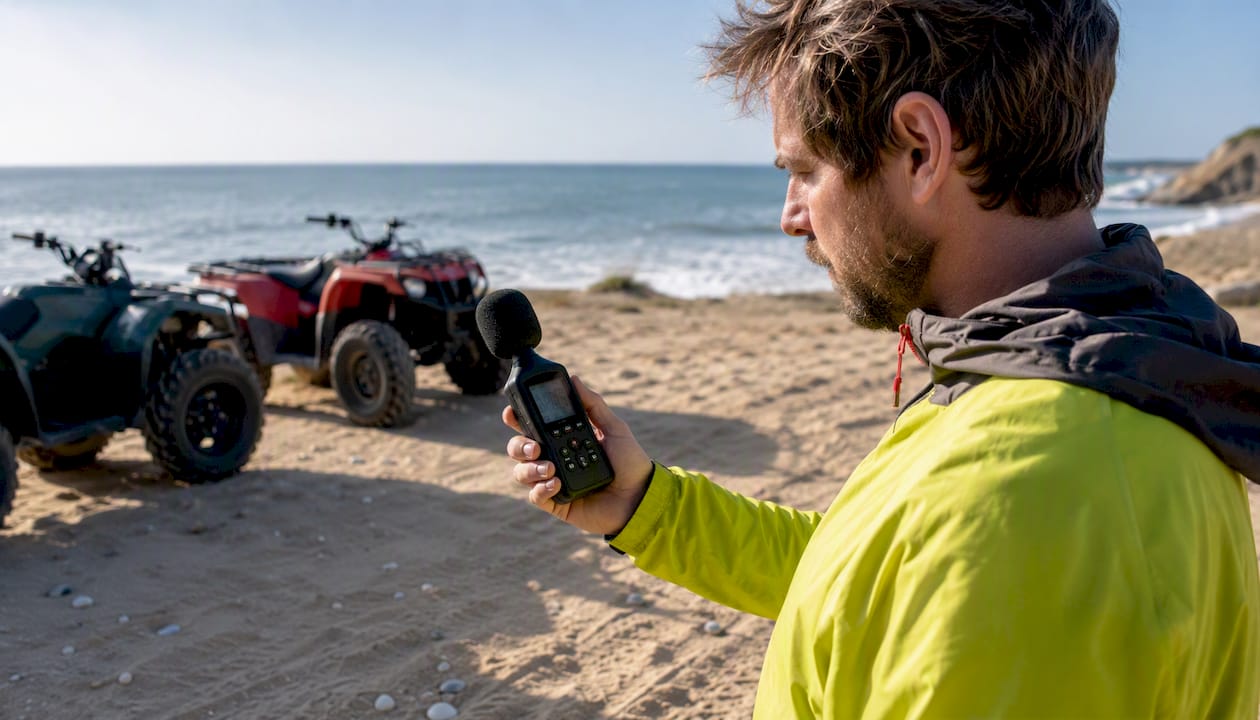
Pro Tip: Rent or borrow a handheld A-weighted sound level meter (available at many tool rental shops and online) and test your own vehicle at 50 feet before heading out. If you are near the local limit at idle, you will almost certainly exceed it under load. A $30 rental can prevent a $500 fine.
For owners who need replacement parts, use only manufacturer-certified mufflers or EPA-compliant aftermarket components. Keep the part number and purchase receipt. Certified shop inspections are available through most powersports dealers and provide a written record of compliance. Avoid any component whose packaging or label restricts it to closed-course or competition use.
Noise reduction beyond parts replacement includes: scheduling professional exhaust repair at the first sign of leaks or unusual sound, avoiding wide-open-throttle acceleration near residential areas even when the vehicle is technically compliant, and checking your state’s specific SAE test standard so you know exactly what distance and RPM condition an officer would use.
For a broader look at how these rules apply across powersports vehicle types, from ATVs to mini bikes to go-karts, understanding the vehicle category helps you map the right federal and state rules to what you ride.
Key Takeaways
Powersports noise ordinances split enforcement between federal manufacture-time standards (EPA/40 CFR) and state or local in-use rules that govern every ride you take.
| Point | Details |
|---|---|
| Federal vs. local split | EPA/40 CFR sets manufacture limits (80 dBA for street motorcycles, 82 dBA for off-road motorcycles); state and local rules govern in-use enforcement. |
| Modification risk | Removing baffles or installing competition-only exhaust parts is unlawful on public roads in most U.S. jurisdictions. |
| Measurement method | SAE J1287 (20-inch tailpipe test) and SAE J1169 (in-motion) are the two dominant test standards; meter calibration affects admissibility. |
| Enforcement and penalties | Fines typically escalate from roughly $500 to $1,000 for repeat violations; impoundment is possible. |
| Gokartsusa compliance support | Gokartsusa carries factory-equivalent replacement parts and compliant vehicles, helping owners stay road-legal and ride with confidence. |
Why compliance protects riders and the whole community
The riders who push back hardest against noise ordinances are often the ones who have never sat on the receiving end of a 96 dBA exhaust at 7:00 AM on a Sunday. That is not a judgment. It is just a perspective gap that compliance rules exist to close.
What I find genuinely underappreciated in most discussions of powersports noise regulations is how much legal exposure riders carry without realizing it. A factory-compliant vehicle with a corroded muffler is not a compliant vehicle anymore. A “competition-only” pipe purchased online and bolted on for the sound is a citation waiting to happen, and in some states it is grounds for impoundment on the first stop. The gap between “I bought it legally” and “I am riding it legally” is where most citations originate.
Compliance also protects access. Communities that experience sustained noise complaints from OHV riders tend to close trails, restrict hours, and push for stricter ordinances. Every rider who keeps their exhaust legal and their throttle reasonable in residential areas is, in a real sense, protecting the freedom of every other rider in that community. That is not an abstract principle. Moab’s 2021 ordinance exists precisely because the city documented a pattern of excessive noise complaints that threatened the area’s OHV access entirely.
Gokartsusa’s commitment to offering outdoor vehicle safety standards and compliant equipment reflects the same philosophy: the thrill of the ride is worth protecting, and protecting it means riding responsibly.
Ride legal with compliant parts from Gokartsusa
Keeping your powersports vehicle noise-legal does not mean sacrificing performance. It means using the right parts.

Gokartsusa stocks a range of factory-equivalent and EPA-compliant vehicles and replacement components, from gas-powered mini bikes built with proper muffler systems to kids’ gas go-karts designed for safe, compliant recreational use. Every vehicle we carry is built to meet manufacturer noise standards out of the box, so you are not starting your compliance checklist from scratch.
One reminder worth repeating: never install a component labeled “competition use only” on a vehicle you plan to ride on public roads, trails, or any property other than a closed motorsports facility. The label is not a suggestion. It is a legal boundary that enforcement officers recognize on sight.
Browse our full catalog at gokartsusa.biz and check product pages for part compatibility and compliance details. If you have questions about replacement mufflers or certified exhaust options for your specific vehicle, our team is ready to help you ride with confidence and stay on the right side of local noise rules.
Useful sources and where to find your local rules
The primary federal and state sources used in this article:
- 40 CFR §205.152 (EPA motorcycle noise standards) — federal manufacture-time dBA limits for street and off-road motorcycles.
- 40 CFR §205.166 (Aftermarket exhaust noise standards) — federal rules for replacement exhaust systems on federally regulated street motorcycles.
- Moab City Ordinance No. 2021-07 — full text of Moab’s noise control ordinance, including OHV provisions.
- Moab OHV Noise Ordinance FAQ — plain-language summary of how Moab enforces in-use limits.
- Colorado Revised Statutes §25-12-110 — state OHV noise limits using SAE J1287 and preemption of local rules.
- Oregon OAR 340-035-0030 — prohibition on competition-use-only motorcycles and exhaust components outside motorsports facilities.
- Riverside County / Palm Springs vehicle noise summary — illustrates California Vehicle Code preemption for on-road noise and local OHV limits.
- Poway Noise Abatement and Control ordinance — example of a municipal code using both numeric and reasonableness standards.
- EPA in-use vs. manufacture standards (NEPIS) — EPA discussion of why factory certification does not protect against in-use citations.
To find your local rules: search your city or county name plus “noise ordinance” or “municipal code noise” in any search engine. Most municipalities publish their codes through platforms such as Municode or Code Publishing. Look specifically for sections titled “Noise Abatement,” “Sound Control,” or “Motor Vehicle Noise.” Check for quiet-hour provisions and any state preemption language that limits what your city can regulate. When in doubt, contact your city attorney’s office or a local powersports attorney for jurisdiction-specific guidance.
This article provides general legal information, not legal advice. Noise ordinance rules vary by jurisdiction and change over time. Confirm current requirements with your local code enforcement office or a qualified attorney before making compliance decisions.