




TL;DR:
- Proper pre-trip inspections, correct weight distribution, and disciplined driving habits prevent most RV accidents and breakdowns. Routine checks of safety equipment and management of weather conditions are essential for safe travel. A consistent checklist and awareness of risks like battery disconnect switches enhance overall RV safety.
Recreational vehicle safety tips are the set of essential practices every RV owner must follow to prevent accidents, mechanical failures, and roadside emergencies. The National Fire Protection Association (NFPA) and the Recreation Vehicle Industry Association (RVIA) both set standards that define minimum safety requirements for RVs on American roads. Ignoring these standards puts you, your passengers, and other drivers at risk. The good news is that a disciplined routine, built around pre-trip inspections, proper loading, and smart driving habits, eliminates most preventable hazards before they start.
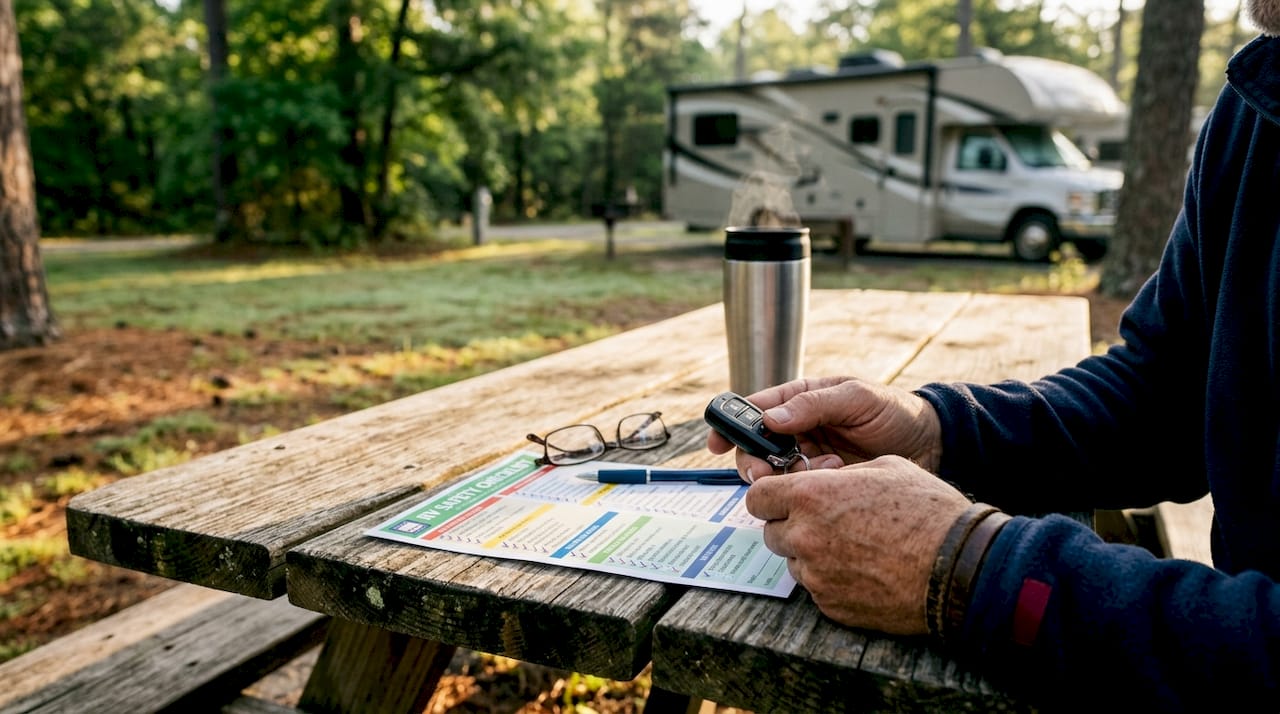
1. What are the essential pre-trip inspection steps for RV safety?
A 30-minute pre-trip inspection is the single most effective habit an RV owner can build. This window covers tires, hitch, brakes, lights, and all safety detectors before every departure. Skipping even one category creates a gap that can turn a minor issue into a dangerous breakdown.
Tires deserve the most attention. Manual pressure checks with a calibrated gauge on cold tires catch slow leaks that TPMS sensors routinely miss. Check tread depth and inspect sidewalls for cracking or bulging. Always include the spare.
Hitch assembly is the mechanical link between your tow vehicle and trailer. Safety chains crossed under the coupler form a cradle that catches the trailer tongue if the hitch separates at speed. Confirm the breakaway cable is attached and the coupler is locked.
Test every brake light, turn signal, and running light before pulling out. Check that your brakes respond firmly. Walk the propane system for any smell of gas, and inspect the regulator for wear.
Pro Tip: Test your smoke, carbon monoxide, and LP gas detectors every single trip. A detector that fails silently is worse than no detector at all.
2. How to manage weight distribution and cargo loading
Proper weight distribution is the primary defense against trailer sway and fishtailing. Tongue weight for travel trailers should be 10–15% of total loaded weight. Fifth wheels require 15–25%. Falling outside these ranges shifts the balance of the rig and makes sway far more likely at highway speeds.
Follow these loading principles every time you pack:
- Place the heaviest items low in the cargo area and forward of the axle.
- Distribute weight evenly from side to side to avoid lean.
- Use ratchet straps to secure loose gear inside the cabin and storage bays.
- Place non-slip mats under items that can shift during cornering.
- Check every exterior storage bay latch before departure.
A weight distribution hitch with sway control is a worthwhile investment for travel trailers over 5,000 pounds loaded. These devices redistribute tongue weight across the tow vehicle’s front axle, restoring steering feel and reducing the risk of the trailer pushing the rear of your vehicle.
Pro Tip: Weigh your loaded rig at a truck stop scale before your first long trip of the season. Knowing your actual axle weights takes the guesswork out of loading.
| Load Position | Effect on Stability |
|---|---|
| Heavy items forward, low | Reduces sway, improves tongue weight |
| Heavy items rear or high | Increases sway risk, reduces steering control |
| Uneven side-to-side | Causes lean and tire wear |
| Unsecured loose cargo | Shifts during turns, alters weight balance |
3. What driving techniques improve RV safety on the road?
Learning how to drive an RV safely means accepting that your vehicle behaves nothing like a passenger car. The extra length, height, and weight demand a completely different mental model behind the wheel.
Increase your following distance and clearance awareness by 20% compared to what you would use in a standard vehicle. That extra buffer gives you time to react when traffic stops suddenly. Merge more slowly and check clearance heights before entering parking structures or low bridges.
Speed management on grades is where many RV drivers make costly mistakes. Downshift to a lower gear before descents rather than riding the brakes. Brake fade, the loss of stopping power caused by overheated brakes, can happen quickly on long mountain grades. Engine braking preserves your stopping ability for when you truly need it.
Wind is one of the most underestimated hazards for RV drivers. At 20 mph, you should reduce speed and grip the wheel firmly. If gusts exceed 30 mph, pull over and wait. A high-profile RV can be pushed out of its lane by a single strong gust, and no schedule is worth that risk.
Practice the G.O.A.L. method (Get Out And Look) every time you back into a campsite or tight space. Use a spotter when available. Check your safe towing practices guide for backing and turning techniques specific to your rig type.
4. How to handle crosswinds and weather conditions safely
Wind gusts above 30 mph are a clear signal to pull over. RVs present a large, flat surface to crosswinds, and the physics are unforgiving. A gust that a sedan barely notices can push a Class A motorhome a full lane to the side.
Slow down at the first sign of strong wind. Steer gently into the wind rather than overcorrecting. Overcorrection causes the trailer to swing in the opposite direction, which can trigger a sway event. Keep both hands on the wheel and reduce speed progressively.
Rain and fog demand the same respect. Wet roads extend braking distances significantly for a heavy rig. Turn on running lights in fog and increase your following distance beyond the standard 20% rule. If visibility drops below a safe threshold, exit the highway and wait it out. Patience is a genuine camping vehicle precaution that costs nothing.
5. How to maintain and test RV safety equipment
Safety equipment has a finite lifespan, and most RV owners do not track it. LP/CO and smoke detectors require replacement every 5–10 years. Fire extinguishers need replacement every 10–12 years based on manufacture date. These are not suggestions. They are the intervals at which the devices become unreliable.
Follow this maintenance schedule:
- Test smoke and CO detectors monthly by pressing the test button.
- Replace detector batteries every six months, or immediately when the low-battery chirp starts.
- Mount LP gas detectors near the floor, since propane is heavier than air and sinks.
- Keep LP detectors away from exterior doors and vents to prevent false alarms from outside air.
- Check fire extinguisher pressure gauges monthly. Replace after any discharge, even partial.
One risk that catches owners off guard: battery disconnect switches disable hardwired LP/CO detectors. When you flip that switch for storage, your safety detectors go offline. This “Store Mode” creates a period where a propane leak or carbon monoxide buildup goes completely undetected. Reconnect the battery before anyone sleeps in the RV, even for a single night.
Keep at least one ABC-rated dry chemical fire extinguisher mounted near the kitchen and another near the exit. Check that both are accessible and that everyone in your group knows where they are.
Key takeaways
Consistent pre-trip inspections, correct weight distribution, and disciplined driving habits are the three pillars of RV safety that prevent the vast majority of accidents and breakdowns.
| Point | Details |
|---|---|
| Pre-trip inspection | Complete a 30-minute check of tires, hitch, brakes, lights, and detectors before every departure. |
| Tongue weight targets | Keep travel trailer tongue weight at 10–15% and fifth wheel at 15–25% of total loaded weight. |
| Following distance rule | Increase following distance and clearance awareness by 20% compared to a standard vehicle. |
| Detector replacement | Replace LP/CO and smoke detectors every 5–10 years; fire extinguishers every 10–12 years. |
| Battery disconnect risk | Reconnect the battery before sleeping in a stored RV to keep LP/CO detectors active. |
What most RV safety guides get wrong
After years around powersports and recreational vehicles, the pattern I see most often is owners who treat safety checks as a one-time learning event rather than a non-negotiable routine. They do the full inspection on their first trip, feel confident, and then start skipping steps. That is exactly when problems happen.
The “Store Mode = Safety Off” issue with battery disconnects is the most overlooked risk I encounter. Owners store the rig for winter, flip the disconnect, and never think about it again until spring. Then someone sleeps in the RV during a pre-season shakedown trip with the detectors completely offline. That is a serious hazard hiding behind a routine habit.
Weight distribution is the other area where I see consistent underestimation. Owners pack the rear of the trailer because it is convenient, then wonder why the rig feels loose at 65 mph. The physics are simple: weight behind the axle lifts the tongue, reduces steering control, and sets up a sway event. Load forward, load low, and weigh the rig before you assume you got it right.
My honest advice is to build a physical checklist, laminate it, and clip it to your sun visor. Every pilot uses a checklist. Every RV owner should too. The ATV safety checklist approach applies directly here: a written routine removes the “I think I checked that” problem entirely.
— Mario
Adventure starts with the right vehicle
At Gokartsusa, we believe that safe outdoor adventure starts before you ever leave the driveway. Whether you are introducing your kids to the thrill of off-road riding or looking for a reliable powersports vehicle for the whole family, we carry a lineup built for fun and designed with safety in mind.

Our kids’ gas go kart is a great entry point for young riders ages 8 and up, featuring a 2.5hp 4-stroke engine and a frame built for control. For teens and adults ready to step up, our gas-powered mini bike delivers a 3.5hp automatic ride that is approachable and dependable. We also carry ATVs with parental remote start and kill switch features, so you stay in control even when your youngest rider is behind the wheel. Explore the full Gokartsusa lineup and find the vehicle that fits your family’s next adventure.
FAQ
What should a motorhome safety check include?
A motorhome safety check covers tires, brakes, lights, hitch components, propane systems, and all safety detectors. Complete the full inspection within 30 minutes before every departure.
How do I prevent trailer sway when towing a travel trailer?
Keep tongue weight at 10–15% of total loaded weight, place heavy cargo low and forward of the axle, and use a weight distribution hitch with sway control on heavier rigs.
How often should I replace RV smoke and CO detectors?
Replace LP/CO and smoke detectors every 5–10 years based on the manufacture date printed on the unit. Monthly testing and semi-annual battery replacement are required between replacements.
What wind speed is too dangerous for RV driving?
Pull over when wind gusts exceed 30 mph. At 20 mph, reduce speed and grip the wheel firmly to counter the effect of crosswinds on your RV’s large profile.
Does using the battery disconnect switch affect RV safety systems?
Yes. Battery disconnect switches disable hardwired LP/CO detectors, leaving your RV unprotected during storage. Always reconnect the battery before sleeping in the vehicle.