




TL;DR:
- Registering for a go-kart racing class involves verifying eligibility, meeting pre-registration deadlines, and signing safety waivers. Most facilities require applicants to meet minimum age and height standards, and minors need parental consent. Proper preparation ensures a smooth experience and safe participation.
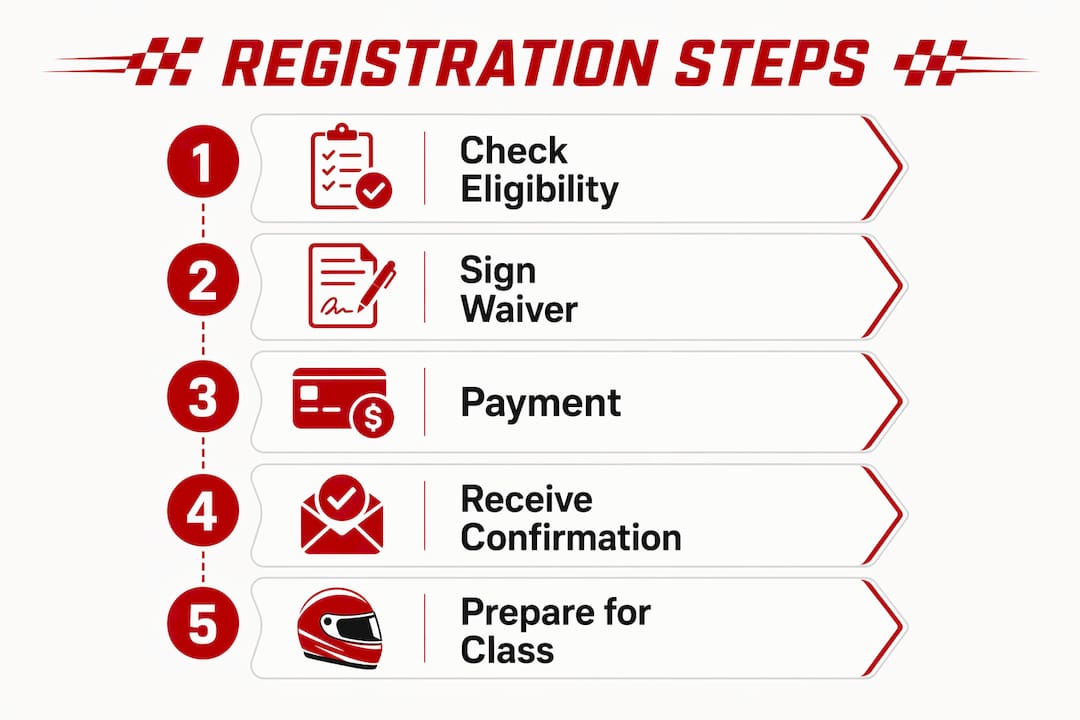
Registering for a go-kart racing class takes six steps: find a local facility schedule, pick a class that matches age, height, and skill level, complete payment and digital waivers, confirm your booking via email or SMS, review cancellation terms, and save your confirmation. Most facilities require pre-registration by a cutoff deadline, so acting early matters.
Quick checklist before you enroll:
- Verify age and height minimums for the specific class
- Gather a valid ID and emergency contact information
- Confirm whether a parent or guardian signature is required
- Check the pre-registration cutoff date and time
- Know whether your purchase secures a date or only buys credit
- Download and sign any required waivers before arrival
No DMV registration is needed for class participation. Facilities in states like Florida (FDACS) and California (Cal/OSHA) operate under state amusement-ride programs that require annual inspections and daily safety logs, so the prerequisites you see on a facility page are regulatory requirements, not suggestions.
Table of Contents
- What eligibility requirements should you check before enrolling?
- How to complete the go-kart racing class registration steps
- What to bring and what to expect on the day of class
- How do pricing, deposits, and cancellations usually work?
- What does state oversight mean for your safety as a participant?
- Tips to get the most out of your first class
- Key Takeaways
- The part most parents overlook
- Ready to take the thrill home after class?
- Useful sources and where to verify the rules
What eligibility requirements should you check before enrolling?
Most tracks publish their prerequisites directly on the class or course page. The two non-negotiable items are minimum age and minimum height. As a reference point, Sykart’s Basic Driving School requires students to be at least 8 years old and 55 inches tall, while Atlanta Motorsports Park’s full-day school requires drivers to be at least 12 years old. Orlando Kart Center sets a 60-inch minimum height with no age floor for its advanced sessions. These numbers vary by track and class level, so always read the specific course page rather than assuming one standard applies everywhere.
For minors, a parent or guardian must typically be present to sign the liability waiver. Most facilities will not allow a child to participate without that in-person signature, even if a digital waiver was completed online beforehand. Bring a valid ID for both the participant and the signing adult.
Health considerations matter too. Recent concussions, pregnancy, and serious cardiac conditions are the most common reasons a facility may ask a participant to sit out. Check the facility’s health restriction language before you pay. If a medical question is unclear, call the track directly rather than assuming clearance.
Pro Tip: Look for the word “required” versus “recommended” on a facility’s prerequisites page. “Required” means you will be turned away without it; “recommended” means it helps but won’t block entry. If the page uses vague language, call and ask for clarification before purchasing.
A parent-focused kids’ go-kart safety checklist can help you cross-reference age and fit guidance before you commit to a class.
How to complete the go-kart racing class registration steps
Follow these steps in order to avoid common pitfalls, especially the voucher-versus-date confusion that catches many first-time buyers off guard.
- Locate a facility schedule. Search for tracks in your area and navigate to their class or school page. Look for a calendar or dropdown that shows available dates, class types, and session times.
- Choose the right class. Match the participant’s age, height, and experience to the class description. Beginner programs typically supply helmets and have lower entry bars; advanced sessions often require prior experience and personal race gear.
- Understand the payment model. Some facilities charge full tuition at checkout and lock in a specific date. Others, like RaceKartsInc, sell vouchers or credits that require a separate booking step to reserve an actual time slot. Confirm which model applies before you pay.
- Meet the pre-registration cutoff. K1 Speed, for example, requires enrollment by the Friday before a weekend class at 3:00 PM PDT. Missing that window means waiting another week.
- Complete digital waivers. Most facilities send a waiver link with the booking confirmation or include it in the checkout flow. Minors need a parent or guardian to sign. Upload or note any required IDs at this stage.
- Save your confirmation. Your email or SMS confirmation should list the class date and time, the check-in window, and what to bring. Note the cancellation and reschedule policy from this same message.
Pro Tip: If you buy a voucher as a gift, confirm the redemption window and whether the recipient needs to create an account to book a date. Some tracks require the student to log in and reserve a slot at least 24 hours before the class.
What to bring and what to expect on the day of class
Arrive 20–45 minutes before your scheduled start time. Check-in typically involves presenting your confirmation, signing any outstanding forms, and a final height check for younger participants. Facilities running youth programs, like Sykart Tigard, ask students to arrive 15 minutes early since classes start promptly and latecomers may forfeit their spot.
What the facility usually provides:
- Helmet and head sock for beginner sessions
- Kart fitting and basic safety briefing
- On-track coaching during exercises
What you should bring:
- Closed-toe shoes (sneakers work; sandals and flip-flops are refused at most tracks)
- Comfortable, non-restrictive clothing; long sleeves are recommended for advanced sessions
- Valid ID for the participant and a guardian for any minor
- Your booking confirmation (digital or printed)
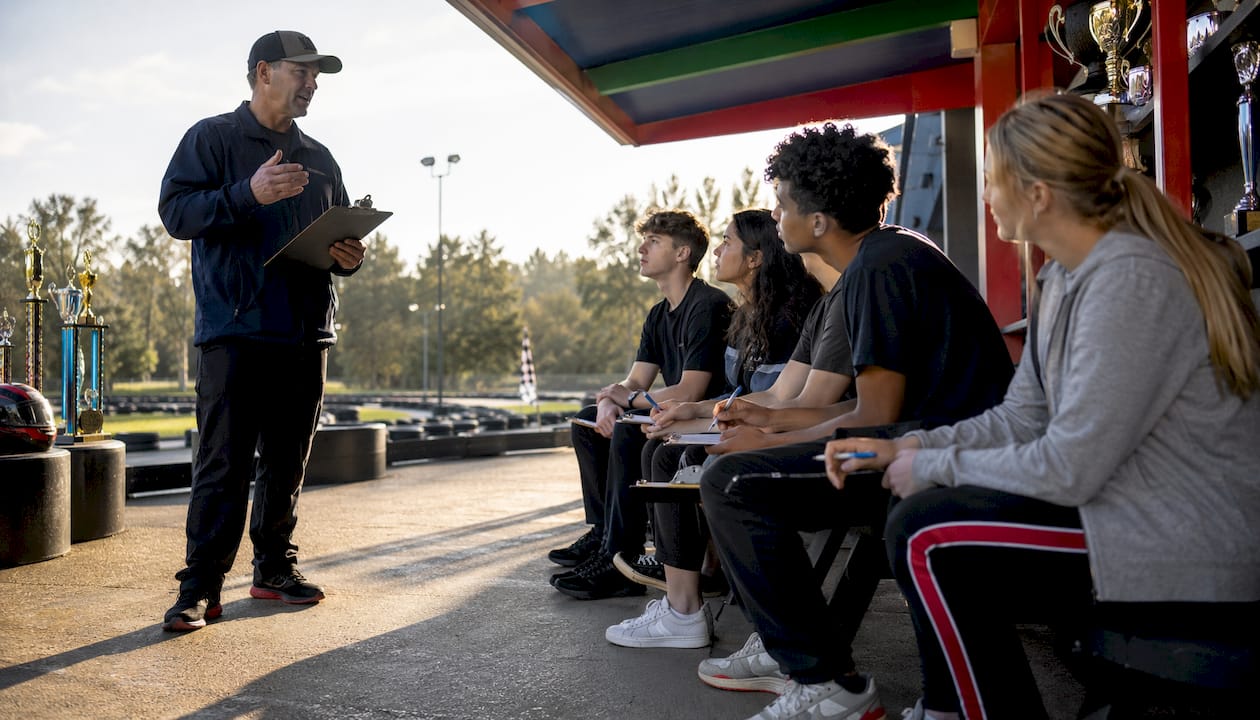
A typical class runs in four phases: a classroom briefing covering track rules and kart control basics (roughly 10–15 minutes), kart fitting, on-track exercises with coach feedback, and a debrief. Road America’s Kart Racing School, for example, groups students by performance and uses coach-led debriefs to reinforce technique after each session. That debrief is where most of the real learning happens, so treat it as part of the class, not a formality.
Our beginner go-kart checklist covers physical and mental prep in more detail if you want to walk in fully ready.
How do pricing, deposits, and cancellations usually work?
Pricing varies widely by class type and facility. Entry-level group sessions tend to vary widely in price per participant, with junior programs often costing more when they include extended track time and coaching. Some providers limit junior programs to a maximum class size of about six students, and pricing can reach several hundred dollars per child for these personalized sessions.
Common pricing structures include:
- Pay-in-full at checkout with a confirmed date and time
- Deposit-hold model where a partial payment secures the spot and the balance is due on arrival
- Voucher or credit purchase that requires a separate booking step
Cancellation policies typically offer a full refund if you cancel 48–72 hours before the session. Cancel inside that window and most facilities treat the payment as nonrefundable. Some tracks will reschedule rather than refund, so read the policy before you pay. Document the exact cancellation terms from your confirmation email. If an emergency forces a last-minute cancellation, call the facility directly; many will work with you once, especially for families.
What does state oversight mean for your safety as a participant?
Registering for a racing class is a private consumer contract with the facility. You are not registering a vehicle with the DMV. The kart stays on private property, and no street-legal titling applies.
What does apply is state amusement-ride regulation. In many states, fixed go-kart tracks are classified as amusement rides and must meet annual registration and inspection requirements. Florida’s FDACS, California’s Cal/OSHA, New York’s Department of Labor, Pennsylvania’s Department of Agriculture, and Texas’s TDI all run programs that require annual inspections and daily pre-operational safety logs. Facilities that fail inspections can face fines or closure.
When evaluating a facility, look for these trust signals on their website:
- Published age and height prerequisites
- Named instructor credentials and class size limits
- Inspection or permit disclosures
- A visible waiver process with guardian-signature requirements for minors
A facility that publishes all of these is operating transparently under its regulatory obligations, which is exactly what you want to see before you hand over payment.
Tips to get the most out of your first class
The classroom briefing is not a warm-up. It is instruction. Students who treat the first 15 minutes as the real class, not the on-track time, consistently leave with better fundamentals.
Pro Tip: Ask your instructor for exactly two specific corrections after each on-track session. One is easy to forget; three is too many to act on at once. Two gives you something concrete to work on during the next run.
A few practical prep steps make a real difference:
- Do a light mobility warm-up before you arrive; kart driving uses your core and neck more than most people expect
- Get a full night of sleep beforehand; reaction time and focus drop noticeably when you’re tired
- Wear the right clothing from the start so you’re not scrambling at check-in
After the class, ask about retake options. Some schools, like Sykart, offer conditional graduation tied to demonstrated safety and control, which means a retake is sometimes part of the process rather than a setback. If the facility offers supervised arrive-and-drive sessions after graduation, book one while the coaching is still fresh.
Key Takeaways
Completing go-kart racing class registration requires verifying eligibility, meeting pre-registration cutoffs, signing waivers, and confirming whether your payment secures a specific date or only purchases credit.
| Point | Details |
|---|---|
| Verify prerequisites first | Check age minimums, height requirements, and health restrictions before paying for any class. |
| Meet the cutoff deadline | Many facilities close enrollment by Friday at 3:00 PM PDT for weekend classes; missing it means waiting. |
| Voucher vs. confirmed date | Confirm at checkout whether your purchase locks in a specific time slot or requires a separate booking step. |
| Arrive 20–45 minutes early | Check-in includes form signing and a height check; late arrivals may forfeit their spot. |
| Gokartsusa for at-home practice | After class, Gokartsusa offers entry-level youth go-karts and ATVs for supervised practice or gifts. |
The part most parents overlook
The waiver feels like a formality. It is not. It is the moment a facility confirms that you understand the physical demands of the activity and accept the inherent risk. Parents who skim it and sign quickly sometimes arrive on class day surprised by the height check, the gear requirements, or the no-refund window they already passed.
The facilities doing this right, the ones worth your money, publish their prerequisites clearly, name their instructors, and give you a cancellation policy in plain language before checkout. That transparency is not just good customer service. It reflects the regulatory environment these tracks operate in. State amusement-ride programs require daily safety logs and pre-operational inspections precisely because kart tracks carry real physical risk. A track that hides its rules is a track that may also be cutting corners on the ones you cannot see.
My honest advice: spend five minutes reading the full class page before you add anything to your cart. The prerequisites, the cutoff, the waiver process, and the cancellation terms are all there if the facility is worth trusting. If they are not, that tells you something too.
Ready to take the thrill home after class?
A racing class lights the spark. What keeps it burning is having a kart of your own to practice on. Gokartsusa carries entry-level recreational go-karts, mini bikes, and ATVs built for supervised backyard and off-road fun, with free shipping and options for both kids and adults.

The Sport Kart Kids Gas Go-Kart is a strong starting point for ages 8 and up, with a 2.5hp 4-stroke engine sized right for young drivers coming off their first class. Families looking for something with a little more range can explore the Mini Sport Kids ATV with a parental remote start and kill switch for added peace of mind. Always confirm local laws and age or size fit before purchasing any at-home powersports vehicle. Browse the full lineup at gokartsusa.biz and find the right fit for your family’s next adventure.
Useful sources and where to verify the rules
These are the primary sources and regulatory bodies referenced throughout this guide. Use them to confirm current requirements, find local facilities, and verify state oversight programs.
- K1 Speed Karting Academy — Class enrollment process, pre-registration cutoffs, and facility locations across the U.S.
- Atlanta Motorsports Park Kart Racing School — Age and experience prerequisites for structured racing programs
- Orlando Kart Center School — Height requirements, waiver process, and gear provided for beginner and advanced sessions
- Sykart Tigard Basic Driving School — Age/height minimums, retake policies, and arrival guidance
- Road America Kart Racing School — Class structure, group sizes, and coaching format
- RaceKartsInc Online Registration — Voucher versus date-secured booking models and pricing
- StartPermit — State Amusement Ride Permits — Overview of state programs (FDACS, Cal/OSHA, NY DOL, PA Dept. of Agriculture, Texas TDI) and inspection requirements
- California Cal/OSHA — State-level amusement-ride safety regulations and operator obligations
For special accommodations or medical questions, contact the facility directly before purchasing. Most tracks list a phone number and email on their class page, and a quick call can save a wasted trip.
This article is general informational guidance, not legal or medical advice. Confirm current rules, fees, and eligibility requirements directly with your chosen facility and the relevant state regulatory authority for your specific situation.