




TL;DR:
- An ATV winch system is a vehicle-mounted device that pulls or recovers heavy loads using an electric motor and cable. It is essential for self-recovery, property work, and heavy pulls, with proper sizing, electrical support, and technique ensuring safety and effectiveness. Synthetic rope with a hawse fairlead and a secure mounting are recommended for most trail riders, and safety involves proper anchoring, controlled pulling, and routine maintenance.
An ATV winch system is a vehicle-mounted pulling and recovery device that combines a motor-driven drum, rope or cable, a secure mounting plate, and electrical controls to pull, tension, or reposition heavy loads. When traction alone fails you on the trail, this system is what gets you moving again. The recovery system works as a coordinated chain: mechanical drive, electrical supply, structural mount, and rated hardware all working together under load.
Quick sizing rule: choose a winch rated at about one and a half times your ATV’s gross weight for general trail use, and higher ratings for mud, steep climbs, or heavy utility work. Typical ATV winches cover a practical capacity range suitable for full-size ATVs.
When you need one:
- Self-recovery from mud, ruts, or steep terrain where throttle alone makes things worse
- Property and utility work: dragging logs, tensioning fence lines, positioning loads
- Occasional heavy pulls where a controlled mechanical advantage beats brute force every time
Table of Contents
- What is an ATV winch system, and how does it work?
- How do ATV winch types and line materials compare?
- How much pulling power do you actually need?
- What can you actually use an ATV winch for?
- How do you choose the right ATV winch?
- How do you install a winch on an ATV?
- How do you winch safely in the field?
- How do you maintain and troubleshoot a winch?
- Which accessories make a winch system safer and more capable?
- Key Takeaways
- A retailer’s perspective on what riders actually need
- Ready to gear up? Gokartsusa has your next ride
- Useful sources and further reading
What is an ATV winch system, and how does it work?
The system converts electrical energy from your ATV’s battery into rotational force at the drum. Here’s how each piece contributes.
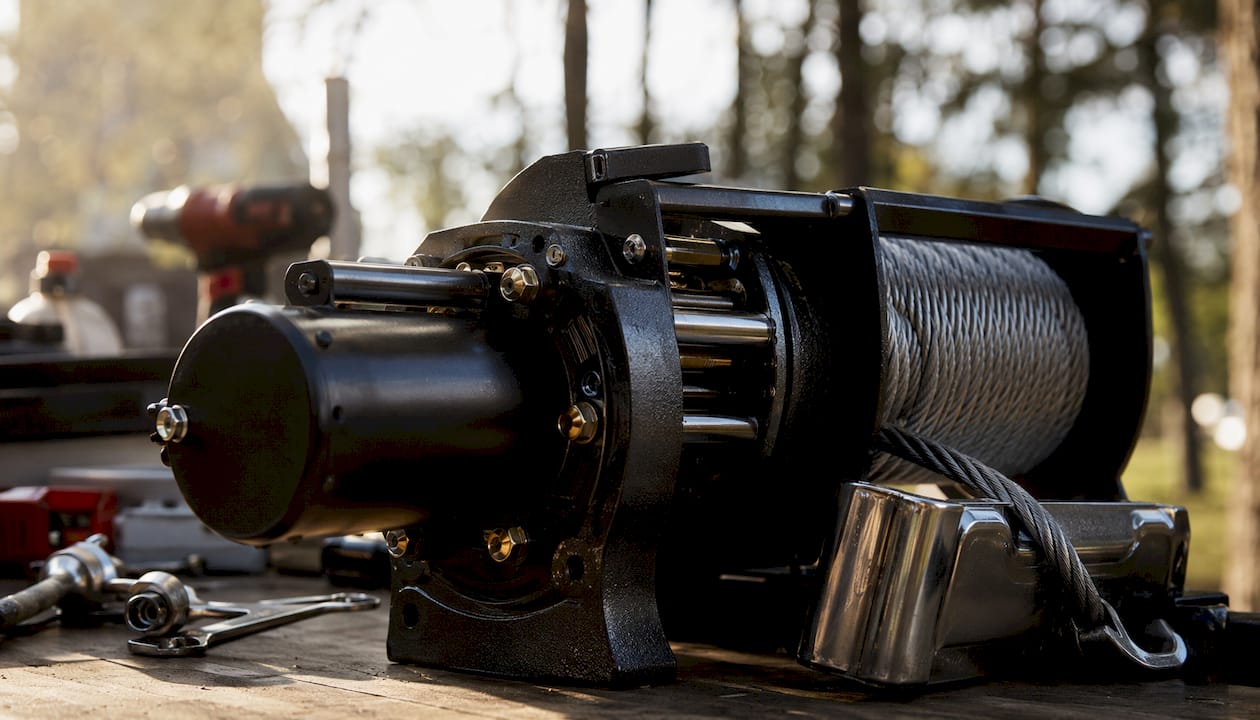
The electric motor draws current from the battery and spins a gear train that multiplies torque. That torque turns the drum, which spools in the rope or cable under tension. A load-holding brake or clutch keeps the drum locked when the motor stops, preventing the load from slipping back. The fairlead guides the line cleanly onto the drum and protects it from abrasion at the frame edge. A contactor (solenoid) acts as a high-current relay between the battery and motor, controlled by your handlebar switch or wireless remote.
The force chain matters as much as the motor rating. A winch is only as strong as its weakest link: the mount, the battery, the wiring gauge, and the rated hardware. Undersized wiring or a weak ground connection will stall even a well-rated motor before the drum ever reaches its limit.
Pro Tip: Mount the contactor as close to the battery as possible, and use the wire gauge your winch manufacturer specifies. Voltage drop across long or undersized runs is the most common reason a winch feels sluggish under load.
How do ATV winch types and line materials compare?
Electric vs. hydraulic
Electric winches dominate the ATV market because they install directly to the existing battery, require no hydraulic system, and work on any machine with a compatible mount. Hydraulic winches offer higher duty cycles and sustained pull for specialty or commercial applications, but they require a hydraulic pump and reservoir, making them impractical for most recreational ATVs.
Steel cable vs. synthetic rope
| Feature | Steel Cable | Synthetic Rope |
|---|---|---|
| Weight | Heavier | Lighter |
| Safety on snap | Stores dangerous energy; can whip | Drops quickly; lower recoil risk |
| Abrasion resistance | High | Needs sleeves and hawse fairlead |
| Maintenance | Lubricate drum; watch for kinks and burrs | Inspect for UV damage and fraying |
| Cost | Lower upfront | Higher upfront, easier to handle |
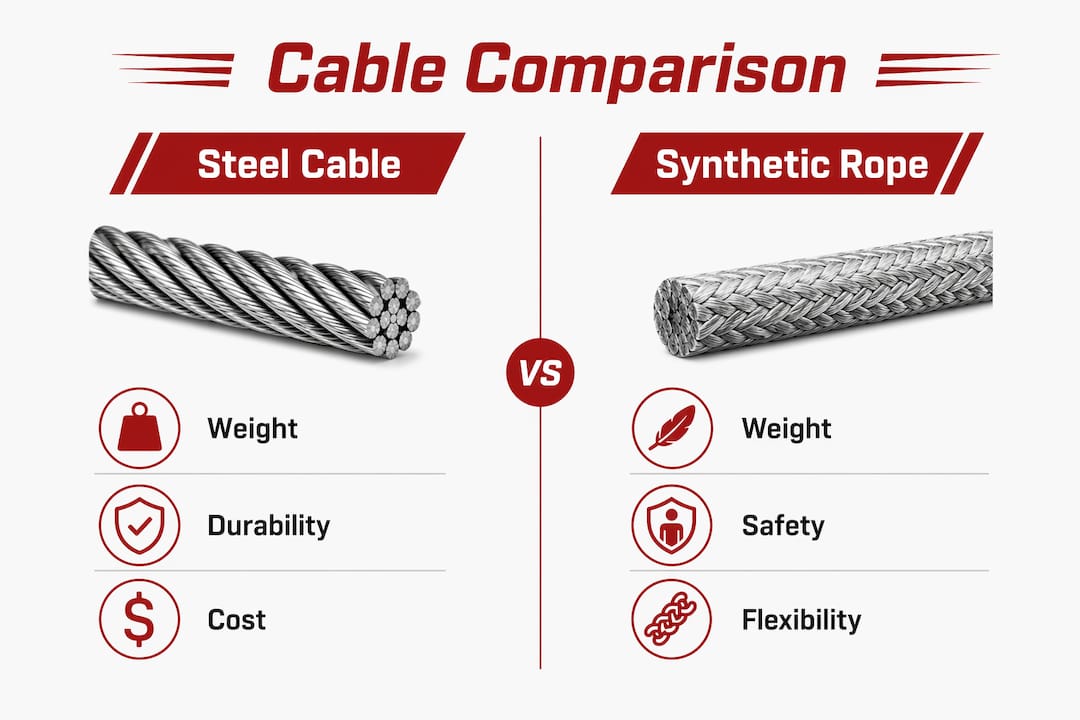
Steel cable is durable and cost-effective, but it develops sharp burrs over time and stores significant kinetic energy under tension. Synthetic rope is lighter, safer to handle, and the preferred choice for most trail riders today.
Fairlead types
Roller fairleads work well with steel cable, using four rollers to guide the line from any angle. A hawse fairlead (smooth aluminum opening) is the correct match for synthetic rope. Running synthetic rope through a roller fairlead can pinch or abrade the fibers, shortening its life fast.
and abrasion sleeves wherever the line contacts shackles or rough anchors.
Pro Tip: If you switch from steel cable to synthetic rope, replace the roller fairlead at the same time. The investment is small; the rope damage from skipping this step is not.
How much pulling power do you actually need?
Rated pull is measured on the first drum layer only. As more rope wraps onto the drum, the effective pulling force drops on each additional layer because the drum diameter increases. In a real recovery, you’re often pulling with multiple wraps already on the drum, so your “rated” winch is working with less muscle than the sticker suggests.
A snatch block doubles your effective pulling force and reduces motor load simultaneously — the standard field tactic for getting extra capability without oversizing the winch.
Sizing by ATV class
Most riders find that winch capacity should be matched appropriately to their ATV’s size and usage, generally sized for the heavier end of their rig plus loads and terrain challenges. The Warn powersports lineup, for example, offers models across this band with IP67/IP68 sealing and gear-train options suited to different duty cycles.
What can you actually use an ATV winch for?
The practical range is wider than most riders expect.
- Self-recovery on trail — pull yourself free from mud, ruts, or a high-centered position without waiting for another rider to help.
- Freeing a stuck trailer — a controlled winch pull repositions a trailer that’s dug in or jackknifed on soft ground.
- Dragging logs and stumps — attach to a tree saver and a rated shackle, and the winch does the heavy lifting during property clearing.
- Tensioning fence lines — a slow, steady pull gets wire taut without a second person or a fence stretcher tool.
- Light snow plowing assist — paired with a plow attachment, a winch can help reposition the ATV when the blade bites deep.
- Hunting and camping tasks — hoisting game, moving camp gear, or pulling a loaded sled across flat terrain.
- Positioning heavy loads — moving equipment, rocks, or debris that would take several people to shift by hand.
A winch is not the right tool for repeated, sustained industrial pulls without an upgraded electrical system. Long duty cycles on a stock ATV battery will drain it fast, and repeated overheating shortens motor life. For occasional trail and property work, though, it’s one of the most versatile upgrades you can add to any machine.
How do you choose the right ATV winch?
Work through this checklist before you buy.
Capacity: Calculate 1.5× your ATV’s gross vehicle weight for general use, 2× if you ride mud or do utility work regularly. Never round down.
Mounting pattern: Confirm the winch bolt pattern matches your mounting plate, and verify the plate fits your ATV’s front frame without blocking suspension travel. Check our ATV suspension guide for load-path context.
Electrical capacity: Your battery and wiring must support the winch’s peak amp draw. Many failures are electrical, not mechanical — undersized wiring and dirty grounds stall motors before the drum hits its limit.
Rope material: Choose synthetic for trail riding and weight savings; steel cable if abrasion from rocky terrain is your primary concern and you’re comfortable with the added maintenance.
Sealing and duty cycle: Look for IP67 or IP68 ratings if you ride water crossings. Match the duty cycle rating to how long and how often you’ll pull.
Brake type and remote: A load-holding brake prevents drum creep. A wireless remote lets you stand clear of the line during operation, which is a safety essential.
Warranty and service: Powersports winches take real abuse. A manufacturer that backs their product with a meaningful warranty is telling you something about build quality.
Red flags: Avoid winches with impressive sticker ratings but no published electrical specs, no sealing rating, and no gear-train details. Real-world performance data at half-load and near-full drum matters more than the zero-load headline number.
Pro Tip: Check buying criteria like line speed under load and current draw at half capacity — not just the peak pull rating. A winch that’s fast and efficient at 60% load will serve you far better on the trail than one that looks impressive on paper.
How do you install a winch on an ATV?
A mechanically competent rider can handle this installation with standard tools. Follow these steps carefully.
- Disconnect the battery before touching any wiring. No exceptions.
- Verify the mount pattern — confirm the mounting plate fits your ATV’s front frame and that the frame can handle the load.
- Bolt the mounting plate to the frame using the manufacturer’s specified hardware and torque values.
- Secure the winch to the plate with four main bolts, checking that the drum and fairlead align straight. A crooked winch will bunch rope and damage the line.
- Install the fairlead — roller for steel cable, hawse for synthetic rope.
- Mount the contactor in a dry, protected location close to the battery.
- Run the heavy-gauge power cables from the winch to the contactor, keeping them away from the engine, exhaust, and moving suspension parts. Use zip ties to secure cables to the frame.
- Connect the contactor to the battery — red to positive, black to negative — and tighten terminals firmly.
- Wire the handlebar switch to a keyed power source so the winch only activates with the ignition on.
- Test under no load before heading out. Spool in and out, listen for unusual sounds, and check all connections.
For a full wiring and safety reference, the ATV safety checklist covers battery precautions and pre-ride checks that apply directly to post-install verification. Re-torque all mounting bolts after the first few uses — vibration on rough terrain will find any loose hardware quickly.
How do you winch safely in the field?
Safe winching is methodical, not rushed. The gear you carry matters, but technique is what keeps pulls predictable.
Anchor selection: Find a solid anchor — a healthy tree, a buried deadman, or a rated recovery point on another vehicle. Wrap trees with a tree saver strap to protect bark and distribute load. Never attach to racks, bumpers, or suspension components unless they are rated recovery points.
Straight-line pulls: Keep the winch line as straight as possible. An angled pull stacks rope unevenly on the drum, reduces effective pull, and puts lateral stress on the fairlead. When a straight line isn’t possible, use a snatch block to redirect the pull angle cleanly.
Mechanical advantage: Rigging a snatch block to double-line your winch halves the load on the motor and extends the pull distance. This is the standard move when a single-line pull is straining the system.
Personal safety: Use a wireless remote so you can stand to the side, away from the line. Place a line damper (a weighted bag or blanket) over the rope midspan — if the line snaps, the damper drops it rather than letting it whip. Wear gloves. Keep hands away from the fairlead while the drum is moving. Never stand in the line of fire, and keep helpers clear of the rope and all connection points.
Pro Tip: Winch in short, controlled bursts. If the motor strains hard and slows, stop. Reposition your anchor, add a snatch block, or reduce resistance by digging out the ATV before pulling again. Pushing through a hard stall overheats the motor and drains the battery fast.
How do you maintain and troubleshoot a winch?
Routine care keeps a winch reliable when you need it most. Check our ATV maintenance guide for a full seasonal schedule that includes winch checks.
Routine tasks: Inspect rope or cable after every hard use. Steel cable needs periodic lubrication and a close look for kinks and burrs. Synthetic rope needs UV protection and inspection for fraying or abrasion damage. Clean electrical connections and check grounds seasonally. Run the winch under light load a few times per season to keep the motor and drum in working order.
Quick troubleshooting:
| Symptom | Likely Cause | First Check |
|---|---|---|
| Motor won’t turn | Dead battery, bad contactor, or broken wiring | Test battery voltage; inspect contactor and connections |
| Slow, weak pull | Voltage drop or multiple drum layers reducing torque | Check wiring gauge and grounds; spool out rope before pulling |
| Motor overheating | Duty cycle exceeded | Let motor cool; add a snatch block to reduce load |
| Stuck clutch | Debris or corrosion in clutch mechanism | Inspect and clean; lubricate per manufacturer spec |
Stop and get professional service if you see smoked electronics, a frayed steel cable (any broken wire strands), or a damaged drum. These are not trail fixes. A limp mode or electrical fault on the ATV itself can also mimic winch problems — rule out the vehicle’s electrical system before assuming the winch is at fault.
Which accessories make a winch system safer and more capable?
The winch is the core, but the supporting gear is what makes it safe and flexible in real conditions. Here’s what belongs in every recovery kit.
- Snatch block: Doubles pulling force and redirects the line angle. Arguably the most useful accessory after the winch itself.
- Tree saver strap: A wide, flat strap that protects bark and distributes load. Never wrap a winch line directly around a tree.
- Soft shackles or bow shackles: Connect recovery gear at rated anchor points. Always match shackle working load to your winch’s rated pull — never use an unrated connector.
- Line damper: A weighted bag or blanket placed midspan on the rope. Reduces whip energy if the line snaps.
- Hawse fairlead: Required for synthetic rope. Smooth aluminum opening prevents abrasion that a roller fairlead would cause.
- Quality gloves: Protect hands from rope fibers, cable burrs, and heat during rigging.
- Wireless remote: Lets you operate the winch from a safe position, away from the line and fairlead.
For a broader look at powersports accessories that complement your ATV setup, Gokartsusa’s accessory guides cover fitment and compatibility across machine classes.
Key Takeaways
A properly sized and maintained ATV winch system turns a high-stress recovery into a controlled mechanical task — but only when the capacity, electrical supply, and technique all match the job.
| Point | Details |
|---|---|
| Size by vehicle weight | Choose 1.5× your ATV’s gross weight for general use; 2× for mud, steep terrain, or utility work. |
| Rope choice matters | Synthetic rope is lighter and safer on snap; pair it with a hawse fairlead to prevent abrasion damage. |
| Electrical health is critical | Undersized wiring and dirty grounds cause most winch failures — check connections and battery condition seasonally. |
| Use a snatch block | Doubling the line halves motor load and extends pulling range without oversizing the winch. |
| Gokartsusa has you covered | Gokartsusa offers ATVs, mini ATVs, and accessories with fitment guidance to help you build the right setup from the start. |
A retailer’s perspective on what riders actually need
Most customers who ask us about winches fall into two camps: the trail rider who got stuck once and never wants to repeat it, and the property owner who realized their ATV could do a lot more work with the right gear attached. Both are right. A winch is one of the few upgrades that pays for itself the first time you genuinely need it.
What we recommend most often is straightforward: size up rather than down, choose synthetic rope unless you have a specific reason not to, and never skip the electrical check. The winch motor gets the blame when a system underperforms, but nine times out of ten the real culprit is a weak battery, an undersized ground wire, or a corroded connection. Get those right first.
Gokartsusa carries ATVs, mini ATVs, and powersports accessories with the kind of product knowledge that helps you match the right machine and the right gear to your riding style. If you have a fitment question, our team is here to help you get it right before you buy.
Ready to gear up? Gokartsusa has your next ride
Whether you’re shopping for your first ATV or adding capability to a machine you already love, Gokartsusa’s catalog covers the full range. From the Mini Sport Kids ATV with parental remote start to full-size recreational machines and the accessories that make them trail-ready, we stock what riders actually need. Our team can help you confirm compatibility, answer fitment questions, and point you toward the right winch-ready setup for your terrain and budget.

Check our ATV lineup and accessory pages, then reach out if you need help matching a winch capacity or mounting plate to your specific machine. Getting the right gear from the start saves time, money, and a lot of frustration on the trail.
Useful sources and further reading
- How to choose an ATV winch — ATVNotes — Detailed sizing guidance, rope type comparison, and real-world selection advice.
- What size winch do I need? — SuperATV Off-Road Atlas — The 1.5×/2× sizing rule explained with snatch block use cases.
- ATV vs. UTV winches — ATVNotes — Key differences in capacity, electrical load, and duty cycle between ATV and UTV winch systems.
- Winch pulling capacity by drum layer — Warn — Technical explanation of how rated pull changes across drum wraps.
- Warn powersports winch comparison — Side-by-side specs on sealing, gear-train type, and warranty across ATV winch models.
- Winch types compared — Heavy Duty Guide — Buying criteria prioritized by real-world performance: line speed, current draw, and duty cycle.
- How to install a winch on your ATV — Can-Am maintenance guide — Step-by-step installation reference with wiring and safety notes.
- Winches and recovery gear 101 — ATV Streets — Practical field guide covering anchoring, snatch blocks, line dampers, and safe operation habits.
- Synthetic rope and fairlead compatibility — video demonstration — Visual guide to hawse fairlead selection and synthetic rope care.
- ATV safety checklist — Gokartsusa — Pre-ride and post-install safety checks relevant to winch mounting and operation.
- ATV maintenance guide — Gokartsusa — Seasonal maintenance routines that include winch and electrical system checks.