




Start your cold pressure around 8 to 15 psi, depending on compound, then measure hot immediately after your out-lap and adjust cold pressure until the hot number lands in your tire’s target window. That’s the whole game. The exact numbers shift with compound hardness, track temperature, and how long you run, but the rule never changes: set a baseline, measure hot, tune cold for next time.
TL;DR:
- Cold tire pressures should start between 8 and 15 psi based on compound hardness, with softer compounds requiring less pressure to reach optimal grip.
- Measure hot pressure within 60 seconds of stopping, log the data, and adjust cold pressure for future runs based on how hot readings compare to target windows.
- Track surface conditions, ambient temperature, and driver weight to refine pressure settings, increasing pressures for heavier drivers or warmer conditions and decreasing for cooler or wet conditions.
- Wet-weather pressures typically require an increase of 5 to 10 psi over dry setup, but adjustments must avoid overinflation signs like vibration or handling issues.
- Consistent use of one high-quality gauge and maintaining a detailed log of pressures and temperatures improves tuning accuracy more than relying on manufacturer charts or rumors.
Table of Contents
- What’s the Right Starting Tire Pressure for Go-Karts?
- How to Check Go-Kart Tire Pressure the Right Way
- Tuning Rules: Adjusting Pressure for Track and Session
- Wet-Weather Tire Pressure: How Much Higher Should You Go?
- Reading Tire Wear: Is It Pressure or Something Else?
- A Repeatable Session Workflow Worth Stealing
- Effect of Kart Weight and Driver Weight on Tire Pressure
- How Ambient Temperature and Altitude Change Your Setup
- Do Different Racing Classes Need Different Tire Pressure?
- Why Disciplined Pressure Mapping Beats Paddock Folklore
- Stock Up on the Gear That Makes Tuning Possible
- Sources
- FAQ
What’s the Right Starting Tire Pressure for Go-Karts?
Every tire manufacturer publishes a starting point, and those numbers are worth memorizing before you ever roll onto the grid. Hoosier’s karting line and other major suppliers put the optimal cold range at roughly 8 to 15 psi, but where you land inside that window depends entirely on compound.
Softer, high-grip compounds run cooler and softer by design, so they need less cold pressure to reach their operating window. Harder compounds need more cold pressure pushed in, because they take longer to build heat and grip. That’s the logic behind these commonly cited supplier baselines:
- MG Yellow (SM): cold around 8 to 10 psi, hot target roughly 10 to 12 psi, according to Top Kart USA’s tire pressure guidance.
- MG Red (SH): cold starting points commonly run 9 to 15 psi depending on ambient temperature, with many club racers targeting roughly 13 to 14 psi hot, per Kinetic Karting’s LO206 pressure guide.
- Bridgestone YLC: cold around 10 to 13 psi, hot around 12 to 15 psi.
- Bridgestone YNB and Evinco compounds: fall in similar ranges, though exact figures vary by batch and track surface, so treat published numbers as a launch point rather than gospel.
Here’s what trips up a lot of newer racers: they read a chart, dial in the number, and never touch it again. Supplier baselines are a starting line, not a finish line. Track surface, ambient heat, and even how scrubbed-in your tires are will all push your ideal number away from the chart. Write the baseline down, run it, and let your hot readings tell you where to actually park your cold pressure.
How to Check Go-Kart Tire Pressure the Right Way
Consistency beats precision here. A great gauge used inconsistently will mislead you faster than a mediocre gauge used the same way every single time.
Here’s the workflow we recommend to every driver who walks through our doors asking about setup:
- Measure cold before your out-lap. Check all four tires while the kart is sitting, engine off, before you’ve turned a wheel. This is your true baseline.
- Run your stint. Three to four laps is enough for most sprint sessions to build real heat; longer stints for endurance testing.
- Measure hot within 60 seconds of pit-in. Pressure bleeds off fast as tires cool, so waiting even two or three minutes can throw your reading off by a full psi or more, according to PURPL’s data-driven tire pressure breakdown.
- Log everything. Cold psi, hot psi, ambient temperature, track temperature, lap count, and lap times.
- Compare hot psi to your target window, and adjust cold pressure up or down for the next run.
Use one gauge, and only that gauge, for the entire session. Different gauges can disagree by a full psi or more, and that discrepancy will send you chasing a problem that doesn’t exist. A tire pyrometer adds another layer: probing tread temperature across the surface tells you whether the whole tire is heating evenly or whether one edge is running hotter than the rest, which usually points to a chassis or camber issue rather than pressure.
Watch your lap times across the stint, not just at the end. Racers call this the “stint-shape.” If your times drop steadily and keep dropping, your starting pressure was probably too high and the tire kept over-heating. If your times improve lap after lap and never plateau, you likely started too low and never gave the tire a chance to reach its window early. This kind of stint-shape analysis is standard practice among data-focused racers, and it’s a far more reliable signal than a single hot reading taken after the checkered flag.
Pro Tip: Keep a simple notebook or spreadsheet with one row per session. Cold psi, hot psi, ambient temp, track temp, laps run. After five or six sessions at your home track, you’ll have your own personal pressure chart that’s more accurate than anything printed on a manufacturer’s website.
Tuning Rules: Adjusting Pressure for Track and Session
Once you’ve got a baseline and a logging habit, tuning becomes a matter of pattern recognition rather than guesswork.
The general rule: a hotter, grippier track pulls heat into the tire faster, so you drop your starting cold psi to keep the hot number from overshooting the target window. A cold or “green” track with less rubber laid down does the opposite. It takes longer to build heat, so you raise your cold starting point to compensate.
A few scenarios that come up constantly at club days:
- Morning practice on a cold track: raise cold pressure slightly above your chart baseline, since the tire will take longer to come up to temperature.
- Afternoon session on a rubbered-in, high-grip surface: drop cold pressure, because the tire heats faster and you don’t want to overshoot into the overinflated range mid-stint.
- Qualifying runs versus feature races: qualifying is short and sharp, so many racers run slightly lower cold pressure to get instant grip on lap one or two. Longer feature races often need a touch more cold pressure so the tire doesn’t overheat and fall off late in the run.
- The cold-to-hot delta is your compass. If your hot reading consistently comes in 2 psi over your target, drop your next session’s cold pressure by roughly that amount and re-test.
None of these adjustments are fixed formulas. They’re directional habits built from your own logged sessions, which is exactly why the step-by-step tuning workflow approach matters more than memorizing someone else’s numbers.
Wet-Weather Tire Pressure: How Much Higher Should You Go?
Rain changes the entire heat equation. A wet track robs tires of friction, which means less heat generation, which means you need more starting pressure to help the tire reach a workable temperature and to displace water more effectively.
The widely cited adjustment is straightforward: add roughly 5 to 10 psi cold compared to your dry baseline, a figure echoed by both Top Kart USA and other karting guides covering wet setup.
That said, safety limits still apply. Push pressure too high and you risk the tire ballooning at the sidewall or seating poorly on the rim, which shows up as vibration or inconsistent handling through fast corners. Rental karts, often running harder, more durable compounds, can typically tolerate the higher end of that wet range without issue. Dedicated racing tires on a lighter chassis need a more careful hand. If you notice the kart bouncing oddly over bumps or the steering feels vague on turn-in, back off a psi or two and reassess.
Reading Tire Wear: Is It Pressure or Something Else?
Your tires tell a story if you know how to read the tread.
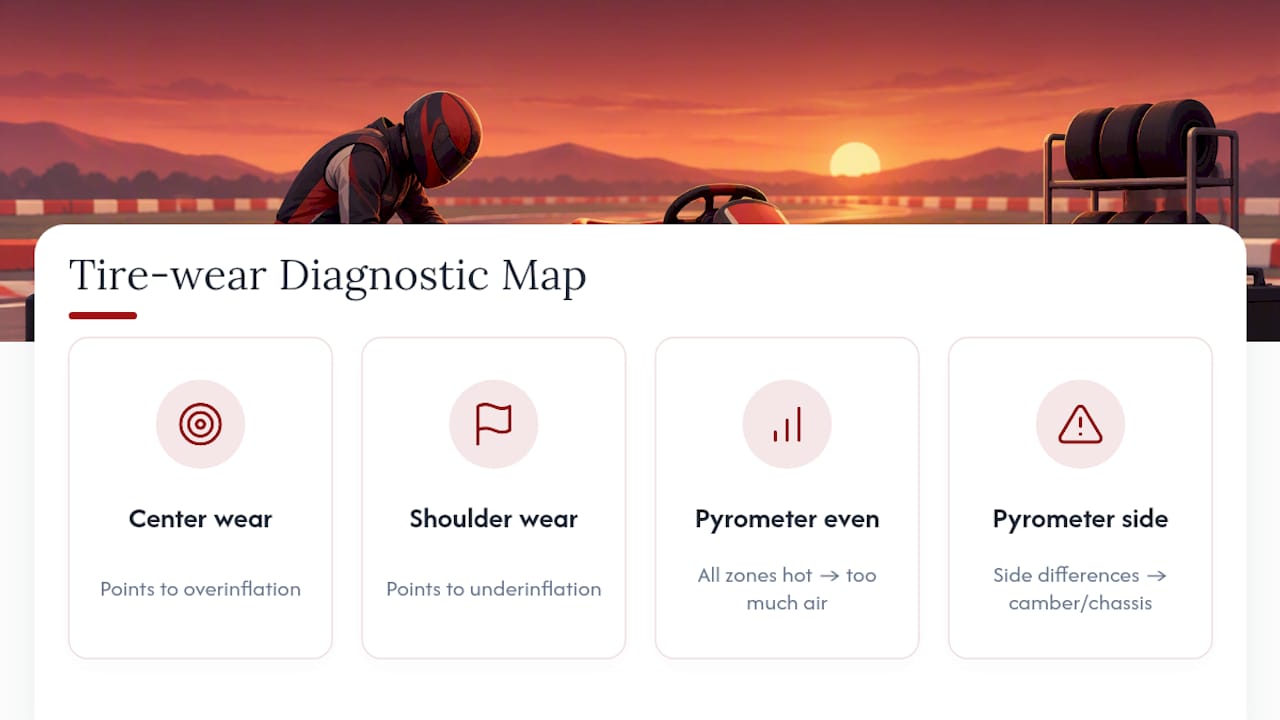
Center wear, a strip of wear right down the middle of the tread with the edges relatively fresh, almost always points to overinflation. The tire is bulging in the middle under pressure, putting all the contact patch stress in one narrow band.
Outer edge wear, especially wear concentrated toward the shoulders, usually signals underinflation. The tire is rolling on its edges because the center isn’t carrying its share of the load.
Handling gives you a second data point. Mid-stint snap-oversteer, where the kart feels planted for a lap or two and then suddenly lets go, often means the tire overheated because starting pressure ran too high. A kart that feels tight and understeer-y early but steadily improves as the stint goes on is telling you the opposite story: pressure started too low and the tire needed time to build into its window.
A pyrometer sharpens the diagnosis. Probe across the tread, inner, center, and outer, and compare corner to corner. Uneven readings side to side point toward camber or chassis balance rather than pressure alone, while even but too-hot readings across the board confirm you’re simply running too much air. For deeper wear-pattern reference, our guide on go-kart tire performance and safety covers additional signs worth checking before every session.
A Repeatable Session Workflow Worth Stealing
The drivers who improve fastest aren’t the ones with the most expensive kart. They’re the ones who treat every session like a small experiment.
Here’s the workflow we walk customers through: set the supplier baseline for your compound, run a 3 to 4 lap stint, measure hot pressure within 60 seconds of pit-in, compare that hot number to your target window, then adjust cold pressure accordingly for the next run.
A few tools make this workflow actually work:
- One trusted gauge, digital or a quality analog, used every single session so your numbers stay comparable.
- A tire pyrometer to check temperature spread across the tread and between corners.
- A notebook or simple session sheet to log cold psi, hot psi, temps, and lap times.
For more on picking and maintaining the tires you’re testing, our tire selection and maintenance guide walks through compound choice in more depth than we can cover here.
Effect of Kart Weight and Driver Weight on Tire Pressure
Weight changes how hard the contact patch works, and that means it changes your ideal pressure too. A heavier driver, or a kart carrying extra ballast to meet a class minimum, presses the tire’s sidewall and tread harder into the track surface with every lap. That extra load generates more heat faster, which usually calls for a slightly higher cold starting pressure to avoid overshooting your hot target once the tire is loaded and working.
Lighter drivers face the reverse problem. Less weight on the contact patch means less heat generation, so tires can stay stubbornly under their target window all stint if you start too high. A common mistake among parents setting up karts for younger, lighter drivers is copying an adult’s pressure chart wholesale. The kart and driver combination might be 40 or 50 pounds lighter than what that chart assumed, and the tire simply never builds the heat it needs.
The fix isn’t a fixed formula, since weight interacts with compound and track grip differently every time. It’s a reason to log driver weight alongside your other session notes. If you run the same kart with two different drivers of noticeably different weights, don’t expect the same cold pressure to produce the same hot result for both. Treat each driver-kart combination as its own mini pressure map, built the same way you’d build one for a new track or a new compound.
How Ambient Temperature and Altitude Change Your Setup
Air temperature outside the tire matters just as much as the heat building inside it. A 90 degree afternoon and a 45 degree morning practice session are two different tuning problems, even on the exact same track with the exact same kart.
Hot ambient air means the tire starts warmer and needs less added heat from friction to reach its window, so you can often run slightly lower cold pressure than a chart built for moderate conditions. Cold mornings do the opposite. The tire starts further from its operating temperature, so a slightly higher cold pressure helps it get there faster and avoids a stint where the tire never fully wakes up.
Altitude adds a subtler wrinkle. Thinner air at higher elevations affects how quickly a tire sheds heat and how the kart’s engine performs, which changes lap speed and, in turn, how much heat friction builds into the tire over a given stint. Racers moving from a sea-level club track to a mountain circuit often find their usual baseline runs slightly different than expected, not because the chart was wrong, but because the whole heat-building equation shifted underneath it.
The practical takeaway: note ambient temperature on every session sheet, and if you race at multiple elevations, keep separate pressure notes for each track. A number that works perfectly at your home circuit in July might miss the window entirely at a higher-altitude track in October.
Do Different Racing Classes Need Different Tire Pressure?
Engine output and class rules change how much heat a tire builds, which means pressure tuning isn’t one-size-fits-all across the karting world.
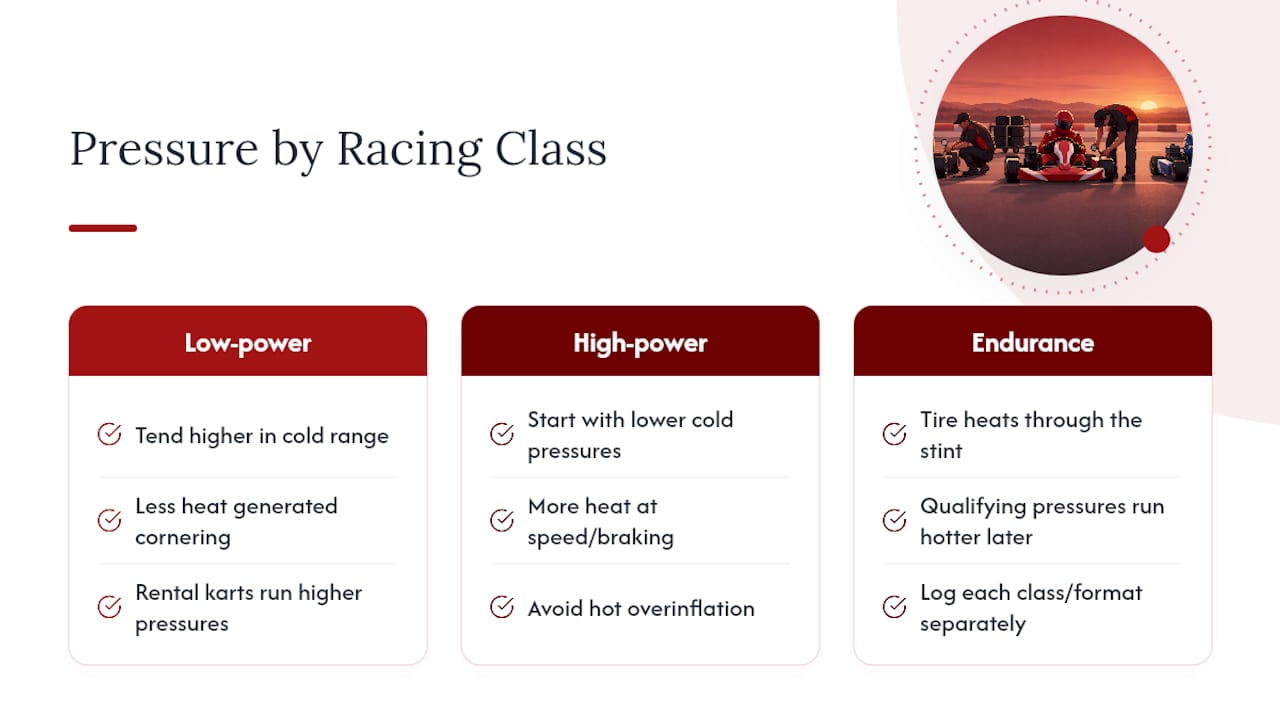
Lower-powered classes, like entry-level rental karts or junior classes, generate less speed and less cornering load, so tires build heat more slowly. These setups often run toward the higher end of a compound’s cold range, since there’s less natural heat generation to rely on. Top Kart USA’s guidance notes that rental karts in particular tend to run higher pressures overall, partly because the compounds used are built for durability over dozens of drivers rather than peak grip for one.
Higher-powered classes, shifter karts, and anything running higher horsepower engines generate significantly more heat through faster corner speeds and heavier braking loads. These setups typically run lower cold pressures to prevent the tire from overshooting into overinflation once it’s fully loaded at speed.
Endurance classes complicate things further. A two-hour enduro stint builds heat differently than a 10-lap sprint, so pressures that work perfectly for a short qualifying run can run too hot by the halfway point of a long race. If you race across multiple classes or switch between sprint and endurance formats, don’t assume one pressure map transfers cleanly. Log each class separately, and treat every new combination of engine, class rules, and race format as its own small tuning project.
Why Disciplined Pressure Mapping Beats Paddock Folklore
Every paddock has a driver who swears by a number they’ve never actually measured hot. Ignore them. The drivers who consistently run up front are the ones logging cold psi, hot psi, and lap times every single session, then adjusting based on what the tire actually did, not what a chart or a rumor said it should do. Supplier baselines get you in the ballpark. Your own notebook gets you to the front.
— Mario
Stock Up on the Gear That Makes Tuning Possible
Dialing in tire pressure only works if you’ve got reliable tires and the right tools to measure them, and that’s where a lot of racers get stuck buying whatever’s cheapest at the track. Various sellers stock parts, tires, and karts that support the workflow covered here, avoiding the guesswork of sourcing gear piecemeal.

Whether you’re outfitting a first kart for a young driver or replacing worn tires on a race-ready chassis, our go-kart parts and vehicle catalog covers everything from replacement tires to full karts built for club racing and weekend track days. Browse the lineup, compare specs against the pressure ranges covered above, and get your next setup ordered with fast shipping straight to your driveway.
Sources
Baseline numbers and workflow steps draw on manufacturer pressure charts, PURPL’s data-driven testing method, and Kinetic Karting’s compound-specific guidance.
- Hoosier Tire - Karting and quarter midgets
- Kart Tire Pressure: Find Your Optimum With Data · PURPL
- LO206 Tire Pressure Guide: MG Red PSI Charts for Every Condition — Kinetic Karting
- Tire Pressure - Top Kart USA
FAQ
What Is the 4 PSI Rule for Go-Kart Tires?
The “4 psi rule” generally refers to keeping cold pressure differences between tires on the same axle within about 4 psi of each other to avoid uneven grip and handling imbalance. Definitions vary by track and class, so treat it as a rough consistency check rather than a strict universal standard.
What Is the 5 PSI Rule for Go-Kart Tires?
Some racers use a “5 psi rule” to describe raising cold pressure by roughly 5 psi when switching from dry to wet conditions, which lines up with the wider 5 to 10 psi wet adjustment range covered by supplier guidance. It’s a starting point for wet setup, not a fixed law, so confirm with hot readings once you’re on track.
How Fast Is a 200cc Go-Kart in MPH?
A go-kart’s top speed varies widely depending on gearing, weight, and track conditions. Tire pressure still matters at these speeds since underinflated tires flex more under load and can hurt straight-line stability at the top end.
How Heavy Is Too Heavy for Karting?
Most karts and classes list a maximum combined driver and ballast weight in their class rules, and exceeding it usually hurts both handling and tire wear rather than creating an outright safety failure. Heavier drivers generally need slightly higher cold tire pressure to compensate for the added heat and load on the contact patch during a stint.
Does Gokartsusa Sell Tire Gauges and Pyrometers?
Gokartsusa carries parts and accessories that support tire maintenance and setup work, with current selection and pricing listed on the main product catalog. Check the site directly for what’s in stock, since inventory shifts with seasonal demand.