




TL;DR:
- Regular inspections of go-karts prevent most mechanical failures and ensure rider safety.
- Perform pre-session, weekly, and monthly checks on tires, brakes, fasteners, and the chassis to catch issues early.
The routine go-kart inspection process is the practice of systematically checking critical kart components before and after each session to maintain safety, performance, and mechanical reliability. Skipping these checks is the fastest way to turn a thrilling ride into a dangerous one. Effective inspection routines can prevent up to 70% of common go-kart mechanical failures, cutting downtime and protecting every rider on the track. Whether you run a single recreational kart or a commercial fleet, a structured go-kart maintenance checklist is your most reliable tool for keeping things running right.
What tools and preparations do you need before a go-kart inspection?
The right tools make every inspection faster, safer, and more thorough. Walking up to a kart without them is like a mechanic showing up without a wrench. Gather your equipment before you touch the kart, and you will catch problems that a quick visual scan would miss.
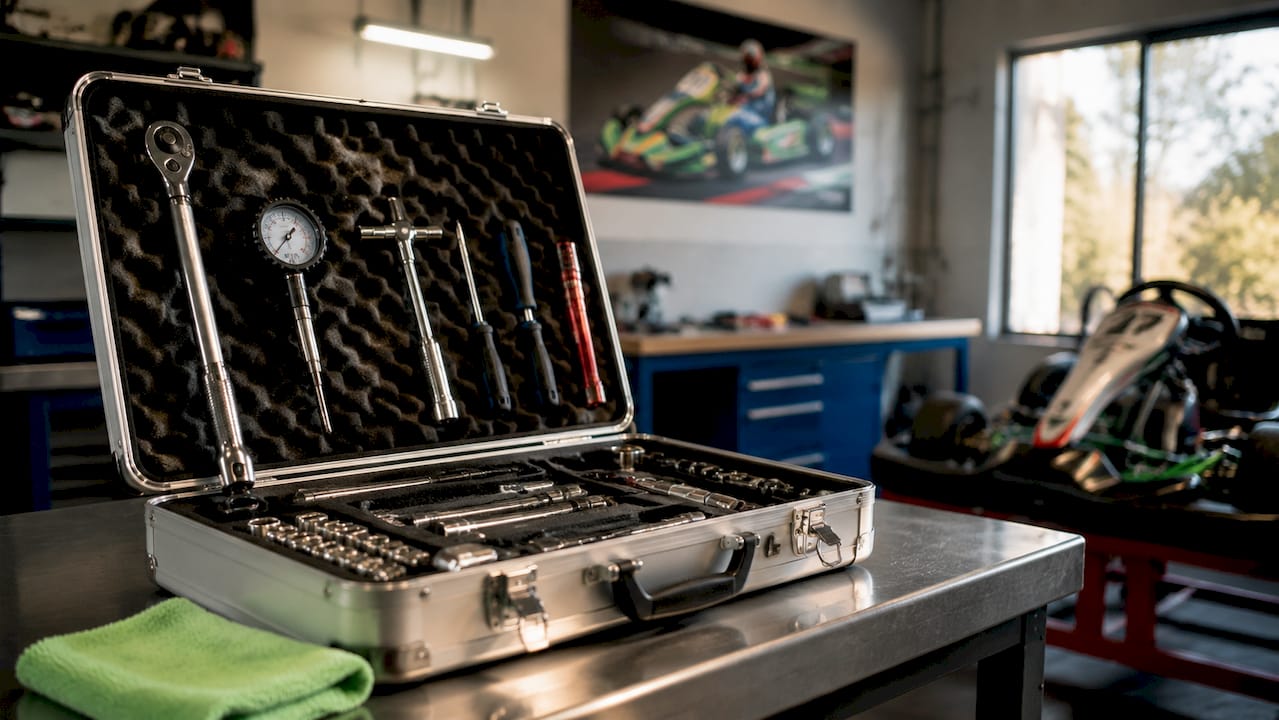
Essential tools for every inspection
| Tool | Function |
|---|---|
| Torque wrench | Verifies fastener tightness to manufacturer spec |
| Tire pressure gauge | Checks inflation levels for safe handling |
| Chain tension gauge or ruler | Measures chain slack to prevent drivetrain failure |
| Cleaning brushes and degreaser | Removes debris from chain, sprockets, and brake components |
| Manufacturer service manual | Provides torque specs, service intervals, and part tolerances |
| Flashlight or inspection light | Illuminates frame welds, undercarriage, and tight spaces |
Every tool on this list serves a specific purpose. A torque wrench, for example, removes guesswork from fastener checks. Tightening by feel alone leads to under-torqued bolts that loosen under vibration or over-torqued fasteners that strip threads.
Your inspection environment matters just as much as your tools. Work on a flat, well-lit surface with the kart fully stopped and the engine off. Wear gloves to protect your hands from sharp edges and hot components. Always consult your manufacturer’s manual before starting. Manufacturer manuals contain model-specific torque specs and service intervals that generic guides cannot replace.
Pro Tip: Keep a dedicated inspection kit in a small toolbox near your kart storage area. When everything is in one place, you are far more likely to actually run the check before every session.
How to inspect a go-kart before each use
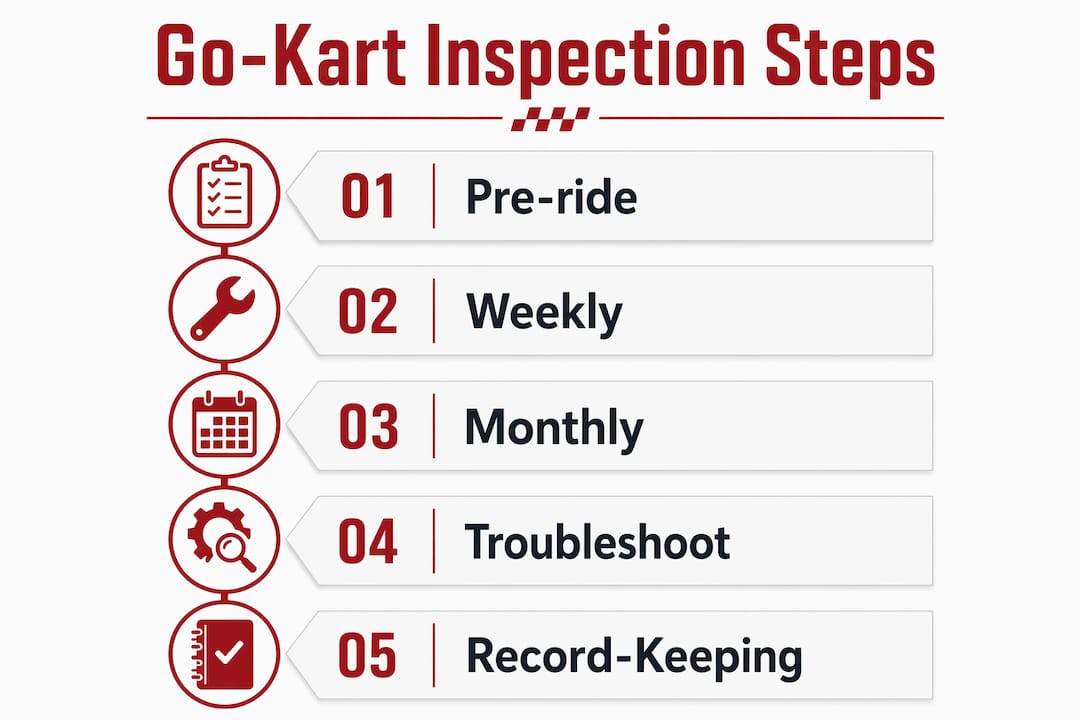
Pre-session checks are the foundation of any go-kart safety inspection. They take roughly 10 minutes and catch the issues most likely to cause a failure mid-session. Follow this sequence every single time you pull the kart out.
-
Check tire pressure. Use a tire pressure gauge and compare readings against the manufacturer’s recommended PSI. Uneven pressure causes handling imbalance and accelerates uneven wear. Cold tires give the most accurate reading, so check before the engine runs.
-
Inspect tires for damage. Look for cuts, bulges, embedded debris, or excessive wear on the tread surface. A compromised tire can fail suddenly under cornering load.
-
Test chain tension. Push the chain up and down at the midpoint between the sprockets. Most karts allow roughly 3–5 mm of vertical play. A chain that is too loose can jump the sprocket; one that is too tight puts stress on bearings and the axle.
-
Examine sprocket teeth. Worn or hooked teeth are a sign the chain and sprocket are past their service life. Chain and sprocket wear cause both safety and performance issues. Replace bent or hooked sprockets rather than adjusting around them.
-
Check all nuts, bolts, and fasteners. Work around the kart systematically. Use your torque wrench on critical points including wheel hubs, axle bolts, and engine mounts. A post-first-hour fastener check is especially important on new karts, as components settle during initial break-in.
-
Test the brakes. Press the brake pedal firmly and check for a solid, responsive feel. Spongy brakes signal air in the line or worn pads. Brake pad wear directly affects stopping performance, and sudden braking failure is one of the most dangerous outcomes of a skipped inspection.
-
Test throttle response. Push the throttle pedal and confirm it returns fully and freely when released. A sticky throttle is a serious safety hazard.
-
Inspect seat mounts and steering. Grab the seat and try to rock it. Any movement means a loose mount. Check the steering wheel for play and confirm the column moves freely without binding.
Pro Tip: Run your checks in the same order every time. A consistent sequence builds muscle memory and makes it nearly impossible to skip a step by accident.
What do weekly and monthly go-kart inspections cover?
Pre-session checks catch immediate hazards. Weekly and monthly inspections go deeper, addressing wear patterns and system health that only show up over time. A three-tier inspection protocol covering pre-session, weekly, and quarterly checks is best practice for fleet operators and serious recreational owners alike.
Weekly inspection priorities
- Engine and air filter: Remove and inspect the air filter. A clogged filter starves the engine of air and degrades performance. Clean or replace it based on operating conditions.
- Chain lubrication: Apply chain lube after every few sessions, or weekly at minimum. Dry chains wear faster and are more likely to snap.
- Brake fluid level: Check the reservoir and top off if needed. Low fluid often signals a leak or worn pads.
- Exhaust system: Look for carbon buildup around the exhaust header and silencer. Neglecting exhaust carbon deposits accelerates performance decline in high-output karts.
- Steering linkage and tie rods: Check for looseness or play in every joint. Worn rod ends cause unpredictable steering.
Monthly inspection priorities
Monthly checks add structural and system-level scrutiny to the routine kart checks you run each week.
| Inspection Area | What to Check | Action if Issue Found |
|---|---|---|
| Chassis and welds | Cracks, stress fractures, weld integrity | Stop use; repair or replace frame |
| Brake pads and rotors | Pad thickness, rotor surface condition | Replace pads below minimum thickness |
| Bearings | Smooth rotation, no grinding or play | Replace worn bearings immediately |
| Valve clearance (gas karts) | Within manufacturer spec | Adjust per service manual |
| Brake fluid | Color and contamination level | Flush and replace if discolored |
Inspections should be scheduled at defined intervals: oil and air filters serviced every 20 hours, with a deep 50-hour service covering valve clearance, brake fluid, and bearings. That structure removes guesswork and keeps you ahead of wear rather than reacting to failures.
Chassis inspection deserves special attention. High-vibration fatigue points such as seat mounts, bumper attachments, and engine mount areas are common failure locations. Constant vibration works fasteners loose and stresses welds over time. Continuous MIG or TIG welds on load-bearing frame joints are the standard for structural safety. Tack welds or intermittent welds at these points require immediate repair or replacement.
How do you troubleshoot problems found during a go-kart inspection?
Finding a problem during an inspection is a good outcome. It means you caught it before it caught you on the track. Here is how to address the most common issues.
Loose or damaged fasteners are the most frequent finding. Retorque to spec using your manufacturer manual. If a bolt strips or a thread is damaged, replace the fastener before the next session. Never run a kart with a missing bolt on a safety-critical component.
Chain wear and sprocket misalignment require a measured response. A stretched chain needs replacement, not just retensioning. Misaligned sprockets require professional adjustment to prevent drivetrain failure. Trying to compensate for misalignment by adjusting chain tension alone will accelerate wear on both components.
Brake system problems range from low fluid to worn pads to air in the lines. Low fluid is a quick fix. Spongy pedal feel after topping off fluid means air is present and the system needs bleeding. Worn pads must be replaced before the next ride, not after.
Chassis cracks are a stop-everything situation. A cracked frame is not a field repair. Pull the kart from service and have a qualified welder assess the damage. Running a cracked chassis risks catastrophic failure under load.
A go-kart that passes a professional safety inspection covering at least 23 checkpoints is still the operator’s responsibility to maintain between sessions. Regulatory compliance checks confirm a baseline. Daily rider safety depends on what you do before every session.
Pro Tip: Keep a simple log of every inspection. Note the date, what you checked, what you found, and what you fixed. Commercial operators should retain these records for at least 3 years for liability purposes. Even recreational owners benefit from spotting patterns in recurring issues.
Key takeaways
A disciplined routine go-kart inspection process, structured across pre-session, weekly, and monthly tiers, is the single most effective way to prevent mechanical failures and protect every rider.
| Point | Details |
|---|---|
| Use a three-tier schedule | Run pre-session, weekly, and monthly checks to catch issues at every stage of wear. |
| Prioritize chain and brake checks | Chain tension, sprocket condition, and brake pad wear are the most common failure sources. |
| Inspect high-vibration points | Seat mounts, engine mounts, and bumper attachments fail first under constant kart vibration. |
| Document every inspection | Written records help spot recurring problems and protect operators from liability. |
| Replace, don’t patch | Cracked chassis components and worn sprockets require replacement, not temporary fixes. |
Why I think most kart owners underestimate the inspection routine
After years around karts, the pattern I see most often is this: owners run thorough checks when the kart is new, then gradually shorten the routine as confidence builds. By month three, the pre-session check is a quick walk-around and a tire kick. That is exactly when things go wrong.
Scrutineering in competitive karting confirms regulatory compliance, but it is not a safety guarantee. The responsibility for mechanical condition between official checks falls entirely on the competitor or operator. That principle applies just as much to recreational karts as it does to race-day machines.
The detail most people skip is chassis inspection. A hairline crack near a seat mount or engine bracket looks like nothing until it does not. Vibration works on metal constantly, and high-vibration fatigue points fail without warning when they are ignored long enough. Fifteen minutes with a flashlight and a systematic eye for welds is the difference between a great session and a serious incident.
The go-kart maintenance checklist approach works because it removes decision fatigue. You are not deciding what to check. You are executing a proven sequence. That consistency is what builds real reliability over hundreds of hours of operation.
— Mario
Gear up with Gokartsusa for every inspection and ride

Gokartsusa stocks a wide selection of go-karts and powersports vehicles built for riders who take reliability seriously. Whether you are setting up a maintenance kit for a new kart or looking for a quality machine that makes routine inspections straightforward, Gokartsusa has you covered. Every kart in the catalog comes with detailed product specs to support your maintenance planning from day one. Check out the Mini Sport Kids ATV for a safety-focused, easy-to-maintain option with parental controls built in. For a full look at what Gokartsusa offers, visit gokartsusa.biz and find the right ride for your adventure.
FAQ
What is the routine go-kart inspection process?
The routine go-kart inspection process is a structured set of checks performed before each session, weekly, and monthly to verify that tires, brakes, chain, fasteners, and chassis are in safe working condition. It follows a defined sequence to catch wear and damage before they cause failures on the track.
How often should you inspect a go-kart?
Check tire pressure, chain tension, and fasteners before every ride. Service oil and air filters every 20 hours of operation, and perform a deep inspection covering valve clearance, brake fluid, and bearings at the 50-hour mark.
What are the most critical checkpoints in a go-kart safety inspection?
Brakes, chain tension, tire condition, and fastener tightness are the highest-priority checkpoints. Steering response and kill switch functionality must also be verified daily on commercial karts.
When should you replace go-kart parts instead of repairing them?
Replace components when they show structural damage, such as cracked chassis welds, hooked sprocket teeth, or brake pads worn below minimum thickness. Repairing these items instead of replacing them creates a safety risk that no adjustment can fix.
Do recreational go-kart owners need to keep inspection records?
Keeping inspection records is strongly recommended for all operators. Commercial operators should retain records for at least 3 years for liability purposes, and recreational owners benefit from logs that reveal recurring mechanical issues before they become serious problems.
Recommended
- Go-Kart Safety Explained: A Parent’s Guide to Confident Driving – GoKarts USA®
- Beginner Go-Kart Checklist: Start Strong and Safe – GoKarts USA®
- How to Inspect a Go-Kart After the First Hour of Operation: Checking N – GoKarts USA®
- Go-kart maintenance checklist: essential tips for safe family fun – GoKarts USA®