




What defines a commercial grade ATV?
A commercial grade ATV is a motorized, off-highway vehicle engineered specifically for sustained, high-duty-cycle work rather than weekend thrills. Under 16 CFR § 1420.2, an ATV is legally defined as any motorized, off-highway vehicle designed to travel on three or four wheels, with a straddle seat and handlebars for steering. Commercial grade variants go well beyond that baseline definition. They are purpose-built with reinforced cargo beds, high payload and towing capacities, and specialized powertrains tuned for low-end torque rather than top-end speed.
What separates a commercial unit from a recreational quad is not just horsepower. It is the entire design philosophy. Where recreational models chase suspension travel and speed, commercial ATVs prioritize chassis stiffness, operator ergonomics, and durability across long daily shifts. Think of them as mobile work platforms rather than sport machines.
Key defining characteristics of commercial grade ATVs include:
- Reinforced cargo racks and beds rated for heavy payloads and daily loading cycles
- 4x4 drivetrain with locking front differential for traction across varied terrain under load
- Low-end torque focus with engine displacements typically ranging from 90cc to 700cc+
- Automatic transmission with engine braking for controlled descents while hauling
- Heavy-duty skid plates, bumpers, and 6-ply rating tires for protection in rough environments
- ANSI/SVIA certification compliance and an active ATV action plan on file with the CPSC
- Speed limiters and adjustable governors to support fleet safety and regulatory compliance
Every commercial ATV sold in the United States must comply with all applicable provisions of the ANSI/SVIA standard and bear a label certifying that compliance. That certification is not a formality. It tracks manufacturer accountability and rider protection across the vehicle’s working life.
Where do commercial ATVs actually get put to work?
The range of professional environments where commercial grade ATVs operate is broader than most buyers realize. These machines show up wherever a full-size truck cannot fit, a tractor is overkill, and the job still demands reliability hour after hour.
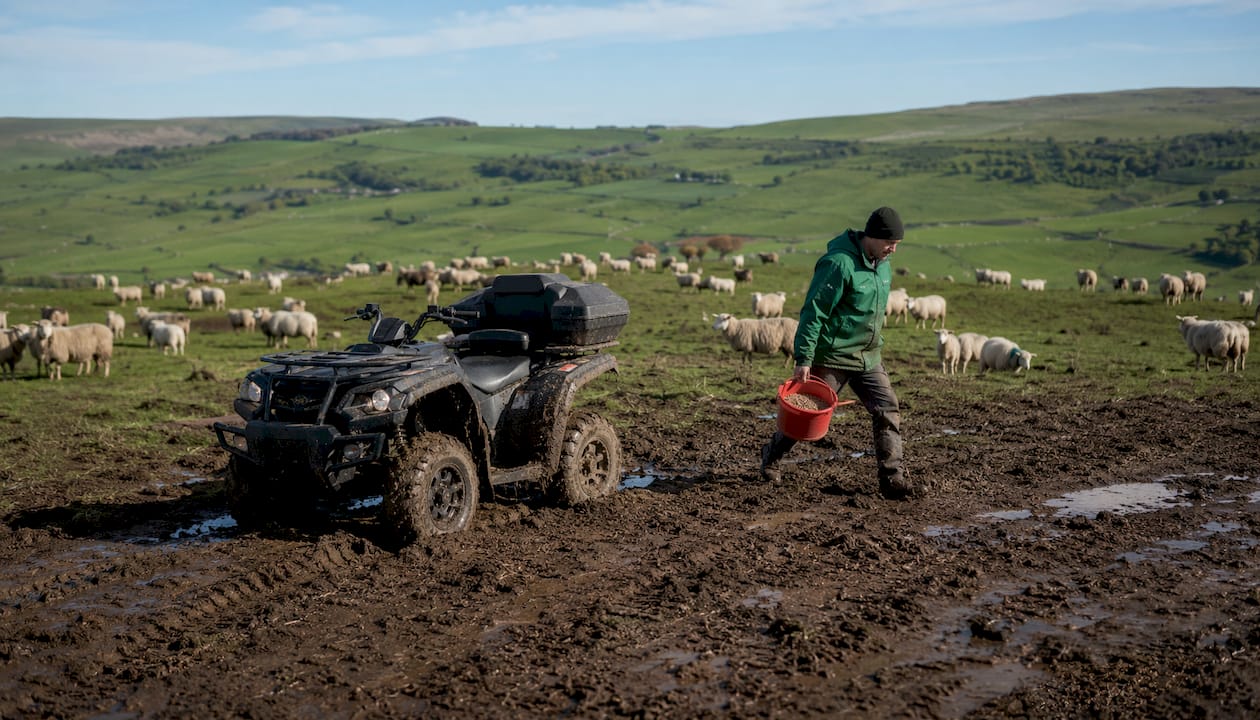
Agriculture is the most common deployment. Farmers use commercial ATVs for crop scouting, livestock monitoring, fence-line inspection, and hauling feed or equipment across fields. The ability to cover rough ground quickly while carrying a meaningful payload makes them far more practical than walking or using larger machinery for routine checks.
Industrial and construction sites rely on them for personnel transport, equipment inspection runs, and moving tools across large job sites. Municipal services, including parks departments and utility crews, use commercial ATVs for patrol routes, trail maintenance, and rapid-response tasks where a full vehicle would be impractical. Search-and-rescue teams in rugged terrain depend on them for the same reason: they go where larger vehicles cannot.
Additional professional applications include:
- Forestry and land management: trail clearing, timber surveys, and fire-line access
- Pipeline and utility corridor inspection: covering long linear routes efficiently
- Golf course and resort maintenance: turf-friendly transport with cargo capacity
- Emergency services: rapid deployment across off-road terrain during rescue operations
- Environmental monitoring: access to remote survey sites with equipment on board
The common thread across all these uses is workload intensity. A commercial ATV in agriculture or industry may run four to eight hours a day, five or six days a week. That duty cycle demands components built to last, not just to impress on a test ride.
Key technical specs that set commercial ATVs apart
The gap between a recreational quad and a true commercial unit shows up clearly in the spec sheet. Understanding these differences helps you evaluate any model with confidence.
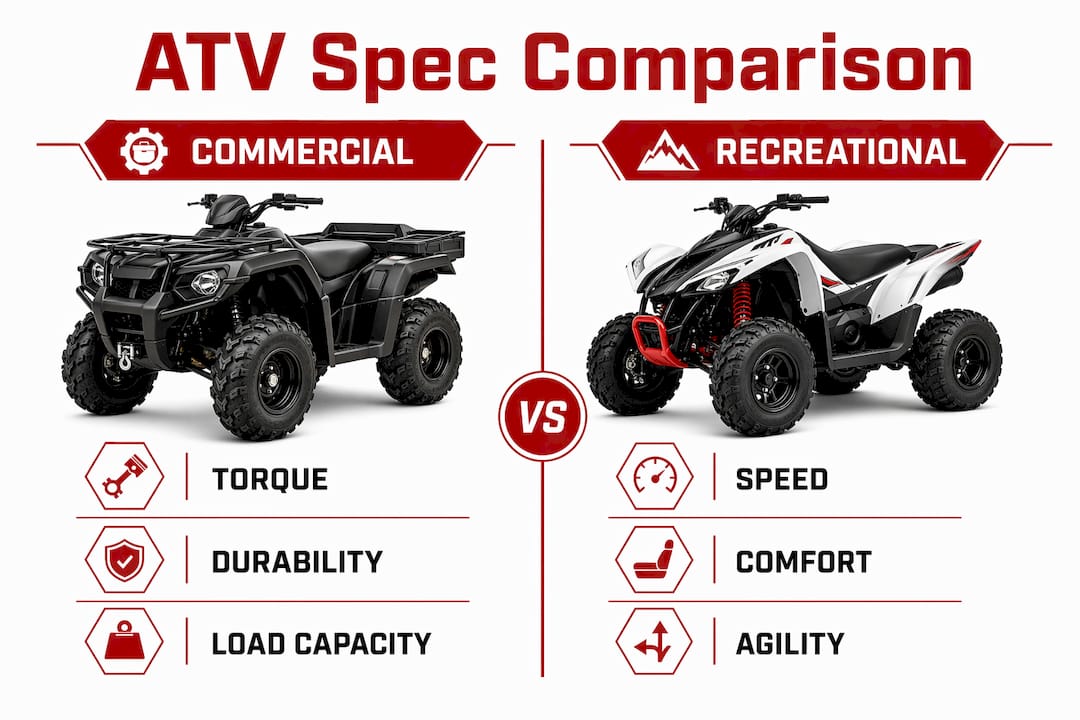
Engine and drivetrain. Work-sized commercial ATVs use engines ranging from 90cc to 700cc+, tuned for torque delivery at low speeds rather than peak horsepower at high RPM. Agricultural and industrial operations rarely need high speeds, focusing instead on stability and load capacity. A 4x4 drivetrain with a locking front differential is standard on purpose-built commercial models, providing the traction needed to haul loads across mud, gravel, and uneven ground.
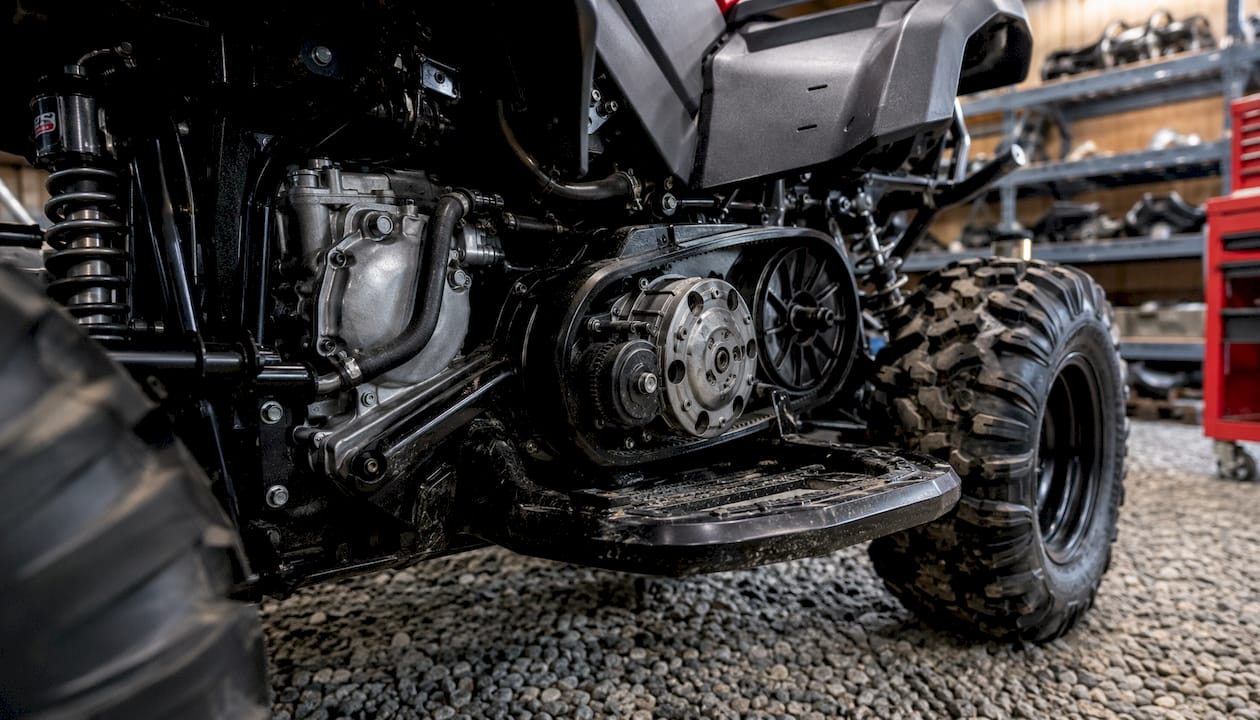
Transmission and braking. Automatic CVT transmissions dominate commercial applications because they simplify operation during repetitive work tasks. Engine braking on descent is a critical safety feature when carrying cargo on slopes, and commercial-tuned CVT belts are built for the thermal stress of continuous load cycles.
Suspension and chassis. Commercial suspensions are calibrated for stability and load capacity, not maximum travel for jumps. Chassis stiffness is prioritized to prevent flex under heavy cargo. Features like the utility-tuned suspension on the 2026 Can-Am Outlander PRO illustrate this philosophy: the geometry is set to keep the machine planted when the rack is loaded, not to absorb big hits at speed.
Protection and safety hardware. Heavy-duty front and rear bumpers, full skid plates, and 6-ply rating tires are standard on commercial builds. Adjustable speed governors allow fleet managers to cap maximum speed at 10–15 mph, reducing liability and supporting insurance compliance.
| Feature | Commercial grade ATV | Recreational ATV |
|---|---|---|
| Engine tuning | Low-end torque, load-optimized | Peak power, high-RPM performance |
| Drivetrain | 4x4 with locking differential | — |
| Suspension | Load-calibrated, stability-focused | High-travel, performance-focused |
| Tires | 6-ply rating, heavy-duty | Standard-ply, trail-oriented |
| Speed | Governed, typically under 15 mph | Ungoverned, up to 70+ mph |
| Chassis | Reinforced, high stiffness | Lighter, agility-focused |
| Maintenance interval | Extended, commercial-tuned components | Standard recreational schedule |
| Safety certification | ANSI/SVIA compliant, CPSC action plan | ANSI/SVIA compliant |
Pro Tip: When comparing models, ask the dealer specifically about CVT belt ratings and clutch service intervals. Commercial-tuned clutch systems can go significantly longer between service stops than standard recreational components, and that difference adds up fast in a working fleet.
How to choose the right commercial ATV for your professional needs
Matching a commercial ATV to a specific job starts with an honest assessment of what the machine will actually do every day. Buyers who focus only on engine size often end up with the wrong tool. The gear ratios and maintenance ease matter more than raw horsepower for hauling tasks at low speeds, and that principle should anchor every purchasing decision.
Start with your workload and terrain. A farm operation covering flat fields has different needs than a forestry crew working steep, rocky slopes. Identify your typical payload weight, the terrain type, and how many hours per day the machine will run. Those three factors determine the minimum drivetrain, suspension, and engine specifications you need.
Evaluate total cost of ownership, not just sticker price. Long-term value depends more on uptime and ease of maintenance than on the initial purchase price. A unit with accessible oil filters, grease points, and field-serviceable components will cost less to operate over three years than a cheaper model that requires dealer visits for routine service.
Check safety and compliance features. For fleet operations, adjustable speed governors are not optional. They reduce liability, support insurance compliance, and let you tailor the machine’s behavior to the skill level of each operator. Confirm that any model you consider carries current ANSI/SVIA certification and an active CPSC action plan.
Before you buy, work through this checklist:
- What is the maximum payload you will carry, and does the model’s rated capacity exceed it?
- Does the terrain require a locking front differential?
- What is the manufacturer’s recommended service interval for the CVT belt and clutch?
- Are skid plates, bumpers, and heavy-duty tires included, or are they costly add-ons?
- Does the model offer an adjustable speed governor for fleet or multi-operator use?
- What is the warranty coverage, and does it include commercial use?
- Are replacement parts and dealer service available within a reasonable distance of your operation?
You can also review a broader ATV buying checklist for additional factors worth considering before committing to a purchase.
Expert insights on getting the most from a commercial ATV
The most experienced commercial operators share a consistent perspective: the design shift from recreational to commercial is fundamental, not cosmetic. A purpose-built work ATV prioritizes chassis durability, low-end torque, and operator comfort for long shifts. That is a different machine from a sport quad with a cargo rack bolted on.
One of the most common purchasing mistakes is chasing horsepower. Power delivery tailored for hauling at low speeds outperforms raw engine output in nearly every commercial application. A 450cc unit with the right gear ratios and a locking differential will outwork a 700cc sport model on a farm or job site every time, because the torque curve is matched to the task.
Modular cargo solutions and field-serviceable parts are where fleet managers find the most operational leverage. Investing in modular cargo solutions and components that a mechanic can service on-site yields better uptime than choosing the cheapest unit available. Downtime on a working farm or construction site has a real cost that a lower sticker price rarely offsets.
Pro Tip: Schedule a full inspection of grease points, CVT belt condition, and tire pressure at the start of every season, not just when something feels wrong. Commercial ATVs running daily duty cycles accumulate wear faster than the calendar suggests.
Speed governors deserve more attention than they typically get in purchasing conversations. The ability to lock maximum speed at 10–15 mph for specific operators or site conditions reduces accident risk, supports insurance compliance, and gives fleet managers meaningful control over how their equipment is used. For operations with multiple riders of varying experience, that feature alone can justify the price difference between a base model and a commercial-spec unit.
For riders who are newer to the powersports world and want to understand how suspension choices affect performance across different terrain types, the role of suspension in ATVs is worth exploring before finalizing any commercial purchase.
Key Takeaways
A commercial grade ATV is defined by its load capacity, drivetrain configuration, and durability under sustained daily use, not by engine size alone.
| Point | Details |
|---|---|
| Legal definition matters | Federal law under 16 CFR § 1420.2 sets the baseline; commercial grade adds payload, drivetrain, and durability requirements beyond it. |
| Engine displacement range | Work-sized commercial ATVs use engines from 90cc to 700cc+, tuned for low-end torque rather than top speed. |
| Gear ratios over horsepower | Power delivery calibrated for hauling at low speeds outperforms raw engine output in agricultural and industrial applications. |
| Total cost of ownership | Long-term value depends more on uptime and ease of maintenance than on the initial purchase price. |
| Speed governors for fleets | Adjustable governors locking speed at 10–15 mph reduce liability, support compliance, and tailor operation to rider skill level. |