




TL;DR:
- Training wheels on minibikes provide stability and help beginners focus on throttle, brake, and steering controls. They do not develop true balance skills, so riders need to unlearn some habits later and transition to two-wheel riding. Proper selection and adjustment of training wheels enhance safety and promote gradual skill development.
Training wheels on minibikes do one thing above all else: they keep a beginner upright long enough to learn the controls. For young riders, especially children as young as three years old, that stability is the difference between a terrifying first session and a confident one. The role of training wheels on minibikes is not to teach balance. It is to remove the fear of falling so riders can focus on throttle, braking, and basic steering before tackling two-wheeled independence.
- Training wheels prevent tipping by widening the bike’s support base
- They let beginners practice throttle and brake control without fighting gravity at the same time
- They build confidence gradually, which is especially valuable for cautious or younger riders
- They act as a transitional aid, not a permanent solution
- They do not develop true balance skills, so riders will need to unlearn some habits later
How training wheels help beginner minibike riders develop control
Training wheels give new riders a gift: the freedom to make mistakes without crashing. When a child climbs onto a minibike for the first time, the mental load is enormous. Throttle response, hand position, braking, and steering all demand attention simultaneously. Training wheels remove the balance variable from that equation, letting the rider focus on throttle control and braking without the constant threat of tipping.
Parents benefit too. Watching your child wobble on a powered bike is nerve-wracking. Training wheels create a safer learning environment that lets you guide your young rider through the basics without hovering in a panic. That peace of mind matters, especially during those first few sessions when everything feels unpredictable.
The progression works best when training wheels are treated as a tool with a clear expiration date. Children as young as three can ride a 50cc minibike with training wheels safely, provided they are supervised and properly fitted to the bike. The key is matching the setup to the rider’s size, maturity, and readiness, not just their age.
What types of training wheels are available for minibikes?
Not all training wheels are built the same, and the type you choose affects both safety and skill development. Here is a breakdown of the main options:
| Type | Mounting Position | Best For | Key Advantage |
|---|---|---|---|
| Standard rear-axle wheels | Rear axle | Entry-level beginners | Simple installation, low cost |
| Adjustable rear-axle wheels | Rear axle | Progressive learners | Height can be raised as skills improve |
| Mid-mount adjustable wheels | Under footpegs, frame bracket | Confident beginners | Better center-of-gravity balance |
| Hard plastic wheels | Rear axle | Smooth surfaces only | Lightweight, affordable |
| Pneumatic (air-filled) wheels | Mid-mount or rear axle | Off-road and uneven terrain | Shock absorption, better traction |
The mounting position makes a real difference. Mid-mount training wheels attach directly under the footpegs using a dedicated frame bracket. That position offers superior center-of-gravity balance compared to rear-axle mounted stabilizers, and it reduces the “tipping leverage” effect that standard rear-axle wheels can create on uneven ground.
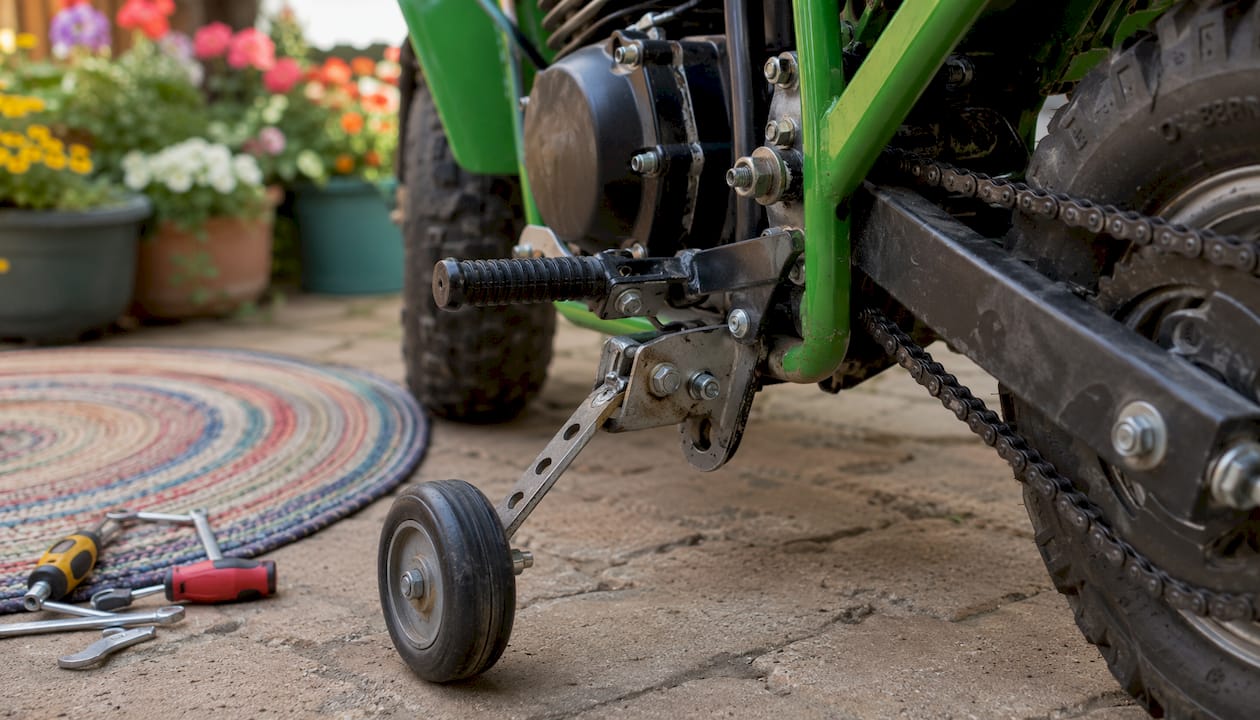
Wheel material matters on rough terrain. Hard plastic wheels work fine on flat driveways, but pneumatic wheels with air-filled tires absorb terrain impact and provide better cornering. For any rider heading onto grass, gravel, or dirt, pneumatic wheels are the smarter choice.
Compatibility is worth checking before you buy. Most universal systems fit the majority of 50cc entry-level minibikes, including popular models across major brands, but always verify fitment for your specific bike before purchasing.
Benefits and limitations of training wheels on minibikes
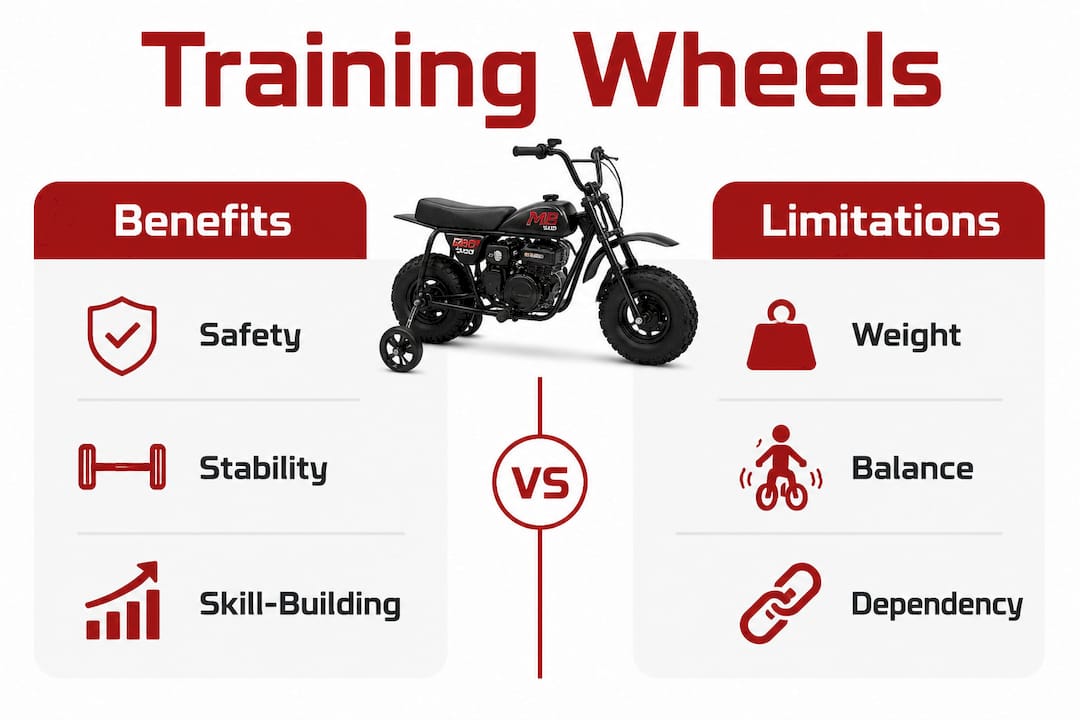
Training wheels deliver real advantages for beginners, but they also carry genuine drawbacks that every parent should understand before committing to them long-term.
Benefits:
- Immediate stability reduces falls during the earliest learning phase
- Riders can practice throttle and brake inputs without fear of tipping
- Cautious or anxious children gain confidence at their own pace
- Parents can supervise more calmly in a controlled environment
- Height-adjustable models allow gradual reduction of support over time
Limitations:
- Training wheels delay balance development by preventing the natural side-to-side motion that balance requires
- Riders learn to steer differently on training wheels, often turning handlebars incorrectly, a habit that must be unlearned later
- The transition to two-wheel riding can feel abrupt and frustrating after extended training wheel use
- Training wheels weigh approximately 1–2 kg, which can reduce a young child’s enjoyment and agility on the bike
- Over-reliance creates a false sense of security that slows long-term progress
The weight issue is underappreciated. A kilogram or two feels minor to an adult, but on a small minibike ridden by a young child, that added mass changes how the bike handles and can sap the fun out of riding. Keep that in mind when deciding how long to keep training wheels on.
Safety considerations every parent needs to know
Training wheels are one layer of protection, not a complete safety system. Minibike safety depends on a full set of practices, including speed limiters, kill switches, chain guards, and routine maintenance, working together. Treating training wheels as the whole solution is where accidents happen.
- Always fit your rider with a helmet, gloves, boots, goggles, and protective clothing before every session
- Never allow unsupervised riding, regardless of how comfortable your child seems on the bike
- Check that training wheels are properly installed and torqued before each ride
- Inspect brakes, tires, and the kill switch regularly as part of your routine minibike maintenance
- Avoid rough terrain, steep hills, public roads, and congested areas when training wheels are mounted
- Keep speeds appropriate to the rider’s skill level; do not exceed 10 mph during early training sessions
Pro Tip: Adjust training wheels so they sit approximately 1 cm above the ground rather than flat against it. This forces the rider to use some balance while still providing a safety catch if they lean too far, which accelerates skill development without sacrificing protection.
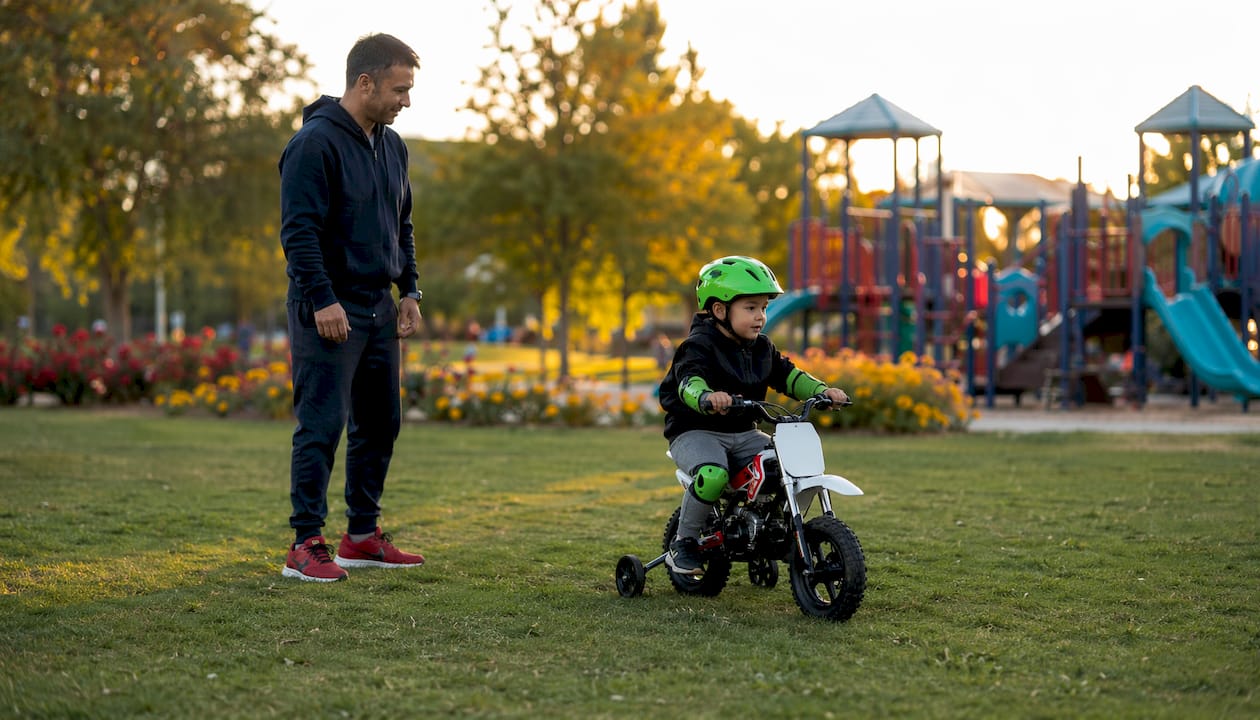
Close supervision is not optional. Young riders need real-time feedback on speed, posture, and control, and an adult nearby can intervene before a near-miss becomes an injury. Check out the cycling safety guide for families for additional age-appropriate protocols that translate well to minibike training.
How to choose and install training wheels for your minibike
Choosing the right training wheels starts with an honest assessment of your rider, not just the bike.
Choosing the right set:
- Match wheel type to terrain: pneumatic for off-road, hard plastic for smooth pavement
- Choose adjustable models if your rider is progressing quickly; fixed models suit very young beginners who need maximum stability
- Verify compatibility with your specific minibike model before purchasing
- Consider mid-mount systems for better stability on 50cc bikes used off-road
- Factor in the rider’s weight and height to confirm the system’s load rating is appropriate
Installation steps:
- Read the manufacturer’s installation instructions completely before starting.
- Position the mounting bracket at the correct frame location, typically under the footpegs for mid-mount systems or at the rear axle for standard models.
- Torque all bolts to the manufacturer’s specified settings; loose hardware is a common cause of training wheel failure.
- Set the initial wheel height so both training wheels contact the ground lightly, providing full stability for a first-time rider.
- Test the setup by gently rocking the bike side to side before the rider mounts.
- After the first few sessions, raise the wheels incrementally, about 1 cm at a time, as the rider’s confidence grows.
- Confirm that the training wheels do not interfere with braking or steering before every ride.
Training wheels adjusted too low prevent the bike from leaning at all, which blocks proper braking and delays balance development. Getting the height right from the start is as important as the installation itself.
What research and experts say about training wheels on minibikes
The research picture is nuanced. Training wheels genuinely help beginners develop throttle and steering skills, but they do not teach balance, and over-reliance on them requires unlearning incorrect steering habits later. That trade-off is worth understanding before you commit to a long training wheel phase.
Experts increasingly recommend a hybrid approach: start with a balance bike to build coordination and balance naturally, then introduce a motorized minibike with training wheels to layer in throttle and brake control. This sequence gives young riders the best of both methods. Balance comes first, then power. The beginner guide to mini bikes from Gokartsusa walks through this progression in practical detail.
Beyond training wheels, a complete safety system matters. Kill switches, chain guards, speed limiters, and proper gear all contribute to rider protection in ways that training wheels alone cannot cover. Think of training wheels as one member of your pit crew, not the whole team.
Key Takeaways
Training wheels on minibikes build throttle and steering confidence in beginners, but balance must be developed separately for riders to transition successfully to two-wheel riding.
| Point | Details |
|---|---|
| Core function | Training wheels prevent tipping so beginners can focus on throttle and brake control. |
| Weight impact | Training wheels add some extra weight, which can affect the handling and enjoyment of the bike for young riders. |
| Height adjustment | Setting wheels about 1 cm above ground forces partial balance use while retaining safety. |
| Balance limitation | Training wheels delay balance development and can create steering habits that must be unlearned. |
| Hybrid approach | Starting with a balance bike before a motorized minibike produces faster, more complete skill development. |
Ready to ride? Find the right minibike at Gokartsusa
When your young rider is ready to graduate from the driveway to real adventure, Gokartsusa has the bikes built for that moment. The Gas Powered Mini Bike, 3.5hp 4-Stroke is a strong starting point for riders ages 12 and up, with reliable automatic transmission and safety features designed for beginners. For families looking to grow into the sport together, browse the full lineup at Gokartsusa and find the model that matches your rider’s stage, size, and sense of adventure. We are your pit crew from the very first ride.