




TL;DR:
- Engine displacement measures the total volume swept by pistons during one cycle and indicates an engine’s potential power and torque. It is calculated using bore, stroke, and cylinder count, affecting performance, fuel consumption, and engine personality. Displacement alone does not determine performance, as factors like airflow and forced induction also significantly influence output.
Engine displacement is defined as the total volume swept by all pistons inside an engine during one complete cycle, excluding the combustion chamber. Measured in liters, cubic centimeters (cc), or cubic inches (ci), this single number tells you how much air and fuel an engine can process per cycle. That capacity sets the foundation for power output, torque delivery, and fuel consumption. Whether you’re comparing a 49cc mini bike engine or a 5.0L V8, understanding what is engine displacement gives you the clearest window into what an engine can actually do.
What is engine displacement and how is it calculated?

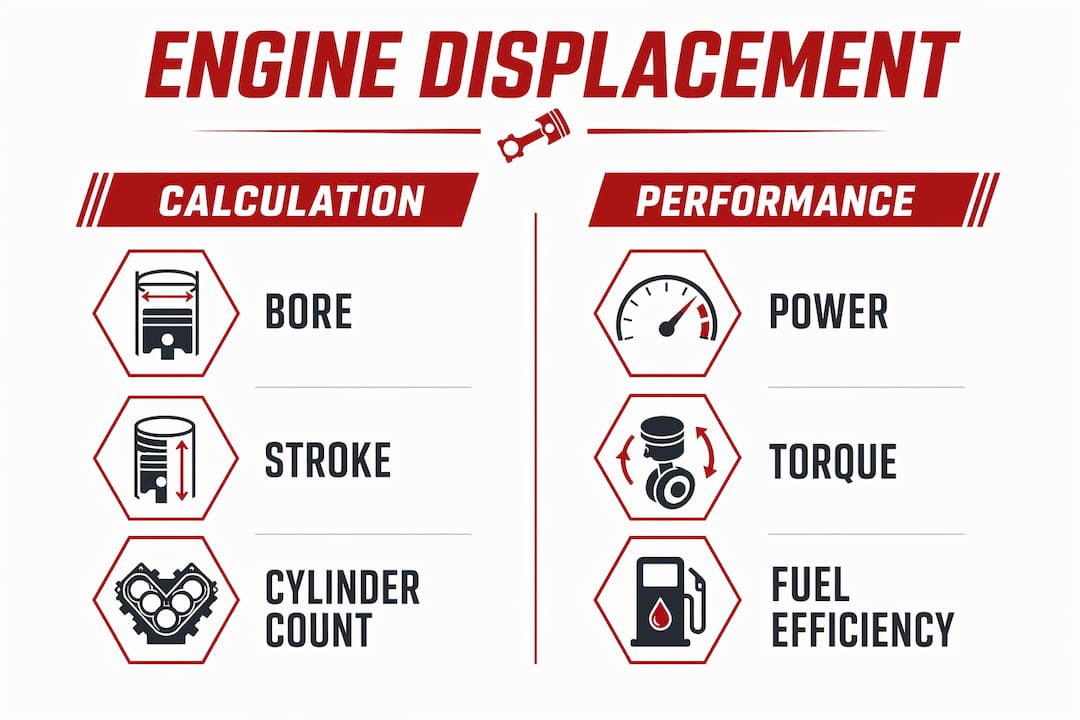
Engine displacement is calculated using three physical measurements: bore, stroke, and cylinder count. Bore is the diameter of each cylinder. Stroke is the distance the piston travels from its lowest point to its highest point inside that cylinder. Multiply those together with the number of cylinders, and you get the total swept volume.
The standard formula is:
Displacement = (π/4) × Bore² × Stroke × Number of Cylinders
Here is how that plays out in practice:
- Measure the bore in millimeters or inches for a single cylinder.
- Measure the stroke in the same unit.
- Square the bore, multiply by π/4 (approximately 0.7854), then multiply by the stroke.
- Multiply by the total number of cylinders to get the full engine displacement.
- Convert units as needed: 1,000 cc equals 1.0 liter; 1 cubic inch equals 16.387 cc.
A practical example: a four-cylinder engine with an 86mm bore and 86mm stroke produces roughly 1,999 cc, which rounds to a 2.0L engine. A classic American V8 with a 4.00-inch bore and 3.48-inch stroke across eight cylinders produces approximately 350 cubic inches, or about 5.7 liters. Common US engines use cubic inches, while metric engines use liters or cc depending on the manufacturer and region.
Pro Tip: When comparing small engine specs on go-karts or mini bikes, always check whether the displacement is listed in cc. A 110cc engine and a 125cc engine may look similar on paper, but that 15cc difference in swept volume translates directly to a noticeable difference in torque at low speeds.
How does displacement affect power, torque, and fuel efficiency?
Displacement sets the potential power ceiling by determining how much air and fuel mixture the engine processes per cycle. Think of the engine as an air pump: the volume it moves per cycle links directly to how much energy it can release. A larger displacement engine pulls in more mixture, burns more fuel, and releases more energy per cycle.
The relationship between displacement and performance breaks down into three clear areas:
- Torque output: Larger displacement engines generate more torque at lower RPMs. A 6.2L V8 truck engine produces peak torque well below 3,000 RPM, making it ideal for towing and hauling.
- Horsepower potential: More displacement means more room for combustion energy. Naturally aspirated engines with higher displacement tend to produce more peak horsepower, all else being equal.
- Fuel consumption: Larger engines generally consume more fuel, though modern engineering is narrowing this gap significantly.
The trade-off is real. A 1.0L three-cylinder engine in a compact car sips fuel efficiently but cannot match the pulling power of a 3.5L V6. The 3.5L processes more air and fuel per cycle, which means more combustion energy and more work done per revolution.
“Displacement is just one factor in engine performance. Air-fuel management and forced induction significantly influence real output.” — Auto Training Centre
Modern technology is reshaping this trade-off. Turbocharging and direct fuel injection allow engineers to extract more power from smaller displacement engines without the fuel penalty of going bigger. Ford’s 2.3L EcoBoost four-cylinder, for example, produces power figures that once required a 3.5L or larger naturally aspirated engine. The displacement number alone no longer tells the whole story.
Bore-to-stroke ratios: how engine proportions shape performance
The ratio between bore and stroke defines an engine’s personality as much as its total displacement does. Bore-to-stroke ratios heavily influence engine behavior and the type of work an engine does best.
| Engine Type | Bore vs. Stroke | RPM Range | Best Application |
|---|---|---|---|
| Oversquare | Bore > Stroke | High RPM | Sports cars, racing engines |
| Square | Bore = Stroke | Balanced | General purpose, passenger cars |
| Undersquare | Stroke > Bore | Low RPM | Trucks, diesel engines, torque loads |
An oversquare engine has a wider bore than its stroke length. The short stroke means the piston travels less distance per revolution, which reduces friction and allows the engine to spin faster. Ferrari’s naturally aspirated V12 engines are a classic example. They rev past 8,000 RPM precisely because the short stroke keeps mechanical stress low at high speeds.
An undersquare engine has a longer stroke than its bore width. The piston travels farther per revolution, which generates more torque at low RPM. Diesel truck engines follow this design. A Cummins 6.7L diesel uses a long stroke to build the torque needed to move heavy loads without needing high RPM.
A square engine, where bore equals stroke, balances both characteristics. Many everyday passenger car engines fall into this category. They offer enough torque for normal driving and enough RPM range for highway cruising.
Pro Tip: When reading go-kart or ATV specs, check both the bore and stroke measurements alongside the total cc figure. Two 110cc engines can have very different power delivery styles depending on whether one is oversquare or undersquare.
Rotary engines, forced induction, and what modern trends mean for enthusiasts
Not every engine follows the piston formula. Wankel rotary engines use specific multipliers in displacement calculations, such as a 1.5x factor, to equate their swept volume to piston engine equivalents for regulation and comparison. The Mazda RX-7’s 1.3L rotary engine produced power figures that rivaled much larger piston engines, which is why regulators developed special classification rules for it.
Forced induction changes the displacement conversation entirely. Turbocharging allows smaller displacement engines to produce power comparable to larger naturally aspirated counterparts by forcing more air into the cylinders than atmospheric pressure alone would allow. More air means more fuel can be burned, which means more power from the same swept volume.
Here is what enthusiasts need to keep in mind when comparing engine specs:
- Displacement is a starting point, not a verdict. Two engines with the same displacement can have very different power outputs depending on compression ratio, cam timing, airflow, and fuel delivery.
- Turbocharged small engines trade low-end grunt for efficiency. A 1.5L turbocharged engine may match a 2.5L naturally aspirated engine at highway speeds but feel softer at very low RPM.
- Small displacement engines in recreational vehicles are tuned for reliability. A 40cc or 49cc engine in a go-kart or mini bike is built for consistent, manageable power rather than peak output.
- cc ratings matter most in the small engine world. For go-karts, ATVs, and mini bikes, the cc figure is the most direct indicator of performance tier and intended rider age or weight class.
Understanding go-kart horsepower alongside displacement gives you the full picture of what a recreational engine can deliver. Displacement tells you the engine’s potential. Horsepower tells you how much of that potential the design actually uses.
Key Takeaways
Engine displacement is the total swept volume of all pistons in one cycle, and it sets the foundation for every performance and efficiency decision an engine designer makes.
| Point | Details |
|---|---|
| Core definition | Displacement equals bore, stroke, and cylinder count combined into one swept volume figure. |
| Formula to know | Use (π/4) × Bore² × Stroke × Cylinders to calculate displacement in cc or cubic inches. |
| Power relationship | Larger displacement raises the power ceiling, but forced induction can close the gap significantly. |
| Bore-to-stroke ratio | Oversquare engines favor high RPM; undersquare engines favor low-RPM torque and load work. |
| Displacement limits | Same displacement can produce very different power outputs depending on airflow and fuel delivery. |
Why displacement is just the beginning, not the whole answer
I have spent years around powersports vehicles, and the single biggest mistake I see enthusiasts make is treating displacement as the final word on engine performance. It is not. Displacement is the starting point. What an engineer does with that volume is where the real story begins.
A 49cc two-stroke engine in a lightweight mini bike can feel shockingly quick because the power-to-weight ratio is favorable. Meanwhile, a 110cc four-stroke in a heavier ATV may feel slower despite the larger displacement. The engine is not working in isolation. Frame weight, gearing, and power delivery style all shape the experience.
The shift toward forced induction in full-size vehicles reinforces this point. Automakers like Ford, BMW, and Volkswagen have spent the last decade shrinking displacement while adding turbos, and the results speak for themselves. A 2.0L turbocharged engine in a performance sedan now competes with the 3.0L naturally aspirated engines of a decade ago.
For recreational vehicle enthusiasts, the practical lesson is this: read the full spec sheet. Check displacement, yes. But also check the engine type (two-stroke vs. four-stroke), the power output, and the intended use case. A four-stroke engine in a kids’ go-kart is tuned for smooth, predictable power. That tuning matters as much as the cc number on the label.
Displacement knowledge is real power. Use it as a lens, not a verdict.
— Mario
Gokartsusa puts engine displacement to work in the real world
At Gokartsusa, we believe understanding your engine specs makes every ride more rewarding. Our gas-powered lineup puts displacement knowledge into action, from entry-level karts to trail-ready mini bikes built for real adventure.

The Sport Kart Kids Gas Go Kart features a 2.5hp 4-stroke engine sized perfectly for riders ages 8 and up, delivering smooth, manageable power that matches the displacement to the rider’s needs. For teen riders ready for more, the Gas Powered Mini Bike packs a 3.5hp 4-stroke engine into a lightweight frame that makes every cc count. Both machines show exactly how displacement figures translate into real-world performance you can feel on the trail. Browse the full Gokartsusa gas-powered lineup and read the specs with confidence.
FAQ
What is engine displacement in simple terms?
Engine displacement is the total volume swept by all pistons in an engine during one complete cycle, measured in liters, cc, or cubic inches. It tells you how much air and fuel the engine can process per cycle.
Does more displacement always mean more power?
Not always. Displacement sets the power ceiling, but compression ratio, airflow, cam timing, and forced induction all determine actual output. Two engines with identical displacement can produce very different horsepower figures.
What does cc mean in small engine specs?
CC stands for cubic centimeters, the standard unit for measuring displacement in small engines. A 110cc engine displaces 110 cubic centimeters of volume per cycle, which directly relates to its torque and power output.
How does turbocharging affect engine displacement?
Turbocharging forces more air into the cylinders than atmospheric pressure allows, effectively letting a smaller displacement engine produce power comparable to a larger naturally aspirated engine. Modern vehicles increasingly use this approach to balance power and fuel efficiency.
What is the difference between oversquare and undersquare engines?
An oversquare engine has a bore wider than its stroke, favoring high-RPM horsepower. An undersquare engine has a longer stroke than bore, favoring low-RPM torque and durability, which is why diesel truck engines follow this design.