




TL;DR:
- Horsepower in go-karts varies widely, with 5-20 HP suitable for family and recreational models.
- Increasing horsepower beyond 20 HP can cause safety issues like wheelspin and loss of control.
- Choosing the right go-kart depends on rider age, skill, terrain, and power-to-weight ratio.
Picking the right go-kart feels exciting until you start reading spec sheets. Suddenly you’re staring at engine displacement numbers, torque ratings, and horsepower figures that don’t mean much without context. Here’s the thing: a single horsepower difference can push a kart from a comfortable family cruiser into something that spins its tires and scares a ten-year-old. Horsepower in go-karts measures the engine’s power output, or the rate at which the engine performs work to move that lightweight frame forward. Understanding what these numbers actually mean gives you the confidence to choose a kart that delivers real thrills without sacrificing safety or control.
Table of Contents
- Understanding horsepower: What it means for go-karts
- Horsepower ranges for recreational vs. racing go-karts
- Why more horsepower isn’t always better: Safety and drivability
- How to choose the right horsepower for your family’s go-kart
- The overlooked truth: Why power-to-weight beats raw horsepower
- Explore go-kart options: Find the best fit for your family
- Frequently asked questions
Key Takeaways
| Point | Details |
|---|---|
| Horsepower basics | Horsepower measures engine power and affects speed, acceleration, and control in go-karts. |
| Ideal HP ranges | Family go-karts should have 5-10 HP for safe, fun recreation; higher HP is best reserved for experienced drivers or racing. |
| Safety first | Too much horsepower can lead to unsafe driving conditions, especially for kids and lightweight karts. |
| Consider all factors | Performance depends on weight, terrain, torque, and chassis—not just HP. |
| Smart buying decisions | Match horsepower to skill level and use case for enjoyable and safe go-karting. |
Understanding horsepower: What it means for go-karts
Horsepower (HP) is the most talked-about spec in any go-kart conversation, but it’s also the most misunderstood. At its core, HP tells you how quickly the engine can perform work. A higher number means the engine can move the kart faster or accelerate more aggressively. Simple enough, right? The challenge is that raw HP interacts with a whole system of variables before it ever translates into real-world speed or fun.
For recreational family karts, engine power output typically falls between 5 and 20 HP. High-end competitive racing machines can push past 90 HP, but those are purpose-built for tracks with skilled adult drivers who train regularly. As a parent or outdoor enthusiast shopping for weekend fun, you’ll almost never need to venture anywhere near those extremes.
Here’s what the typical HP spectrum looks like for consumer go-karts:
- 5-8 HP: Entry-level kids’ karts and beginner family models
- 8-12 HP: Mid-range recreational karts for teens and adults
- 12-20 HP: Performance recreational and light competitive karts
- 20+ HP: Serious racing applications only
“The engine’s power output is just the starting point. Gearing, chassis weight, tire grip, and track surface all shape how that power actually feels from the driver’s seat.”
What most buyers miss is that performance in go-karts depends on the whole package, not just one number. A 10 HP kart with poor gearing will feel sluggish next to a well-tuned 7 HP machine. That’s why understanding performance features for families goes far beyond glancing at a single spec.
| Go-kart type | Typical HP range | Top speed estimate |
|---|---|---|
| Kids’ beginner kart | 5-8 HP | 25-40 mph |
| Family recreational | 8-12 HP | 35-50 mph |
| Adult performance | 12-20 HP | 50-65 mph |
| Competitive racing | 20-90 HP | 65+ mph |
Now that you know why horsepower matters, let’s dig deeper into the real-world numbers and what they mean for your family go-kart.
Horsepower ranges for recreational vs. racing go-karts
Numbers on a spec sheet only tell half the story. Context tells the rest. When you’re shopping for a go-kart your kids will actually use safely, knowing the established HP benchmarks for each use case is genuinely valuable.
Recreational go-karts for family use typically feature 5-10 HP engines from air-cooled 4-stroke models like 163cc to 212cc designs. The Honda GX200 delivers 6.5 HP and the Predator 212cc matches it, both providing top speeds of 25-50 mph with the kind of predictable, manageable control that keeps beginners and kids safe. These engines are quieter, more fuel-efficient, and far easier to maintain than racing alternatives.

Racing go-karts run significantly higher HP: 12-20+ HP for 4-stroke competitive models, and 20-50+ HP for 2-stroke race machines like the 125cc TaG class (28-34 HP) or shifter karts (36-50 HP). Those 2-stroke engines are aggressive by nature. They’re louder, less fuel-efficient, and demand experienced handling. Putting a beginner in a 2-stroke racing kart is like handing a new driver the keys to a track-spec sports car.
Here’s a side-by-side breakdown:
| Engine type | HP range | Best for | Top speed |
|---|---|---|---|
| 4-stroke 163-212cc | 5-7 HP | Kids and beginners | 25-45 mph |
| 4-stroke 270-390cc | 8-13 HP | Teens and families | 40-55 mph |
| 2-stroke 125cc TaG | 28-34 HP | Competitive adult racing | 70-80 mph |
| Shifter kart | 36-50 HP | Advanced racing only | 80+ mph |
A few key things to keep in mind when comparing recreational and racing specs:
- 4-stroke engines offer smoother power delivery and easier maintenance for families
- 2-stroke engines deliver sharper, more aggressive power that demands skill
- Safe buying decisions for go-karts should always factor in the rider’s experience level, not just age
- Our beginner’s guide to go-karting walks you through how to match your family’s skill level to the right model
Stat worth knowing: A family recreational kart with a 212cc 4-stroke engine typically delivers 6-7 HP and reaches a controlled 35-45 mph. That’s genuinely exciting without being reckless.
With these HP ranges in mind, it’s important to know how other factors influence performance and why horsepower isn’t the only number to focus on.
Why more horsepower isn’t always better: Safety and drivability
More power sounds better on paper. In practice, it can create serious problems for family karts and young drivers. When HP climbs past 20 on a lightweight go-kart frame, you get tire spin, drivetrain stress, and a dramatic loss of control that even experienced adult drivers find challenging to manage. Kids don’t stand a chance.
The problem isn’t just speed. It’s the character of excess power. A kart that overwhelms its tires breaks loose unpredictably, especially in corners or on gravel surfaces. That kind of sudden oversteer isn’t a learning moment for a child. It’s a safety hazard.
Here’s a practical look at the real risks of mismatched horsepower:
- Wheelspin and instability: Too much HP on a light frame spins the rear tires before the kart builds speed, causing skids and spin-outs.
- Drivetrain wear: Excess power strains chains, sprockets, and axles faster than they’re rated for, leading to costly repairs.
- Driver fatigue: High-HP karts require constant physical input to stay in control, which exhausts young or novice drivers quickly.
- Reduced enjoyment: Counterintuitively, too much power makes karts less fun for beginners because they spend more energy managing the machine than actually driving it.
“Off-road use actually prioritizes torque in the 6-12 HP range over peak horsepower. Instant pulling power through mud or grass matters far more than top-end speed.”
For off-road situations, torque over peak HP is the smarter priority. Torque is the rotational force that gets a kart moving from a stop and pulls it through rough terrain. A lower-HP engine with strong low-end torque will outperform a high-HP engine with a narrow power band on a dirt trail every single time.
You can also use a go-kart performance calculator to model realistic speed and power estimates before you buy. Plug in the kart’s weight, engine HP, and gearing ratios to see what top speed and acceleration you can actually expect. It removes the guesswork. Keeping kids safe and having fun is always the first priority, and understanding the difference between adult and kids go-karts in terms of HP and frame specs makes that easier.
Pro Tip: Before upgrading HP, upgrade your understanding of power-to-weight ratio. A lighter kart with modest power often outperforms a heavier kart with more HP in terms of acceleration and handling feel.
Understanding the risks of excessive horsepower leads us to practical strategies for matching specs to your needs.
How to choose the right horsepower for your family’s go-kart
Choosing the right HP isn’t guesswork when you approach it with a clear framework. Start by thinking about who will be driving, where they’ll be driving, and what kind of experience you’re after. Those three answers will narrow your options fast.
Here’s a checklist to work through before you buy:
- Driver age and size: Younger, lighter kids need less HP for safe speed and control
- Skill level: Beginners need predictable, forgiving power delivery more than raw speed
- Terrain type: Flat pavement allows higher HP; dirt, grass, or hills call for more torque and conservative HP
- Intended use: Weekend family fun differs from competitive track days
- Frame weight: Always consider the kart’s total weight, not just the engine rating
Here are the recommended HP ranges broken down by rider profile:
- Young kids (ages 5-10): 5-8 HP, 163-196cc 4-stroke engines. Safe speeds, manageable power, confidence-building fun.
- Preteens and teens (ages 11-15): 8-12 HP, 212-270cc engines. More speed and excitement without overwhelming control demands.
- Adults and experienced riders: 12+ HP with appropriate chassis and safety gear.
A 10 HP kart typically delivers 35-50 mph and 9-11 ft-lbs of torque. That’s a genuinely solid performer for a teen or adult but it’s too much for a young child who needs time to build confidence and skill. Explore the full range of go-kart types and learn what defines a youth go-kart to better understand age-appropriate specs. Detailed beginner go-kart features guides walk you through exactly what to look for in a first kart beyond just HP.
Pro Tip: Never ignore torque when comparing engines. A 4-stroke with strong low-end torque will deliver a smoother, more enjoyable ride for a child than a high-strung 2-stroke with a higher peak HP number.
Once you’ve matched the specs to your needs, you’re ready to make a confident purchase or upgrade.
The overlooked truth: Why power-to-weight beats raw horsepower
We’ve spent years helping families find the right karts, and if there’s one pattern we keep seeing, it’s this: parents fixate on HP because it’s the easiest number to compare. But raw horsepower without context is almost meaningless for family riding decisions.
The number that actually matters is power-to-weight ratio. A 200-pound kart with 7 HP and a 100-pound kart with 7 HP feel completely different to drive. The lighter machine accelerates harder, corners more responsively, and demands more skill to keep in check. Actual performance depends on gearing, weight, tires, and track conditions, not just HP alone.
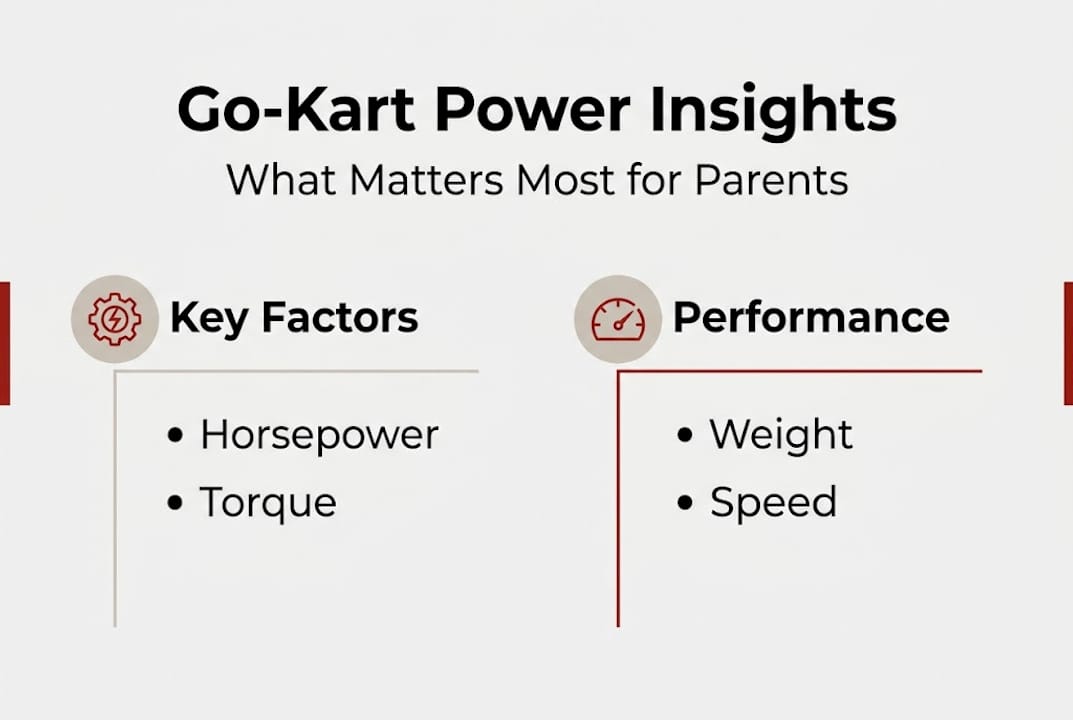
We’ve seen families purchase 15+ HP karts for ten-year-olds because the number sounded impressive. Those karts sat unused because the kids couldn’t safely manage them. That’s not adventure. That’s a wasted investment and a missed opportunity for real family fun.
Before chasing higher horsepower, invest in the right chassis, quality tires, and skill-appropriate training. Read our guide on go-kart upgrade tips to understand how smart setup choices outperform raw engine swaps almost every time. Start right, and the riding experience will reward you and your family for years.
Explore go-kart options: Find the best fit for your family
Now that you understand how horsepower works in real-world go-karting, the next step is finding a model that matches your family’s needs, budget, and adventure level. We’ve curated options across the full spectrum, from gentle youth karts to exciting family performers.

For younger riders just discovering the thrill of the track, browse our kids ATV options designed with safety and confidence-building in mind. Families looking for a more relaxed outdoor experience will love the comfort and versatility of our family golf cart options. Ready to find your perfect match? Shop go-karts and filter by age, HP range, and intended use to land on exactly the right ride for your crew.
Frequently asked questions
What horsepower is safe for kids in go-karts?
For kids, 5-8 HP is ideal, delivering controlled speeds up to 35-45 mph with manageable power that builds confidence without creating dangerous situations.
Is higher horsepower always better in go-karts?
No. Over 20 HP risks wheelspin and loss of control on lightweight frames, making excessive horsepower a genuine safety concern for kids and beginners.
What factors besides horsepower should I consider?
Gearing, weight, tires, and track all shape real-world performance, so always evaluate power-to-weight ratio, torque, terrain, and the rider’s skill level alongside HP.
How fast can a go-kart with 10 HP go?
A 10 HP kart typically reaches 35-50 mph with 9-11 ft-lbs of torque, making it a solid choice for teens and adults but not ideal for young children.