




TL;DR:
- Safety features like roll cages, seat belts, and parental kill switches are essential for beginner go-karts.
- Electric go-karts are safer and easier for first-time drivers due to quiet operation and low maintenance.
- Proper fit, adjustable seats, and brake responsiveness are critical for safety and enjoyment.
Not every go-kart on the market is built with a first-time driver in mind. Parents often assume that picking the smallest or cheapest model is enough, but the reality is that beginner go-karts vary widely in safety design, ergonomics, and ease of control. Choosing the wrong one can turn an exciting outdoor adventure into a frustrating or even dangerous experience. The good news is that once you know which features actually matter, the decision becomes much clearer. This guide walks you through everything from essential safety hardware to engine type, fit, and how top models compare side by side, so you can shop with real confidence.
Table of Contents
- Safety features every beginner go-kart must have
- Electric vs. gas: Which engine type fits first-timers?
- Ergonomics and comfort: Why fit is critical
- Comparing top beginner go-kart features
- Our expert perspective: What most buyers underestimate in beginner go-karts
- Find the perfect beginner go-kart with GoKarts USA®
- Frequently asked questions
Key Takeaways
| Point | Details |
|---|---|
| Safety first | Choose go-karts with rollbars, seat belts, and reliable brakes for maximum beginner safety. |
| Electric advantages | Electric go-karts are quieter and easier for kids, making them great for families starting out. |
| Fit and comfort | Adjustable seats and pedals significantly reduce accident risk and improve driving experience. |
| Supervision matters | Adult supervision and parental remote shutoff features are key for safe fun at home. |
| Compare before buying | Use feature comparison tables to pick the beginner go-kart that fits your child’s age and needs. |
Safety features every beginner go-kart must have
After understanding why feature selection matters, what truly makes a go-kart safe for beginners? The answer starts with the physical structure of the kart itself. A sturdy steel chassis and a roll cage or roll bar are non-negotiable. These components absorb impact and protect a young driver if the kart tips or collides with an obstacle. Think of them as the foundation of the entire safety system. Without them, no amount of supervision fully compensates.
Beyond the frame, seat belts are equally critical. Many entry-level karts skip this feature to cut costs, which is a mistake we strongly advise against. A properly fitted seat belt keeps a child securely in the seat during sharp turns or sudden stops. Pair that with the must-have safety features that experienced riders know well, and you have a much safer starting point.
Parental remote kill switches and remote start controls are among the most underrated features in beginner karts. These allow a parent to cut the engine instantly from a distance if the child loses control or enters an unsafe area. Visibility aids like tall safety flags and bright colors also help parents track the kart’s location, especially in open yards or parks.
Brakes deserve special attention. Effective, responsive brakes are often overlooked in favor of flashier specs like top speed or engine size. But for a beginner, stopping power is everything. Poor braking is one of the leading causes of home go-kart incidents. Always test brake responsiveness before your child’s first ride.
Here are the core safety features to check before buying:
- Roll cage or roll bar
- Full seat belt system
- Parental remote kill switch
- Responsive disc or drum brakes
- Adjustable seat and pedal reach
- Tall safety flag for visibility
- DOT-approved helmet compatibility
“KART safety rules emphasize helmets, supervision, and basic chassis and rollbar requirements even for young drivers.”
For a broader look at entry-level safety guidance and why go-kart safety matters for new riders, those resources are worth reviewing before you finalize any purchase.
Pro Tip: Test the brake responsiveness and seat adjustment at home before the first real ride. Have your child sit in the kart and reach the pedals fully before the engine ever starts.
Electric vs. gas: Which engine type fits first-timers?
With safety features understood, choosing the right engine type comes next. This decision shapes the entire beginner experience, from how easy the kart is to start, to how much maintenance you will deal with over time.
Electric go-karts are the top choice for most first-time riders, and for good reason. They start with the push of a button, produce no exhaust fumes, and operate at a noise level that won’t disturb neighbors or startle young drivers. Electric models are favored for entry-level use due to quiet operation, low maintenance, and smooth start. That smooth, gradual acceleration is a major safety advantage for kids who are still learning throttle control.
Gas-powered karts, on the other hand, deliver more raw torque, which makes them better suited for hilly terrain or older teens who want a more authentic racing feel. They also tend to have a longer run time per refuel compared to battery charge cycles. However, they require oil changes, air filter maintenance, and more careful starting procedures. For a parent managing a young child’s first kart experience, that added complexity can quickly become a burden.
| Feature | Electric go-kart | Gas go-kart |
|---|---|---|
| Startup | Push button | Pull cord or electric start |
| Noise level | Very quiet | Moderate to loud |
| Maintenance | Low | Moderate to high |
| Ideal age range | 5 to 13 years | 10 years and up |
| Cost to run | Low (charge only) | Moderate (fuel + oil) |
| Best use | Flat yards, driveways | Hills, open terrain |
| Torque/power | Moderate | Higher |
For families focused on performance features that still keep safety front and center, electric models consistently hit the sweet spot for beginners.
Key advantages of electric for first-timers:
- No fumes or carbon monoxide risk in enclosed areas
- Soft-start acceleration reduces sudden jolts
- Simpler for children to operate independently
- Quieter for neighborhood use
Pro Tip: For smaller yards and first-time drivers, choose electric to keep start and stop safe and stress-free. You can always upgrade to gas once your child builds real confidence behind the wheel.
Ergonomics and comfort: Why fit is critical
Beyond engines, the go-kart must fit the driver comfortably to maximize its benefits. This is one of the most overlooked factors in the buying process, and it directly affects both safety and enjoyment.
Adjustable seats and pedals are essential. Children grow fast, and a kart that fits perfectly at age eight may feel cramped by age ten. More importantly, if a child cannot fully reach the pedals or sits too far forward, their reaction time drops significantly. Proper pedal reach and seating adjustments are often overlooked but critical for safety and accident prevention. A child straining to reach the brake pedal in an emergency is a real and avoidable risk.
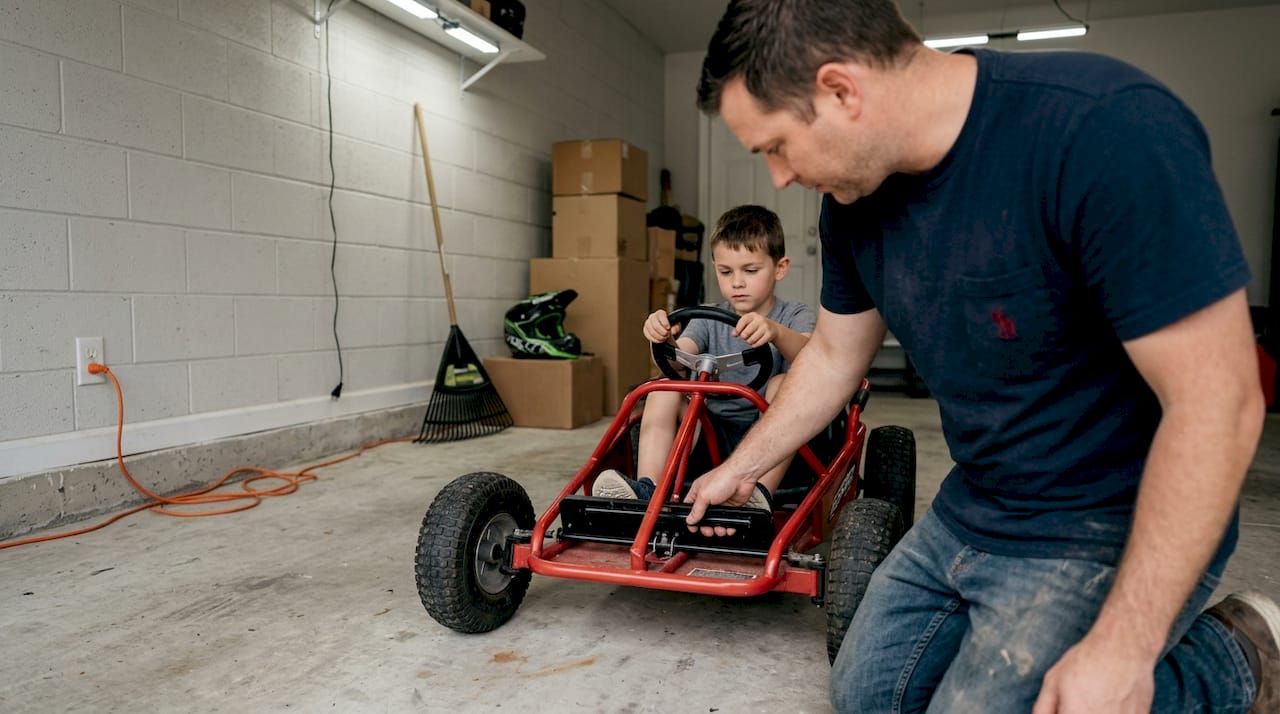
Visibility aids are equally important from the parent’s perspective. Tall safety flags mounted to the rear of the kart make it visible over tall grass, around corners, or in crowded spaces. Some models also include mirrors, which help older beginners develop awareness of their surroundings. These features make it easier for parents to monitor their child without hovering directly behind the kart at all times.
Here is a quick checklist parents should run through before any purchase:
- Can the child reach both pedals with feet flat?
- Does the seat adjust forward and backward by at least three positions?
- Is the steering wheel at a comfortable height without straining the arms?
- Is a safety flag included or available as an add-on?
- Does the harness or seat belt fit snugly without being restrictive?
For more on age and fit considerations that match specific models to specific kids, that resource breaks it down clearly by height and weight.
| Model feature | Beginner-friendly rating | Notes |
|---|---|---|
| Multi-position seat | High | Look for 3 or more positions |
| Adjustable pedals | High | Critical for shorter riders |
| Safety flag included | Medium | Easy to add if not included |
| Padded seat | Medium | Comfort on longer rides |
| Harness seat belt | High | Preferred over lap belt alone |
Poor fit is not just uncomfortable. It is a hidden safety hazard that no amount of supervision fully corrects.
Comparing top beginner go-kart features
Now that you know what to look for, see how these features stack up across leading beginner go-kart models. When shopping, it helps to have a visual framework that cuts through marketing language and focuses on what actually matters for a first-time rider.
According to industry safety standards, there is no single official U.S. standard for recreational go-karts, but racing and industry bodies consistently advise safety wiring, rollbars, and supervised use. That means the responsibility for choosing a well-built kart falls squarely on the buyer. Knowing how to compare models side by side is your best tool.
| Feature | Entry electric kart | Mid-range gas kart | Premium youth kart |
|---|---|---|---|
| Roll cage | Yes | Yes | Yes |
| Seat belt | Lap belt | Lap belt | 5-point harness |
| Remote kill switch | Often included | Rarely included | Often included |
| Adjustable seat | 2 to 3 positions | 2 positions | 3 to 5 positions |
| Brake type | Disc | Drum | Disc |
| Safety flag | Add-on | Add-on | Included |
| Parental controls | Yes | No | Yes |
For a more detailed breakdown of choosing kids go-karts that matches your child’s age, size, and riding environment, that guide is a strong next read.
A critical statistic worth knowing: most home go-kart injuries are linked to lack of adult supervision and inadequate braking systems, not to engine power or speed. This reinforces why brake quality and parental controls should sit at the top of your checklist, not as afterthoughts.
Key buying priorities at a glance:
- Prioritize braking system quality over top speed
- Confirm parental remote kill switch is included
- Verify seat and pedal adjustability before ordering
- Check whether a safety flag and helmet are included or sold separately
- Look for models from brands that follow recognized industry guidelines
Our expert perspective: What most buyers underestimate in beginner go-karts
We have seen thousands of go-kart purchases over the years, and one pattern stands out clearly. Most first-time buyers focus almost entirely on price or engine size. They want to know how fast it goes or how much it costs. What they rarely ask about is how well the brakes work or whether the seat truly adjusts to their child’s size.
Our own experience with customer returns and post-purchase upgrade requests tells a consistent story. The karts that come back or prompt calls for help are rarely the ones with too little power. They are the ones where the brakes felt soft, the seat could not be adjusted properly, or the emergency shutoff was buried in the manual rather than built into the design.
The truth is that for a true beginner, responsive brakes and a real emergency stop feature matter far more than horsepower. A kart that stops reliably and shuts off instantly when needed is worth far more than one that hits a higher top speed. Our go-kart troubleshooting insights back this up repeatedly. Always test the brakes and shutoff before your child’s first ride, regardless of model or price point. That single habit prevents the majority of avoidable incidents we hear about.
Find the perfect beginner go-kart with GoKarts USA®
Ready to find a go-kart with all the beginner features we covered? Here’s where to start.
At GoKarts USA®, we carry a carefully selected range of beginner-friendly models built with parental remote shutoff, strong steel chassis, adjustable seats, and reliable braking systems. Whether you are shopping for a young child’s first electric kart or a youth model with a bit more power, our catalog makes it easy to filter by age, engine type, and safety rating.

Our team is here as your pit crew and trail guide through every step of the buying process. Browse youth and beginner models including the popular Mini Sport Kids ATV, or reach out directly for personalized recommendations. We are proud to help families fuel their first adventure safely and confidently.
Frequently asked questions
What is the recommended minimum age for beginner go-kart drivers?
The typical minimum age for beginner go-karts is 7 to 8 years, based on industry racing guidelines that also require safety wiring and rollbars. Always match the kart’s weight and height limits to your specific child.
Are electric or gas go-karts safer for children?
Electric go-karts are generally safer for children due to their soft-start acceleration, lower noise levels, and simpler maintenance requirements. They are the preferred choice for most beginner and youth riders.
What safety gear is essential for kids in beginner go-karts?
A DOT-approved helmet, closed-toe shoes, and active adult supervision are mandatory for safe beginner go-karting. Industry rules consistently emphasize helmets and supervision as the first line of defense.
How can parents prevent accidents with home go-karts?
Choose karts with reliable brakes and parental controls, and always supervise children during use. Testing the brake system and emergency shutoff before the first ride is the single most effective preventive step you can take.