




TL;DR:
- Many buyers assume four-wheel drive is only for snow or muddy fields, leading to over- or under-equipped vehicles. Four-wheel drive is most beneficial off-road, providing traction in deep mud, sand, snow, or steep climbs, especially with low-range gearing. However, it adds cost, weight, and complexity, so matching it to your actual terrain and driving habits ensures optimal value and performance.
A lot of buyers assume four-wheel drive is just for snowstorms or muddy farm roads. That assumption leads to either over-spending on capability they never use or under-equipping a vehicle for the terrain they actually love. Understanding why choose four-wheel drive correctly starts with cutting through the myths. Whether you’re planning weekend trail runs, hauling a trailer to the lake, or just want the confidence to handle whatever nature throws at you, this guide gives you the real picture on when 4WD earns its keep and when it doesn’t.
Table of Contents
- Key Takeaways
- How four-wheel drive actually works
- The real advantages of 4WD for off-roading
- Trade-offs you need to understand before buying
- When 4WD is worth it and when it isn’t
- Practical tips for using and maintaining your 4WD
- My take on 4WD after years on the trail
- Find your off-road freedom with Gokartsusa
- FAQ
Key Takeaways
| Point | Details |
|---|---|
| 4WD is for off-road and low-traction use | Engaging 4WD on dry pavement causes drivetrain stress and should be avoided. |
| Traction, not braking, improves with 4WD | Four-wheel drive helps you accelerate in snow or mud but does not shorten stopping distance. |
| Tires matter more than drivetrain | Quality tires have a larger impact on braking and cornering safety than your choice of drive system. |
| Towing benefit is situational | 4WD adds traction value when launching or retrieving trailers on loose or wet surfaces, not on open highway. |
| Match drivetrain to your real habits | If most of your driving is pavement with occasional rough terrain, AWD or 2WD may serve you better. |
How four-wheel drive actually works
Before you can decide whether 4WD is worth it for you, you need to understand what the system actually does under the hood. Most traditional 4WD setups are part-time systems, meaning you engage them manually when conditions call for it. The system works through a transfer case that splits power between the front and rear axles and typically offers at least two modes: 4H (four-wheel high) for moderate off-road speeds and 4L (four-wheel low) for maximum torque at very slow speeds like rock crawling or steep climbs.
Here is where four-wheel drive vs two-wheel drive gets interesting. In a standard 2WD truck, power goes to only one set of wheels (usually rear). In 4WD mode, locked front and rear axles spin at exactly the same speed, forcing all four wheels to pull together. That locked behavior is powerful off-road but destructive on pavement because the front and rear wheels need to rotate at slightly different speeds during turns.
All-wheel drive (AWD) solves that pavement problem by sending power variably and automatically. But the trade-off is that AWD is optimized for on-road traction and everyday driving, not for the kind of extreme, low-speed off-road control that 4WD provides. AWD cannot replicate the mechanical lock of a true 4WD system in deep mud or boulder fields.
Here is a quick comparison to frame your decision:
| Feature | 4WD | AWD | 2WD |
|---|---|---|---|
| Driver engagement | Manual (part-time) | Automatic (full-time) | None required |
| Best terrain | Off-road, extreme low-traction | Light off-road, foul weather | Paved roads |
| Low-range gearing | Yes | Rarely | No |
| Towing advantage | Yes (traction phases) | Limited | No |
| Fuel economy | Lower | Moderate | Best |
Pro Tip: If the vehicle you’re considering has a transfer case with a dedicated 4L mode, that is a true 4WD system built for serious off-roading. Many crossovers labeled “4WD” are actually AWD systems without low-range capability.
The real advantages of 4WD for off-roading
This is where the benefits of four-wheel drive show up most clearly. When you’re pushing through sand dunes, navigating rocky trails, or pulling through a muddy field, the mechanical lock between axles ensures engine torque reaches wheels with traction even when some wheels are spinning in the air or slipping in muck. AWD systems rely on computer sensors to detect slip and redirect power, which introduces a slight delay. Locked 4WD doesn’t wait for software. It acts.
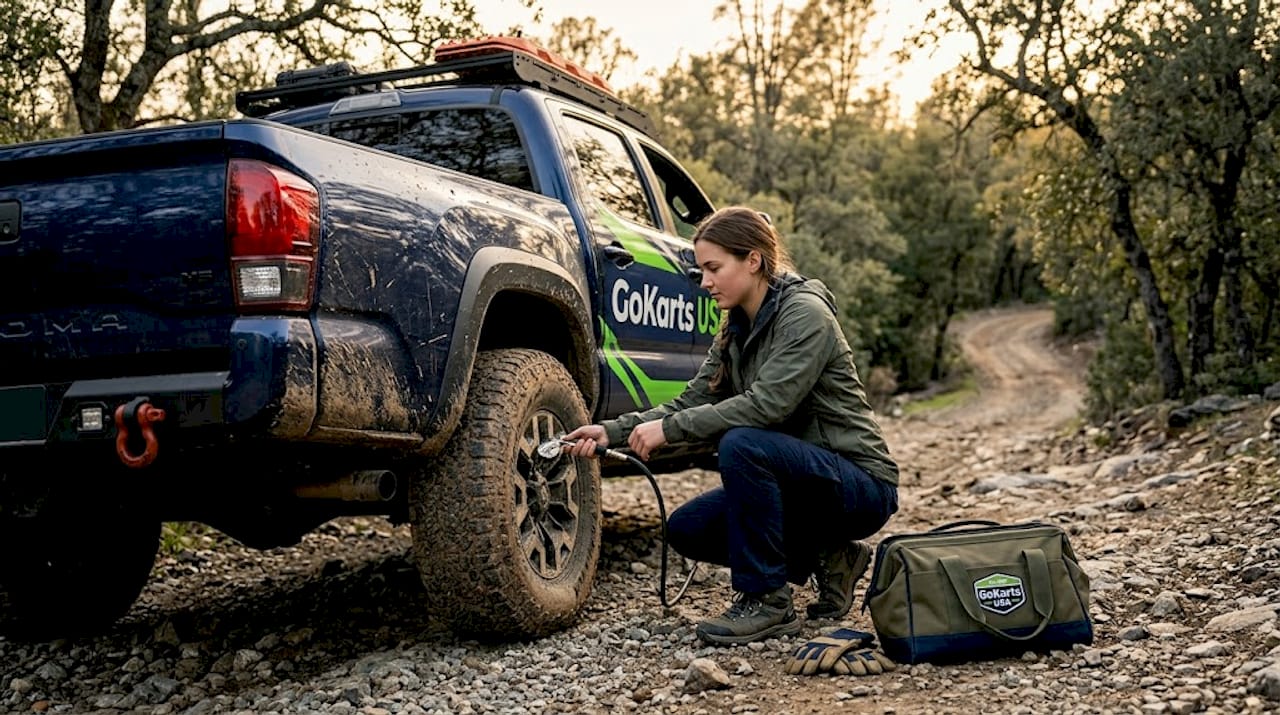
The low-range setting deserves special attention because it multiplies torque through a lower gear ratio. You get the pulling power of a much bigger engine, delivered slowly and deliberately. That matters enormously for four-wheel drive for off-roading scenarios like descending a steep grade under full control, winching through a wash, or inching over boulders without spinning out.
Here are five specific situations where 4WD genuinely outperforms every other drivetrain option:
- Deep mud and ruts. Locked axles keep all four wheels pulling even when one or two lose contact entirely.
- Sandy terrain. Momentum and torque distribution prevent you from digging in and getting stuck.
- Snow-covered backroads or trails. 4WD provides roughly twice the traction for acceleration in snow compared to 2WD vehicles.
- Steep rocky climbs. Low-range gearing gives you precise throttle control without wheel spin.
- Towing on loose or wet surfaces. 4WD improves traction during traction-limited towing phases like launching a boat trailer down a wet ramp or pulling out of a soft campsite.
Knowing these off-road terms every enthusiast should know will help you communicate your vehicle’s capability and choose the right trails for your skill level.
Pro Tip: Use 4L any time you need maximum pulling power at low speed. Reserve 4H for higher-speed off-road travel like gravel roads or light snow. The difference in torque multiplication is significant.
Trade-offs you need to understand before buying
Reasons to buy 4WD are real and compelling, but the system comes with genuine costs that deserve honest attention.
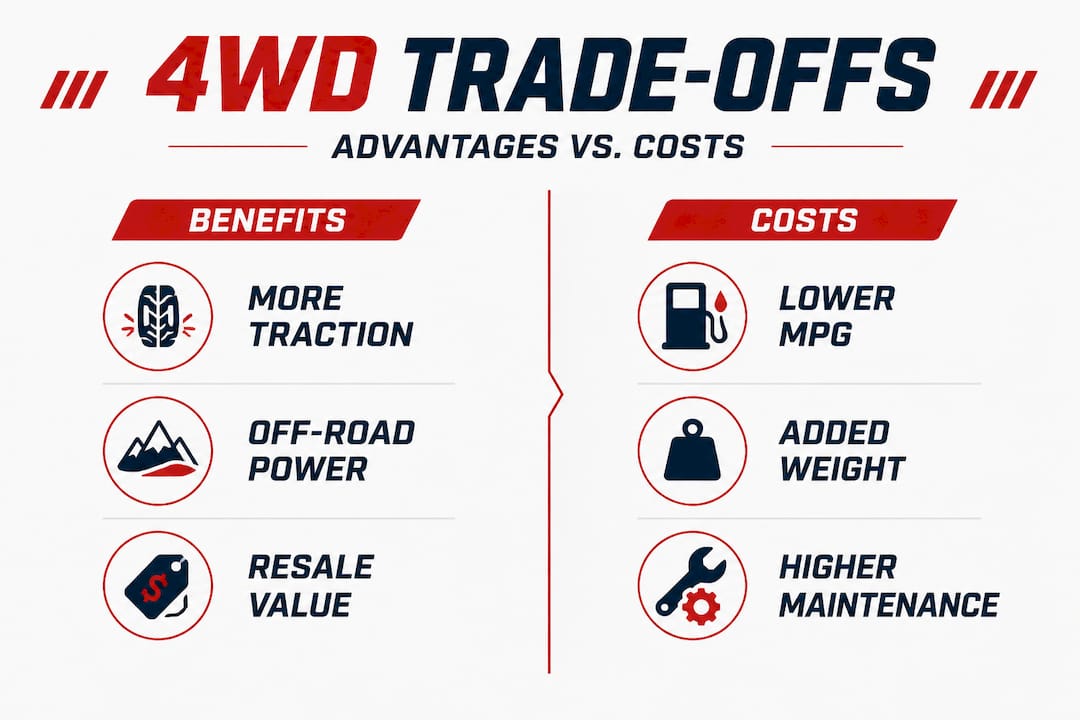
The most visible cost is fuel economy. The added weight of a transfer case, front axle, and additional driveshaft components reduces efficiency on every trip, even when you’re not using 4WD. The added weight and drivetrain complexity of a 4WD system translates directly to worse miles per gallon compared to a comparable 2WD model. For a truck you drive 25,000 miles per year mostly on highways, that adds up fast.
There are also mechanical realities to consider:
- Purchase price. 4WD vehicles carry a notable price premium over their 2WD counterparts, sometimes $3,000 to $5,000 or more depending on the model.
- Insurance costs. Higher vehicle value typically means higher insurance premiums.
- Maintenance. Transfer cases require fluid changes, and front axles, CV joints, and locking hubs add service items that 2WD trucks don’t have.
- Handling on pavement. The extra weight affects stopping distance. 4WD adds weight and complexity but does not help you stop faster; braking performance depends entirely on your tires.
- Drivetrain damage risk. Using part-time 4WD on dry pavement causes binding and stress in the drivetrain. The axles are locked to spin at the same speed, which fights the natural rotation difference through turns.
None of these trade-offs are dealbreakers for the right buyer. But if you mostly drive on paved roads and rarely see truly rough terrain, you may be paying for capability that lives dormant under your truck bed.
When 4WD is worth it and when it isn’t
This is the decision most people get wrong. Is four-wheel drive worth it for you specifically? The honest answer depends on three things: frequency of low-traction conditions, the nature of your terrain, and how honestly you assess your own driving habits.
4WD is genuinely worth it when:
- You regularly drive unpaved, rocky, muddy, or sandy terrain for recreation or work.
- You tow trailers in conditions with loose or wet surfaces where traction at launch and recovery matters.
- You live in an area with heavy snowfall and regularly drive unplowed roads, not just slushy commutes.
- You enjoy technical off-roading where AWD simply cannot replicate the locked axle advantage.
Two-wheel drive or AWD makes more sense when:
- Your off-road exposure is limited to light gravel or occasional snowy commutes.
- You prioritize fuel economy and lower long-term ownership costs.
- Most of your driving is highway or urban pavement where 4WD would never be engaged.
Here is a practical reference to help you match drivetrain to lifestyle:
| Driving Scenario | Best Drivetrain Choice |
|---|---|
| Daily commuting on pavement | 2WD or AWD |
| Weekend trail riding and camping | 4WD |
| Light snow and rain | AWD |
| Deep snow, mud, or sand recreation | 4WD |
| Highway towing in dry conditions | 2WD or 4WD (equal) |
| Boat ramp / wet surface towing | 4WD |
One truth that frequent traction challenges justify 4WD while mostly dry conditions make 2WD or AWD more practical is worth internalizing before you sign anything. And regardless of what drivetrain you choose, tires dominate in stopping and turning even on 4WD vehicles. A 4WD truck on all-season tires will lose to a 2WD vehicle on quality winter tires in braking and cornering on ice. The drivetrain gets you moving; the tires get you stopped.
Exploring the benefits of ATVs for outdoor recreation can also help you understand how four-wheel capability transforms the recreational experience across different vehicle types.
Practical tips for using and maintaining your 4WD
Owning a 4WD vehicle is not complicated, but using it incorrectly is one of the most common and costly mistakes new buyers make. Incorrect 4WD use on dry pavement leads to axle binding and drivetrain stress that adds up to expensive repairs. Learning the system before you need it saves both money and frustration.
Pro Tip: Before your first off-road trip, practice engaging and disengaging your transfer case in a safe, low-speed environment. Know whether your system requires you to stop completely or if it allows shifts on the move.
A few practices that will extend your drivetrain’s life and your enjoyment on trail:
- Engage 4WD before you need it. Getting stuck in the middle of a muddy stretch and then trying to engage 4WD is harder on the system and often too late.
- Return to 2H on pavement. This is non-negotiable for part-time systems. Even short distances on dry roads cause binding stress.
- Service your transfer case regularly. Transfer case fluid should be inspected and changed per manufacturer intervals, typically every 30,000 to 50,000 miles depending on use.
- Choose tires that match your primary terrain. All-terrain tires balance trail grip with highway manners. Mud-terrain tires are for serious off-road use and wear faster on pavement.
- Know your approach and departure angles. Understanding your vehicle’s geometry prevents high-centering and undercarriage damage. Check our guide on ATV suspension for off-road handling for a deeper look at how vehicle geometry shapes trail performance.
My take on 4WD after years on the trail
I’ve watched countless buyers choose four-wheel drive because it felt like the responsible, capable option, then spend four years driving exclusively on dry pavement with a system they never touched. That’s not a failure of the vehicle. It’s a mismatch between expectation and reality.
In my experience, the buyers who get the most out of 4WD are the ones who honestly answer one question: “How often am I actually going somewhere that would stop a two-wheel drive vehicle?” If the answer is regularly, especially for recreational trail riding, camping, or hunting access roads, then 4WD pays for itself in freedom and capability. If the answer is “maybe once or twice a winter,” a set of quality winter tires on an AWD crossover will likely serve you better and cheaper.
What I’ve learned about drivetrain misuse is that it’s almost always a knowledge gap, not negligence. People don’t know that driver education on part-time 4WD prevents costly mechanical damage, so they leave it engaged because it feels safer. It isn’t. It’s wearing out your components on every dry turn. The system is a tool. Learn when to pick it up and when to put it down.
My recommendation for anyone drawn to recreational off-roading is simple. Buy the 4WD. Get proper all-terrain tires. Learn your transfer case settings. And then actually go use the capability you paid for. The thrill of a locked axle pulling you through a trail that stops other vehicles never gets old.
— Mario
Find your off-road freedom with Gokartsusa

At Gokartsusa, we’re passionate about getting riders of every age out onto the terrain they love. Whether you’re just starting to explore the world of four-wheel adventure or you’re a seasoned trail enthusiast looking to add to your fleet, our selection of gas-powered off-road vehicles is built to deliver real capability with family-friendly confidence. From kids discovering the thrill of their first trail to adults who live for weekend adventure, our catalog is stocked with machines ready for it all. Explore the Mini Sport Kids ATV with 110cc gas engine as a fantastic entry point for young riders, featuring a reliable gas engine, parental remote start, and the kind of rugged build that makes off-road fun genuinely safe. Visit Gokartsusa and let us be your trail guides to the right ride.
FAQ
What does four-wheel drive actually do differently from two-wheel drive?
4WD locks the front and rear axles to spin together, sending engine torque to all four wheels simultaneously. This dramatically improves traction for acceleration on loose, muddy, snowy, or rocky terrain but does not improve braking or cornering performance.
Should I choose four-wheel drive or AWD for recreational off-roading?
For serious off-road recreation including trails, sand, and mud, 4WD with a low-range transfer case is the stronger choice. AWD is better suited for everyday driving in foul weather and light gravel, not technical terrain where locked axles make the real difference.
Is four-wheel drive worth it if I mostly drive on pavement?
Probably not for most buyers. The fuel economy penalty, higher purchase price, and added maintenance complexity are hard to justify if your low-traction driving is rare. AWD or a good set of winter tires on a 2WD vehicle will handle most everyday challenges at lower cost.
Can I use 4WD on dry roads?
No. Part-time 4WD systems should never be used on dry pavement. The locked axles cause drivetrain binding because front and rear wheels need to rotate at slightly different speeds through turns, which stresses and eventually damages the transfer case and axles.
Do tires really matter more than having 4WD?
For braking and cornering, yes. Quality tires, especially purpose-matched all-terrain or winter tires, have a greater impact on stopping distance and turning grip than your drivetrain choice. Four-wheel drive helps you get moving; your tires determine whether you can stop and steer safely.