




TL;DR:
- Regular ATV maintenance prevents costly repairs and ensures optimal performance and safety on the trail.
- Following a tiered schedule of pre-ride checks, after 50 hours, and seasonal servicing extends the vehicle’s lifespan and resale value.
Most ATV owners don’t think about maintenance until something breaks. That’s the costly mistake. Understanding why maintenance matters for ATVs goes well beyond keeping your machine looking clean. It directly affects how your ATV performs on the trail, how safe you are when you’re riding, and how long that investment lasts before it needs serious work. Skip the upkeep, and you’re not just risking a breakdown. You’re risking your safety and your wallet at the same time. This guide breaks down what regular maintenance actually does for you and how to build a routine that keeps the adventure going.
Table of Contents
- Key Takeaways
- Why maintenance matters for ATVs: the real benefits
- Your ATV maintenance schedule explained
- Safety risks that maintenance prevents
- The cost reality of maintenance vs. repairs
- My take on building a maintenance habit that actually sticks
- Find your next ATV at Gokartsusa
- FAQ
Key Takeaways
| Point | Details |
|---|---|
| Maintenance prevents costly repairs | Preventive care saves an estimated $8 to $12 in repairs for every maintenance dollar spent. |
| Pre-ride checks take minutes | A 5-minute inspection before every ride catches issues before they become trail emergencies. |
| Many failures show no warning | Brake and steering failures can develop silently, making routine checks non-negotiable. |
| Scheduled servicing extends lifespan | Fluid and filter replacements on a set schedule dramatically reduce mechanical wear over time. |
| DIY maintenance keeps costs low | Annual DIY upkeep runs $150 to $300 and protects a $6,000 to $14,000 vehicle investment. |
Why maintenance matters for ATVs: the real benefits
Here’s the truth most people learn the hard way. ATVs operate in conditions that would push any vehicle to its limits. Mud, water crossings, steep climbs, rough terrain, and extreme temperatures all put stress on every component simultaneously. That kind of punishment accelerates wear in ways that highway driving simply never does.
Regular maintenance keeps that wear from compounding. When you change your oil on schedule, inspect your brake pads, and check tire pressure before you ride, you’re catching small problems before they turn into mechanical failures that sideline you for weeks. Consistent maintenance preserves performance and prevents safety hazards that sneak up without warning.
The performance benefits are immediate and real. A clean air filter means your engine breathes better and delivers full power. Fresh oil means less friction and cooler running temperatures. Properly inflated tires give you predictable handling on uneven ground. Every maintenance task has a direct performance payoff you’ll feel on the trail.
Here’s what consistent upkeep actually delivers for you:
- Optimized power output: A well-maintained engine with fresh spark plugs and a clean air filter produces noticeably more power than a neglected one.
- Reliable braking: Brake pads and fluid in good condition give you stopping power exactly when you need it, not when it’s convenient.
- Extended component life: Greasing suspension fittings and swingarm pivots prevents metal-on-metal wear that kills components prematurely.
- Higher resale value: An ATV with documented maintenance history sells for significantly more than one without records.
- Fewer trail breakdowns: The number one cause of mid-trail mechanical failures is deferred maintenance, not bad luck.
Pro Tip: Keep your ATV’s air filter clean religiously. A clogged filter doesn’t just reduce power. It forces the engine to run rich, which contaminates your oil faster and shortens engine life across the board.
Your ATV maintenance schedule explained
The most effective approach to ATV upkeep is a tiered system. You don’t do everything every ride, but you also don’t wait until something fails. Think of it in three layers: before every ride, every 50 hours of use, and seasonally.
Before every ride is your first line of defense. A pre-ride inspection takes five minutes and catches the issues that cause trail failures. Work through this before you ever turn the key.
- Check tire pressure and look for cuts or sidewall damage.
- Squeeze the brake lever and pedal to confirm firm, consistent feel.
- Inspect the steering by turning handlebars lock to lock and noting any stiffness or play.
- Verify throttle returns to idle smoothly when released.
- Check engine oil level with the dipstick and look for coolant level in the reservoir.
- Scan for any fluid leaks under the machine.
At the 50-hour or monthly mark during heavy use, go deeper. Change your engine oil and filter using the weight your owner’s manual specifies. Inspect the brake pads for thickness. Check and clean or replace the air filter. Grease all fittings on the suspension, swingarm, and steering components. Inspect the CVT belt for cracks, fraying, or glazing. This interval is where you catch the kind of wear that builds invisibly between rides.
Seasonally is when you do the deep work. Brake fluid and coolant replacement every two years is the standard recommendation from most major manufacturers, regardless of how many miles you’ve ridden. Replace spark plugs, clean the fuel system, inspect the exhaust, and check the battery terminals for corrosion. If you’re storing your ATV over winter, drain or stabilize the fuel. Modern fuel degrades quickly and stale gasoline is one of the most common causes of hard starting and sluggish throttle response in spring.
Always cross-reference your owner’s manual for your specific model. Manufacturers set these intervals based on the engineering of each machine, and generic schedules are a starting point, not a replacement for the manual.
Pro Tip: Start a maintenance log. Record the date, odometer reading, and hour meter reading every time you service your ATV. A maintenance log tracks servicing history, prevents overlooked tasks, and becomes a selling point when you eventually move the machine on.

Safety risks that maintenance prevents
This is where the stakes get real. Most riders think of safety gear as their primary protection. Helmets, gloves, boots, and body armor absolutely matter. But none of that gear protects you from a brake failure at speed on a rocky downhill. That’s a maintenance problem.
The critical insight here: many mechanical failures show no warning lights. Brake pad wear doesn’t trigger a dashboard alert on most ATVs. A failing CVT belt won’t give you much notice before it snaps. Steering components that have lost grease will feel fine right up until they bind at an inconvenient moment. Waiting for a symptom to appear before performing maintenance is like waiting for a tire to blow before checking the pressure.
Here’s what unserviced components actually risk on the trail:
- Worn brake pads that lose stopping power on steep descents without any prior warning
- Deteriorated tires with cracking sidewalls that can blow out under off-road stress
- Corroded or loose battery connections that cause sudden power loss
- A glazed CVT belt that slips under load and leaves you stranded far from the trailhead
“Maintenance protects safety not just by fixing visible issues, but by preventing hidden failures that warning systems simply cannot detect.” — CarneeTrains maintenance safety insight
There’s also the connection between maintenance and gear condition that riders often overlook. When you’re doing your regular ATV checks, run through your riding gear at the same time. Helmets should be inspected for shell cracks or compromised foam lining. Gloves and boots should be checked for wear. Use your maintenance routine as a full safety audit, not just a mechanical one. Check out ATV safety tips for smarter riding to pair your maintenance habits with solid on-trail practices.
The cost reality of maintenance vs. repairs
Let’s talk numbers, because this is where the importance of ATV maintenance becomes impossible to argue with.
DIY annual maintenance costs run $150 to $300, covering oil, filters, spark plugs, grease, brake fluid, and other consumables. Dealer servicing covers similar ground but costs $400 to $800 or more per year. Either way, you’re protecting an ATV worth $6,000 to $14,000 and avoiding repair bills that can easily run into four figures.
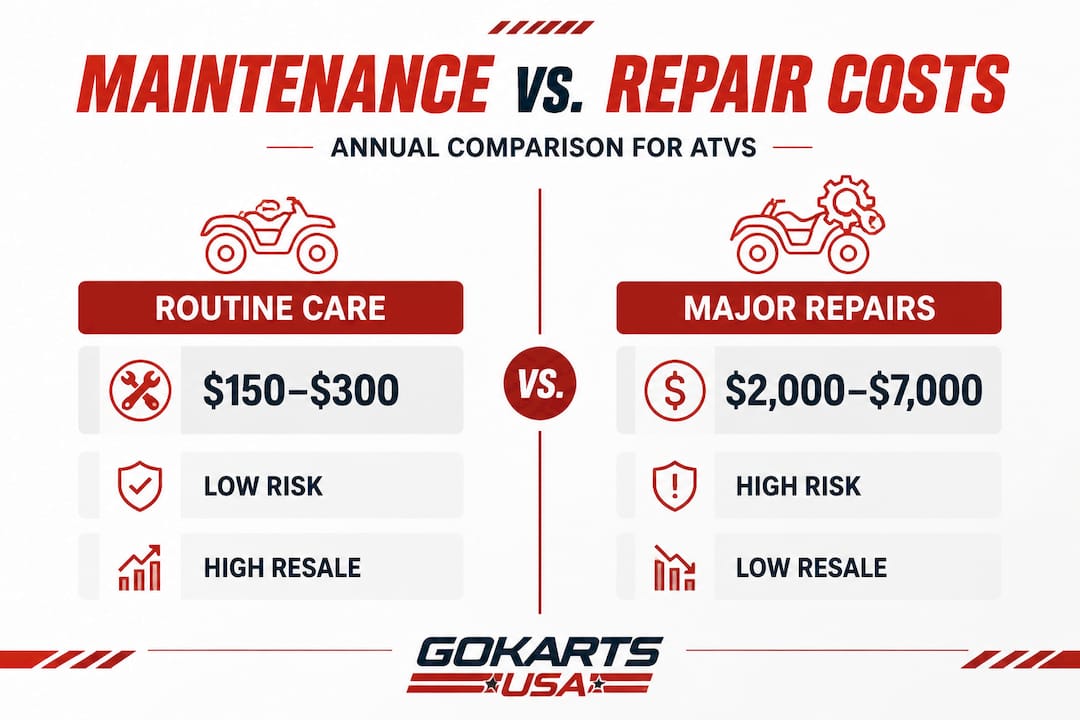
Here’s the comparison that matters most:
| Scenario | Typical Annual Cost | Risk Level |
|---|---|---|
| DIY preventive maintenance | $150 to $300 | Low |
| Dealer preventive servicing | $400 to $800 | Low |
| Ignoring maintenance (repair costs) | $1,500 to $5,000+ | High |
| Engine rebuild from oil neglect | $2,000 to $7,000+ | Very High |
Preventive care saves $8 to $12 in avoided repair costs for every dollar you spend on maintenance. That’s not a marketing claim. That’s the math of catching a worn belt before it snaps and destroys secondary clutch components, or replacing brake fluid before moisture contamination causes brake fade on a technical trail.
DIY maintenance makes sense for most routine tasks. Oil changes, air filter cleaning, greasing, and spark plug replacement are all straightforward with basic tools and a decent manual. Dealer servicing is worth the cost when you need diagnostic work, valve adjustments, or any task requiring specialized equipment that most home mechanics don’t own.
Maintenance also protects resale value. An ATV with a clean, documented service history commands a premium from any informed buyer. Riders who plan to upgrade in three to four years are essentially paying for their next machine by keeping detailed records today.
Pro Tip: Buy your consumables in bulk when they go on sale. Oil, filters, and grease are the same whether you buy them in January or July. Stocking up keeps cost per service lower and removes the excuse of “I’ll do it when I get to the store.”
My take on building a maintenance habit that actually sticks
I’ve watched riders pour thousands of dollars into machines they clearly love, then skip oil changes for six months because the riding was too good to stop. I get it. When the trails are perfect and the weather cooperates, paperwork and wrenching feel like obstacles to freedom.
But here’s what I’ve learned from years of watching ATVs age well and age badly. The machines that last and perform reliably aren’t necessarily the ones with the biggest engines or the best specs at purchase. They’re the ones owned by riders who treat maintenance like part of the ride, not an inconvenience after it.
The biggest pitfall I see is inconsistency. Riders do everything right the first year, then gradually extend intervals until they’re running double the recommended mileage on old oil. The second biggest is relying on feel. If the ATV feels fine, it’s assumed to be fine. That assumption is where expensive surprises are born. Engines and drivetrains in off-road conditions wear faster than typical vehicles precisely because they’re working harder on every ride.
My personal recommendation: build the log habit from day one. A simple notebook in your garage works. Write down what you did, when you did it, and how many hours were on the machine. Review it before every major ride. That five-minute habit has saved me from carrying tools I wished I had on the trail more than once. It also makes you a better, more confident rider because you know your machine. And knowing your machine means fewer surprises when you’re ten miles from the truck.
— Mario
Find your next ATV at Gokartsusa

At Gokartsusa, we believe responsible ATV ownership starts with the right machine and the right mindset from day one. The Mini Sport Kids ATV with 110cc gas engine is built with that philosophy in mind. It features a reliable 110cc gas engine, parental remote start and kill switch, and a rugged design that makes routine upkeep approachable for any owner. Teaching young riders early about pre-ride checks and basic care sets them up for a lifetime of smart, safe riding. When the foundation is a quality, well-designed machine, maintenance is simpler, safer, and more rewarding. Explore the full lineup at GokartsUSA.biz and gear up for your next adventure with a machine built to go the distance.
FAQ
Why does ATV maintenance matter so much?
Regular ATV maintenance prevents mechanical failures, protects rider safety, and extends the life of your vehicle. Neglecting upkeep leads to costly repairs and dangerous conditions on the trail.
How often should I service my ATV?
Perform a quick inspection before every ride, do oil and filter changes every 50 hours or monthly during heavy use, and schedule a full seasonal service at least once a year.
Can skipping maintenance really cost me thousands?
Yes. Neglecting routine care can lead to engine rebuilds and drivetrain failures that cost $2,000 to $7,000 or more, while annual preventive maintenance runs just $150 to $300 DIY.
What are the most critical maintenance tasks?
Brake inspections, oil and filter changes, air filter cleaning, tire pressure checks, and CVT belt inspections are among the highest-impact maintenance tasks for safety and performance.
Does maintenance help with ATV resale value?
Absolutely. A documented maintenance history shows buyers the machine has been cared for and commands a noticeably higher resale price than an ATV with no service records.