




TL;DR:
- Off-road capability depends on the integration of traction, ground clearance, vehicle angles, and suspension working together as a system.
- Understanding these elements is essential for real terrain handling, not just relying on individual specs or appearances.
Most people assume that buying a vehicle with chunky tires and some extra ground clearance automatically makes it off-road capable. That assumption has stranded more rigs in the mud than any mechanical failure ever has. What is off-road capability, really? It’s the interaction of traction systems, suspension geometry, vehicle angles, and driver-assist technology all working together as one unit. Understanding this system, not just individual specs, is what separates a vehicle that handles real terrain from one that only looks the part.
Table of Contents
- Key takeaways
- What is off-road capability, really?
- Safety and driver-assist features
- How tires define your off-road limits
- Evaluating off-road readiness before you buy
- My honest take on what off-road capability actually means
- Ready to explore off-road vehicles for your family?
- FAQ
Key takeaways
| Point | Details |
|---|---|
| Off-road capability is a system | Traction, clearance, control, and suspension must work together for real terrain performance. |
| Vehicle angles matter as much as height | Approach, breakover, and departure angles determine what obstacles a vehicle can actually clear. |
| Tires are your first line of contact | Tread pattern, sidewall strength, and tire pressure tuning directly affect grip and safety on any terrain. |
| Driver-assist features have real limits | Hill Descent Control and Trail Control improve confidence but cannot replace driver skill or judgment. |
| Know your terrain before you go | Matching vehicle specs to the trails you actually ride prevents dangerous mismatches between ability and expectations. |
What is off-road capability, really?
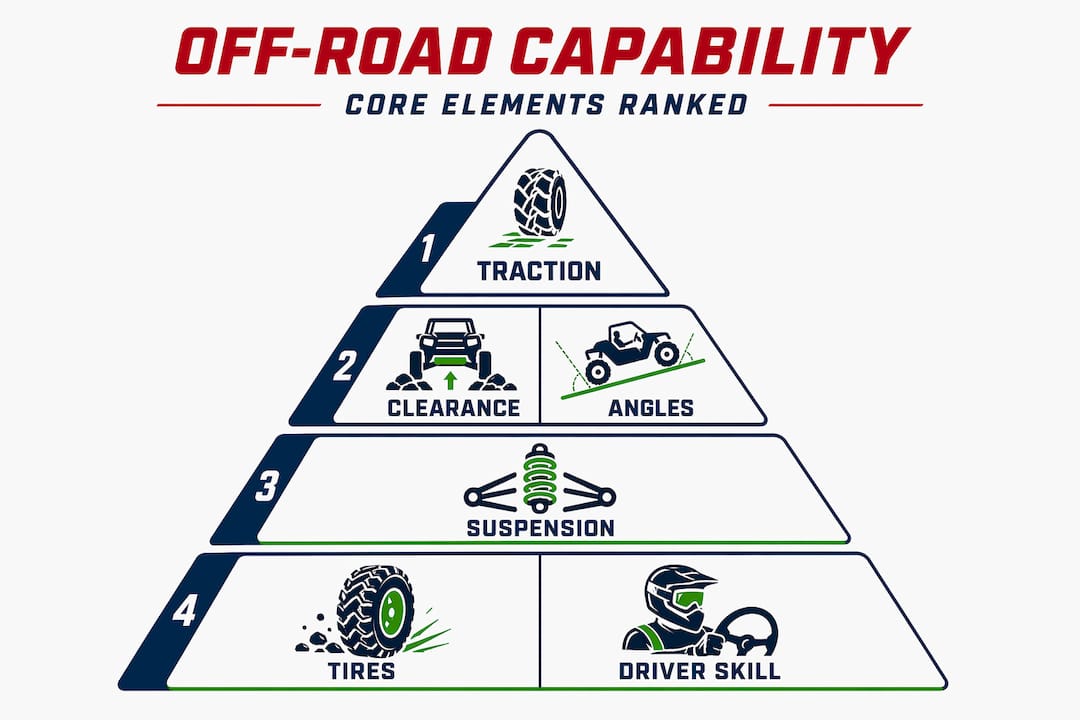
The phrase gets thrown around in every truck commercial and ATV product listing on the market. But off-road capability is not a single spec. It’s the combination of traction systems, ground clearance with precise vehicle angles, and suspension articulation all functioning in harmony. Pull any one of those elements out of the equation and the whole system weakens.
Traction: the foundation of everything
Without traction, power is just noise. A 4WD system distributes power to the wheels that need it most, keeping a vehicle moving when one or two tires lose grip. Locking differentials take that further by forcing both wheels on an axle to spin at the same speed, which is critical when one wheel is completely off the ground. Traction control electronics add a software layer on top, cutting power or applying brakes to individual wheels before a slip gets out of hand.
What trips people up is confusing high horsepower with off-road power. Controllable low-RPM torque is what actually matters. Crawling over a rocky ledge at 2 mph requires steady, manageable pull, not a burst of acceleration that breaks the tires loose.
Ground clearance and the angles nobody talks about
Ground clearance is the distance between the lowest point of a vehicle and the ground. But that single number tells an incomplete story. Three angles define what a vehicle can actually clear in the real world.
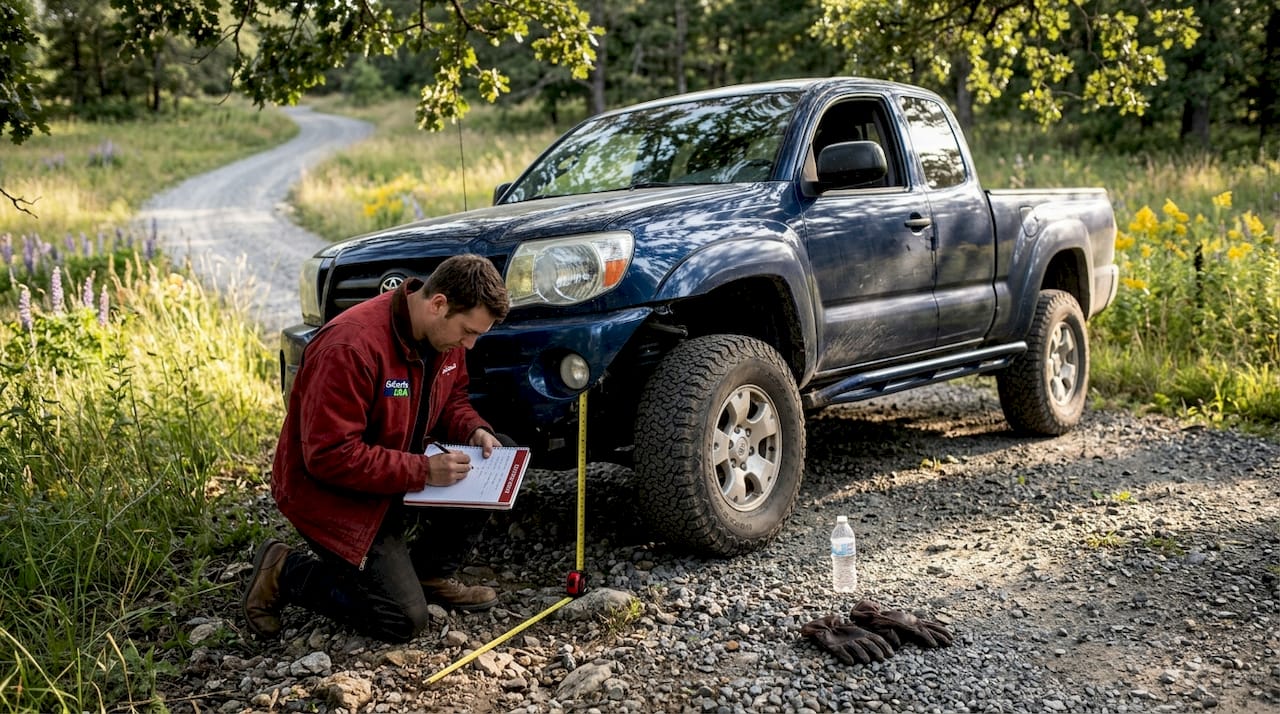
The approach angle is how steep a rise the front of the vehicle can climb without the bumper scraping. The departure angle measures the same concept for the rear. The breakover angle is perhaps the most overlooked: it describes how sharp a ridge the vehicle can straddle without the undercarriage dragging.
Approach, departure, and breakover angles must be balanced with traction and control technology for the vehicle to perform safely. A vehicle with great clearance but a shallow breakover angle will high-center on a modest rise and become completely stuck.
Suspension and wheel articulation
Suspension is what keeps all four tires on the ground when the terrain gets uneven. Wheel articulation allows each wheel to move independently, so when one corner drops into a rut, the opposite wheel rises to compensate. Without strong articulation, a wheel lifts off the ground, traction drops to zero at that corner, and the vehicle loses stability.
You can dive deeper into how these systems connect by reading the ATV suspension guide from Gokartsusa. It breaks down exactly how suspension geometry influences your ride over real terrain.
Pro Tip: When evaluating any off-road vehicle, ask for the specific approach, departure, and breakover angles in the spec sheet, not just ground clearance. Those three numbers reveal far more about real-world obstacle handling than clearance alone.
Safety and driver-assist features
Modern off-road vehicles pack a range of electronic aids that genuinely change what’s possible for everyday riders. But these tools work best when you understand what they can and cannot do.
Hill Descent Control (HDC) manages vehicle speed on steep descents, keeping you between approximately 3 mph and 20 mph without requiring constant brake input. That’s a genuine confidence builder on a long, loose slope. But the same documentation warns clearly that HDC has limits. On ice or extreme grades, it cannot maintain control. It supplements your braking judgment, not replaces it.
Trail Control and Trail Turn Assist, technologies demonstrated on platforms like the Ford Bronco, manage throttle and braking during slow off-road driving. The vehicle handles speed regulation so the driver can focus entirely on steering line and obstacle placement. For riders new to technical terrain, that mental load reduction is significant.
Here’s a useful way to categorize what electronic aids do well and where they fall short:
- Steep descents: HDC handles consistent speed but cannot adapt to sudden surface changes like black ice or a loose rock shelf
- Low-speed crawling: Trail Control excels at maintaining momentum in a crawl but still needs an aware driver choosing the right path
- Wheel-spin events: Traction control reacts faster than any human but can sometimes cut power at an inconvenient moment if calibrated aggressively
- Driver experience gaps: No electronic aid substitutes for knowing how to read terrain, pick a line, or recover from a bad approach
Pro Tip: Practice using driver-assist features in low-stakes environments before you rely on them on challenging terrain. Understanding the feel of HDC engaging on a mild hill prepares you for trusting it when the slope gets serious.
The family off-road safety guide at Gokartsusa covers these technologies specifically in the context of recreational riding, which is worth reading before your first trail session.
How tires define your off-road limits
You can have the most capable chassis on the trail, and the wrong tires will still get you stuck. Tire choice dramatically shapes traction, ride comfort, and safety. The two main categories most off-road riders choose between are all-terrain and mud-terrain tires, and the difference is substantial.
All-terrain tires have moderate tread blocks with enough spacing to clear loose material without sacrificing ride quality on pavement. They are the right choice for mixed use: weekend trails followed by highway driving. Mud-terrain tires use large, aggressive tread blocks with wide voids that self-clean in deep mud. They are exceptional in soft, loose conditions but can feel loud and less predictable on hard surfaces.
Sidewall strength matters just as much as tread. A reinforced sidewall resists punctures from sharp rocks and allows for tire pressure reduction without risking a blowout. Dropping tire pressure increases the footprint of the tire against the ground, spreading load and improving grip on soft terrain. The difference between 35 PSI and 18 PSI on sand or packed dirt can be the difference between forward momentum and getting stuck.
For an interesting parallel on tire engineering designed for versatile terrain, the all-terrain tire guide from GOLFCARTSTUFF.COM™ explains tread engineering principles that apply across many recreational vehicles.
- Inspect tread depth before any off-road outing. Worn tread does not self-clean effectively and dramatically reduces wet and loose-surface grip
- Check sidewalls for cuts, bulges, or embedded debris after every ride
- Rotate tires regularly to prevent uneven wear that can create unpredictable handling
Pro Tip: Carry a portable air compressor and a tire pressure gauge on any serious off-road outing. Airing down for the trail and re-inflating for the drive home is one of the highest-return adjustments any off-road rider can make.
Evaluating off-road readiness before you buy
Off-road capability explained in a brochure and off-road capability on a real trail are two different things. Here is a practical way to assess whether a vehicle actually delivers what it promises.
- Check the ground clearance and the three angles. If a manufacturer lists clearance but not approach, departure, and breakover angles, ask for them directly or look up owner documentation.
- Identify the drivetrain options. Does the vehicle offer 4WD or AWD? Does it include a low-range transfer case? Does it offer a locking rear differential or limited-slip?
- Examine suspension travel. Greater wheel travel means better articulation. Longer travel shocks and independent suspension components indicate real capability rather than cosmetic ruggedness.
- Look for what’s missing in the marketing. A manufacturer that talks only about horsepower and ignores traction management, suspension specs, and clearance angles is telling you something.
- Separate mild and serious off-road categories. A crossover with all-terrain tires and a slightly raised ride height is not in the same category as a purpose-built ATV or a dedicated trail truck. Both have real value, but for different terrain.
Driver technique completes the picture. Off-road capability is often misjudged by consumers who focus only on clearance while ignoring traction and control. A skilled rider on a modest vehicle consistently outperforms an inexperienced rider in a top-spec machine. Reading terrain, choosing the right line, and managing speed are skills that multiply the value of any hardware you bring to the trail.
The off-road terms guide at Gokartsusa gives you the vocabulary to evaluate vehicles confidently and have informed conversations with dealers before you commit.
Pro Tip: When comparing two vehicles, create a side-by-side list of ground clearance, all three angles, drivetrain type, suspension travel, and available driver-assist features. That five-factor comparison will reveal capability gaps that a test drive on a smooth lot never will.
My honest take on what off-road capability actually means
I’ve spent a long time advising riders at every experience level, and the most consistent mistake I see is treating off-road capability as a checklist of individual features. I’ve watched people spend heavily on clearance lifts and aggressive tires while ignoring that their vehicle had no low-range gearing and a breakover angle that would high-center on a modest trail ridge. The machine looked aggressive. It was not capable.
What I’ve learned is that off-road capability is a system problem. Traction, clearance, and control working in harmony matters far more than any single spec. A vehicle with modest clearance but a proper 4WD system, good articulation, and a skilled driver will go places that a lifted, under-geared truck simply cannot.
The rise of electronic driver aids has genuinely changed the game for new riders. Features like HDC and Trail Control give less experienced riders a real safety margin on terrain that used to require years of practice to handle safely. But I always caution against trusting those systems as a substitute for understanding the terrain you’re riding. Technology assists judgment. It does not replace it.
My real recommendation to anyone evaluating off-road vehicles: spend as much time learning your vehicle’s limits as you spend learning the trail. That knowledge combination is where real confidence and real capability live.
— Mario
Ready to explore off-road vehicles for your family?
At Gokartsusa, we know the thrill of finding a vehicle that can handle real terrain and bring the whole family along for the adventure. Whether you’re just getting started or you’re helping your kid discover the freedom of the trail, we’ve got options built with genuine capability and safety in mind.

The Mini Sport Kids ATV with a 110cc gas engine is a strong starting point for families. It features a parental remote start and kill switch, giving adults confidence while young riders build their skills on real terrain. We stock a range of recreational off-road vehicles designed to balance performance with the kind of reliability your family deserves. Explore the Gokartsusa catalog and let our team help you match the right machine to your adventure.
FAQ
What does off-road capability mean for a vehicle?
Off-road capability refers to a vehicle’s ability to perform safely and effectively on unpaved, rough, or uneven terrain through the combination of traction systems, ground clearance, vehicle angles, and suspension articulation working together.
What makes a vehicle off-road ready?
A truly off-road ready vehicle has adequate ground clearance, favorable approach and departure angles, a capable drivetrain with 4WD or locking differentials, strong suspension travel, and tires suited to the terrain type.
How does tire choice affect off-road capability?
Tire tread design, sidewall strength, and pressure adjustment all directly affect traction and safety. All-terrain tires suit mixed use, while mud-terrain tires excel in soft conditions but sacrifice on-road comfort.
Is Hill Descent Control enough for steep off-road descents?
Hill Descent Control helps manage speed between roughly 3 mph and 20 mph on steep grades, but it has operational limits and cannot replace driver judgment on ice, very loose surfaces, or extreme slopes.
Why is low-range gearing important for off-road use?
Low-range gearing multiplies torque at slow speeds, giving the driver precise, controllable power for technical obstacles without breaking traction. It’s one of the clearest differences between a capable off-road vehicle and one that only looks the part.